She had stopped praying for rescue before the snow began to fall.
By the time the first white flakes drifted across the Wyoming trail, Sarah Collins had already learned the shape of disappointment. It looked like closed doors, empty bread sacks, and strangers who glanced at her child before looking away. It sounded like polite refusals from ranch kitchens, hard laughter from boardinghouse owners, and the silence that came after she told people her husband was dead. It felt like the small weight of her two-year-old son, Noah, growing heavier in her arms while his stomach stayed empty.
The wind came down from the mountains just before dusk, dragging winter with it. Sarah pulled her torn brown shawl tighter around Noah’s sleeping body and pressed her back against a crooked cottonwood tree beside the road. Her suitcase sat near her feet, its leather split at one corner, one brass clasp missing, holding everything she still owned: two dresses, a cracked comb, a wedding photograph, and a folded letter she could not bring herself to burn. The letter had been signed by Silas Vale, owner of the Iron Mercy Mine, the man who had taken her cabin after her husband died underground.
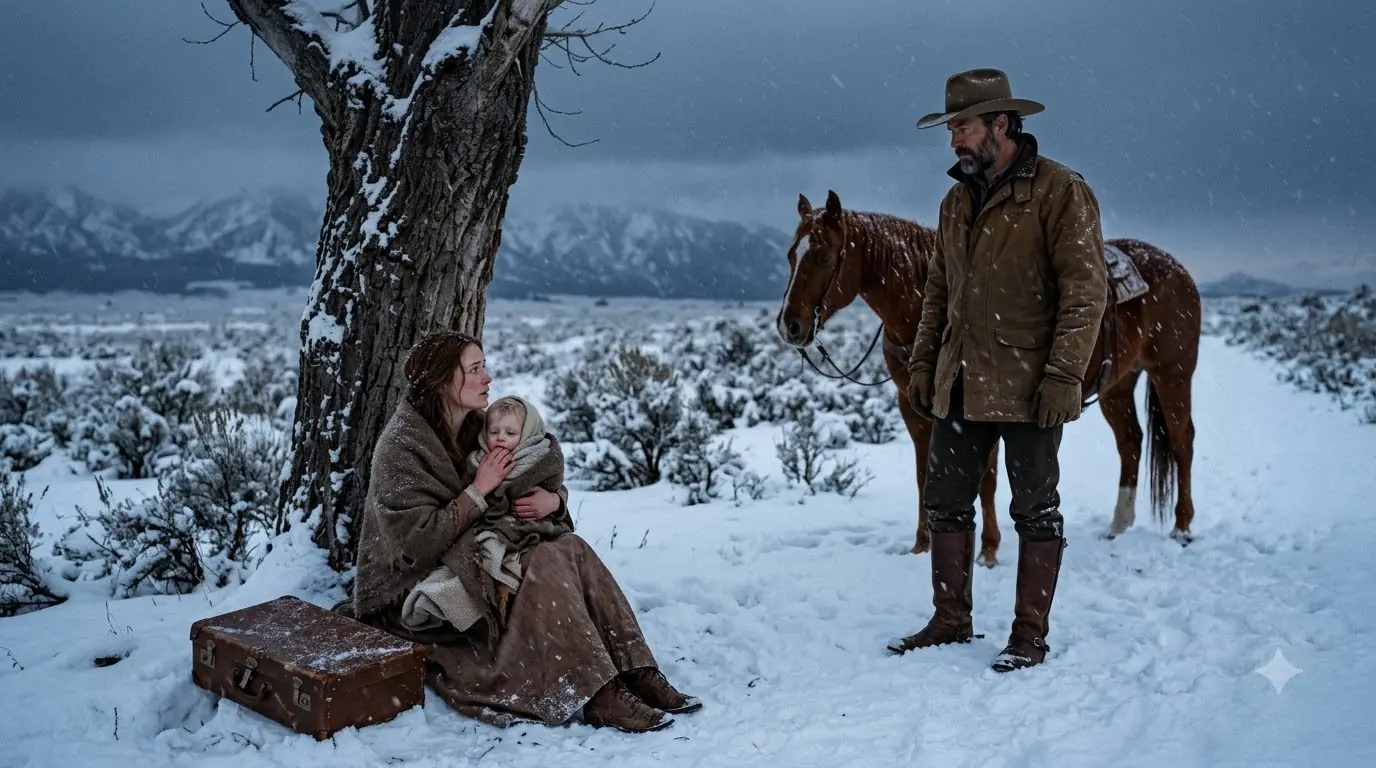
Noah stirred against her shoulder and whimpered. Sarah rocked him slowly, even though her own legs trembled from cold and hunger. She had given him the last piece of cornbread that morning outside a church in Red Hollow, telling him she had eaten already. He had believed her because he was too young to know the particular way a mother could lie with love in her voice. Now his breath warmed the hollow of her neck, soft and uneven, and fear crawled through Sarah as the snow thickened.
“We’ll be all right,” she whispered.
The words disappeared into the wind as soon as she spoke them. She no longer believed them, but Noah needed to hear something besides the howl of the prairie. Behind them, the road stretched back toward Red Hollow and the people who had watched her leave. Ahead of them lay open country, dark hills, and a ranch someone had mentioned in town, though nobody had been willing to say whether the owner hired women with children. Sarah had started walking anyway because staying where nobody wanted her had become worse than walking toward nothing.
She had not gone three miles before exhaustion broke her. The sky had turned the color of old iron, and the ground had hardened beneath her thin shoes. Every time she lifted one foot, pain sharpened through her sole. She had tried to keep moving for Noah’s sake, but when the child’s head lolled against her chest and his hand slipped limp from her collar, panic forced her to stop. Hunger could be endured. Cold could be endured. But a child going quiet in his mother’s arms was a terror no prayer could soften.
Sarah sank down beside the cottonwood and opened her suitcase with clumsy fingers. She pulled out the wedding photograph, not because it could help, but because grief had strange habits. In the picture, Thomas Collins stood beside her with coal dust still under his fingernails and a smile too bright for a man who worked underground. He had promised that one more season in the mine would buy them land. He had promised Noah would grow up under open sky. Six months later, four men carried Thomas out beneath a canvas sheet while Silas Vale told the widows that accidents were the cost of progress.
Sarah had not believed it was an accident.
Thomas had come home two nights before the collapse with fear in his eyes and a leather notebook hidden beneath his coat. He said the mine supports were rotten, the east tunnel was cracking, and Silas had bribed the inspector to keep the mine open through winter. Thomas had written everything down, names, dates, payments, warnings ignored. The next day he disappeared into the east tunnel. The day after that, the mountain swallowed him.
When Sarah went looking for the notebook, the cabin had already been searched.
When she asked questions, people stopped visiting.
When she refused to sign Silas Vale’s settlement papers, the debt collector came with a judge’s notice and took the cabin, the stove, the bed, and the mule Thomas had bought before Noah was born. “Your husband owed the company store,” the collector said. “Paper says so.” Sarah knew the paper lied, but paper had men with guns behind it. Truth had only a widow holding a baby.
The wind struck harder. Snow blew sideways now, stinging Sarah’s face. She tucked the photograph back into the suitcase and tried to stand, but her knees failed her. Noah made a small sound, not quite a cry. She touched his cheek and found it too cold.
“Noah,” she whispered, suddenly frantic. “Baby, wake up.”
His lashes fluttered, but he did not open his eyes.
Sarah pulled him inside her shawl until he was pressed against her heartbeat. She looked down the empty road, then up at the darkening sky, and something inside her gave way. She had begged for work. She had begged for mercy. She had begged God to show her one open door before the world closed around her child. Now the prairie answered only with snow.
“I’m sorry,” she said into Noah’s hair. “I’m so sorry.”
That was when the horse appeared.
At first she thought it was a shadow moving inside the storm. Then a lantern swung through the snow, casting a small amber circle ahead of a chestnut gelding. A man rode low in the saddle, his hat pulled down, his coat dark with melting flakes. He was broad shouldered, older than Thomas by perhaps ten years, with a beard trimmed close and the kind of stillness that belonged to men who had survived more than they cared to explain. When he saw Sarah beside the tree, he reined in so sharply the horse tossed its head.
For a moment, neither of them spoke.
Sarah tried to rise again, frightened by habit more than reason. “We’ll move,” she said quickly, voice raw. “I didn’t know this was your land. We won’t trouble you.”
The man swung down from the horse. “You’re not troubling me.”
She clutched Noah tighter. “I don’t have money.”
“I didn’t ask for any.”
His voice was low and steady, not gentle in a soft way, but careful, as though he knew sudden kindness could frighten a person who had been hurt too often. He stepped closer, then stopped far enough away that Sarah could breathe. His eyes went to Noah’s pale face, to the torn shawl, to her shoes, then to the suitcase at her feet. He took off his gloves and reached toward the child, not touching him yet.
“How long since he ate?”
Sarah swallowed. “This morning.”