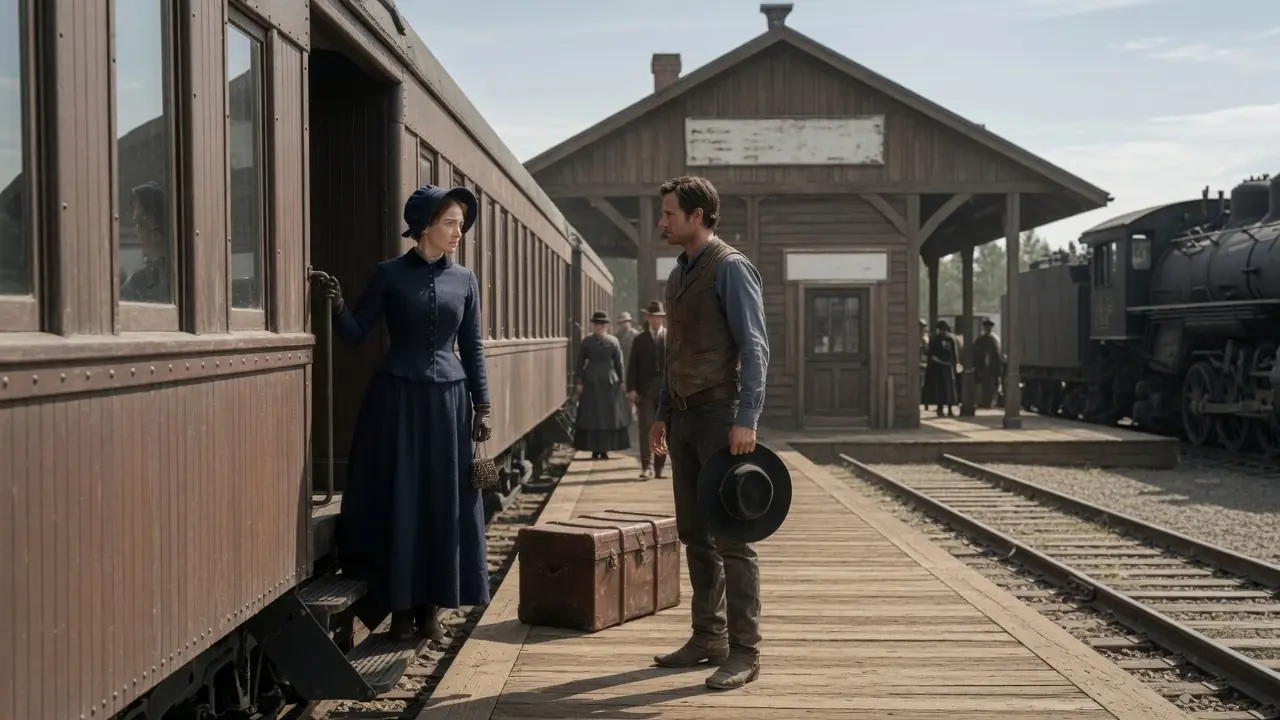
The train was already breathing when Wilhelmina Dalton reached the platform. White steam rolled along the clean wooden boards of Hawthorne Train Station, drifting around the wheels like restless ghosts waiting to pull her away. Her worn leather trunk sat beside her, scuffed from the journey west and now ready to carry her shame back east. The locomotive stood beside the platform under a hard blue Nevada sky, iron, smoke, brass, and noise, and every hiss from its engine sounded like the end of a dream.
It was November of 1876, and the wind had a sharpness that cut straight through her navy wool traveling dress. She kept one gloved hand wrapped around her reticule and the other on the handle of her trunk, trying to look composed. Dalton women did not break down in public, not even in dusty railroad towns far from home. Her mother had taught her that dignity was a woman’s armor, though Wilhelmina had begun to suspect that armor could feel very much like a cage.
Three months earlier, she had arrived in Hawthorne with hope folded neatly inside her valise. She had answered an advertisement for a schoolteacher position, believing the Nevada Territory might give her what Boston never could. In Boston, she was the banker’s daughter, the young woman expected to marry well, pour tea gracefully, and never speak too much about politics, science, or the troubling unfairness of the world. Out here, she had imagined she might become simply herself.
For a short time, she believed she had succeeded. The children had listened to her with wide eyes when she read poetry aloud. The girls had smiled when she placed arithmetic problems in front of them just as difficult as the boys’ lessons. She had taught history, spelling, geography, and the proper use of curiosity. It seemed innocent enough to her, but innocence had never protected a woman with ideas.
The trouble began when she refused the advances of Nathan Reed, the mine foreman’s son. He had called on her twice without invitation and once suggested that a woman alone in the territory should be grateful for a man’s attention. Wilhelmina had informed him that gratitude was not owed to arrogance. Within a week, mothers who had once praised her lessons began asking why their daughters needed so much learning.
Then came the whispers. She was too proud. Too eastern. Too ambitious. Too friendly with families other people ignored. When she helped Mrs. Chen carry groceries on a windy afternoon, the gossip turned meaner, because Hawthorne had strict ideas about whom a respectable white woman should acknowledge. Wilhelmina had smiled politely through all of it until the school board informed her that her services were no longer required.
Now the ticket in her reticule felt heavier than the trunk beside her. Reno, Sacramento, and then points east. Back to Boston. Back to her father’s quiet disappointment, her mother’s wounded pride, and Charles Payton’s satisfied smile when he learned she had come home defeated.
Charles Payton had proposed before she left. He was wealthy, predictable, and confident in the way men are when the world has never contradicted them. He had told her she would outgrow her independence once she understood the safety he offered. If she returned now, he would not say I told you so aloud, but his eyes would say it every time they passed across a dinner table.
“All aboard for Reno, Sacramento, and points east,” the conductor called.
Wilhelmina lifted her trunk. It was not heavy, but her hands trembled. Each step toward the passenger car felt like a confession. She had wanted to prove she could build a life of purpose, and instead she was retreating with no position, little money, and a pride so bruised she could barely bear the weight of it.
She placed one boot on the metal step and gripped the brass rail. The train door stood open in front of her. Behind that door was safety, humiliation, and the life her family had always expected her to accept. She drew one breath and prepared to climb aboard.
Then a hand closed gently around her wrist.
“Miss Dalton,” a man said, his voice rough and urgent. “Please wait.”
Wilhelmina turned sharply, ready to rebuke whoever had dared to touch her without permission. But the words caught in her throat when she saw him. He was tall, broad-shouldered, and sun-weathered, with dark brown hair beneath a worn black Stetson and gray eyes fixed on her with a desperate sincerity that made the noisy platform seem suddenly smaller.
She had seen him before. He was often near the general store, or riding through town with quiet purpose, or tipping his hat to her when other men stared too long. She remembered that he had never spoken out of turn, never crowded her path, never made her feel examined like an object. His name came to her only because she had heard one of the stable boys call it once.
Daniel Walker.
“Sir,” she said, pulling herself tall, “I do not know you well enough for you to take my wrist.”
He released her immediately and took a step back, removing his hat. “You are right. I apologize.”
“The train is leaving.”
“I know.”
“Then whatever you mean to say must wait for another life, Mr. Walker.”
His eyes widened slightly. “You know my name.”
“I know the names of most people in a town small enough to discuss a woman’s lessons as if they were crimes.”
A flicker of pain crossed his face. Not offense. Understanding. “That is part of why I am here.”
The conductor shouted again, impatient now. Passengers were climbing aboard, skirts lifting from the platform, boots clanking against steps, voices fading into the waiting cars. Wilhelmina glanced at the open door, then back at Daniel. Her good sense told her to turn away.
Daniel spoke before she could.
“Do not go back east,” he said.
She stared at him. “I beg your pardon?”
“I know I have no right to ask anything of you. I know this is improper. But I have been working up the courage to speak to you for two months, and I will not forgive myself if I let you board that train without saying what I came to say.”
Wilhelmina’s fingers tightened around the brass rail. “Mr. Walker, I have lost my position. I have no income, no respectable reason to stay, and no wish to linger in a town that has made its opinion of me plain.”
“Then stay for one person who has a different opinion.”
Her heart gave a foolish little knock against her ribs.
Daniel looked down at his hat, then back at her. “I own a ranch ten miles north of town. It is not fancy, but it is mine. Good water, decent grass, cattle enough to keep a man honest, and plans enough to keep him tired. I have been building it for three years.”
“I fail to see what your ranch has to do with my ticket.”
“I am asking you to give me a chance.”
The words seemed to silence the train for one impossible second.
Wilhelmina looked at him carefully. “You cannot possibly mean what that sounds like.”
“I mean it exactly. Not marriage. Not tomorrow. Not some wild claim on you like a man finding a horse loose on the range.” He flushed, realizing the comparison was clumsy. “That came out poorly.”
“Yes,” she said. “It did.”
“But I mean honorable courtship,” he continued, voice lower now. “Proper calls. Respectful distance. Time enough for you to decide I am not worth your trouble, if that is what you decide. Only do not leave before I have had the chance to know you.”
The conductor approached, irritated. “Miss, you are boarding now or not at all.”
Wilhelmina felt the whole world narrow to the space between the train step and Daniel’s face. “Why?” she asked.
Daniel seemed confused. “Why what?”
“Why me? You have barely spoken to me.”
“I have admired you.”
The answer was so direct that she had no ready defense.
He took a breath. “I saw you teach those Miller boys after they tried to make a joke of your class. You did not shame them, and you did not cower. You made them sit down and think. I heard you reading poetry through the schoolhouse window once, and I stood there with my reins in my hand like a fool because the words sounded different when you spoke them.”
Wilhelmina swallowed.
“And I saw you with Mrs. Chen,” he said. “You helped her carry that basket when half the town would have walked past her like she was made of dust. You spoke to her like she mattered. A woman who does that has more courage than most men I know.”
The train whistle screamed across the platform.
A memory flashed through Wilhelmina’s mind: Mrs. Chen’s small weathered hands, the grateful tilt of her head, the way several townspeople had stared as if kindness were a scandal. She had thought no one understood. She had thought no one noticed anything except what they could condemn.
But Daniel had noticed.
“You are asking me to stay in a town that dismissed me,” she said.
“I am asking you to stay in the West,” he replied. “Not for the town. Not for the school board. For the chance that your story here is not finished.”
The locomotive gave a heavy lurch. The cars began to shift. The open door beside her seemed to move away even before it moved. Wilhelmina had one second to decide whether to climb into certainty or step back into risk.
She thought of Boston drawing rooms and polite suffocation. She thought of Charles Payton waiting like a locked gate. She thought of her father’s voice telling her that adventure was not suitable for a woman of her upbringing. She thought of her own heart, tired of being managed by other people’s expectations.
Then she stepped down from the train.
Daniel’s face changed as if dawn had struck it.
The conductor muttered something unkind and climbed aboard. The train began to move, slowly at first, then with gathering force. Wilhelmina watched her ticket home pull away from the platform, watched the passenger cars carry her old life into the distance, watched the final car disappear in a cloud of steam and dust.
Only when the sound faded did she turn to Daniel.
“You have just caused me to miss my train, Mr. Walker.”
“Yes, ma’am,” he said, still holding his hat like a man afraid to move too quickly.
“I hope you understand the seriousness of what you have done.”
“I do.”
“I have nowhere to stay tonight.”
He straightened immediately. “Mrs. Patterson runs a respectable boarding house on Third Street. Clean rooms, strict rules, no nonsense. I will take you there and pay for one month.”
“You will not.”
He paused. “I beg your pardon?”
“I did not step off that train to become a dependent woman under a different name. If I stay, I will pay what I can, and if there is a remainder, I will accept it as a loan only.”
A smile touched the corner of his mouth. “I believe I can agree to that.”
“I have conditions.”
“I expected you might.”
“You will call no more than three times a week, and only at proper hours. You will not assume my consent because I missed a train. You will not decide my future for me simply because you asked me to remain in it. And if I choose to leave later, you will respect it.”
Daniel put his hat over his heart. “Agreed.”
“All of it?”
“All of it.”
She studied him. He did not look offended by her conditions. If anything, he looked relieved to have rules, as if boundaries were proof this reckless moment could become something respectable. That softened her more than any pretty speech could have.
“Then, Mr. Walker,” she said, lifting her chin, “you may carry my trunk to Mrs. Patterson’s.”
“Yes, Miss Dalton.”
As they walked away from the platform, Wilhelmina did not look back immediately. She heard the last faint echo of the train far down the line and felt both terrified and strangely light. The town of Hawthorne stretched ahead in all its dust and judgment, but for the first time since losing her position, she did not feel entirely defeated.
Mrs. Patterson’s boarding house was as Daniel promised. A plain white building with a tidy porch, clean windows, and a stout woman who looked Wilhelmina over as if deciding whether she would be trouble. Daniel explained the situation with remarkable restraint, leaving out all mention of train platforms and desperate declarations.
“I have a room upstairs facing east,” Mrs. Patterson said. “Breakfast at seven. Dinner at six. No drinking, gambling, or improper behavior.”
“That sounds ideal,” Wilhelmina replied.
“Fifteen dollars a month, meals included. Laundry extra.”
Daniel reached for his wallet, but Wilhelmina placed a gloved hand on his sleeve. “I will pay half now. The rest may be loaned until I find employment.”
Mrs. Patterson’s eyes sharpened with approval. Daniel nodded and said nothing. That, too, counted in his favor.
The room was small but clean, with a narrow bed, a washstand, a writing desk, and a window looking toward the dusty street. Daniel carried the trunk inside and set it down carefully. He stood near the open door, suddenly awkward, as if only now realizing the impropriety of being in a woman’s room.
“I should let you settle,” he said.
“That would be wise.”
“Might I call tomorrow evening? Supper at the hotel restaurant, if you are willing?”
Wilhelmina removed her gloves slowly. “Six o’clock.”
His smile was almost boyish. “Six o’clock.”
He turned to leave, then stopped at the threshold. “Miss Dalton, I know I have asked something unreasonable of you today.”
“Yes,” she said.
“But I will do everything in my power to make certain you do not regret granting me the chance.”
After he left, Wilhelmina sat on the edge of the bed and let out a breath she seemed to have been holding since the station. What had she done? She had abandoned her ticket home for a cowboy she barely knew in a town that had already rejected her once. Every rule of sense and propriety suggested she had made a terrible mistake.
Yet beneath the fear was something else.
Possibility.
The next morning, she began searching for work. It was harder than she had hoped. Mr. Griggs at the general store claimed he needed no help, though he could not meet her eyes. The hotel manager said business was slow. The newspaper editor politely explained that his accounts were already handled, though Wilhelmina could see the chaos on his desk from where she stood.
By noon, she was dusty, tired, and fighting despair.
Then Mrs. Chen found her.
The elderly woman approached with a covered basket and a kind smile. “Miss Dalton. I hear you stay.”
“For now,” Wilhelmina said.
“You need work.”
“I do.”
“My daughter May runs laundry. Many customers. Need English letters, accounts. You come.”
May Chen was in her thirties, sharp-eyed, efficient, and clearly more capable than half the businessmen in Hawthorne. Her laundry stood at the edge of town, clean and busy, with lines of white sheets snapping in the dry desert wind. May interviewed Wilhelmina with direct questions about ledgers, correspondence, and customer records, then offered her twenty dollars a month.
“It is honest work,” May said. “Not fancy.”
“Honest work is exactly what I need.”
That evening, when Daniel arrived at the boarding house, Wilhelmina was wearing her best green dress and feeling steadier than she had in days. He had washed, shaved, and chosen a clean shirt and vest. His hair was still slightly damp, and she found his effort unexpectedly touching.
“You look lovely,” he said.
“Thank you.”
He held out his arm. “Shall we?”
The hotel restaurant was modest by Boston standards but respectable by Hawthorne’s. Daniel held her chair with careful concentration. Over roast beef, potatoes, and strong coffee, they began the delicate work of learning each other. He told her about coming west from Missouri, losing his parents young, saving every dollar until he could buy land.
She told him about Boston, about her father’s bank, her mother’s expectations, and the suffocating certainty of a life everyone else had already planned. Daniel listened without interrupting. Not merely waiting for his turn to speak, but truly listening. Wilhelmina found that rarer than wealth, rarer than charm, and perhaps more dangerous to her composure than either.
“What did you hope to find out here?” he asked.
She considered the question. “Myself.”
“And did you?”
“I found that I am stubborn, sometimes foolish, and more willing to fail honestly than succeed in a life that belongs to someone else.”
Daniel smiled. “That sounds like a fine beginning.”
Weeks passed.
Daniel called exactly three times a week, never without notice. He took her walking beyond town, showed her the hills and the plants that survived where no reasonable plant should survive. He brought her books borrowed from a rancher’s wife who had a surprisingly good shelf. He asked questions about teaching, about poetry, about whether she might ever want to open a school of her own.
He showed her his ranch in December.
It sat ten miles north of Hawthorne, cradled in rough hills where grass grew near a dependable water source. The cabin was plain but sturdy, the barn well-kept, the cattle healthy. Nothing about it was grand, but everything spoke of work, care, and ownership. Daniel watched her face as she looked around, clearly worried she would find it too simple.
“It is beautiful,” she said.
His shoulders eased. “It is not Boston.”
“No,” she replied. “That is part of its appeal.”
By Christmas, Wilhelmina had become Willa to him. Not at first, not all at once, but slowly, through evenings at Mrs. Patterson’s parlor and walks under cold starlight. The name felt strange in his voice, softer and freer than Miss Dalton. She began to look forward to the sound of his boots on the boarding house porch.
One evening, he stood before her looking more nervous than he had at the station.
“I am falling in love with you,” he said.
There was no poetry in it. No performance. Just truth, laid bare like a man setting his last coin on a table.
Willa’s heart pounded. “Daniel.”
“I know it is soon. I know I may be a fool. But I have tried to slow it down and I cannot.”
She looked at his hands, calloused and strong, then at his face, open and afraid. Boston love had always seemed like arrangement, possession, and polished cages. Daniel’s love felt like an offer made with both hands open.
“I think I am falling in love with you too,” she whispered. “And it terrifies me.”
“Why?”
“Because I came west to prove I did not need a man.”
He stepped closer, but not too close. “Loving me does not mean needing me to complete you. It means letting me stand beside you while you remain yourself.”
She wanted to believe him.
So she did.
Their first kiss was gentle, careful, and asking. It did not take. It waited. When she kissed him back, something in her heart that had been clenched for years finally opened.
In March, Daniel proposed beside a clear spring on his ranch, kneeling in the grass with a simple gold ring and eyes full of wonder. He told her he had little to offer compared to Boston, only land, cattle, work, and a love that would last as long as he had breath. Willa cried before she answered.
“Yes,” she said. “You are more than enough.”
They married in May of 1877 in Hawthorne’s small church. May stood with her. Mrs. Chen cried openly. Mrs. Patterson pretended not to cry and failed. Even a few townspeople who had once whispered about the eastern schoolteacher came to wish her well.
Willa wore a simple white dress altered from one she had brought from Boston. Daniel wore his best suit and looked so nervous she nearly laughed during the vows. When the minister pronounced them husband and wife, Daniel kissed her as if the entire world had narrowed to gratitude.
Life did not become easy.
The ranch demanded more than Willa had imagined. Dust found its way into everything. Winters were bitter, summers harsh, and cattle had no respect for a woman’s plans. She burned biscuits, misread weather, and once ruined an entire batch of preserves so thoroughly that Daniel buried it behind the barn with mock ceremony.
But he kept his promise.
Their marriage was a partnership. He consulted her on accounts, cattle purchases, land improvements, and hiring hands. She helped organize the business, wrote letters to buyers, kept ledgers, and eventually started teaching local children in a small schoolhouse Daniel built near the ranch. He made desks with his own hands and painted the door blue because she said school doors should look hopeful.
Their first child, Thomas, came in 1878. Catherine followed in 1881, and James in 1885. Motherhood exhausted Willa, frightened her, softened her, and strengthened her in ways she had not expected. Daniel changed diapers, carried babies through sleepless nights, and never once suggested that children belonged only to a woman’s hands.
Years later, when her parents came from Boston to visit, Willa braced for judgment. Her mother stepped from the carriage looking dusty and displeased. Her father examined the ranch with a banker’s careful skepticism. But then Thomas climbed into his grandfather’s lap and began explaining horses with grave importance, and something in the old man’s face melted.
By the end of the visit, her mother took Willa aside on the porch.
“I do not understand all your choices,” she said. “But I see that you are happy.”
Willa held back tears.
“And your husband respects you,” her mother added. “That is not a small thing.”
“No,” Willa said. “It is not.”
Decades passed. The ranch prospered. The school became known throughout the area. Willa’s students grew into ranchers, teachers, clerks, mothers, doctors, and men and women who could read contracts before signing away their futures. She wrote essays about education and frontier life, then a memoir that found readers far beyond Nevada.
On their thirtieth anniversary, Daniel took her back to the spring where he had proposed. His hair had silver in it now, and her auburn curls had faded, but his eyes still softened every time they found her. They sat on a bench beneath cottonwood trees that had grown larger with them.
“If you could return to that train platform,” Daniel asked, “would you still step down?”
“In a heartbeat,” Willa said.
“Even knowing the hard parts?”
“Especially knowing them. The hard parts proved the life was real.”
He took her hand. “I was afraid you would disappear forever.”
“And I was afraid I would stay and discover I had been foolish.”
“Were you?”
She smiled. “Often. But never about you.”
In 1924, after forty-seven years of marriage, Daniel died peacefully at the ranch with Willa beside him. She mourned him deeply, but not bitterly. Their life together had been too full to regret its ending, though she would have gladly taken more time. She lived three more years, surrounded by children, grandchildren, students, books, letters, and the wide Nevada sky that had become the roof of her life.
In her final years, she often told the story of the train station. Not as a tale of a cowboy saving a woman, though many people tried to make it that. She always corrected them. Daniel had asked, but she had chosen. He gave her a chance, but she was the one who stepped back from the train.
When Willa died in 1927, she was buried beside Daniel on a hill overlooking the ranch. Her headstone read: Wilhelmina Dalton Walker, beloved wife, mother, teacher, and friend. She took a chance on love and built a beautiful life. Daniel’s stood beside hers, simple and true: He asked her to stay, and she said yes.
Years later, their great-great-granddaughter stood at the old Hawthorne station, now preserved as a piece of frontier history. She looked at the wooden platform and imagined a young woman in a navy wool dress, one foot on the train step, her heart torn between safety and possibility. She imagined a nervous cowboy holding his hat and asking for one chance.
Everything in their family had begun with that moment.
A train waiting.
A choice made.
A woman brave enough not merely to be stopped, but to stay.