Clara Whitmore had been standing at Red Hitch Junction for three days when Bo Callahan first noticed her. Dust moved across the wooden platform in slow circles, gathering along the hem of her faded blue traveling dress. Her green velvet suitcase sat beside her boots with its broken brass latch tied shut by a strip of ribbon. Every person in town knew she had come west to marry Jedediah Larkens, and every person in town also knew he had not come for her.
On the first day, people looked at Clara with curiosity. On the second day, they looked at her with pity. By the third morning, pity had sharpened into gossip, and gossip had become entertainment. Women peered from boardinghouse windows, men slowed their horses near the depot, and boys invented errands just to pass the platform and see if the abandoned bride was still there.
Clara kept her chin lifted because lowering it would have felt like surrender. She had traveled from Charleston with a wedding dress wrapped in tissue, three letters from Jedediah tucked into her Bible, and the foolish courage of a woman who believed promises could cross half a continent and remain whole. Her sister Irene had begged her not to go, crying at the station and saying the West swallowed women who came alone. Then Irene had taken the next train after her and reached Jedediah first.
The telegram arrived on the second evening. A sleepy porter handed it to Clara with apology already written across his face. She opened it beneath the depot sign with fingers stiff from hunger and fear. The message was short enough to break a life in one breath: He chose me instead. I’m sorry. He’s richer than the letter said. Irene.
Clara did not cry when she read it. That seemed to disappoint the women watching from the boardinghouse window. She folded the telegram once, then again, and slipped it into her glove as if it were a receipt for something she had already paid too dearly to return. Then she sat on the bench until the stars came and the stationmaster locked the waiting room around her.
By the third evening, her stomach had stopped asking for food. Shame had taken up the space hunger used to occupy. She had a little money left, not enough to return east, not enough to begin again, and not enough to survive long in a town that had already decided her story for her. She was the bride nobody wanted, the sister chosen second and abandoned first, the woman whose suitcase had become part of the depot scenery.
Bo Callahan rode in just as the sky began to pale toward evening. He came slow, leading a pack horse and a second mount that favored one leg. His hat was pulled low, his shirt was dust-worn, and his face had the hard patience of a man who had crossed too many miles to waste words. Clara saw him hitch the horses near the rail, speak to the stationmaster, and glance once toward the bench where she sat.
He did not stare. That was the first mercy. Men had stared at her for three days as if humiliation gave them permission to look longer than decency allowed. Bo only noticed, registered, and kept his distance until the stationmaster went inside and the platform emptied into the dry hush before sunset. Then he came near, leaving enough space between them for a woman’s caution.
“You waiting for someone?” he asked. His voice was rough, but not unkind. Clara looked down at her gloved hands, where the fingers were stained with soot from the train and dust from the platform. “I was,” she said. “He changed his mind.”
Bo lowered himself onto the far end of the bench. He did not ask the man’s name. He did not ask what she had done wrong, which was what everyone else seemed to wonder without saying aloud. He looked toward the tracks, where the empty rails burned faintly under the setting sun. “A man who changes his mind after letting a woman wait three days ought to be ashamed enough to leave town with his face covered.”
Clara almost laughed, but the sound broke before it could become real. “He chose my sister.” Bo’s eyes shifted toward her then, calm and steady. “Then he chose twice wrong.” The words landed so simply that Clara had no defense against them.
She reached into her glove and pulled out the telegram. Bo did not take it until she offered it directly. He read the message once, and something cold moved across his face. His hand closed slowly around the paper, not crushing it yet, but making Clara feel as if the insult finally had weight outside her own chest.
“Irene always knew how to arrive first where she was not invited,” Clara whispered. “She said she wanted to protect me. Then she took my place.” Bo folded the telegram carefully and handed it back. “A place that can be stolen was never worthy of you.”
The sentence was too kind, and kindness hurt worse than gossip. Clara looked away before he could see her eyes fill. Bo stood, picked up her fallen handkerchief from the dust, and shook it clean before setting it on the bench beside her. “Name’s Bo Callahan,” he said. “I’ve got a cabin west of Silver Creek, and tomorrow I ride that way.”
Clara looked up. “Why tell me?” He adjusted his gloves, his face unreadable beneath the hat brim. “Because if you’re still here at sunrise, you can ride with me. Not as obligation, not as pity. Just a road away from people who have enjoyed watching you suffer.”
He left before she answered. Clara sat in the dark long after his boots faded from the platform boards. The handkerchief lay warm in her lap from where his thumb had brushed it clean. For the first time in three days, she looked west not as a direction of betrayal, but as a possibility.
Morning arrived soft and silver. Clara stepped onto the platform with her suitcase in one hand and the paper flower still pinned to her hat, though its edges had curled from dust and heat. The town had not fully awakened, but curtains were already shifting in the boardinghouse windows. She felt judgment stirring behind glass before anyone spoke.
Bo was waiting beside the rail with two horses saddled. He did not smile when he saw her, but his eyes softened in a way that made her throat tighten. “You still here,” he said. Clara nodded. “Nowhere else to be.”
He took her suitcase without asking for the weight of it to be explained. The spare horse was gentle, a chestnut mare with a white blaze and tired eyes. Bo helped Clara mount by offering his hand, not his waist, not his arm around her, nothing that presumed more than permission. That careful respect nearly undid her.
They rode out of Red Hitch Junction while the town was still rubbing sleep from its windows. The road bent past the livery stable, the dry goods store, and the church where a woman sweeping the steps stopped to watch them pass. Clara did not look back until the depot sign had become small behind her. When she finally did, she saw Mrs. Given standing in the boardinghouse doorway, mouth open in disappointment that the scandal had chosen to leave without a final performance.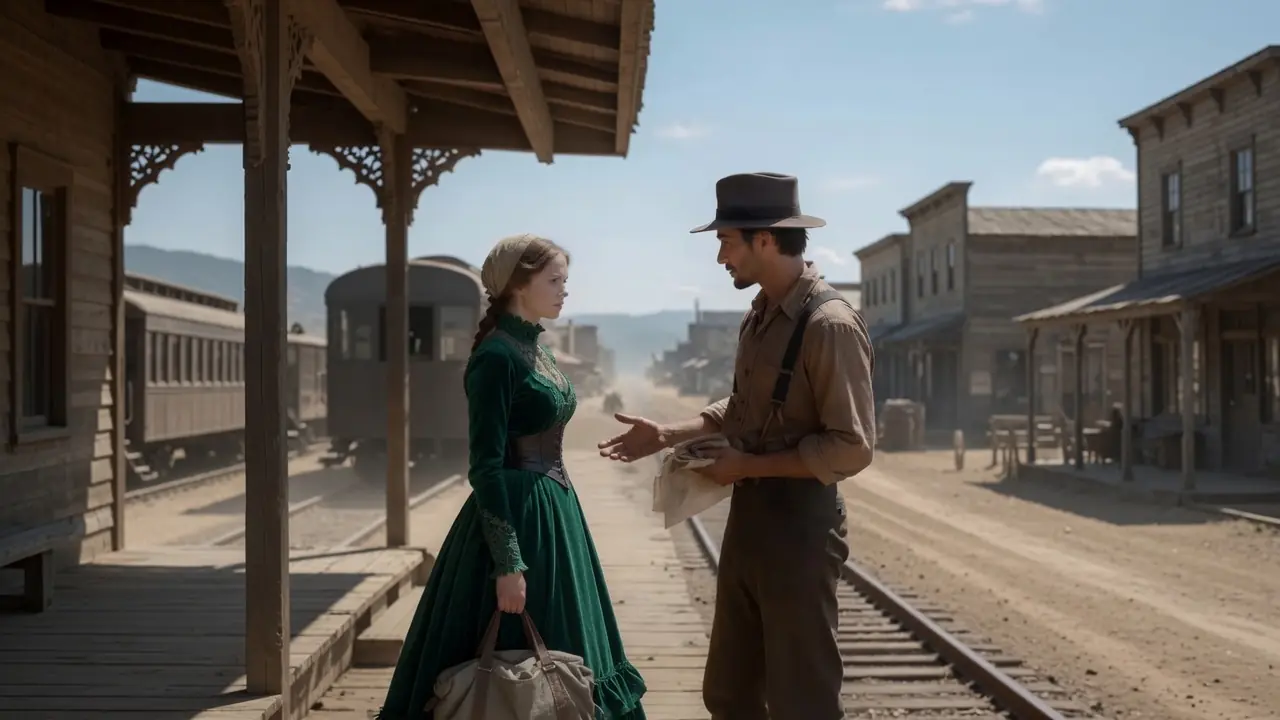
The land west of town opened like a book no one had written in yet. Sagebrush silvered the hills, jackrabbits scattered from the trail, and the rails vanished behind them as the path climbed toward rough country. Clara’s body ached from three nights on depot benches, but she sat straighter with every mile. Shame had followed her out of town, but it seemed to lose strength in open air.
They stopped at midday beside a shallow creek. Bo gave her dried venison, hard biscuits, and water from a tin cup. Clara ate slowly, embarrassed by how badly she needed it. He turned away while she washed her face in the creek, giving her privacy without making a ceremony of it.
“You always this quiet?” she asked when they mounted again. Bo glanced over. “Only when noise won’t improve the day.” Clara smiled despite herself. It felt unfamiliar on her face. “That must be often.”
He gave the smallest shrug. “Often enough.” For a while, only the horses spoke through their reins and hoofbeats. Then Bo said, “You came west to marry a man from letters.” Clara’s smile faded. “Yes.” “Did you love him?” he asked.
The question was blunt, but not cruel. Clara thought about Jedediah’s letters, full of land, plans, and descriptions of sunsets that had seemed almost tender from far away. “I loved the person he pretended to be when paper kept him honest,” she said. Bo nodded as if he understood that kind of lie. “Paper is patient with cowards.”
By late afternoon, the hills grew rougher, and a line of cottonwoods marked Silver Creek. Bo made camp in a small hollow sheltered from the wind. Clara gathered kindling while he watered the horses, and the simple usefulness of the work steadied her. For the first time since arriving in Red Hitch Junction, she did something that did not involve waiting.
They ate by firelight as the sky turned violet. Bo told her little about himself, but the little he gave mattered. He had served in the war, lost friends, ridden farther than he meant to, and learned that some wounds closed only when a man stopped showing them to every stranger. He had once been engaged to a banker’s daughter who wanted a safer life than his boots could promise.
“Did you love her?” Clara asked. Bo pushed a stick into the fire until sparks lifted. “I loved what I thought resting might feel like.” He looked at the flames. “She loved the idea of taming something wild. We were both mistaken.”
The answer stayed with Clara through the night. She slept a few feet from the fire, wrapped in her shawl, listening to the horses breathe and Bo shift now and then on the other side of the camp. He never came closer. That mattered more than a thousand pretty promises.
At dawn, she woke to hoofbeats in the distance. Bo was already standing at the edge of camp, one hand near the pistol at his hip. Clara sat up, heart pounding. Two riders appeared along the eastern ridge, moving fast enough to raise dust. As they came closer, Clara recognized the gray horse first.
Jedediah Larkens rode like a man who expected the world to move aside for him. Beside him rode Irene, wearing a dark red traveling dress Clara had helped her sew two summers earlier. Irene’s face looked pale beneath her hat, but her chin held its old defiance. Clara stood slowly, her fingers closing around the edge of her shawl.
Jedediah reined in twenty feet from camp. He was younger than Clara had imagined and handsomer in the shallow way of men who know mirrors have been kind. His eyes moved over Bo, then over Clara, and stopped on her suitcase near the bedroll. “Miss Whitmore,” he said. “You left town before we could explain.”
Clara looked at Irene. Her sister’s eyes flickered away. “You explained in six words,” Clara said. “He chose me instead.” Irene flinched, but Jedediah gave a polished sigh. “That telegram was poorly phrased.”
Bo stepped closer to Clara, but not in front of her. “Careful,” he said softly to Jedediah. “You have a habit of poor phrasing around this woman.” Jedediah’s eyes sharpened. “This is family business.”
“I see no family standing on her side but herself,” Bo said. The words were quiet, but Irene’s face colored. Clara felt them strike the air between all four of them. She lifted her chin.
Jedediah dismounted. “Clara, you have misunderstood. Irene arrived first, yes, and emotions ran high, but after reflection, I believe the proper arrangement should be restored.” Clara stared at him, not understanding at first because the arrogance was almost too complete to recognize. “Restored?” she repeated.
Irene’s fingers tightened on her reins. “Jedediah,” she said quietly. He ignored her. “Your father’s letter mentioned a settlement held in your name upon marriage,” he said to Clara. “I was unaware the sum was so considerable. It changes matters.”
For a moment, Clara felt the world go silent. Then all the humiliation of the depot, the waiting, the gossip, the hunger, the telegram, and the ride west gathered inside her like storm heat. Jedediah had not come because he regretted hurting her. He had come because someone had discovered she was worth more money than her sister.
Bo’s face went still in a way that made even the horses seem uneasy. “You followed her into open country to bargain for her like a bank note?” he asked. Jedediah’s mouth tightened. “She came west under agreement to marry me.” Clara stepped forward before Bo could answer. “And you broke that agreement when you chose Irene.”
Irene finally dismounted. “Clara, please. I didn’t know about the settlement until yesterday.” Clara looked at her sister, and the pain there was older than Jedediah. “Would it have mattered?” she asked. Irene’s eyes filled. “I don’t know.”
That was the first honest thing Irene had said. It did not heal anything, but it made Clara’s anger steadier. Jedediah reached into his coat and pulled out a folded letter. “Your father expected this marriage to secure your future. I am prepared to overlook the confusion.”
Clara laughed once, sharp enough to startle herself. “You will overlook being faithless?” Jedediah reddened. “A woman alone should think carefully before refusing protection.” Bo stepped forward then, his hand no longer near his pistol but open at his side, which somehow looked more dangerous.
“She is not alone,” Bo said. Jedediah looked him over with contempt. “And what are you? A drifter with a tired horse and a campfire?” Bo’s jaw tightened. “A man who kept his word after giving it. That already sets me above you.”
Jedediah’s face twisted. “You think she’ll choose a cowboy over a house, land, and respectability?” Clara looked from Jedediah’s polished boots to Bo’s dust-worn ones. She remembered three days on the station bench while respectability watched from windows and did nothing. Then she looked at Bo, who had offered her a road without asking for ownership of her destination.
“I would choose an honest road over your house every day of my life,” Clara said. Irene covered her mouth with one hand. Jedediah stared as if no woman had ever refused him with witnesses present. Bo’s eyes remained on Clara, and something warm moved behind their quiet.
Jedediah stepped toward her. “You are making a foolish mistake.” Bo moved between them in one smooth motion. “Take one more step toward her without invitation,” he said, “and you will carry that mistake back to town in your teeth.” The threat was low, controlled, and absolute.
Clara touched Bo’s sleeve. “No,” she said softly. “He is not worth blood or jail.” Bo did not look away from Jedediah. “He is not worth dust.” Clara almost smiled, despite everything.
Jedediah turned to Irene. “Mount up.” Irene did not move. He looked at her sharply. “I said mount up.” Irene’s face changed then, not into courage exactly, but into the first painful shape of it. “No,” she said.
Clara looked at her sister. Jedediah’s eyes widened. “What?” Irene lifted her chin, though tears slipped down her cheeks. “I stole a place that was never mine, and you followed Clara for money the moment you heard she had any. I would rather go back east disgraced than west married to a man whose promises change with the price.”
Jedediah cursed under his breath. Bo took one step, and the curse died unfinished. Jedediah mounted hard, yanked his horse around, and rode toward Red Hitch Junction without looking back. Dust swallowed him before the morning fully warmed.
Irene stood beside her horse, shaking. For a long time, neither sister spoke. Then Clara walked to her suitcase, opened the broken latch, and pulled out a small purse of coins. She pressed it into Irene’s hand. “This will get you back to Charleston if you do not waste it.”
Irene sobbed once. “I don’t deserve that.” Clara’s voice trembled, but it did not break. “No. You don’t.” She closed Irene’s fingers around the purse anyway. “But I will not become cruel just because cruelty found me first.”
Irene left before noon, riding east alone with her head bowed. Clara watched until her sister became a small red mark against the pale road. Bo stood beside her in silence. He did not tell her she had done right, because perhaps he knew right choices did not always feel good.
When Clara finally turned to him, her eyes were dry. “You said there was a cabin past the ridge.” Bo nodded. “There is.” “Does the roof leak?” she asked. “Only if the rain is sideways and feeling ambitious.”
For the first time in days, Clara laughed fully. It surprised both of them. Bo’s answering smile was brief, but it reached his eyes. He offered his hand to help her mount, and this time she took it without hesitation.
The cabin was smaller than she expected and lonelier than she hoped, but it was clean. It sat beneath a ridge where wind moved through grass in long silver lines. Bo gave Clara the bed and slept outside under the lean-to the first night, ignoring her protests with a stubbornness she would later learn was one of his least negotiable qualities. The next morning, he showed her the spring, the garden patch, and the old stove that smoked unless handled with patience.
Days became weeks. Clara did not become Bo’s wife because loneliness asked them to hurry. She mended shirts, learned to bake biscuits in his unreliable stove, and wrote letters she was not yet ready to send. Bo repaired fences, checked traps, and rode with her to the ridge at sunset when the sky opened wide enough to make shame seem small.
In time, Clara received a letter from Charleston. Her father had been ill, her settlement was real, and he had indeed intended Jedediah to secure her comfort rather than her love. The letter hurt, but not as much as she expected. A father’s fear had mistaken marriage for safety, but Clara had learned that safety without respect was another kind of cage.
Winter came early that year. Bo built shelves for Clara’s books, and she planted paper flowers in a tin cup by the window, not because she was waiting anymore, but because she liked seeing delicate things survive. One evening, while snow softened the ridge beyond the cabin, Bo placed a folded square of blue cloth on the table. It was her handkerchief, the one he had lifted from the depot dust.
“I kept it clean,” he said, suddenly awkward. Clara touched the embroidered C with two fingers. “Why?” Bo looked at the fire. “Because it was yours before anyone tried to make you feel unwanted.”
Clara’s heart ached softly. “Bo,” she whispered. He stood, uncertain for once, until she crossed the small room and placed the handkerchief in his palm. “Keep it,” she said. “But only if you understand I am giving it freely.”
His hand closed around hers. “I would not take it any other way.” That was the closest thing to a vow she had ever trusted. She lifted her face, and when he kissed her, it felt nothing like being chosen from a list. It felt like being seen.
They married in spring at the little church near Silver Creek. No grand dress, no velvet suitcase, no man waiting at a station with ownership in his eyes. Clara wore the blue dress she had traveled in, washed and mended, with a new paper flower pinned to her hat. Bo stood beside her in a clean shirt, his hands steady except when he took hers.
Years later, people still told the story of the abandoned bride and the passing cowboy. Some made it prettier than it was, forgetting the hunger, the shame, and the three long days when Clara learned how cold pity could be. Clara never forgot. She simply stopped letting the station be the place where her story ended.
Sometimes, when the westbound train whistled far below the ridge, Clara would step onto the cabin porch and listen. Bo would come stand beside her without asking what she remembered. He knew by then that love did not erase old wounds; it only gave a person a safe place to stop bleeding. Clara would take his hand and look toward the rails, no longer waiting for anyone to arrive.
Because Jedediah Larkens had left her at a station, but Bo Callahan had offered her a road. Irene had stolen the promise, but Clara had found the life. And somewhere between dust, silence, and the long ride west, she had become the kind of woman no man could abandon again. She had not been rescued from worthlessness. She had been reminded she was never worthless at all.