The morning fog had not yet lifted from the lane when the coach came around the bend, and the young woman standing by the low stone wall lifted her hand before she had time to think about it. She had been on her way to the village with a basket of eggs, her boots damp from the wet grass, the cold morning air biting at her cheeks and the tip of her nose. The eggs were warm under the cloth because she had wrapped them close to her body during the walk. Now she stood very still, her eyes fixed on the front wheel of the coach as it turned, and she felt something in her chest go tight.
The wheel was wrong. She could see it plainly. The wooden spokes were bent just a little at the base, and the iron rim had a thin crack running along the outer edge. And the whole wheel wobbled as it turned, the way a loose tooth wobbles in a child's mouth.
She knew wheels. Her father had been a wheelwright before he died, and she had spent her childhood in the yard behind his shop, learning the sound of good wood and bad wood, learning the way a wheel sings when it is well made, and the way it hums low and wrong when it is about to fail. This wheel was about to fail. She stepped forward into the road.
The coachman was a stout man with a red face and a heavy coat, and he was singing something under his breath, and he did not see her at first. She had to wave both arms. The horses saw her before he did, and they slowed, and the coach came to a stop with the creak of leather and a huff of horse breath that steamed white in the cold air. “You there,” the coachman said, frowning down at her. “What is it, girl?”
“Move aside.” “Your wheel,” she said. Her voice was quiet, but clear. “The front wheel on the left. It will not last another mile.”
The coachman blinked at her. He was a man who had driven this coach for eleven years, and he did not care to be told his business by a girl in a wet cloak with mud on her boots. He drew himself up on the box and looked down his nose at her. “My wheel is fine,” he said. “Now, stand aside.”
“It is not fine,” she said. She did not raise her voice. She kept her eyes on his, and she spoke the way her father had taught her to speak when she was certain of a thing. “The spokes are bent at the hub. There is a crack in the iron.”
“If you go over the hill and down the far side, the weight will shift and the wheel will come apart. I have seen it before. My father was a wheelwright. I know what I am looking at.” The coachman opened his mouth and closed it and opened it again.
He was not used to this. His face went a deeper shade of red. Behind him, inside the coach, there was a small sound, the sound of a man moving a curtain aside. She did not know he was there. She could not see through the dark glass of the window.
She only knew that the coachman was staring at her with something between anger and doubt, and that the horses were shifting on their hooves, and that the cold was starting to seep through her cloak into the skin of her arms. “Get down,” she said, “and look at the wheel yourself. I will wait. I do not want to be paid. I only ask that you look.”
Something in the way she said it made the coachman pause. He grumbled, and he set down the reins, and he climbed heavily off the box. His boots hit the wet road with a soft thud. He walked around the front of the horses muttering under his breath, and he crouched down by the wheel, and for a long moment he did not move.
She stood very still. She could hear the horses breathing. She could smell the wet earth and the wool of the coachman's coat and the faint warm smell of eggs from her basket. Somewhere in the hedge a small bird was singing a thin high song.
The fog was beginning to lift and a pale sun was starting to show above the far hills. The coachman stood up slowly. His face had changed. “Bless me,” He said quietly. “Bless me, she's right.”
He looked at her and there was a new expression in his eyes. And it was not quite respect, but it was on the road to it. He shook his head. “Another mile.” He muttered.
“Down that hill.” “God's mercy.” Then the door of the coach opened. She had not expected that. She had thought the coach was empty.
Or perhaps carrying goods. Or perhaps carrying a merchant who would stay inside and let his coachman handle the matter. But the door opened. And a man stepped down into the road. And she saw him properly for the first time.
He was tall. That was the first thing. He took up more room than a tall man ought to. Though he was not doing anything to make himself larger. He wore a dark coat of very fine wool.
And his boots were clean. And his gloves were the color of cream. His hair was dark and cut close. And his face was not the face of a merchant. His face was the face of a man who was used to being listened to.
And who did not raise his voice because he had never needed to. He looked at the wheel. He looked at the coachman. Then he looked at her. She did not curtsy.
She did not know she was supposed to. She only stood there with her basket of eggs. Her cheeks pink from the cold. Her dark hair coming a little loose from the braid she had pinned that morning. And she looked back at him.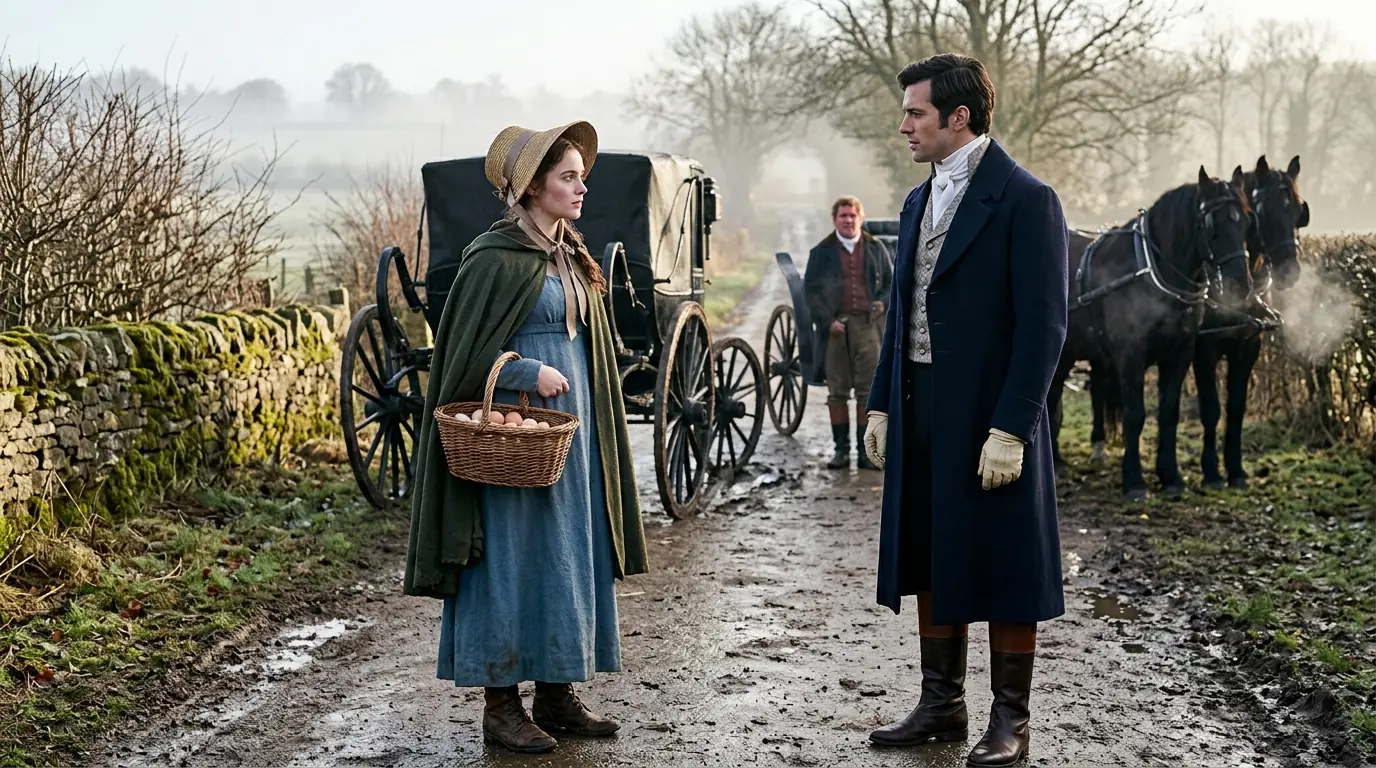
“You stopped my coach,” He said. His voice was low and even. Not angry. Not warm. Just a fact spoken plainly.
“Yes,” she said, “because of the wheel.” “Yes.” He was quiet for a moment. His gaze went over her, not the way some men looked at women, but the way a man looks at a page he is trying to read. He took in the mud on her boots, the basket in her hand, the way she was standing with her weight even on both feet, the way she was not looking away.
It was not a smile. It was something smaller than a smile. But she saw it. “What is your name?” he said. She hesitated.
She did not know why. Perhaps because she was suddenly aware that he was not a merchant, and that this was not an ordinary morning, and that the fog was lifting, and that everything in the day had shifted slightly to one side. “Maren,” she said. “Maren Ashcombe.” “Miss Ashcombe,” he said, and he inclined his head, only a small movement, but it was more than she had ever received from a man in a coat like his.
“You have most likely saved my life and my man's. I will not forget it.” She did not know what to say. She had never spoken to a man like this before. She had spoken to the vicar, and to the miller, and to the men who came to buy eggs.
She had not spoken to a man in cream gloves who bowed his head to her in the middle of a wet road. “You should walk her to the village,” he said to the coachman, without looking at him. “The wheel will not hold. I will walk with her.” The coachman opened his mouth as if to say something, and then closed it.
He nodded. He began the slow business of unhitching one of the horses so that the coach could be led rather than driven. The tall man turned back to her. “May I walk with you as far as the village, Miss Ashcombe? It seems I have some time to spend and no wish to spend it on the box of a broken coach.”
She swallowed. “It is a long walk.” “I have long legs.” That at least was true. She began to walk and he fell into step beside her.
And the coachman came behind with the horse and they made a strange little party on the wet road as the sun came up. They walked in silence for a little while. She was very aware of him not because he did anything because of the space he took up because of the faint smell of his coat which was clean wool and something else something like leather and rain. Because of the way his boots did not slip on the wet stones though hers did. “You live near here,” he said at last.
“In the cottage past the mill.” “With my aunt.” “Your father?” “Died four years ago in the spring.” He nodded once.
He did not say he was sorry. She was glad of that. She had heard too many men say they were sorry when they were not. Instead he said, “Twenty-one years is a long time to make wheels. He must have been very good.”
“He was.” They walked on. She shifted the basket to her other arm. Her arm was starting to ache from carrying it, but she would not have said so. “Give me the basket,” he said.
“No, Miss Ashcombe.” “They are my eggs, sir. I can carry them.” That small movement of his mouth came again. He said nothing.
He walked beside her and he did not ask again and she was grateful and also a little irritated that he had noticed her arm was tired. The village came into view. The little gray church, the row of stone houses, the smoke from the chimneys curling up into the pale sky. She stopped just outside the first house. “This is far enough, sir,” she said.
I thank you for your company. I hope your coach is mended soon. He looked at her for a long moment, that heavy gaze. She felt as if she had been weighed. “May I ask one thing?” he said.
“You may ask.” “If you had not stopped that coach, what would you have done today?” She thought about it. She did not answer quickly. She could tell he did not want a quick answer.
“I would have sold my eggs to the baker's wife,” she said. “I would have bought a pound of flour and a small piece of salt beef. I would have walked home. I would have helped my aunt with the mending. I would have gone to bed.”
“And tomorrow?” “The same. Only without the eggs.” He nodded slowly.
He seemed to be filing this away somewhere. “Good day, Miss Ashcombe.” “Good day, sir.” He did not tell her his name.
She did not ask. She watched him turn and walk back toward the coachman and the horse and the broken coach, and she watched him until he was small on the road. Then she went to sell her eggs. She did not know as she walked into the baker's shop that the man in the cream gloves was the duke of Windermere, and that he was on his way to his estate three miles east of the village, and that he had been thinking as he walked beside her about a great many things that had nothing to do with wheels.
The baker's wife took the eggs and counted out the coins. The salt beef was small. The flour was dear. Maren tucked the little parcel into her basket and turned to go home. And she thought, without quite meaning to, about the mouth of the tall and the way it had moved without smiling.
And she pressed her lips together and told herself she was being a fool. At the estate, three miles east, the duke of Windermere came in through the tall front doors of Asham Hall and handed his gloves to the footman without looking at him. He walked straight through the great hall and into his study and closed the door behind him. He did not ring for anything. He sat down in the leather chair by the window and he looked out at the wet garden for a long time.
His housekeeper, when she came in later to see whether he wanted tea, found him still sitting there. She was a small woman named Mrs. Pruitt with gray hair pulled back very tight and a quiet, watchful manner. She had served the duke's father before him and she had known the duke since he was a boy in short trousers and she was one of the very few people alive who was not afraid of him. “You are back early, Your Grace.” “The coach broke.”
“On the road?” “Just before it broke. A young woman stopped it.” “She saw the wheel.” Mrs. Pruitt paused, her hand on the tea tray.
“Saw it, sir?” “She knew it was about to give. Her father was a wheelwright.” “She stood in the middle of the road and would not let us pass.” Mrs. Pruitt's mouth twitched.
“Bold of her.” “Yes. Did you learn her name?” “Maren Ashcombe.” “She lives past the mill with her aunt.”
Mrs. Pruitt set the tray down carefully. “Ashcombe. I knew her father, sir—a good man. Died of a fever four years back. Left the girl and her aunt with very little.”
The duke did not answer at once. He was still looking at the garden. “She would not let me carry her basket,” he said at last. Mrs. Pruitt did smile then, very slightly, and she did not let him see it.
“No, sir,” she said. “I don't suppose she would.” That evening, the duke sat down to dinner alone. The great dining room at Asham Hall was made for twenty, and he sat at one end of the long table with a single candle and a plate of roast pheasant, and he ate slowly. The room smelled of beeswax and old wood.
Somewhere down the hall, a clock ticked. He could hear the wind rising outside. He was a man of thirty-four years, and he had been the duke of Windermere for eleven of them, and in that time, he had not married. This was not for lack of trying on the part of the mothers of the county. Every ball, every dinner, every afternoon call had been an attempt to press some daughter or niece upon him.
He had been patient with all of them, and he had chosen none of them, and the reason was very simple. He did not want to spend his life with a woman who was performing. He had seen too much performing. He had watched women laugh at jokes that were not funny. He had watched them lower their eyes at the right moment, and lift them at the right moment, and say the words they had been trained to say.
He had watched them look at his house and his title, and his lands, and he had watched them fail to look at him at all. He set down his fork. He thought about the wet road and the mud on her boots, and the way she had said, “They are my eggs, sir. I can carry them.” He had not been looked at like that in years, not as a duke, as a man in a coat who had asked too much.
He picked up his fork again and finished his pheasant. The next morning, he called for a horse, and he rode himself without a groom, past the mill and past the low stone wall where he had first seen her. He did not stop at the cottage. He only rode past. He saw the small garden, the neat row of beans on their poles, the goat tied to a post.
He saw a woman hanging washing on the line. It was not Maren. It must have been the aunt. He rode on. He did this three more times over the next week.
He did not tell himself why. He told himself he was inspecting the road. He told himself the horse needed exercise. On the fourth day, he saw her. She was in the lane walking toward the village again, and she had a bundle of cloth this time instead of eggs.
He drew rein. “Miss Ashcombe.” She looked up. She did not curtsy. He was beginning to understand that she did not curtsy to anyone unless she meant it.
Sir? Are you well? I am well. And you? I am well.
He paused. The coach has been mended. I am glad. She stood there with the bundle in her arms, and the wind was moving small pieces of her dark hair against her cheek, and he had the strong and unfamiliar feeling that he was in danger of saying something he had not planned to say. “I have not yet paid you,” he said, “for what you did.”
“You do not owe me anything, sir.” You saved my life. Perhaps, or perhaps you would have fallen and been bruised. I did not ask you what you would give me because I did not want anything. I do not want anything now.
There was a silence. The wind blew again. “Then let me ask you something else,” he said. “There is a great deal of work at my house that needs doing before the winter: blankets to be mended, curtains to be rehung, linen to be sorted. My housekeeper is short of hands.”
Would you come and work for me? For proper wages, paid weekly. She looked at him for a long time. Why are you offering this to me? She said, and not to any of the other women in the village.
He held her eyes. “Because I saw what you did in the road,” he said, “and I have not been able to forget it. And because I trust very few people, and I would like to see whether I can trust you.” She did not answer at once. She shifted the bundle in her arms.
She looked at the road and at the hedge and at the sky. Then she looked back at him. “I will come for 1 month,” she said. “If it does not suit me, I will leave. And I will not be treated as though you own me.”
“Miss Ashcombe,” he said quietly, “I have no wish to own anyone.” “Then I will come on Monday.” She dipped her head, only a very small dip, and she walked past him toward the village. He turned his horse and watched her go. He did not smile, but the small movement came again at the corner of his mouth, and it stayed there for most of the ride home.
She arrived on Monday at eight o’clock in the morning in a clean gray dress and a shawl her aunt had lent her. She was met at the servants' door by Mrs. Pruitt, who looked her up and down once, briskly, and then held out her hand. “Miss Ashcombe, I am Mrs. Pruitt. You will call me Mrs. Pruitt. I called your father a friend, and I hope we shall get on.”
“Yes, ma'am.” “Come with me.” Maren was led through a long passage that smelled of soap and cold stone. Mrs. Pruitt walked briskly.
She did not slow her step. She spoke as she walked. There are 11 of us here now. There used to be 22.
His grace does not like a fuss. You will find the house is run quietly. You will find the wages are fair. You will find some of the other women here have been at Asham Hall for many years, and they may not welcome you at first. Do not take it to heart.
Asham Hall. Maren repeated the name in her mind. She had known it belonged to the duke of Windermere. Everyone in the county knew that. She had not, until this moment, put together that the man in the cream gloves and the master of Asham Hall were one and the same.
She stopped walking. “Mrs. Pruitt?” The housekeeper turned. “Yes?” “His Grace—the duke—is he the man who was in the coach?”
Mrs. Pruitt looked at her with a very level expression. “Yes, my dear.” Maren stood very still for a moment. Then she nodded once, and she walked on. She did not say anything about it.
She did not go to him and complain that he had not told her. She did not go back home. She only followed Mrs. Pruitt to the linen room, and she took off her shawl, and she began to sort blankets by their edging without a word. Mrs. Pruitt watched her for a long minute. Then she said quietly, “You will do.”
Maren looked up. “Ma’am?” “Nothing, child. Get on with the blankets.” The other women in the house did not welcome her at first, as Mrs. Pruitt had said.
There was a tall, thin woman named Miss Yarrow who had charge of the china, and there was a rounder woman named Mrs. Fenn who did the cooking, and there was a girl her own age named Perpetua who did the fires. Miss Yarrow watched Maren the way a cat watches a mouse. Mrs. Fenn was polite but distant. Perpetua only stared. But there was a fourth woman, older than the others, who came into the linen room on the second day and sat down heavily on a stool and said, “You are Perry Ashcombe's daughter.”
“Yes.” “He mended my father's wagon wheel in the year of the great snow. Would not take payment. Said the wood was already cracked and he should have caught it when it was made.” Maren smiled.
It was the first time she had smiled in this house. That sounds like him. “You have his hands.” the old woman said. “I can see it. Now come, I will show you where the winter linen is kept.”
Her name was Mrs. Halston and she was the head of the still room. And from that day on she was the closest thing Maren had to a friend at Asham Hall. The duke did not come to see her. He had promised he would not treat her as though he owned her and he did not. She saw him only at a distance, in a passage, in the great hall, once at the far end of the garden.
He never spoke to her. He nodded to her once when they passed in the corridor. That was all. She told herself this was proper. She told herself she was glad of it.
She did not always believe herself. At the end of her first week, she was carrying a stack of folded sheets across the upper landing when she heard voices in the room to her left. She would have walked past without stopping but she caught her own name. “Ashcombe, the wheelwright's daughter. He picked her up off the road, Pruitt tells me.”
The voice belonged to a woman and it was pitched to carry. “He didn't pick her up, Lady Corvin. He offered her honest work. Of course.”
“Honest work. That is what they always call it, is it not? Honest work for the pretty ones.” Maren stopped very still in the passage. She could feel her face going hot.
She is not going to last a fortnight, Pruitt. Girls like her never do. They come in with their heads full of nonsense and they leave with their skirts full of stolen silver and my nephew is left looking like a fool. I have seen it before. Miss Ashcombe is here to mend the linen, my lady.
She is here to catch a duke. Do not be a fool, Pruitt. You have always been a good woman. But you are not clever. She is here to catch him.
And she will fail. Because he is not the sort of man to be caught by a girl who smells of the road. She will be gone by the end of the month, and I would put a guinea on it. There was a small silence, and then Mrs. Pruitt's voice, calm as ever. “I do not gamble, my lady.”
Will you take tea in the yellow drawing room? The door opened. Maren pressed herself against the wall, the sheets held tight against her chest, and Lady Corvin swept past her without so much as a glance. She was a tall woman with silver hair pinned very high, and a face that had once been handsome, and was now only sharp. She smelled of a heavy sweet scent that caught in Maren's throat.
She did not see Maren. She swept down the stairs and was gone. Mrs. Pruitt came out of the room a moment later. And she saw Maren standing there with the sheets, and she saw her face, and she said quietly, “Come with me, child.” She led Maren into the small sitting room where she took her tea.
And she closed the door. Maren stood with the sheets still in her arms. She did not know what to say. “How much did you hear?” Mrs. Pruitt said.
“Enough.” Then hear this. Lady Corvin is His Grace's aunt. She has been trying for eleven years to marry him off to one girl or another. Every one of them has been her friend's daughter.
And every one of them has failed. She is not cruel by nature. She is only frightened that he will die without an heir. And she has decided that anything short of the daughter of an earl is a disaster. Do not take her words to your heart.
She said I smell of the road. You do not. She said I would be gone by the end of the month. Mrs. Pruitt looked at her steadily. Then stared past it.
Maren swallowed hard. She looked down at the sheets in her arms. She thought of her father in his yard with the shavings of wood at his feet telling her once that the world would try many times to move her off the mark she was standing on and that the only answer was to stand more firmly. “I will stay,” she said. “Good.” said Mrs. Pruitt.
That evening when the duke came in from his ride Mrs. Pruitt was waiting for him in the hall. She did not usually meet him there. He looked at her. “What is it?” “Your aunt was here today, your grace.”
She spoke of Miss Ashcombe. “Miss Ashcombe overheard.” He was very still. “What did she say?” Mrs. Pruitt told him not softly.
She told him every word in the order it had been spoken. She had served his father and she had earned the right to tell him things he did not want to hear. He listened without moving. When she had finished, he said only, “Thank you, Pruitt.” He went into his study and closed the door.
He sat down in the leather chair. He did not send for tea. He did not send for anything. He sat for a long time and he thought about the wet road and the mud on her boots and the way she had said “They are my eggs, sir. I can carry them.”
He thought about his aunt and the eleven years and the girls in the ballroom who had all smelled of the same heavy scent and he thought about a great many things. He did not act at once. He did not go to Maren and apologize because he had not been the one to speak the cruel words and because he had promised her that he would not treat her as though he owned her, and running to her now would break that promise in another direction. Instead, he sat, and he thought, and he decided.
The next morning, he called Mrs. Pruitt into the study. “When my aunt comes to the house again,” he said, “she is to be received politely. She is to be given tea. She is to be told that I am not at home. Sir, for as long as it takes.”
“Yes, sir,” she turned to go. “Pruitt, yes, sir. Does Miss Yarrow know I have been told?” “No, sir. Do not tell her.”
Mrs. Pruitt smiled only a very little, and she went out. Maren, for her part, did not know any of this. She only knew that the days went on. The blankets were mended.
The curtains were taken down and beaten and rehung. The winter linen was aired. She learned the passages of Asham Hall the way she had once learned the lanes of the village. She learned which floorboards creaked and which did not.
She learned that the duke rose at 6:00 and went riding at 7:00, and that he took his breakfast in the small east room where the sun came in. She did not see him often. She did not go looking for him. When she did see him in a passage or across a room, she nodded once and went on with her work, and he nodded once and went on with his, and no words passed between them. Two weeks became three.
Three became four. Her first month came to an end. On the last day of the month, Mrs. Pruitt came to her in the linen room. “His Grace asks whether you will stay another month.” “He might have asked me himself.”
“He might have. He has not.” Maren looked down at the shirt she was mending. She took another stitch. “Tell him I will stay another month.”
Mrs. Pruitt went out. That night, alone in her small room at the top of the house, Maren sat on the edge of her narrow bed and looked out at the moon over the fields. She could hear an owl somewhere in the woods. She could smell the smoke of the fire she had banked in the little grate. She could feel the wooden floor cold under her bare feet.
She thought about her father. She thought about the way he had built things to last. She thought about her aunt at home, alone in the cottage with the goat and the beans. She thought about the tall man in the cream gloves who had not smiled at her but had almost smiled, and who had not carried her basket because she had told him not to. She did not know what she was doing here.
She only knew that she was not going to run. The second month began. There was more work now. The house was preparing for the winter. Mrs. Pruitt asked Maren to take on the counting of the household linens, a task that had been Miss Yarrow's, and which Miss Yarrow had done badly for years.
Miss Yarrow took offense. She said several sharp things in the servants' hall. Maren did not answer any of them. She only took the ledger and the keys and did the work. At the end of the first week, Mrs. Pruitt looked over her figures and said, “You count very well, Miss Ashcum.”
“My father kept his own books.” “So I see.” She was given more. The mending of the wages ledger, which had grown untidy, the ordering of the winter candles, small things given quietly, one at a time. She did all of them without complaint.
She did not know it, but her name was beginning to appear in the duke's mind almost every day now, and in a very particular way. Not as a girl on a road, as a person he was learning to rely on. One cold morning in the second month, she was crossing the yard behind the stables when she saw a boy sitting by the wall crying. He was the stable boy, thin and small with a bloody lip. She stopped.
What has happened to you? Nothing, miss. Your lip is bleeding. I fell. She looked at him.
She had grown up in a village. She knew what a boy looked like when he had fallen and she knew what a boy looked like when he had been struck. This boy had been struck. Who did this? He shook his head.
He would not say. She sat down on the wall beside him. She did not press him. She took a clean square of cloth from her pocket and gave it to him and she waited. After a long time, he said, “Beeching, miss.”
Beeching was the head groom, a large man with a very red neck. She had seen him about the yard. “Why I let the bay mare's water go dry.” “He said I was a slow boy. He said I was worthless.”
She sat with him a while longer. Then she said, “Go and wash your face. Come and find me in the linen room this afternoon. I will give you something for your lip.” She did not go to Beeching.
She did not go to Mrs. Pruitt. She thought for a long time and then she wrote a short note in her clearest hand and she put it under the study door in the evening when no one was watching. The note said only, “Your stable boy has been struck by the head groom for letting a water pail go dry. The boy is nine years old. I do not know what should be done about it, but I did not think you should remain unaware.”
“M. Ashcombe.” She did not sign the note with any pretense of importance. She only put it under the door and went to bed. The next morning, Beeching was dismissed.
There was no fuss. There was no announcement. He was simply told at eight o’clock in the morning that his services were no longer needed and he was gone from the yard by noon. The stable boy did not know why. He came to Maren in the linen room in the afternoon with a wondering look on his face and she gave him a small pot of salve for his lip and she did not tell him what she had done.
She did not tell anyone. She did not for that matter know whether the duke had read her note or whether he had cared or whether he had done anything at all. She only knew that Beeching was gone and that the boy's lip was healing and that the mare's water pail was now checked twice a day. Some weeks later on a very cold evening in the middle of the second month she was walking past the kitchen when she heard Mrs. Fenn talking to Mrs. Halston, “Did you hear then about Beeching? I heard he was let go.”
“Not just let go. His Grace paid his passage to his brother's farm in the north. Gave him a purse for the road. Said he would not have him ruined for a moment of temper but he would not have him near the boys either. That is the story.”
Mrs. Halston sniffed. “Kinder than Beeching deserved. Kinder than most of us would have been. His Grace does not raise his voice, Halston. That does not mean he does not see.”
Maren stood in the passage very still. She had a lamp in her hand. The oil was low and the flame was small and it flickered in the draft from the door. She had thought when she wrote the note that the duke might dismiss the man.
She had not thought that he would give him money to start again. She had not thought that he would try in his own quiet way to save the man from becoming worse than he already was. She had not thought that he would do it without telling her without asking for her thanks without letting her know that he had even seen her note. She stood in the passage for a long time. She thought about it.
She thought about the cream gloves and the small movement of his mouth that was not a smile. She thought, “He is a better man than I knew.” She did not say it aloud. She did not tell anyone. She only went back upstairs and she blew out her lamp and she slept.
The winter came in hard that year. The snow fell before the middle of the month and the roads froze. And Asham Hall drew in on itself the way a great house does when the world outside becomes cold and unfriendly. The duke did not go into the village. He did not ride out.
He worked in his study and he read in the library and he took his meals alone at the long table. Maren had by now been at the house for nearly three months. Her wages had been paid every week without fail. Her name had been added quietly to the roll of the upper servants. She had a small room to herself and a fire she was allowed to light.
She had made friends of a sort with Mrs. Halston and with Perpetua and even very slowly with Miss Yarrow who had at last decided that Maren was not going to disappear and might as well be spoken to civilly. Lady Corvin had called at the house three more times. Each time she had been received politely. Each time she had been given tea. Each time she had been told with great regret that his grace was not at home.
Each time she had left in a colder temper than she had arrived in and each time Maren had known nothing about it. One evening in the middle of December, a great snow began to fall. It came down thick and slow and by nightfall the yard was white and the roads were closed. Maren was in the small east room where the duke took his breakfast, mending the pull on a curtain that had come loose. She was alone.
The house was very quiet. She could hear the snow on the window and the soft settling of the coals in the grate. The door opened. The duke came in. He stopped when he saw her.
She stood up from the chair by the window and set her needle down. Miss Ashcombe. Your Grace. He looked at her for a long moment. The candle on the small table flickered.
The snow tapped softly on the glass. He was dressed for the evening and his coat was very dark and his cravat was white and his face in the candlelight was tired in a way she had not seen before. I did not know you were here. I am sorry to disturb you. I will go.
No. She stayed. He closed the door behind him. Please sit down. She sat down slowly.
He crossed to the fire and stood before it with his hands behind his back. He did not look at her. He looked at the flames. “I owe you an apology,” he said. She did not answer.
She waited. “When I first met you,” he said, “I did not tell you who I was. I did not tell you because I have found over the years that people speak differently to me when they know. I wanted to know how you spoke when you did not know. That was not fair to you.”
I have been meaning to say so for some time. Sir. I know you overheard what my aunt said. Mrs. Pruitt told me. I have not spoken to my aunt since.
“I will not speak to her again until she has understood what she said. I want you to know that I do not share her view of you. I have not shared it from the moment I saw you standing in the road.” Maren felt something in her chest go tight. She did not speak.
“I also want to thank you,” he said, “for the note about the boy. I should have known myself. He is my stable boy. He is my responsibility. That I did not know is my failing, and you spared me a worse one.”
“Beeching would have broken that child in another month.” “You gave him money,” she said quietly. “You know about that?” “I heard Mrs. Fenn speaking of it.” He turned then, and he looked at her.
The firelight was on one side of his face. “He is a man who might yet do better,” he said. “I did not wish to make him worse. That is all.” “That is a great deal, sir.”
He was quiet. He looked at her for a long time. She looked back at him. She did not know what her face was showing. She was trying very hard to keep it still.
“Miss Ashcombe,” he said, “may I ask you a question?” “You may ask.” “What would you have done today if you had not been in this house?” She thought about it. She did not answer quickly.
“I would have gone with my aunt to the market at Fellstone. We would have sold two of the last of the winter apples. I would have come home and helped her salt the small piece of pork we bought last week. I would have gone to bed with cold feet.” He smiled.
It was not a full smile, but it was more than the small movement she had seen before. It reached his eyes. And instead, he said, “You are mending my curtains in a warm room.” “Yes, sir.” “Are you glad?”
She was quiet for a long moment. She looked at the fire. She looked at him. She looked at her hands. “Yes, sir,” she said, “I am glad.”
Neither of them spoke for a long time after that. The snow kept falling on the window. The coals settled. Somewhere in the house, a clock chimed the hour. At last he said, “Good night, Miss Ashcombe.”
“Good night, Your Grace.” He went out. He closed the door behind him very quietly. She sat by the window for a long time before she picked up her needle again. And when she did, her hand was not quite steady.
The snow did not lift for four days. The house was cut off from the village and from the road. The servants moved about their work in the great quiet of a snowed-in house, and the duke was much more often in the rooms where Maren was working. He did not seek her out. He simply happened to be in the library when she was arranging the winter covers on the chairs.
He happened to come through the small east room when she was polishing the brass on the fender. He happened to be walking in the long gallery when she was hanging the mended curtains back at the tall windows. He did not speak much. He asked her once about a book she was dusting. She said she had not read it.
He said she might, if she cared to. He did not press her. She took the book to her room and read three chapters that night by the small light of her fire. The book was about a woman who traveled to a foreign country and learned the language of a people who lived in a valley among mountains. It was not a book about romance.
It was a book about paying attention. Maren read it slowly. She did not know why he had suggested it, but she thought about it as she read. On the fifth day, the snow began to thaw. The road slowly opened.
Lady Corvin sent a note to the house saying that she wished to call the following afternoon on a matter of great importance. The duke received the note in his study. He read it. He set it down. He rang the bell.
Mrs. Pruitt came. “My aunt is coming tomorrow.” So I understand, sir. I will be at home. Mrs. Pruitt looked at him.
Very good, sir. And I would like Miss Ashcombe to be in the yellow drawing room when my aunt arrives. Mrs. Pruitt was very still. Sir? Not as a servant, Pruitt.
Ask her to sit by the window. Ask her to bring her mending, if she likes. But ask her to be in the room. Sir, may I speak plainly? You may.
You are going to make her a spectacle. I hope not. I am going to do something that ought to have been done weeks ago. If Miss Ashcombe would rather not be there, she is not to come. But I would like her to know what I am about to do.
And I would like her to see it. If she does not wish to see it, then she does not have to. Mrs. Pruitt looked at him for a very long moment. Then she nodded once. I will ask her, sir.
She found Maren in the linen room. She closed the door behind her. She told Maren, plainly and quietly, what the duke had said. Maren listened. When Mrs. Pruitt had finished, Maren set down the sheet she was folding.
She looked out of the small window at the melting snow on the eaves. Mrs. Pruitt? Yes, my dear. He does not owe me this. No, he does not.
But he means to do it. He does. Maren was quiet for a long time. She thought about a great many things. She thought about her father.
She thought about her aunt. She thought about the goat, and the beans, and the eggs she had carried into the village on a morning that seemed very long ago now. “I will come,” she said. “I will bring my mending. I will sit by the window.”
Good, Mrs. Pruitt. Yes, he is not doing this to marry me, is he? Mrs. Pruitt looked at her. Her face was kind and it was steady.
“I do not know, child,” she said. “I do not know what he means to do beyond tomorrow. I only know that he is not doing it to shame you. That much I do know.” Then I will come.
The next afternoon was clear and cold. The snow was still thick on the ground, but the sky was blue and the sun came in through the tall windows of the yellow drawing room. Maren sat in the wide armchair by the window in her clean gray dress and her mother's small brooch at her throat. She had a piece of mending in her lap. Her hands were very still.
The duke stood by the fireplace. He wore his dark blue coat and cream gloves. He did not speak. He did not look at her. But she knew in a way she could not have said that he was aware of every breath she took.
At three o’clock exactly Lady Corvin was announced. The doors opened. She swept in. She had on a dark red gown and her silver hair was pinned very high and her scent came in with her heavy and sweet. She did not see Maren at first.
She saw only her nephew and her face brightened and she said, “My dear boy, at last.” I have been trying to see you for weeks. “Aunt, sit down.” Come, come, we have much to discuss. I have brought you news from town.
Lady Ferndale's daughter has returned from Bath and is much improved. I do not think you have seen her since. Her eyes moved. They landed on Maren. They fixed there.
Her mouth stopped moving for a moment. “Who is that?” she said. Her voice had changed. “That is Miss Ashcombe,” the duke said. “I believe you have spoken of her before.”
Lady Corvin's mouth went thin. Yes, I recall the name. “Please sit down, Aunt.” She sat down. She was very stiff.
She kept looking at Maren. Maren did not look back. She kept her eyes on her mending. “Aunt,” the duke said. His voice was calm and even.
“I have asked you here for a specific reason. I understand that when you last called at this house, you spoke about Miss Ashcombe in front of my housekeeper. You said Miss Ashcombe had come here to catch me. You said she would be gone in a fortnight. You said, among other things, that she smelled of the road.”
“Lady Corvin's face went pale and then a deep, ugly red. I do not remember saying, Mrs. Pruitt remembers, Aunt. So do I. So does Miss Ashcombe. Because she was in the passage, and she heard every word.”
Lady Corvin's mouth opened. She looked at Maren. Maren did not look up. Her needle moved once, quietly into the cloth. “Nephew,” Lady Corvin said.
Her voice was low. “You cannot mean to—” “I mean,” the duke said, “to say a few things very plainly. I would like you to hear them. Then I would like you to go home and think about them. And I would like you to write a letter to Miss Ashcombe.”
“In that letter, you will apologize for what you said. You will not soften it. You will not explain it. You will apologize. If you cannot bring yourself to write that letter, you will not enter this house again.”
Lady Corvin drew in a sharp breath. You would choose this girl over your own Aunt. I am not choosing between you. I am telling you what will happen. What you do next is your choice.
He walked from the fireplace to the window. He stopped beside Maren's chair. He did not touch her. He did not look down at her. He looked at his aunt.
Miss Ashcombe stopped my coach on the road three months ago. She stopped my coach because she saw that the wheel was about to fail. She did not know who I was. She did not want money. She did not want anything at all.
She would not even let me carry her basket. Since she has been in this house, she has done the work of three women and she has done it well. And she has never once asked for anything more than her fair wages. She has cost me nothing. She has spared me a great deal.
She is not a girl who smells of the road. She is a person of quiet worth. And I will not have her spoken of in this house or any other in the terms you used. The room was silent. The fire hissed once, softly.
Somewhere far down the hall a door closed. Lady Corvin sat very still. “Do you mean to marry her?” she said. The duke was quiet for a long moment. He did not look at Maren.
He looked at his aunt. “That is not the matter before us, aunt. “The matter before us is how you have spoken of her and how you will speak of her from this day forward. Whether I marry her or not is not your concern. Whether she is treated with respect under my roof is.”” Lady Corvin's mouth trembled.
Only a little. She looked at Maren. Maren lifted her eyes then for the first time. She met Lady Corvin's gaze steadily, without triumph and without anger.
She did not smile. She did not say a word. She held the look until Lady Corvin looked away. “I will write the letter.”
Lady Corvin said. “Thank you.” She rose. She stood for a moment, small and stiff in her red dress, and Maren felt, unexpectedly, something very close to pity for her.
“Good day, nephew.” “Good day, Aunt.” She went out. The doors closed behind her. The duke did not move at once.
He stood by Maren's chair looking at the doors. Then, slowly, he turned to her. She set the mending down in her lap. “Miss Ashcombe.” “Sir.”
“Was I wrong to have you in the room?” She thought about it. She thought carefully. “No, sir. You were not wrong.”
“You did not speak.” “There was no need. You said what needed to be said.” “If I had spoken, it would have made it into an argument.”
“It was not an argument.” “It was a decision.” His mouth moved. The small movement was more than a small movement now. It was almost a full smile.
“You understand me very well, Miss Ashcombe.” “I have been paying attention, sir. Yes,” He said quietly. “So have I.” He stood there for a long moment.
She did not stand up. He did not move. The sun was coming in slantwise through the window, and it fell across her lap, and across the mending, and across the toe of his boot. “Miss Ashcombe.” “Yes.”
“When the roads have properly opened, I would like to walk with you to the village, as we did before. I would like to see what you buy at the baker's, and I would like, if you will let me, to carry your basket on the way home. That is all I ask. I do not ask for anything more than that.” She looked up at him.
She looked at his face for a long time. She looked at his eyes, which were dark and steady, and at the small line at the corner of his mouth, and at the way he was standing very still, waiting for her answer in a room full of afternoon sunlight and the soft settling of a coal fire. “You may carry my basket, sir,” she said. He inclined his head. Just a small movement.
But it was more than she had ever received from a man in a coat like his. And it was, she understood now, everything he was able to give her in this room at this hour without frightening her. “Thank you,” he said. He turned and walked out of the room and he left her there in the sunlight by the window with her mending in her lap and her heart beating in a way it had not beaten in a very long time. The letter from Lady Corvin came four days later.
It was short. It said in plain words that she had spoken of Miss Ashcombe in terms that were unjust and unkind and that she was sorry. And that she hoped Miss Ashcombe would in time forgive her. It was not a warm letter. It was an honest one.
Maren read it twice and she folded it and she put it in her drawer. The roads opened fully in the second week. The snow melted from the fields and the lane down to the village was slow with mud. And one morning in the middle of the month the duke came to the servants' door of his own house with his hat in his hand and asked Mrs. Pruitt whether Miss Ashcombe might be spared for the morning. “For what purpose, sir?”
For a walk to the village. “I have promised to carry her basket.” Mrs. Pruitt without moving a muscle of her face said “I will fetch her, your grace.” Maren came out in her cloak and her plain bonnet with an empty basket over her arm. She looked at him.
He looked at her. “Good morning, Miss Ashcombe.” “Good morning, sir.” They walked down the drive together. The horse chestnuts had lost their leaves.
The sky was a pale winter blue. The mud sucked at her boots and at his and neither of them was fast. “I am going to buy a pound of flour,” she said, and a small piece of salt beef. “That is all.” “That is all?”
“That is all, sir. Very good.” They walked on for a while in silence. Then he said, “The book. Did you read it?”
“I did.” “What did you make of it?” “I thought,” she said slowly, “that the woman in the book was very brave to go where she went. But I thought that the bravest thing she did was not the going.”
“It was the paying attention. She could have gone to that country and never seen a thing. Instead, she looked. That is not the same thing at all.” He looked at her.
She kept her eyes on the road. “That is why I gave you the book,” he said. “I know, sir.” They walked into the village. She bought her flour.
She bought her salt beef. She bought, with a shilling she had not planned to spend, a small paper twist of tea for her aunt. She came out of the shop, and he took the basket from her without a word, and she let him. They walked back up the lane together. The sun was higher now.
The mud was drying at the edges. Somewhere in a hedge, a small bird was singing a thin, high song, and it sounded, to Maren, very like the bird she had heard. It was the bird she had heard on the morning she had stopped his coach. Halfway up the drive, he stopped. He set the basket down at his feet.
She stopped, too. She looked at him. “Miss Ashcombe.” “Sir.” “I do not know how to do this well.”
“I have not asked such a thing before. I do not wish to frighten you. I do not wish to be your master, or your keeper, or a man who owns you. I wish to be your husband, if you will have me. And if you will not, I wish to be the man who carried your basket up this drive, and who is grateful for the morning, and who does not ask you again.”
She stood very still. She could feel the cold air on her cheeks. She could smell the wet earth and the wool of his coat, and the faint warm smell of the paper twist of tea in her basket. She could hear the small birds still singing, and the sound of a horse somewhere in a far field, and a soft slow beat of her own heart. She thought about the road three months before, and the wheel, and the coachman's red face.
She thought about the note under the study door, and the stable boy's lip, and the man who had been sent to his brother's farm with a purse in his hand. She thought about the yellow drawing room, and Lady Corvin, and the sunlight on her mending. She thought about her father, who had built things to last. “I would like,” she said, “to be the woman who paid attention, and who was seen. That is what I would like.”
He waited. He did not press her. “Yes,” she said, “I will have you.” He did not sweep her up.
He did not kiss her in the middle of the drive, though she thought perhaps he wanted to. He only picked up the basket again, and he offered her his other arm, and she took it. And they walked the last of the way to the house together, slowly without speaking, with the winter sun on their faces, and the mud drying at the edges of the road. A year later, on a morning much like the one on which they had first met, Maren stood at the tall window of the yellow drawing room with a cup of tea in her hand, and looked down at the drive. The trees were bare.
The lane was wet. Somewhere at the bottom of the drive a coach was coming up, slowly, with a fine new wheel that had been made in the village by a young man her father had trained. Behind her, in the room, the duke sat by the fire with a book on his knee. He was not reading. He was looking at her.
She could feel it, though she did not turn around. “There is a coach,” she said. “Yes, it is my aunt. She has come for the christening.” “Yes.”
She turned then, and she came away from the window, and she crossed the room, and she stood beside his chair. He set the book down. He took her hand. His hand was warm. Her hand was warm, too.
The fire was warm. The room smelled of beeswax and old wood, and the faint milky smell of a small child who was asleep in a small bed in a small room upstairs. He did not say he loved her. He never said it in those words. He only closed his hand around hers.
And he held it. And outside the wheel of the coach came round the last bend of the drive, whole and strong and true. She had warned a coachman once that his wheel was about to give way, and she had not known that his master was the duke. And now she knew. And now she was home.