By the time Officer Daniel Reyes arrived at Hawthorne Ridge, the leaf blower had been turned off for nearly twenty minutes.
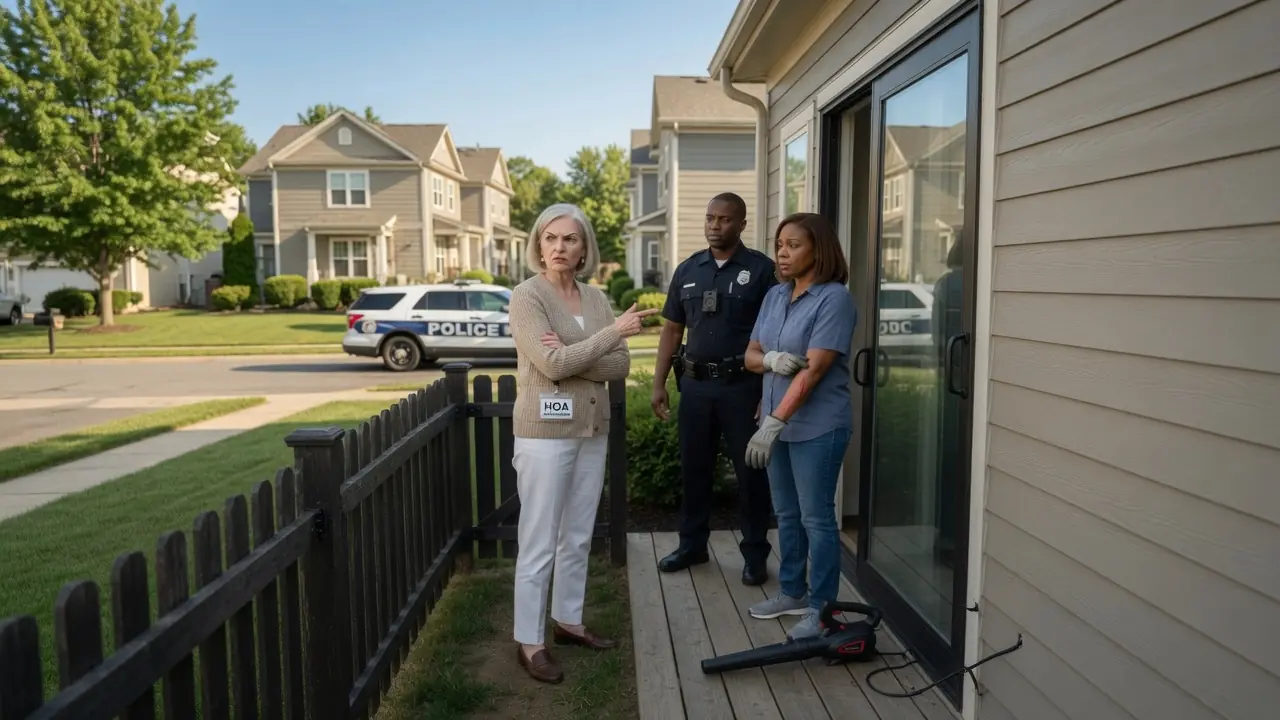
The machine sat on the rear patio of Unit 58, its orange plastic body resting beside a pile of damp leaves. A woman in gardening gloves stood near the sliding door, one hand wrapped around her opposite arm.
Three red marks crossed the skin above her wrist.
Across the lawn, another woman paced beside the community mailbox, speaking rapidly into her phone.
“She attacked me first,” the pacing woman said. “Not physically, but deliberately. There are rules here. Noise rules. She knows that.”
Officer Reyes closed the door of his patrol car.
His partner, Officer Lena Foster, moved toward the woman with the injured arm while Reyes approached the one near the mailbox.
“Ma’am,” he called.
She turned.
She was in her late sixties, with silver-blond hair cut neatly at her jaw and a blue cardigan buttoned over a white blouse. Her shoes were expensive but wet from crossing the grass. She held herself rigidly, as though posture alone might establish authority.
“You’re the police?” she asked.
“Yes. Officer Reyes. What’s your name?”
“Nancy Rosenberg.”
“Mrs. Rosenberg, I need you to stay here while we figure out what happened.”
“I called you.”
“I understand.”
“They were making that noise again.”
“We’ll talk about it.”
Nancy began walking toward Unit 56.
Reyes stepped into her path.
“Ma’am, please stay with me.”
“My husband is inside. I need to tell him—”
“You can tell him later. Right now, I’m investigating a possible crime.”
Nancy stopped.
“A crime?”
“Yes.”
Her expression changed from irritation to disbelief.
“I’m the one who called.”
“That does not automatically make you the victim.”
Across the lawn, Officer Foster spoke quietly with the neighbor. A teenage girl stood just inside the sliding door, holding a small white dog against her chest.
Nancy looked toward them.
“They’re going to make me the bad person.”
“I don’t know who did what yet.”
“I do.”
“Then tell me.”
Nancy crossed her arms.
The afternoon wind moved through the bare branches above the condominium complex. Hawthorne Ridge consisted of sixty attached homes arranged around narrow lanes, shared lawns, and carefully maintained flower beds.
It was the kind of community where people argued about trash cans being visible from the street and whether front-door wreaths could remain up after holidays.
Nancy had moved there seven months earlier.
Before that, she and her husband, Harold, lived for thirty-two years in a detached home outside Evanston. They had a large backyard, a tall cedar fence, and no neighbors close enough to hear through closed windows.
Then Harold’s health changed.
A mild stroke left him with weakness on his right side. The stairs became dangerous. Yard work became impossible. Their daughter persuaded them to sell and move somewhere smaller.
Hawthorne Ridge seemed ideal.
Snow removal.
Landscaping.
A homeowners association that promised quiet enjoyment and consistent standards.
Nancy read every rule before signing the purchase agreement.
Harold did not.
“You’re buying a home, not joining the Navy,” he told her.
Nancy believed rules protected people.
Harold believed people survived rules by knowing when to ignore them.
For the first month, the move felt manageable.
Then the noises began.
Children bounced basketballs in the parking lot.
Dogs barked behind patio doors.
Delivery trucks blocked the lane.
The woman in Unit 58 used a leaf blower several times a week.
Her name was Elena Martinez.
She was forty-six and had lived at Hawthorne Ridge for almost twenty years. She worked from home as a physical therapist reviewing rehabilitation cases for an insurance company.
Her mother, Sofia, lived with her.
So did Elena’s sixteen-year-old daughter, Maya.
Their small patio contained potted tomatoes, herbs, two folding chairs, and an old maple tree that dropped more leaves than seemed physically possible.
Elena used the blower because her mother walked with a cane and wet leaves made the patio slippery.
The noise lasted ten or fifteen minutes.
To Nancy, it felt endless.
The first time she complained, Elena apologized and finished quickly.
The second time, Nancy quoted the association rules.
Elena explained that the rules allowed power equipment until eight in the evening.
Nancy disagreed.
She had found another paragraph referring to excessive or persistent noise.
Elena told her to contact the board.
Nancy did.
The board president, Richard Coleman, listened politely during a Tuesday meeting.
“Elena’s blower isn’t violating the equipment-hours rule,” he said.
“It violates peaceful enjoyment.”
“That section is meant for repeated disturbances, parties, music, ongoing construction.”
“It is repeated.”
“How long does she use it?”
Nancy hesitated.
“Long enough.”
“Ten minutes?”
“Sometimes more.”
Richard leaned back.
“Nancy, I understand it bothers you, but we cannot ban ordinary maintenance.”
“Then what am I supposed to do?”
“Talk to her calmly. If you believe there is an immediate disturbance, call the non-emergency police line.”
Nancy stared.
“You want me to call the police over a leaf blower?”
“No. I’m saying that is the proper channel if you believe a law is being broken.”
Nancy heard only part of the answer.
The proper channel.
She returned home believing the board had confirmed that she was right, even if they lacked courage to act.
Over the next week, she watched Unit 58 closely.
Sunday afternoon, the blower started at 4:42.
Nancy closed the windows.
The sound remained.
She turned on the television.
Still she heard it.
She walked onto her deck and shouted across the grass.
“Elena!”
The blower continued.
“Elena, turn that off!”
Elena glanced up but did not stop.
Nancy’s anger rose.
Being ignored had always affected her more than open disagreement.
As a child, she had been the youngest of four daughters. Her father settled arguments by leaving the room. Her mother listened only after Nancy raised her voice.
As a teacher, Nancy managed classrooms by insisting that every disruption receive a response.
After retirement, she joined committees and boards because silence felt too much like surrender.
Harold often said she mistook being heard for being obeyed.
The accusation infuriated her because part of her feared it was true.
On Sunday, Elena finished and returned inside.
The following day, the blower started again.
Tuesday, it ran for twelve minutes.
Sunday afternoon, one week after the board meeting, Nancy heard it at 5:03.
She had spent the morning caring for Harold, who had fallen while dressing. He refused to let her call their daughter. He refused to use the walker.
By late afternoon, Nancy’s nerves felt scraped raw.
Then the blower started.
Harold was sleeping in his recliner.
Nancy stood in the kitchen, listening.
The sound rose and fell beyond the windows.
She told herself to ignore it.
She made tea.
The noise continued.
She turned on the radio.
The machine seemed louder.
Finally, she put on her cardigan and crossed the lawn.
Elena stood on the patio, blowing damp leaves toward a corner beside the fence. Ear protection covered her head.
Nancy stopped outside the gate.
“Elena!”
No response.
Nancy opened the gate.
The blower continued.
“Elena, I am talking to you.”
Elena looked over.
She removed one side of the hearing protection.
“What?”
“You need to stop.”
“I’m almost finished.”
“You said that last time.”
“I’m clearing the patio.”
“You’ve been doing this all week.”
“Because leaves keep falling.”
“Turn it off.”
Elena replaced the hearing protection.
That small action transformed Nancy’s irritation into fury.
She stepped onto the patio.
Elena turned away and continued working.
Nancy reached for the blower tube.
Elena pulled it back.
“Don’t touch my equipment.”
“I’m trying to talk to you.”
“Then wait until I’m done.”
“No. You’ll listen now.”
Nancy grabbed the blower handle.
Elena held on.
For several seconds, the two women struggled over the machine.
The blower motor screamed between them.
Elena shouted, “Let go.”
Nancy reached across and caught Elena’s forearm.
“Turn it off.”
“Take your hands off me.”
The sliding door opened.
Maya appeared inside with the dog barking behind her.
“Mom?”
Elena released the blower and pushed Nancy’s hand away.
The machine fell against a chair.
Nancy stumbled but did not fall.
“You cannot come onto my property and grab me,” Elena said.
“You were pointing that machine at me.”
“I was moving it away from you.”
“You were provoking me.”
“Get out.”
“I came to tell you I did not want to call the police.”
“Then leave.”
Nancy’s eyes moved toward the open sliding door.
Sofia sat at the kitchen table beyond it, watching.
Nancy believed that if she explained the situation to another adult, someone would finally understand.
She knocked on the glass.
Sofia did not move.
Nancy knocked again.
“Elena is refusing to follow the rules.”
“Elena stepped between Nancy and the door.
“Go home.”
The dog barked.
Maya began crying.
Nancy reached for the handle.
Elena said, “Do not open that door.”
Nancy opened it.
She stepped one foot into the kitchen.
Sofia rose from the table.
“You need to leave,” she said.
“I only want someone to listen.”
“You are inside my daughter’s home.”
Elena took out her phone.
“I’m calling the police.”
Nancy backed onto the patio.
“Good. I was going to call them myself.”
She crossed the lawn and dialed before Elena could.
That was the story Nancy told Officer Reyes.
Not all at once.
He had to slow her repeatedly.
“You went through the patio gate?”
“Yes.”
“Was it your property?”
“It’s a shared community.”
“The deck belongs to Unit 58.”
“It is visible from common ground.”
“That isn’t what I asked.”
Nancy sighed.
“Yes, it belongs to them.”
“Did Elena invite you onto the deck?”
“No, but she knew I wanted to speak.”
“Did she tell you to leave?”
“Eventually.”
“Did you grab the leaf blower?”
“I tried to stop the noise.”
“Did you grab Elena?”
“I may have touched her arm.”
Officer Reyes looked toward the red marks.
“She has visible injuries.”
“Injuries? Those are not injuries.”
“Did you put your hand on her arm?”
“I was trying to prevent her from pointing the machine at me.”
“Did you enter the house?”
“The door was open.”
“Did anyone invite you inside?”
“No.”
“Did anyone tell you not to enter?”
Nancy looked away.
“She was ignoring me.”
“That doesn’t give you permission.”
“I understand that now.”
Reyes studied her.
“Do you?”
Nancy’s face tightened.
“I said I understand.”
Officer Foster approached.
Elena remained near the patio with Maya and Sofia.
Foster spoke quietly to Reyes, then showed him photographs on her phone.
The marks on Elena’s arm were clearer up close.
Maya and Sofia had given matching accounts.
The patio camera recorded most of the confrontation.
Nancy watched the officers.
“What are they saying?”
Reyes turned toward her.
“Mrs. Rosenberg, Elena wants to pursue charges.”
“For what?”
“Battery and criminal trespass.”
Nancy laughed once.
It was a startled sound.
“You’re serious.”
“Yes.”
“I called you.”
“And you admitted entering her property, grabbing her equipment, grabbing her arm, and opening her door after being told to leave.”
“I was not thinking clearly.”
“That may explain your behavior. It does not make it lawful.”
Nancy began walking toward her unit.
Reyes stepped beside her.
“Ma’am, stop.”
“My husband needs me.”
“You are not free to leave.”
“This is absurd.”
“Put your hands behind your back.”
Nancy stared at him.
“You’re arresting me over a leaf blower?”
“No. I’m arresting you for entering someone’s residence without permission and making physical contact with her.”
“I barely touched her.”
“You cannot touch people because they ignore you.”
Nancy looked toward Elena.
“They must be loving this.”
Officer Reyes took out the handcuffs.
“I don’t think anyone is enjoying this.”
“For heaven’s sake.”
“Hands behind your back.”
Nancy complied.
The metal closed around her wrists.
For the first time that afternoon, she became quiet.
Harold stood in the doorway of Unit 56.
He held his cane in his left hand.
“What happened?”
Nancy’s face changed.
The anger disappeared, replaced by something smaller.
“Harold, go inside.”
“What did you do?”
“I’ll be back soon.”
Officer Foster crossed the lawn to speak with him.
Nancy lowered her head as Reyes guided her toward the patrol car.
The curtains moved in several windows.
Neighbors watched.
The same woman who had spent months insisting that other people respect community standards now crossed the parking lot in handcuffs.
At the station, Nancy received citations and a court date.
She was processed, photographed, and released two hours later.
Officer Reyes drove her home because Harold could not drive after dark.
During the ride, Nancy sat rigidly in the back seat.
“I was trying to be considerate,” she said.
Reyes glanced in the mirror.
“How?”
“I went over there instead of calling the police.”
“You went onto her property after she refused to speak with you.”
“She was making noise.”
“You could have documented it and called the association.”
“They did nothing.”
“You could have called the non-emergency line.”
“I didn’t want to escalate.”
Reyes looked at her again.
“You entered her home and grabbed her.”
Nancy said nothing.
“That is escalation.”
When they arrived, Harold waited at the kitchen table.
Nancy entered carrying the court paperwork.
He looked at it.
Then at her.
“You touched her?”
“She was pointing the blower at me.”
“That isn’t what I asked.”
Nancy placed her purse down.
“I grabbed her arm.”
“You went inside?”
“The door was open.”
Harold closed his eyes.
“You cannot keep saying that as though it matters.”
“I was upset.”
“So was she.”
“You’re taking her side?”
“I’m taking the side of the person whose house you entered.”
Nancy stared at him.
For fifty years, Harold had calmed her after conflicts. He complained about her stubbornness but usually defended her publicly.
Now he looked tired.
“I needed peace,” she said.
“No. You needed control.”
The sentence landed harder than the arrest.
Nancy walked into the bedroom and closed the door.
For three days, she refused to discuss the incident.
She called an attorney named Melissa Grant.
Melissa watched the patio recording twice.
The video showed Nancy opening the gate, reaching for the blower, grabbing Elena, and entering through the sliding door.
“There is no meaningful dispute about what happened,” Melissa said.
“I did not intend to hurt anyone.”
“Intent matters, but it does not erase the conduct.”
“Elena was provoking me.”
“By using a legal piece of equipment on her property?”
“By ignoring me.”
Melissa leaned forward.
“You do not have a legal right to someone’s attention.”
Nancy bristled.
“I understand the law.”
“Then understand the practical issue. A judge will see a homeowner repeatedly telling you to leave while you advance toward her door.”
“What am I supposed to do?”
“Take responsibility.”
“I already admitted what happened.”
“Admitting facts while insisting they were justified is not responsibility.”
Nancy looked toward the window.
“What will happen?”
“Possibly probation, fines, community service, counseling, and a no-contact order. Jail is unlikely if you have no prior record.”
“A no-contact order? We live two doors apart.”
“Then you will have to become very good at distance.”
Hawthorne Ridge reacted quickly.
The board sent Nancy a formal violation notice for entering another resident’s limited common area without permission and creating a disturbance.
Someone posted part of the arrest video in a neighborhood social-media group.
By the following morning, hundreds of strangers had viewed it.
Comments called Nancy entitled, unstable, dangerous, and insane.
One person wrote that she should be removed from the community.
Another found her old teaching profile and shared it publicly.
Nancy stopped leaving the house.
Harold read the comments until Nancy took his tablet away.
“They’re making me into a monster.”
“You frightened that family.”
“That doesn’t make me a monster.”
“No.”
Harold looked at her.
“But refusing to understand why they were frightened won’t help.”
Two weeks later, Elena obtained a temporary no-contact order.
Nancy could not approach her property, speak to her directly, or communicate through other residents.
The leaf blower continued.
Not often.
Not for long.
But when Nancy heard it, she felt something inside her tighten.
She began closing the windows.
Then she would stand in the center of the living room, listening.
The sound was no louder than before.
What changed was that she could no longer act.
That powerlessness exposed the real problem.
The noise was only part of it.
Since Harold’s stroke, Nancy’s life had narrowed.
She managed his medication, appointments, diet, exercises, and transportation. He resisted help and resented dependence. Their daughter visited twice a month but had a family and job of her own.
Nancy told everyone she was coping.
The association rules became one thing she believed she could still control.
When Elena ignored her, it did not feel like a neighbor refusing a complaint.
It felt like the world confirming that Nancy no longer mattered.
The court required an anger-management evaluation before sentencing.
Nancy entered the counselor’s office determined to say as little as possible.
Dr. Helen Shaw was sixty-one and unimpressed by silence.
“What were you feeling before you crossed the lawn?” she asked.
“Annoyed.”
“Only annoyed?”
“Yes.”
“What happened that morning?”
Nancy looked away.
“Nothing relevant.”
“Try me.”
Eventually, she described Harold’s fall.
The fear she felt when she found him on the bathroom floor.
The anger when he refused medical care.
The resentment she immediately hated herself for feeling.
“I did not ask to become a nurse,” Nancy whispered.
Dr. Shaw waited.
“I love my husband.”
“Both statements can be true.”
Nancy began crying.
It was the first time she had cried since the arrest.
Not in the police car.
Not at the station.
Not while strangers mocked her online.
She cried because someone allowed her to say she was exhausted without turning that exhaustion into an excuse.
Over the next three months, Nancy attended counseling.
She pleaded guilty to misdemeanor battery and criminal trespass under an agreement that avoided jail.
The judge sentenced her to eighteen months of supervision, community service, continued counseling, and compliance with the no-contact order.
Before sentencing, Elena gave a brief statement.
“My daughter was in the kitchen,” she said. “My mother was there. Mrs. Rosenberg kept coming after I told her to leave. This was not about a machine. It was about whether ‘no’ meant anything inside my own home.”
Nancy sat beside her attorney and listened.
For once, she did not prepare a response.
At the end of the hearing, the judge asked whether she wished to speak.
Nancy stood.
“I believed being ignored gave me the right to demand attention.”
Her voice shook.
“It did not.”
She turned slightly toward Elena but did not address her directly.
“I frightened a family in their own home. My frustration explains why I became angry. It does not excuse what I did with that anger.”
Elena’s expression remained guarded.
Nancy continued.
“I am sorry.”
There was no immediate forgiveness.
No dramatic reconciliation.
The court was not designed to produce one.
Nancy began community service at a neighborhood mediation center.
At first, the assignment seemed insulting.
She had spent her career managing conflict in classrooms.
Then she listened to volunteers help neighbors discuss barking dogs, property lines, parking spaces, tree branches, and noise.
The mediators did not decide who deserved to win.
They helped people speak without turning every disagreement into a contest of authority.
Nancy began filing intake forms.
Then observing sessions.
Months later, she was permitted to assist with scheduling and follow-up calls.
One afternoon, an elderly man complained that a young couple’s children made too much noise in the unit above him.
“They run constantly,” he said. “Nobody listens to me.”
Nancy felt the old response rise.
The urge to validate the grievance completely.
Instead, she asked, “What would a workable solution look like?”
He stared.
“I want them to stop.”
“Children cannot stop existing.”
“They can behave.”
“Perhaps. But what specific change would help you most?”
The man thought.
“Quiet after seven.”
The couple agreed to install rugs and move playtime away from the bedroom above his living room.
He agreed to stop striking the ceiling with a broom.
No one received everything.
The building became quieter.
Nancy understood that peace was not obedience.
It was negotiation with limits.
At Hawthorne Ridge, the no-contact order remained.
Nancy and Elena passed each other at a distance.
Maya avoided Nancy entirely.
Sofia watched her carefully.
One spring morning, Nancy found a letter in her mailbox.
It came from the association board.
Elena had requested permission to replace the gas-powered blower with an electric model through the community’s equipment-rebate program.
The new machine would be quieter.
Nancy felt a complicated rush of gratitude and shame.
Elena had changed the equipment after everything.
Not because Nancy had forced her.
Because Elena chose to.
Nancy wrote a thank-you note.
Then remembered the no-contact order.
She brought the note to her attorney.
Melissa advised against sending it.
“Respecting the boundary may be the most meaningful apology available.”
Nancy took the note home and placed it in a drawer.
A year after the arrest, Harold suffered another stroke.
This one was more serious.
He survived, but could no longer walk independently.
Nancy’s first instinct was to manage everything herself.
Then she remembered the bathroom floor.
The leaf blower.
The patrol car.
She called their daughter.
She accepted home-health assistance.
She joined a caregiver support group.
She allowed people to see that she was overwhelmed before anger turned exhaustion into something dangerous.
One evening, while a nurse helped Harold prepare for bed, Nancy sat on the deck.
A soft mechanical hum began two units away.
Elena was using the electric blower.
The sound barely carried across the lawn.
Nancy watched leaves move along the patio.
Elena glanced up.
For a moment, their eyes met.
Neither woman spoke.
Nancy lowered her gaze first.
Not in defeat.
In recognition of the line between them.
Several weeks later, the no-contact order expired.
Elena did not request an extension.
That did not mean she wanted friendship.
Nancy understood.
At the next association meeting, residents discussed proposed quiet hours.
The old Nancy would have quoted rules and demanded strict enforcement.
Instead, she proposed a written schedule allowing maintenance during specific afternoon periods and requiring residents to notify immediate neighbors before unusually loud work.
Elena attended from the opposite side of the room.
The proposal passed.
After the meeting, people gathered near the exit.
Nancy waited until Elena was not surrounded.
Then she stopped several feet away.
“May I say something?”
Elena hesitated.
“One thing.”
Nancy nodded.
“I am sorry.”
“You said that in court.”
“I know.”
Nancy kept her hands at her sides.
“I thought I understood what I had done then. I understand more now.”
Elena’s face remained unreadable.
Nancy continued.
“You did not owe me a conversation. Your mother and daughter should never have watched a stranger enter their home because she believed her anger was more important than their safety.”
Elena looked toward the floor.
“I was afraid you would come back.”
“I know.”
“You acted like I caused everything.”
“I did.”
Nancy swallowed.
“I’m not asking you to forgive me.”
“Good.”
The answer was sharp.
Nancy accepted it.
Elena looked at her again.
“But I appreciate the apology.”
That was all.
No hug.
No renewed friendship.
No sentimental promise to start over.
They became neighbors who respected distance.
Sometimes that was the most honest form of peace available.
Two years after the arrest, Nancy still volunteered at the mediation center.
New volunteers occasionally recognized her from the old video.
Most were polite enough not to mention it.
One young man finally asked.
“Were you really arrested over a leaf blower?”
Nancy considered the question.
“No.”
He looked confused.
“I was arrested because I believed my frustration gave me authority over another person.”
She handed him a stack of intake forms.
“The leaf blower was only the excuse.”
At home, Harold’s health continued to decline.
Nancy cared for him with help.
Not alone.
That distinction changed everything.
On warm evenings, she sat beside him on the deck.
They listened to dogs, children, delivery trucks, lawn equipment, and the ordinary noise of people living close together.
“Bother you?” Harold asked once when the electric blower started.
Nancy smiled faintly.
“Less than it used to.”
“Because it’s quieter?”
“Because I am.”
Harold reached for her hand.
Across the lawn, Elena finished clearing leaves and carried the machine inside.
Nancy watched the patio door close.
She had once believed closed doors were insults.
Now she understood they could be boundaries.
And a boundary was not an attack.
It was simply the place where another person’s rights began.
The arrest became a story strangers told for entertainment.
A woman lost control over a leaf blower.
A difficult neighbor finally faced consequences.
The video reduced Nancy to her worst fifteen minutes.
Some of the criticism was deserved.
But a life did not end at the moment a person became ashamed of herself.
What mattered afterward was whether shame became another form of self-defense or the beginning of change.
Nancy could not undo the fear on Maya’s face.
She could not remove the marks from Elena’s arm or erase the memory of stepping into a home where she had not been invited.
She could only become someone less likely to repeat it.
That work was slow.
Private.
Mostly invisible.
It brought no applause.
Years later, when residents at Hawthorne Ridge argued about noise, parking, pets, or fences, Nancy rarely spoke first.
She listened.
Then she asked the question she once believed other people should answer for her.
“What can we do without taking away someone else’s right to say no?”
The answer was never perfect.
But it was better than forcing open a gate.
Better than grabbing an arm.
And far better than learning the difference between being ignored and being wrong while standing beside a patrol car with her hands behind her back.