The blizzard had swallowed the road, the mountains, and nearly Rose Callahan with them by the time the lonely lights of Montezuma appeared through the Colorado night. She had walked close to fifteen miles through snow deep enough to swallow her boots, stopping only when the wind became so violent that she had to turn her back and brace both feet against the frozen road. Her threadbare wool coat had grown heavy with ice, the hem of her brown traveling dress was soaked nearly to her knees, and the fingers wrapped around the handle of her carpetbag had become frighteningly numb. Still, Rose kept moving because stopping meant freezing, and she had already lost too much to let winter claim the only possession no landlord, disease, or bad luck had yet managed to take from her—her life.
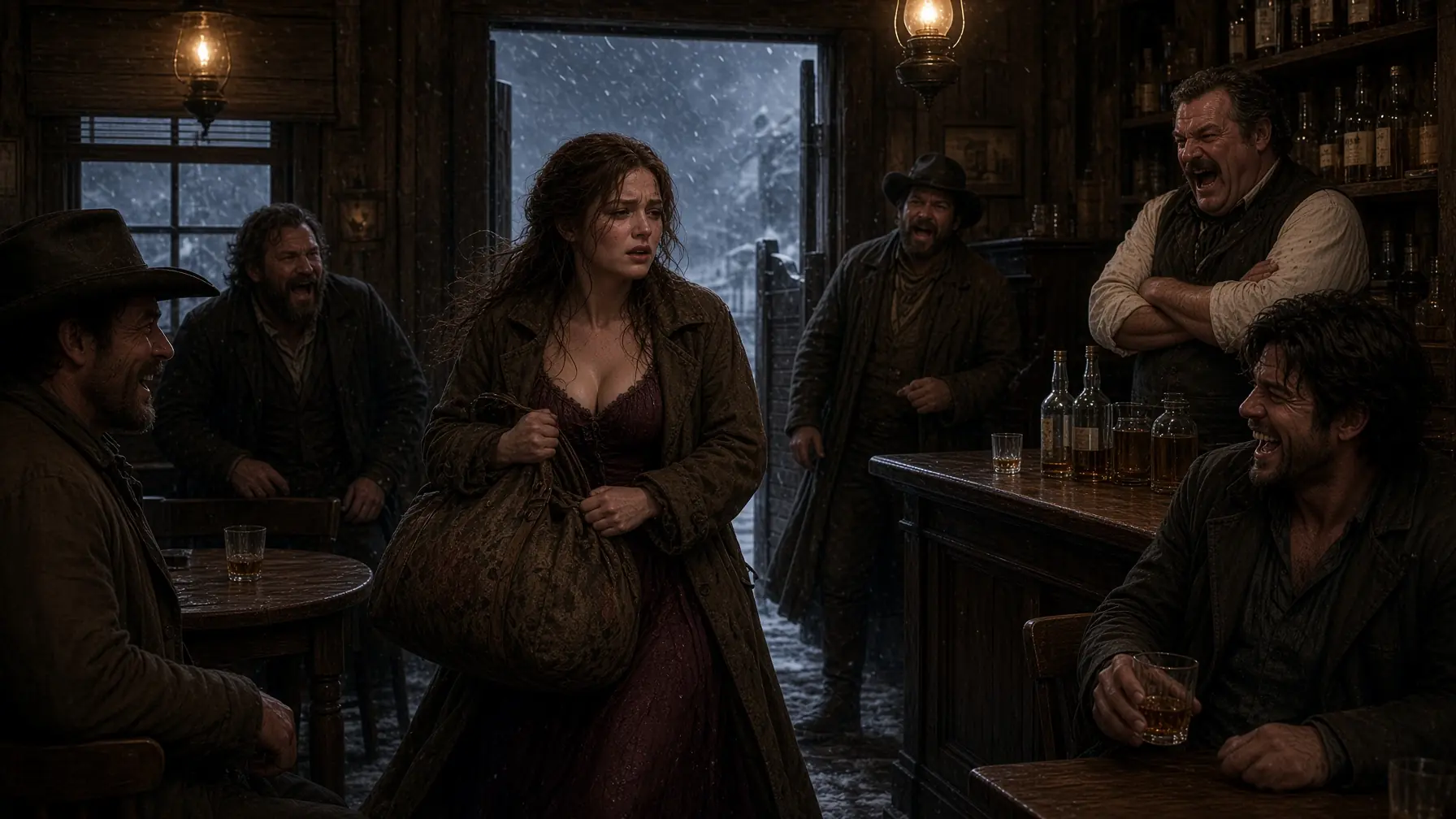
The stage had left her at a lonely road junction shortly after noon when the driver explained that her fare covered travel only as far as the southern fork and the remaining distance to Montezuma required another payment. Rose possessed sixty-three cents, two hairpins, one extra pair of stockings, a Bible that had belonged to her mother, and a leather-bound ledger she protected more carefully than any of them, but she did not possess the additional dollar and a half the driver demanded. He had looked toward the darkening sky and warned that weather was moving down from the mountains, yet the company rules mattered more than concern for a passenger who could not pay. Rose stepped from the coach with her carpetbag, watched the wheels disappear into blowing snow, and began walking because waiting beside the road offered even less hope than moving.
By the tenth mile, she could no longer feel individual toes. By the twelfth, she had begun imagining warm rooms with such clarity that she worried her mind was preparing to surrender before her body did. Several times she stumbled, once falling completely onto her knees and remaining there long enough for snow to gather across her shoulders before fear forced her upright. Each time she stood, she told herself the same thing aloud through chattering teeth: “One more fence post, Rose, and then another.”
Montezuma looked less like salvation when she reached it than a collection of exhausted buildings refusing to disappear beneath winter. A general store, blacksmith, church, boarding house, livery, and saloon stood along one snow-clogged street, their windows glowing through curtains of wind while horses huddled beneath roofs crusted white. Rose tried the boarding house first, but the woman behind the door said every room was taken by miners trapped in town until the pass reopened. The church was locked, the general store had already closed, and that left the saloon with its swinging doors, yellow windows, and the sound of a piano leaking faintly into the storm.
Rose had never entered a saloon alone. Her father would have disliked it, her mother would have worried about it, and several women who employed Rose during the previous year would probably have declared that any respectable young woman choosing such a place could no longer complain about the opinions formed inside it. None of those people were standing in snow with fingers turning blue. Rose pushed through the doors.
Warmth struck her so suddenly it hurt. Tobacco smoke, whiskey, lamp oil, wet wool, roasted meat, and the stale sweetness of sawdust rolled together beneath a ceiling darkened by years of smoke, while a piano at the far wall stumbled to the end of a tune and stopped after the musician noticed who had entered. Men in trail coats and work shirts turned from card tables, glasses paused halfway to mouths, and conversations faded one by one as Rose stood dripping onto the wooden floor. She straightened her shoulders because dignity was sometimes the last coat a poor person could still wear.
Behind the bar stood Calvin Henderson, a thick-mustached man nearing fifty whose face looked built for suspicion. He folded his arms across his apron and examined Rose from ice-crusted hair to ruined boots without a trace of welcome. “We don’t serve women in here unless they’re working,” he announced, loud enough for the room to hear, “and I’ve already got all the help I need.” Several men chuckled because Henderson had delivered the statement as though Rose had attempted to join a private club rather than escape a blizzard.
Rose swallowed. “I’m looking for honest work, sir, and I can cook, clean, mend clothing, keep household accounts, tend horses well enough for stable chores, and work for room and board until spring if wages are impossible.” Henderson looked toward her boots, then at the soaked dress clinging heavily around her ankles. He laughed and said, “Girl, you look like the next gust could carry you clear to Kansas, so what rancher is going to hire somebody who can’t even afford a proper coat?” This time the laughter spread widely enough that Rose felt it physically.
She had been mocked before. Employers had commented on how plain her clothes were, boarding-house women had asked whether grief had made her too thin, merchants had looked at the small coins in her palm and decided poverty must mean foolishness, and one hotel manager had told her that respectable customers disliked seeing desperation at the front desk. Rose had survived all of it because survival rarely allowed time to defend pride. Yet standing half-frozen while strangers laughed at the evidence of how hard she had already fought nearly broke something inside her.
For one terrible second, the saloon doors behind her seemed inviting. She imagined stepping back into the storm and disappearing down the white road where snow, at least, could not decide she deserved what happened to her. Then a chair scraped loudly across the floor from a shadowed corner. The laughter stopped so abruptly that Rose turned.
The man rising near the rear wall was tall enough that the low ceiling seemed suddenly lower around him. He wore a dark work coat faded at the shoulders, heavy boots stained with mud beneath snow, and a gray flannel shirt buttoned at the throat, while his hair had grown long enough to curl slightly above a collar that appeared to have been mended more than once. His hands were broad, scarred, and deeply callused, but it was his eyes Rose noticed most because they were gray with the same cold color as the mountain sky before snow. He looked first at Henderson, then at Rose, and said, “I’ll hear her out.”
Nobody laughed. Henderson frowned but reached for a coffee pot when the stranger added, “Bring coffee, and whatever stew you haven’t ruined yet.” A few men smiled carefully at that, though none loudly enough to invite the stranger’s attention. He pulled out the chair opposite him and told Rose, “Sit before you fall.”
Rose hesitated because exhaustion had made trusting strangers feel more dangerous than cold. The man did not touch her, move toward her, or repeat the invitation with impatience. He simply waited beside the table until her trembling legs decided for her. Rose crossed the room and sat.
Henderson brought a chipped mug first. Rose wrapped both hands around it and nearly cried when heat stabbed painfully into her fingers because feeling returning was almost worse than numbness. The stranger noticed and said, “Don’t put them too close to the stove yet,” then slid the mug nearer without reaching across her hands. A bowl of beef-and-potato stew followed, and Rose forced herself to eat slowly for the first three bites before hunger overcame manners and she began taking spoonfuls as quickly as she could swallow.
The stranger waited until half the bowl was gone. “You’ve been walking since morning,” he said, and Rose nodded. She explained the stage fare, the southern fork, and the driver’s warning about the storm without exaggerating his cruelty because a man refusing charity was not the same as a man deliberately trying to kill her. The stranger’s jaw tightened anyway.
“He put you out fifteen miles from town with weather coming?” he asked. Rose lifted one shoulder. “The ticket ended where the ticket ended.”
“That doesn’t answer whether he should’ve done it.” Rose looked into the steam.
“People with rules usually think rules are answers.” The stranger’s mouth moved slightly, almost a smile.
“Adam Xavier,” he said. Rose introduced herself as Rose Callahan.
Outside, wind hammered the windows while the piano player cautiously began another song. Card games resumed, although several men continued glancing toward Rose because a half-frozen woman having supper with Adam Xavier apparently interested them more than cards. Rose noticed but no longer cared. Warmth had begun spreading through her body, and food made the room feel less hostile.
Adam asked where she was heading. “California,” Rose answered automatically, though the word sounded less like a destination than something she had been repeating because movement required direction. Adam asked what waited for her there, and Rose realized the honest answer was nothing. She lowered her spoon.
“My father and I were going west,” she said. “He believed California would have work for a man who understood accounts and freight records, and I believed wherever he went was still home enough for me.” Her father, Patrick Callahan, had died of cholera outside St. Joseph after becoming sick almost overnight, and Rose had spent most of their remaining money on a doctor, burial, and lodging. The boarding-house keeper later sold their trunk and several pieces of Patrick’s equipment toward unpaid rent, leaving Rose with only what she had carried in a smaller bag.
Adam listened without interrupting. Rose described working laundry in Kansas City, cooking for a widow in Topeka, mending shirts for railroad crews, helping a boarding house in Hays, and traveling west whenever she had enough money to buy the next portion of a ticket. She had reached Colorado after nearly eleven months of work measured in meals, beds, and short distances rather than wages large enough to save. “Winter caught me,” she finished.
Adam looked toward the frost-covered window. “Winter catches people who have houses too.”
Rose managed a tired smile. “Then I suppose it has an unfair advantage.”
He asked what she could actually do with accounts. Rose placed her spoon down and reached toward the leather ledger protruding from her carpetbag, though she stopped before opening it. “My father taught me bookkeeping when I was twelve, and I kept supply records for two households, wages for a boarding house, freight calculations for a hardware merchant, and personal accounts for my father when he was ill.” Adam’s interest sharpened.
“Why carry a ledger through a blizzard?” Rose untied the leather strap and opened the book.
The pages held clean examples she had copied from work she was legally entitled to preserve: inventory methods, expense categories, household budgets, freight calculations, payroll lists, and several sample reconciliations with private names removed. Rose had created them partly as references and partly because she had discovered that saying I can keep books produced polite doubt while showing finished books changed expressions. Adam turned several pages carefully. “This yours?”
“The work is.” Rose watched him.
“My father taught the method.”
Adam closed the ledger. “You said you’ll do anything honest until spring.”
“Yes.”
“Why only until spring?”
“Because California was the plan.”
“Still is?”
Rose looked around the room. “I don’t know.”
That admission frightened her more than hunger had.
For almost a year, California had represented the continuation of a future Patrick Callahan never lived to see. Abandoning the destination felt dangerously close to abandoning him, even though Rose knew her father had wanted opportunity rather than a specific coastline. She had never stopped long enough to separate the two. Survival kept decisions small.
Rose leaned forward. “Mr. Xavier, I’m stronger than I look, and I’m not asking for charity.” She told him she could cook before sunrise, clean, mend harness if somebody showed her the ranch’s preferred method, keep accounts, care for poultry, help with horses, preserve food, and do whatever other work a household required. “Give me a roof until spring and wages only if I earn them,” she said, “and I’ll prove I’m worth keeping.”
Adam’s fingers tightened around the untouched whiskey glass. Around them, the piano continued a slow tune while men pretended not to listen. Rose waited for the question she had answered repeatedly across several states: Why should I trust you? Instead, Adam said, “I don’t need a worker.”
Hope collapsed so quickly that Rose almost laughed at herself. She pushed the chair backward slightly and nodded. “I understand.”
“No,” Adam said. “I don’t think you do.”
Rose stopped.
Adam leaned forward, his weathered face completely serious. “What I need is a wife.”
For several seconds Rose thought exhaustion had altered the sentence between his mouth and her ears. She stared at Adam, then glanced once toward the surrounding tables to see whether the room had become part of some elaborate joke. Nobody laughed. Henderson had stopped polishing a glass.
“You need what?” Rose asked. Adam did not look away.
“A wife.”
Rose stood so quickly the chair nearly tipped. “Then you have mistaken desperation for stupidity, Mr. Xavier.”
The room went completely still.
Adam rose too, though he remained on his side of the table. “I haven’t mistaken anything.”
“You’ve known me perhaps twenty minutes.” Rose could feel heat rising into her face despite the cold still trapped beneath her clothes.
“I know.” Adam’s voice remained controlled.
“You heard I need shelter, then decided that makes me available for marriage?” He shook his head.
“No.”
“What exactly did you think you were offering?”
Adam looked around the saloon. “Not here.”
Rose laughed once, without humor. “How convenient.”
Adam’s expression changed slightly. “You’re right.”
The simple admission disarmed her for half a second.
He pulled the chair back into place but did not ask Rose to sit. “What I said sounded like a man trying to buy a wife for stew and shelter, and if that’s what I meant, you ought to walk out the moment the storm breaks.” He pushed his whiskey aside. “Sit if you want the explanation, leave if you don’t, and either way Henderson will give you a room upstairs tonight because I’ll pay for it.”
Henderson opened his mouth. Adam looked toward him.
“You have a room.”
Henderson closed his mouth.
Rose remained standing. “And tomorrow?”
“If you decide you want work and nothing more, I’ll still offer work.”
That answer made her suspicious in a different way.
“Then why say wife?”
Adam rubbed one hand across his jaw. “Because I’m tired, I’m bad at explaining things, and I’ve spent three months trying to solve six problems as though they’re one.”
Rose slowly sat again. Adam did too.
“Explain all six.”
A few men nearby laughed quietly at Adam this time. He ignored them.
Adam Xavier owned a cattle ranch seven miles north of Montezuma with his late brother’s two children living under his roof. Twelve-year-old Caleb and eight-year-old Lucy had lost their parents eighteen months earlier when Adam’s brother Jacob died after being crushed beneath a wagon and Jacob’s wife Margaret succumbed to pneumonia the following winter. Adam became guardian because there was no other close family in Colorado, but running the ranch left him away from the house far more than children that age needed. Three housekeepers had come and gone in less than a year, one because of isolation, one because she married, and the most recent because Adam’s aunt from Denver convinced herself the ranch was too rough for respectable domestic work.
Rose listened. “That explains a housekeeper.”
“Yes.”
“Not a wife.”
Adam nodded. “My aunt keeps telling me the children need a woman permanently in the house, the church women keep trying to introduce me to daughters I don’t want to marry, and half the town has apparently decided a bachelor raising two children is a public emergency.” He looked embarrassed. “I started thinking the most practical answer would be marrying someone who wanted a stable home more than romance.”
Rose stared. “You make marriage sound like hiring a winter team.”
“I know.”
“Do you?”
“Yes.”
She folded her arms. “And this imaginary wife cooks, cleans, raises your brother’s children, keeps your household, perhaps keeps the books, and gets what?”
Adam answered without hesitation. “A legal share of anything built after the marriage, her own money, a room of her own if she wants it, no expectation of children, no expectation of sharing my bed unless she chooses, and the right to leave if I break the agreement.”
Rose had not expected that. “You have considered this.”
“For three months.”
“With whom?”
“A lawyer.”
Several men at the nearest table turned visibly.
Rose asked, “You consulted a lawyer before finding the woman?”
“I wanted to know whether what I was imagining could be written fairly.”
“And can it?”
“Fairer than a handshake.”
Rose looked down at her hands. “Why me?”
Adam answered, “I didn’t offer because you were half-frozen.”
“That is exactly when you offered.”
“Yes.”
“That sounds like contradiction.”
“It probably is.”
He thought before continuing.
“I listened to you describe eleven months of work without once asking me to rescue you, and when Henderson laughed at your coat, you still asked for employment instead of charity.” Adam nodded toward the ledger. “Then I saw that.”
Rose’s eyes narrowed. “So competence makes me marriage material?”
“It makes you somebody I want to talk to again tomorrow.”
“That is not the same thing.”
“No.”
Rose stared at him.
Adam said, “I should have said that first.”
She almost smiled despite herself.
The conversation lasted another hour. Adam explained that the ranch had a detached room over the cookhouse where Rose could live separately, that she would receive fifteen dollars a month as household manager if she accepted work, and that the possibility of marriage would not be mentioned again unless she chose to raise it. He would pay Henderson for her room that night, buy proper winter boots because walking back out in ruined ones would be foolish, and deduct nothing unless Rose later insisted. Rose told him she would insist.
“You haven’t agreed to work yet,” Adam said. Rose looked toward the storm.
“I’m considering my options.”
“You have another?”
“Freezing.”
Adam nodded. “Bad option.”
“I’ve had worse.”
That sentence made his expression change.
Rose accepted one night at the saloon and no more. Henderson gave her a narrow upstairs room with a washbasin, rough blanket, and door that locked from inside, while Adam told him privately that if anyone bothered her they would answer to him. Rose overheard and disliked the threat until Henderson answered, “Nobody’s bothering Xavier’s woman,” and Adam corrected him immediately. “She isn’t my woman.”
Rose closed the door before they realized she had heard.
She slept twelve hours.
When she woke, the storm had weakened but snow still covered Montezuma nearly to porch steps. A pair of used but sturdy boots waited outside the door with wool stockings and a note written in surprisingly neat handwriting: These belong to the ranch until you decide whether you do. — A.X. Rose read the sentence three times, disliked the phrasing, then noticed another line below it. Bad wording. The boots belong to you either way.
She laughed for the first time since the stage left her.
Adam returned near noon with a wagon fitted for snow and two heavy horses. Rose came downstairs wearing the boots, her own dress dried beside Henderson’s kitchen stove, and a borrowed coat Mrs. Henderson had reluctantly provided after learning Adam was paying. Henderson no longer laughed at her. Money had apparently taught him manners overnight.
Adam asked whether she wanted to see the ranch. Rose said yes.
He did not ask about marriage.
The road north crossed white pasture broken by pine, low stone ridges, and fences half-buried under drifting snow. Adam drove carefully while Rose sat beneath a heavy buffalo robe and watched the mountains emerge as clouds lifted. The world looked enormous, severe, and so clean after months of crowded boarding houses that loneliness suddenly seemed less frightening than she expected.
Adam pointed out landmarks. Cottonwood Creek marked the southern grazing section, a narrow cut between hills led toward summer pasture, and three miles west lay the Palmer place, whose owner was currently convinced Adam had stolen two calves despite neither animal carrying a readable brand. Rose listened. “Do all ranchers spend this much time accusing one another of stealing cattle?”
“Only the friendly ones.”
She smiled.
The Xavier ranch house appeared shortly after two. It was built from dark timber and stone with a wide front porch, two chimneys, several outbuildings, corrals, barn, bunkhouse, and cookhouse arranged behind it beneath a slope covered in pine. Snow softened everything except the windmill, whose metal wheel turned slowly above the yard. Rose noticed immediately that the house was larger than she had imagined but looked neglected in the way houses become neglected when everybody inside is surviving rather than living.
A boy stood on the porch before the wagon stopped. Caleb Xavier was tall for twelve, thin, dark-haired like Adam, and wore suspicion openly. Beside him stood Lucy, small and fair, with two uneven braids and a red scarf wrapped almost to her eyes. Neither child smiled.
Adam climbed down. “This is Miss Callahan.”
Caleb looked at Rose’s carpetbag. “Another housekeeper?”
Rose saw Adam tense.
“For now,” she answered before he could.
Caleb nodded toward the road. “They all leave.”
Lucy looked down.
Rose said, “Then I suppose you shouldn’t waste energy pretending you like me yet.”
Caleb looked surprised.
Lucy’s eyes appeared above the scarf.
Adam coughed into one glove, hiding amusement.
Rose was given the room above the cookhouse rather than a bedroom inside the main house. It contained a bed, dresser, small stove, writing table, and narrow window overlooking the barn. The space was cold but clean, and more important, the door belonged entirely to her. Adam handed Rose a key.
“No one comes in without asking,” he said. Rose looked toward him.
“Including you?”
“Especially me.”
She placed the key in her pocket.
“Good.”
Her first official day began before sunrise. Rose entered the ranch kitchen at five and found a place less disastrous than expected but managed with no consistent system. Flour stood open near damp firewood, bacon hung properly but was almost gone, beans existed in three containers, one barrel of apples had begun spoiling because nobody removed damaged fruit, and coffee supplies could last either three weeks or three days depending on the habits of the bunkhouse.
Rose lit the stove. Lucy appeared fifteen minutes later wearing a nightdress, boots, and the red scarf.
“You’re leaving?” the child asked.
Rose looked toward her.
“Not before breakfast.”
“After?”
“Not today.”
Lucy considered this. “Tomorrow?”
Rose smiled. “I’ll tell you if I decide.”
The girl nodded and climbed into a kitchen chair.
Rose made oatmeal, biscuits, fried salt pork, and stewed apples from the fruit still salvageable. Six ranch hands came through at half past five and stopped talking when they saw her. A gray-bearded foreman named Amos Reed introduced himself politely.
Two younger hands stared.
One whispered, “Xavier found her in Henderson’s.”
Rose looked directly at him. “He did.”
The cowboy reddened.
“And Henderson found me in a blizzard,” she continued. “Now you know the whole scandal.”
Amos laughed.
The tension broke.
Adam entered last. He looked at Lucy already eating and then at Caleb sitting nearer Rose than he had stood the previous afternoon. Nobody commented. Adam poured coffee.
After breakfast, Rose asked to see the accounts.
Adam hesitated. “Already?”
“You said household and books.”
“I thought you’d want a week before finding reasons to regret coming.”
Rose smiled. “I found those yesterday.”
He brought two ledgers.
Rose’s smile disappeared.
The ranch books looked less like accounts than evidence left after an argument between numbers. Purchases appeared without categories, wages were recorded irregularly, cattle sales were listed by total rather than head count, several notes payable lacked current balances, and household expenses disappeared almost completely during months when Adam was busy with calving or hay. Rose spent twenty minutes reading before asking who had managed the books previously.
“My brother.” Adam sat across from her.
“Was he good?”
“Yes.”
“When did he stop?”
“When he died.”
Rose looked at the date.
The deterioration began almost exactly there.
She softened. “You did what you could.”