Tom Harding woke to laughter.
Not the distant kind drifting across a fence from somebody else’s backyard. This laughter was close enough to echo off his bedroom windows, followed by a heavy splash and the unmistakable thump of music playing somewhere beneath him.
For several confused seconds, Tom remained in bed listening.
Another splash.
A woman shouted something.
Then three people laughed.
Tom sat up.
His house was supposed to be empty except for him.
He crossed the bedroom, pulled back the curtain, and froze.
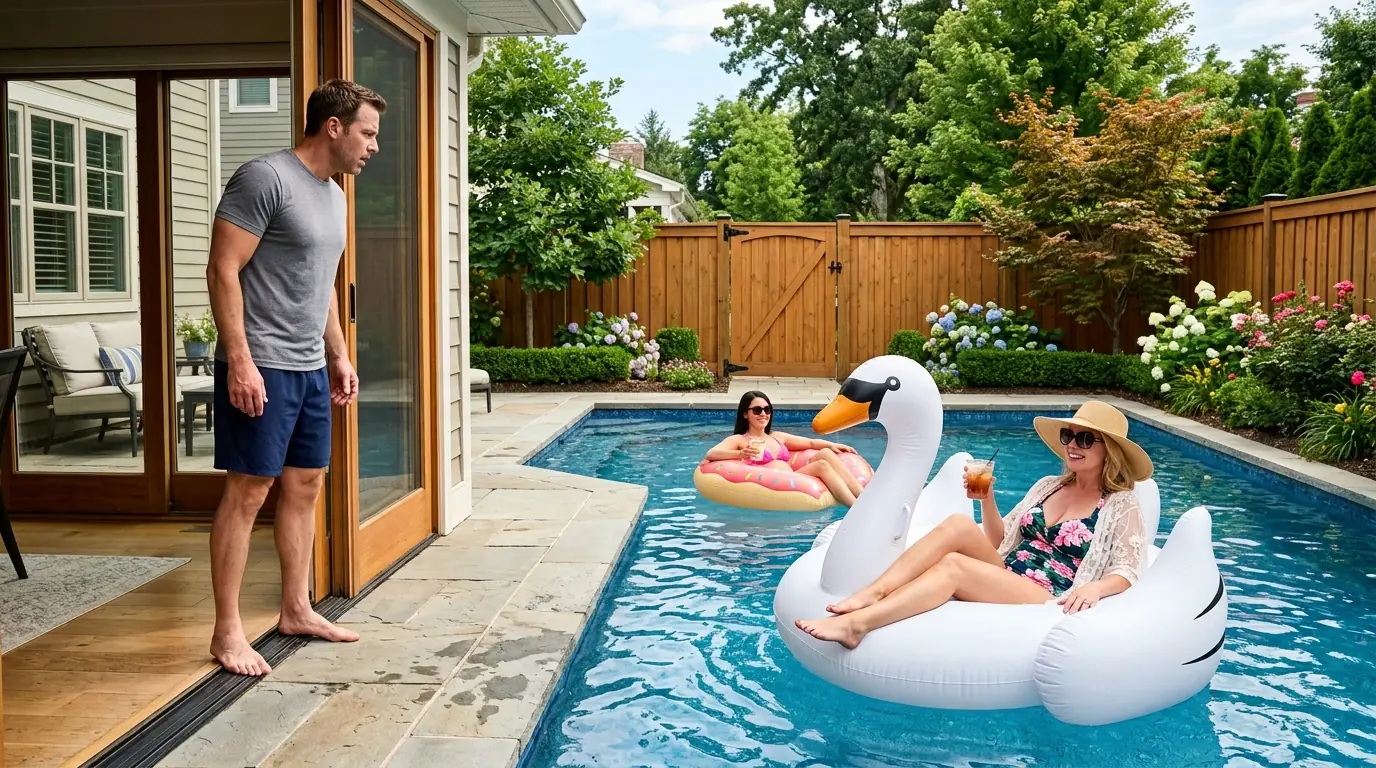
Three women were swimming in his pool.
One floated on a white inflatable swan. Another sat on the edge with her feet in the water, holding a plastic cup. A Bluetooth speaker rested on Tom’s patio table, playing music loud enough that the bass reached the second floor.
And stretched across Tom’s favorite lounge chair was a woman wearing an enormous sun hat and oversized sunglasses.
She raised one hand.
Waved at him.
As though he were the neighbor who had unexpectedly wandered into her morning.
The basic violation was unmistakable: strangers were already inside the private backyard pool of the home Tom had recently purchased.
Tom stared for ten full seconds.
Then he looked around his bedroom as though reality might correct itself if he waited.
It did not.
Two months earlier, Tom had closed on the house after twenty years of careful saving, moving, promotions, setbacks, and one divorce that had taught him how quickly a place could stop feeling like home.
He was forty-eight now.
He managed industrial construction projects for a regional engineering company, had no children living with him, and had wanted one thing from his next house.
Peace.
The property sat near the rear of Briarwood Hills, a manicured subdivision outside Raleigh where mature oak trees separated large homes and the HOA newsletter contained more pages than some local newspapers.
Tom’s house was not the largest.
But it had something he had wanted since childhood.
A private pool.
Not enormous.
Not luxurious enough for magazine photographs.
Just a clean rectangular pool behind a cedar fence, surrounded by stone decking and enough quiet that Tom could sit outside after work and hear insects instead of traffic.
He had paid for the property.
Read the survey.
Read the deed.
Read every line of the title documents because Tom was the sort of man who read warranty exclusions before buying a refrigerator.
The pool was unquestionably inside his lot.
So were the deck and side gate.
Tom pulled on sweatpants and a T-shirt, walked downstairs, unlocked the back door, and stepped outside.
The women looked toward him.
The one in the sun hat lowered her sunglasses.
Tom kept his voice level.
“Good morning.”
The woman smiled.
“Morning.”
“This is private property.”
Her smile widened.
One of her friends stopped paddling.
The other looked away.
Tom continued.
“I need you to get out of the pool.”
The woman in the hat laughed.
“Your pool?”
“Yes.”
“Oh, sweetheart.”
Tom already disliked the way she said it.
“This is the community pool.”
“No.”
She sat upright.
“Yes.”
Tom looked around his own backyard.
Then back at her.
“I bought this house two months ago.”
“Congratulations.”
“This pool is part of the property.”
She shrugged.
“I’ve used it for years.”
“That doesn’t make it yours.”
The two friends exchanged glances.
Neither looked nearly as comfortable now.
The woman removed her sunglasses completely.
She was probably in her late fifties, with carefully styled blond hair, a floral cover-up, and the absolute confidence of someone who believed confidence itself constituted documentation.
“My name is Karen Peton.”
Tom waited.
She seemed surprised that the name produced no effect.
“I’m on the HOA board.”
“Okay.”
“I've been involved with this neighborhood for fifteen years.”
“Okay.”
“And I’m telling you this pool has historically been used by residents.”
Tom shook his head.
“It isn’t listed as an HOA amenity.”
Karen stood in the shallow end.
“You’re new.”
“I’m still the owner.”
“You obviously weren't informed about the arrangement.”
“What arrangement?”
“Community access.”
“Show it to me.”
Karen’s smile faded slightly.
“You want paperwork?”
“Yes.”
“Seriously?”
“Yes.”
Karen climbed the steps.
Water ran from her cover-up onto Tom’s deck.
She picked up her sunglasses and slipped them back on.
“I have a key.”
Tom looked toward the gate.
“That gate was rekeyed when I bought the house.”
Karen shrugged.
“Apparently not very well.”
That was the first moment Tom felt something beyond irritation.
She really had entered through the gate.
No climbing.
No broken lock.
No damaged fence.
Tom looked toward her.
“How?”
Karen smiled again.
“Call Paul.”
“Who?”
“Paul Merritt. HOA president.”
She gathered her towel.
“Tell him Karen said hello.”
Her friends quickly began collecting their belongings.
Tom stepped aside so they could leave.
He did not shout.
Did not touch anyone.
Did not block the gate.
Karen paused beside him.
“Friendly advice?”
“I’m not sure I want it.”
“You’ve been here eight weeks.”
She lowered her voice.
“People who move into established communities usually do better when they don’t start by telling everyone else how things work.”
Tom looked toward the pool.
Then toward her.
“People who enter somebody else’s backyard usually do better when they leave after being asked.”
Her smile disappeared.
For perhaps the first time that morning, Karen looked genuinely offended.
“We’ll see who owns this pool.”
Then she walked out.
Tom locked the gate behind her.
Tested it.
Locked.
He stood beside the pool listening to the water settle.
Ten minutes earlier it had been the feature he loved most about his new home.
Now he felt exposed.
That evening he drove to the HOA office.
Paul Merritt was sixty-three, soft-spoken, silver-haired, and professionally friendly in the way of men who had chaired enough committees to turn avoidance into a management style.
He smiled when Tom entered.
“Tom! How’s the new place?”
“Apparently popular.”
Paul laughed.
Then saw Tom’s face.
“What happened?”
Tom showed him a photograph from his upstairs window.
Karen.
Two friends.
Pool.
Paul’s smile changed.
“Oh.”
“You recognize her.”
“Of course.”
“She says my pool is a community amenity.”
Paul removed his glasses.
“Well…”
Tom waited.
“Historically there were some arrangements.”
“What arrangements?”
“The previous homeowner was generous.”
“That isn’t what Karen said.”
Paul leaned back.
“She’s been here a long time.”
“That isn't an answer either.”
“Tom.”
Paul smiled again.
“Briarwood is a close community.”
“Does close mean people get keys to private property?”
“It was probably a misunderstanding.”
“She told me she had access.”
Paul looked uncomfortable.
“Years ago, when the clubhouse pool was being renovated, the previous owner let some neighborhood groups use his pool occasionally.”
“Occasionally.”
“Yes.”
“By written agreement?”
“I don’t know.”