By the time Captain Daniel Mercer stepped off Engine 14, the woman standing in the driveway was already shouting that nobody was allowed to enter her house.
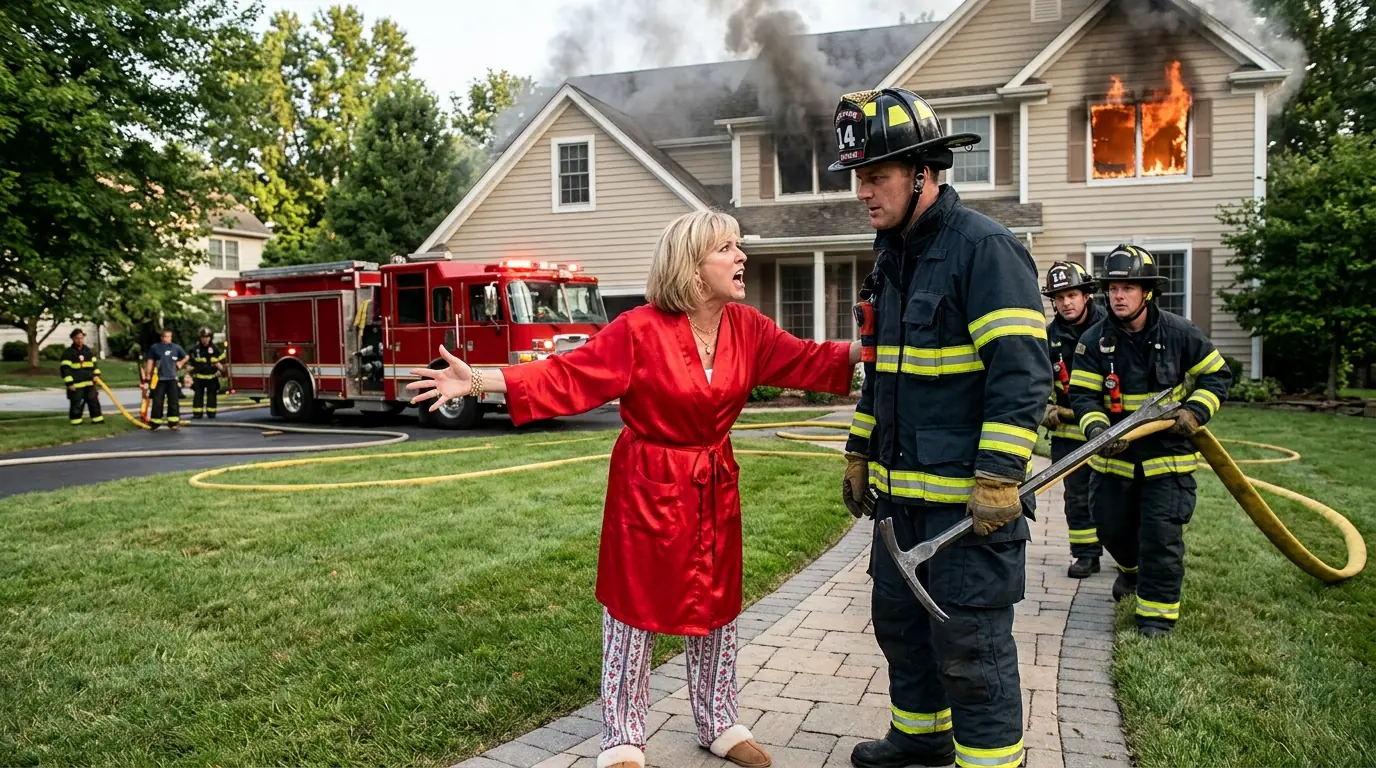
Smoke disagreed with her.
It leaked in thin gray ribbons from beneath the second-floor eaves of a large brick Colonial on Briar Glen Court, almost invisible against the January sky until the wind pushed it sideways. The front lawn was white with frost. A garden hose lay across the driveway, still running, and a blackened hand towel sat near the front steps beside a red household fire extinguisher.
Daniel had been a firefighter for twenty-four years. He had learned that the smallest-looking residential fires sometimes created the largest arguments because homeowners could still see most of their house standing. A roof fully involved in flame made the decision obvious. A little smoke from an attic invited negotiation.
“Nothing is burning anymore,” the homeowner insisted. “I handled it.”
Her name, according to dispatch, was Cynthia Harrow. Fifty-nine years old. No reported occupants trapped. Alarm came from a neighbor who saw smoke near the roofline and called 911 after Cynthia apparently told him not to.
Daniel looked up.
The smoke pulsed once.
Not much.
Enough.
He turned toward Lieutenant Marcus Bell, who had brought the thermal camera from the engine. “Check the second-floor ceiling from outside if you can get a clean angle.”
Cynthia stepped between them.
“You are not taking axes into my house.”
Daniel looked at her.
“We haven’t taken anything inside yet.”
“I know how this works. You people tear open walls, flood everything, then tell the insurance company it was necessary. The fire was in a light fixture. I put it out.”
“What light fixture?”
“Upstairs hallway.”
“Any attic above it?”
“No.”
Daniel glanced at the roof.
“House this size has attic space.”
“It’s inaccessible.”
“That’s different from not having one.”
Cynthia’s expression tightened. She wore a camel-colored coat over dark slacks, expensive boots without a trace of mud on them, and one black leather glove. Her other hand was bare because she had been clutching her phone hard enough to turn her knuckles pale.
“The attic was sealed during renovation,” she said. “There is nothing up there.”
Marcus returned with the thermal camera.
“Cap.”
One word.
Daniel knew the tone.
Marcus showed him the screen. A hot area spread across the upper hallway ceiling and continued laterally farther than a single light fixture should have accounted for. The temperatures were not extreme yet, but they were climbing.
Daniel asked Cynthia, “When did you use the extinguisher?”
“Ten minutes ago.”
“And smoke started before or after?”
“It was a small electrical problem.”
“That wasn’t my question.”
Her voice sharpened. “I told you it is out.”
Daniel looked at the roof again. “It isn’t.”
Cynthia moved closer.
“You do not have permission to enter.”
Daniel had heard variations of that sentence many times. Sometimes from frightened people. Sometimes from intoxicated people. Sometimes from property owners more terrified of water damage than fire.
He did not enjoy forcing entry into someone’s home.
He also did not conduct a referendum while smoke moved through an enclosed void.
“We have an active fire condition,” he said. “That gives us authority to enter and make the building safe.”
“You don’t know there’s an active fire.”
“We have smoke from the attic and heat above the ceiling.”
“You have a machine pointed at my house.”
“Yes.”
“You could be reading the heating system.”
“The furnace is in the basement?”
She hesitated.
“Yes.”
Daniel nodded toward Marcus.
“Interior team. Dry line first. Keep water use controlled until we locate it.”
Cynthia stepped directly in front of the doorway.
“No.”
Daniel’s patience changed shape.
Not anger.
Procedure.
“Ms. Harrow, move away from the entrance.”
“You are not destroying my ceiling.”
“We’re going inside.”
“You’ll hear from my attorney.”
“That’s your right.”
“I’m serious.”
“So am I.”
Police had not yet been requested because the call had not originally sounded like a confrontation. Daniel keyed his radio and asked dispatch for an officer to assist with an obstructive homeowner.
Cynthia heard him.
For the first time, something besides anger appeared on her face.
Fear.
It lasted perhaps one second.
Then disappeared.
Daniel noticed.
He would remember it later.
At that moment, he had a more immediate problem.
The smoke coming from the eaves had darkened.
Briar Glen Court was the kind of street built to reassure people who had recently acquired enough money to become worried about protecting it. Large homes sat behind careful lawns. Mailboxes matched. Trees had been planted at mathematically pleasing intervals. Even in winter, landscaping companies arrived weekly to remove leaves that had somehow escaped autumn.
Cynthia Harrow had lived at number 28 for seventeen years.
She chaired the neighborhood architectural committee for eleven of them and served three terms as president of the Briar Glen Homeowners Association. She was the person who noticed when shutters were the wrong shade of black or a trash bin remained visible six inches beyond a fence.
Her neighbors had opinions.
Mrs. Keller across the street called Cynthia “organized.”
Mr. Delaney beside her used the word “exhausting.”
Both watched from their windows as firefighters entered her house.
Daniel’s crew moved quickly but carefully. Marcus Bell and firefighter Erin Shaw took the line upstairs while Daniel followed with the thermal camera. Firefighter Luis Ortega stayed near the entry to manage hose and monitor conditions.
The first floor was clear.
No open flame.
No visible smoke below the stairs.
Upstairs was different.
A faint haze hung in the hallway.
The smell was wrong for a simple light fixture.
Electrical fires have no single universal smell, but Daniel had spent enough years around burned insulation, hot wiring, scorched wood, and plastics to recognize when heat had been working somewhere unseen.
Marcus pointed toward a recessed light in the hallway ceiling.
“Homeowner said this one?”
“Supposedly.”
The trim ring was scorched.
The paint around it had blistered.
But the thermal camera showed heat extending six feet beyond the fixture.
Then ten.
Then nearly the entire center section of the hallway.
Erin looked toward Daniel.
“That’s running above us.”
“Yes.”
She scanned the ceiling.
“Where’s the attic hatch?”
Daniel looked toward a linen closet shown on the original floor plan stored in the department’s building database.
According to the plan, the access opening should have been there.
They opened the closet.
Shelves.
Fresh plaster.
No hatch.
Marcus looked upward.
“Renovation covered it.”
Daniel radioed the exterior crew.
“Get me building records if dispatch can access them. Any remodel permits on twenty-eight Briar Glen.”
Cynthia appeared at the bottom of the stairs.
Daniel turned immediately.
“You need to stay outside.”
“I’m telling you there is nothing above that ceiling.”
“You need to leave the structure.”
“My paintings are in the bedroom.”
“Then we’ll protect them if conditions allow.”
“You don’t understand. The plaster upstairs is custom. That ceiling cost almost forty thousand dollars.”
Marcus looked at Daniel.
Neither spoke.
Cynthia continued.
“If you open it, you’ll ruin the entire hallway.”
Daniel pointed downward.
“Outside.”
“The fire is out!”
A small cracking sound answered her.
Everyone heard it.
Not loud.
A dry snap somewhere above the ceiling.
Then a narrow thread of smoke pushed from the edge of a recessed fixture.
Daniel said, “Marcus, open a small inspection point.”
Cynthia screamed.
“No!”
That was not exaggeration.
She screamed the word hard enough to echo through the stairwell.
Then she started up the stairs.
Luis intercepted her before she reached the second landing.
“Ma’am, you cannot come up here.”
“Get away from me!”
“Outside.”
“You are destroying my property!”
Daniel looked toward Luis.
“Remove her from the house.”
Luis did.
Not roughly.
Not theatrically.
He guided her back toward the front door while she protested every step.
Daniel turned to Marcus.
“Smallest opening that gives us a look.”
Marcus positioned himself away from the hottest area and opened the ceiling at the edge of the hallway.
The first section of plaster came down.
There was drywall above it.
Marcus stopped.
“That’s odd.”
Daniel stared upward.
The original ceiling had been covered.
Not replaced.
Covered.
A decorative suspended layer had been installed several inches beneath an older structural ceiling.
Erin looked at the thermal camera.
“Heat’s above the second layer.”
Marcus widened the opening enough to inspect.
Drywall.
Wood furring.
Then another cavity.
He broke through the older layer.
Hot smoke immediately pushed downward.
Daniel felt the pressure change.
“Fire above us. Mask up.”
The crew went on air.
They opened farther.
The camera showed a concentrated hot area twelve feet toward the master bedroom side of the house.
Marcus shined his light through the opening.
“Cap.”
“What?”
“Come look.”
Daniel stepped beneath him.
Above the ceiling was not the open attic space he expected.
There was plywood.
Finished plywood.
A vertical partition.
Insulation.
And something that looked like a door frame.
Daniel stared.
“Building plan doesn’t show that.”
“No.”
Erin said, “She said there was nothing up there.”
Daniel raised the thermal camera.
Behind the plywood partition, the screen lit bright orange.
Then something hit the other side.
Three knocks.
Everyone froze.
Marcus looked at Daniel.
Another knock.
Then two.
Not structural movement.
Not settling.
Something—or someone—was inside.
Daniel keyed his radio.