My Sister Laughed at My Uniform During Dinner - Then Her Ranger Fiancé Froze When He Saw My Patch
My sister laughed during dinner and said, “Meet my fiancé, a Ranger,” as if his title was supposed to prove something about mine. Then she looked at my uniform, smiled at her friends, and turned me into the joke again. She had done it for years, but that night was different. Her fiancé saw the patch on my shoulder and stopped smiling instantly. Then he snapped to attention and said, “Maya, stop. Do you have any idea what that means?”
My sister, Maya, has always cared about status. She measures people by their zip code, their watches, their job titles, and the way other people react when they enter a room. In her eyes, I was always the disappointment. While she climbed the corporate ladder in public relations, I was away serving. She told people I was traveling because she was too embarrassed to admit I was in the military. To her, being a soldier was what people did when they could not make it in the kind of world she respected.
For years, she turned me into the punchline at family dinners. She would make little comments about my job, my uniform, my schedule, and the fact that I was never around long enough to explain myself. I usually stayed quiet. I am not the kind of man who needs to brag about what he does. My work is not something I discuss casually over wine and appetizers. Silence, however, gave Maya all the room she needed to build her own version of me.
Last night was her engagement dinner. She invited the whole family to an upscale steakhouse to meet her fiancé, Liam. She had been bragging about him for months. “A real hero,” she called him. “An Army Ranger with more commendations than you could count.” I came straight from base, exhausted, still wearing my service uniform, and honestly, all I wanted was a decent steak and a quiet meal.
I did not think much of what I was wearing. My jacket was on, my sleeves were rolled up, and the patches from my specialized unit were visible on my shoulder. The second I sat down, Maya’s face changed. She did not say hello. She did not ask how I was. She just looked at my uniform and let out an exaggerated sigh loud enough for nearby tables to hear.
“Seriously, Chris?” she said, swirling her wine glass. “You couldn’t even change first?” She looked me up and down like I had dragged mud into a ballroom. “We’re at a five-star restaurant, and you look ready to go fix a truck.” Then she shook her head dramatically. “So embarrassing. Some of us actually have careers we’re proud of.”
The table went silent. My parents stared down at their plates like the steak suddenly required their full attention. Maya’s friends looked at me with a mixture of pity and curiosity. I just took a sip of water. “It’s a uniform, Maya,” I said calmly. “Not a costume.” She laughed like that was the funniest thing I had said all night.
“Low-level job, let’s be honest,” she said, glancing toward her friends. “Everyone, this is my fiancé, Liam. He’s a Ranger, you know, elite. The guys who actually do the hard work while Chris here probably just guards a gate or whatever it is he does.” She smiled as if she had explained the natural order of the universe. I said nothing. There are moments when silence is not weakness. Sometimes silence is simply discipline.
Liam smiled politely and reached out to shake my hand. “Good to meet you, mate,” he started. Then he stopped three inches short of my hand. His eyes were no longer on my face. They were locked on my right shoulder, where the rolled sleeve exposed the patch sewn into the fabric. I watched his jaw tighten. Then I watched the blood drain from his face in less than a second.
His hand lowered. His back straightened. His heels snapped together beneath the table with a sharp click the tablecloth could not hide. “Maya, stop,” he barked. The sound cut through the restaurant. Glasses stopped moving at the surrounding tables. A waiter carrying a water pitcher froze two steps away, and my mother dropped her fork.
Maya blinked twice. “Liam, babe, don’t be dramatic. It’s just...” “I told you to stop,” Liam said. I had never heard him use that tone before. Honestly, neither had I. But the tone was not directed at me. It was directed at her.
Maya did not understand why her fiancé suddenly sounded like a soldier addressing a civilian. I said nothing and took another sip of water. The glass was warm. Liam stayed standing, arms tight at his sides, chin tucked. He was not looking me in the eyes anymore. He was staring at a point on the wall behind me, the way men do when they are waiting for an order.
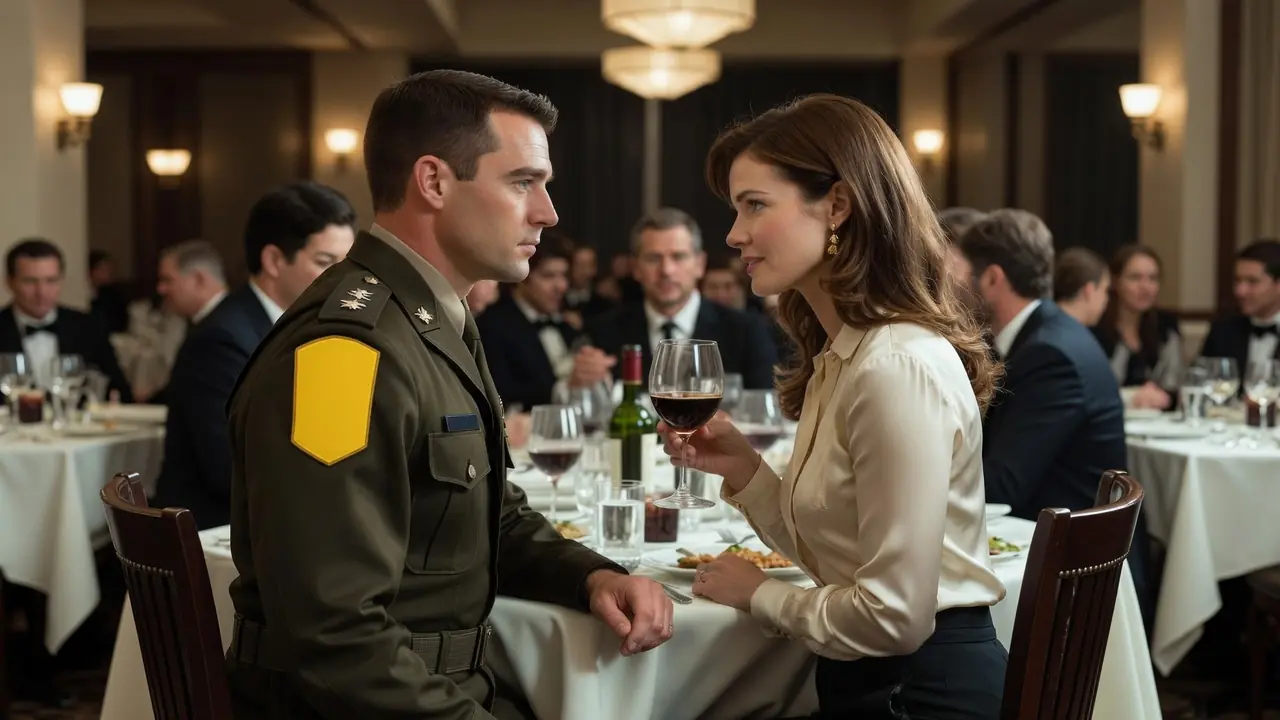
“Sir,” he finally said. The word dropped between the plates like a coin into an empty glass. Maya let out a short laugh. “Sir? Liam, are you joking? It’s Chris, my brother.” Liam did not move. “It is your brother,” he said. “And he is exactly the kind of soldier you have spent the last two months insulting right in front of me.”
My father carefully placed his napkin on the table. He said nothing. My mother looked at Maya, then at me, then back at Maya again, like she was recalculating something she had convinced herself she understood. One of Maya’s friends, the blonde in the green dress, reached for her purse beneath the chair. The other friend, a coworker from Maya’s firm, stayed completely still with her phone in her hand and the screen dark. She was listening.
“Liam, sit down,” Maya said quietly. “You’re making a scene.” Liam answered without looking at her. “You made the scene.” I looked up then. Liam was still rigid, so I made a small gesture with my hand, two fingers lowering toward the chair. It was a subtle command, almost nothing, but he caught it immediately.
He sat. The chair creaked beneath his weight. “At ease,” I said. It was the only thing I had said in the last three minutes. Liam relaxed his shoulders, but not completely. Maya stared at me, eyes narrowing. “What did you just say to him?”
“Nothing important,” I replied. “Don’t talk to me like that, Chris. This isn’t your barracks.” I looked at her and said, “No. It isn’t.” My father coughed. My mother placed a hand on his arm, not to stop him, but to steady herself. The waiter finally resumed moving and poured the water. Nobody thanked him.
Maya adjusted herself in her chair and tucked her hair behind her ear. That was always her tell before she started talking her way out of something. “Okay,” she said, forcing her smile back into place. “Clearly there has been some kind of misunderstanding. Liam, sweetheart, my brother serves. Yes, we all respect that, but there are levels to this stuff. You’re a Ranger. That’s elite. What he does...”
“Don’t continue, Maya,” Liam said. “Why not?” she snapped. “Because you have absolutely no idea what you are talking about.” Maya set her wine glass down too hard, and the crystal sound made the next table turn around. “Then explain it to me,” she said. “I’m listening.”
Liam inhaled slowly. He did not look at me before speaking because he did not need permission to identify what he had seen. “Your brother is not a Ranger,” he said carefully. “Exactly,” Maya said, relieved. “That’s what I’ve been saying.” Liam kept his voice controlled. “Your brother is from the unit that trains Rangers like me.”
My mother’s fork hit the plate. Maya blinked, opened her mouth, closed it, then opened it again. “What are you talking about?” Liam looked at her, and every trace of pride she had been wearing started to slip. “I am talking about the man sitting at this table,” he said. “The one you have spent months calling low-level.”
Maya looked toward my father for help. He was staring at the table. She looked at my mother. My mother was staring at the table too. “This is ridiculous,” Maya said, her voice climbing higher. “Liam, you don’t need to defend him. Chris is perfectly capable of speaking for himself. If he were what you say he is, he would have said it years ago. Right, Chris?”
I looked at her and did not answer. I picked up my knife, cut another piece of steak, chewed, and swallowed. Maya exhaled sharply through her nose. “Seriously? You’re just going to eat right now? In the middle of this?” I glanced down at the plate. “You picked a good restaurant,” I said. “Seems like a waste not to.”
Liam lowered his gaze to his plate, but he did not touch the food. His hands rested flat at his sides, palms down. “Maya,” he said quietly, “I have spent two months listening to you. I tolerated the jokes about your brother because I thought it was family humor. Tonight I thought I was finally going to meet the guy you always insulted. I came ready to defend him if I had to. I just did not tell you.”
He paused. “And it turns out the man you have been insulting is the same man who signed the recommendations that got me into advanced operator school four years ago.” Maya whispered, “What?” Liam continued, “I did not recognize his face because the last time I saw him, half of it was covered in camouflage paint and the other half was wrapped in a shemagh. I recognized the patch.” Maya said his name, but he cut her off. “Do not say my name like that, Maya. Not tonight.”
Silence settled over the table. I counted the seconds out of habit. Four. Five. My mother broke first. “Chris?” “Yes, Mom.” Her voice trembled. “Is it true?” I answered, “More or less.” She blinked. “More or less?” “That’s the short version.”
She lowered her eyes, and I saw her bottom lip tremble. My father cleared his throat. “Chris.” “Dad.” He struggled for the words. “Why didn’t you ever...” I finished it for him. “Because nobody asked.” There was no anger in my voice. No accusation. Just fact.
Maya leaned forward. “Okay. Fine. I get it. This is a huge misunderstanding. But this can be fixed. Chris, why don’t you tell us? Go ahead. You’ve got the audience.” I looked at her for the first time that night with real exhaustion. “I don’t have anything to tell.” “Come on,” she said. “Liam just said you signed recommendations. That alone is a story.”
“It’s paperwork,” I said. “Chris.” “Maya,” I replied. This time I held her gaze directly. “You wanted a Ranger to show off. You got one. Enjoy it. Don’t mix me into this.”
“I’m not mixing anything,” she said. “Yes, you are.” “And what exactly am I supposed to do?” she shot back. “Pretend I didn’t hear what Liam just said?” I returned to my steak. “Do whatever you want. You were already doing that before you knew.”
Her face went still. I cut the last two bites of steak with the same precision you use when you stop feeling anything at all. My mother stared at her plate. My father poured himself water, something he never did at restaurants. Liam cleared his throat. “I need a minute,” he said quietly. “Excuse me.”
He stood and walked toward the restroom without looking at Maya. Maya started to follow him, but the blonde friend grabbed her wrist and whispered something too low for me to hear. Maya sat back down. The waiter appeared with the dessert menu, read the atmosphere instantly, and left without offering it. My mother spoke without lifting her eyes. “Chris, honey...” “Later, Mom,” I said. The words were not harsh, just firm.
Without Liam beside her, Maya had lost the center of the room. The audience was still there, her friends, my parents, the waiters pretending not to look, but she had lost the spotlight. And Maya lived for the spotlight. “Chris,” she tried again, quieter this time. “This isn’t fair.” I asked, “What part?” She swallowed. “You let me do this for years, knowing I did.”
“I could have stopped you,” I said. “Then why didn’t you?” she demanded. “Because I know you.” She lifted her chin. “What’s that supposed to mean?” I set my fork down. “It means if I had told you, you would have used it. You would have called your friends and said, ‘My brother is one of the real ones.’ You would have taken pictures. You would have made up stories. You would have done exactly what you are about to do right now.”
One of her friends, the quiet one with the phone, looked up for the first time. She looked at me, then at Maya, and said nothing. The look alone was enough. Maya noticed it. Her voice dropped. “This doesn’t just stay like this.” I answered, “It never does with you.”
Liam returned from the restroom. His face was wet. He stopped behind his chair but did not sit. “Maya,” he said calmly, “we’ll talk about this at home.” Then he turned toward me. This time he looked me directly in the eyes and saluted. A proper salute. Sharp hand, straight fingers, chin tucked. “Sir, I apologize for the introduction.”
I returned the salute sitting down. Short and clean. “At ease, Sergeant.” Liam held position for two more seconds before finally sitting. Maya stared at both of us. She did not understand. She was not going to understand that night. The waiter returned with the check, and both my father and Liam reached for it at the same time. They split the bill in silence.
Maya stood first and grabbed her coat. Her friends followed a second later. Nobody hugged goodbye. My mother squeezed my hand. My father placed his hand on my shoulder, directly over the patch, without saying a word. I walked out into the parking lot behind Liam while Maya spoke loudly about traffic, the restaurant rating, and anything except what had happened.
Liam stopped beside my car. I unlocked the door, and before I got in, he looked at me. “Sir, I didn’t know.” “I know.” He said, “It won’t happen again.” “It’s not yours to fix,” I told him. His jaw tightened. “Yes, it is.”
I looked at him then. Thirty years old, shoulders like a tank, perfect posture, and the eyes of a man who had just seen the woman he planned to marry from a completely different angle. Once you see that, you cannot go back to the old picture. “Call me when you know what you are going to do,” I said. “Yes, sir.” I closed the door and started the engine.
In the rearview mirror, I watched Maya try to get into Liam’s car. Liam opened the passenger door for her with the exact politeness of a soldier who had already made a decision. He just had not said it out loud yet. I pulled out of the parking lot. The highway was empty. I turned on the radio, then turned it back off. Four hours to base. I would make it before sunrise.
I got back to base at 4:20 a.m. The gate guard recognized me and raised the barrier without questions. I parked, went upstairs, took off the uniform, hung it carefully, and slept for four hours. At nine, I found the messages. Four were from my mother, one from my father, and none from Maya.
My mother’s first text asked if I had arrived safely. The next said to let her know when I got there. Another just said my name. The last one said, “I love you, son.” My father’s message came at five in the morning. “Call me when you can.” I answered my mother first, then told my father I would call Saturday.
At ten, I had duty. I did not think about Maya again until lunch, when one of the younger lieutenants asked how the dinner went. I told him it was fine. He looked down at his tray and did not ask another question. Wednesday, Maya called. I did not answer. She left a voicemail. I deleted it without listening.
Thursday, she called twice more. I ignored both calls. Friday, my mother called, and I stepped outside the barracks to answer from a bench. She said my father wanted me to come home and did not want to talk about everything over the phone. I told her I could come the next weekend. Then I asked whether Maya would be there.
There was a long silence. My mother admitted she did not know. Then she said she had told my father she would rather Maya was not there. That was new. My mother apologized, and I told her she did not have to. She said she did, and for once, I did not argue.
Saturday, I called my father. He asked about my service for the first time in a way that sounded genuine. He asked if I had people under my command, and I told him I had twelve operators that cycle. He said, “I see,” though I knew he did not fully understand. He was trying. That mattered more than getting every detail right.
I asked him why he was asking now. He said, “Because I never asked before.” I leaned back in my chair and said, “That’s fair.” He answered quietly, “No, it’s not fair. But I’m starting now.” That was the closest thing to an apology my father had given me in fifteen years. I accepted it without comment.
That night, I opened Maya’s messages for the first time. There were five total. The first said, “We need to talk.” The second was just my name. The third said she knew I was mad, but this was not fair. The fourth asked if I knew why Liam was not answering her. The fifth simply said, “Please.” I did not answer any of them.
Liam did not call that week either. I had told him to call me when he knew what he was going to do. I did not take the silence as disrespect. A man making a serious decision does not call on Monday. He calls when the decision is already made. Saturday night, right before lights out, he finally texted three words: “Still processing, sir.” I replied, “Take your time.”
The following week, rumors began moving through base. Sergeant Nunez sat across from me in the dining hall and said there was talk about a Ranger snapping to attention for me at a restaurant. I asked who said it. He told me it had come through the chain, from someone who knew someone. I took another sip of coffee and said nothing. That was when I understood the dinner had not stayed at the dinner.
It had walked out through waiters, through Maya’s friends, through Liam’s peers, and through every person who had watched the room change when Liam saw my patch. Maya was not going to control the story anymore. I was not going to chase it, but I was not going to stop it either. That afternoon, I signed forms, approved training paperwork, and handled exactly the kind of work Maya thought I did. Then I went to the firing range and signed off on a corporal’s qualification.
A few days later, Liam called. He asked direct questions, and I gave direct answers. He asked how long Maya had spoken about me that way. I said about fifteen years. He asked whether it started when I joined. I said it started when I decided to join. He asked if she said those things to my face or behind my back. I told him both.
He asked if my parents supported it. I told him they did not support it, but they also did not contradict her in public. He was quiet for a while. Then he asked why I never defended myself. I said arguing with Maya publicly would not change anything. It would only make dinners longer.
Then he asked the only question that mattered. “What do you want me to do?” I said, “Nothing.” He repeated the word, surprised. I told him I was not asking him to defend me, leave her, or fight on my behalf. What he did with Maya was his business. What he knew now, he knew.
Before hanging up, I told him something important. “If you leave her, don’t leave because of me. Leave because of yourself. Or don’t leave at all.” He said, “Yes, sir.” Then we ended the call. I stayed outside on the bench for ten more minutes, thinking not about Liam or Maya, but about the next morning’s training exercise.
The next Friday, I went home. My mother had made lamb, and my father was outside lighting the grill. For ten minutes, we stood together in silence with the smoke rising straight upward. At seven, the doorbell rang. My mother appeared at the patio entrance and said, “It’s Maya.” My father asked if she was alone. My mother said, “She brought Liam.”
Maya stood in the living room with red eyes and a cream-colored coat. Liam stood behind her, one step back, hands clasped in front of him. When he saw me, he gave a small nod, and I returned it. Maya said she needed to talk to everyone. My father calmly told us to go to the dining room. We sat with Maya and Liam on one side, my parents across from them, and me at the head of the table.
Maya started with a prepared speech. She said she understood why people were upset, but she also needed everyone to understand that she did not know. She claimed that if I had explained what I actually did, she never would have said those things. She said it was unfair that everyone was treating her like the villain. She said the family had allowed her to believe I only did administrative work.
Nobody spoke. Then my father finally did. He brought up the tree incident when Maya broke my arm as a child and let me say I had fallen. He mentioned the phone she lost and blamed on me. He mentioned the military graduation she skipped. He mentioned the airport pickup after my first deployment, when she forgot to come and left me waiting for three hours.
Maya looked shocked. She said those things had nothing to do with now. My father said they had everything to do with now. He told her he and my mother had stayed silent for twenty-five years, thinking it was personality, thinking she would grow out of it. Then he said, “You didn’t. You just learned how to dress it better.” Maya went completely still.
Until then, Liam had said nothing. Then he looked at Maya and asked one question. He reminded her that on their second date, when he had asked about her family, she told him she had a sister. My mother lifted her head for the first time. Liam asked why Maya had told him that. Maya did not answer.
“Because your brother embarrassed you,” Liam said. “Not because of what he did, but because of what you decided he was.” He paused. “And the only reason you finally introduced him to me was to use him as the punchline of a joke.” Silence filled the room. Then Liam stood, nodded respectfully to my parents, looked at me, and said, “Sir, sorry for the intrusion.”
I told him he could stay for dinner if he wanted. He considered it for two seconds, then shook his head. “Not tonight, sir.” He walked out without waiting for Maya. Maya stayed seated, suddenly looking much smaller inside her cream-colored coat. My mother went to the kitchen, and my father stepped out to the patio. That left Maya and me alone.
“Chris,” she said. “Yeah?” “This isn’t fair.” I looked at her and said, “Stay and eat with us if you want, or leave. But don’t sit there and tell me this is about fairness.” She stood abruptly, grabbed her purse, and walked out without her coat. A moment later, I heard the engine start.
The next morning, Liam called. I stepped outside to the patio, where the grill still held ashes from the night before. He told me he had ended the relationship with Maya that morning. It was short, at a coffee shop near her apartment. He gave the ring back and told her they had incompatible values. He said he did not mention me because he did not want her thinking it was revenge on my behalf.
I told him that was good. He said he was heading to his father’s cabin by the lake for three days. He had requested administrative leave. Then he said he did not want to keep calling me about this and believed he had done what he needed to do. I told him he owed me no updates. What he did, he had done for himself.
After we hung up, I stayed outside for a while. My father came out with a bag of charcoal and began pouring it into the grill without asking any questions. Later that day, Maya called the house, devastated that Liam had left her. My mother told her the house was not a shelter for her that day and that she could call Monday if she still wanted to talk. Then she came outside and asked if she had done the right thing.
I told her she had done what she could that day. She said that was not the same thing. I said no, it was not, but for now it was enough. We ate reheated lamb in the afternoon. Later, my mother received a text from one of Maya’s friends saying Maya’s firm already knew Liam had ended things. Maya had caused trouble on a client call and was pulled from the account.
The friend said Maya was trying to build a version of the story where the family had turned against her for no reason. My father’s face hardened slightly when he heard that. He asked if the friend believed her. My mother said no. That evening, I packed to return to base, and my father walked me out to the car.
When I opened the door, he offered his hand, then gave mine a second squeeze. “Chris,” he said. “If you ever need anything from me, anything, you ask.” I said, “Yes, Dad.” He looked down and admitted, “Late. But I’m asking too, if you ever need it.” I nodded and got in the car.
As I pulled away, I saw Maya parked near the corner by my parents’ house. She had not gotten out. She was just sitting in the car, staring toward the house. I drove past her without stopping. She never looked at me. In the rearview mirror, I watched her stay there for five more minutes before driving away in the opposite direction.
Months passed. Maya started therapy and was reassigned to a smaller account at her firm. My mother stopped calling me with regular updates, because I asked her not to turn herself into Maya’s messenger. My father called and asked about my training cycles. He did not always understand the answers, but he listened. That was enough.
Two months later, I received a letter from Maya. Actual paper, stamped envelope, my correct rank written beside my name. It was four pages. It was not exactly an apology. It was an inventory. She listed things she had done, specific moments, approximate dates, the broken arm, the phone, the skipped graduation, the airport, the dinners, the comments, the uniform jokes.
There was one thing I had not known. In college, she had once told a roommate that her brother had died because having a dead brother embarrassed her less than having a soldier brother. That line stopped me. At the end, she wrote, “I’m not asking for anything. This was for me, not for you, but I thought you had the right to read it. M.” I folded the pages carefully and placed them beneath the regulation manuals in my desk drawer.
I did not answer that week or the next. On the third week, I sent a blank postcard with one handwritten line: “Received. Chris.” I mailed it to her office, not her apartment. Eight months later, Liam emailed me requesting a recommendation for an instructor development program. I signed it within forty minutes and sent it back. He replied with two words: “Thank you, sir.”
The next time I visited home, my father asked if I wanted to go fishing that summer. I said yes. We went in July and stayed three days at a cabin near the lake. We caught small trout, none worth keeping, and released every one back into the water. On the second night, sitting beside the fire, he asked about the unit. I told him what I could and kept back what I could not. He did not push.
Before bed, he said quietly, “Chris.” “Yeah, Dad?” He looked into the fire. “If your sister truly changes someday, I’m not going to ask you to start over with her. You’ll decide that.” I said yes. Then he added, “And if she doesn’t change, I’m not going to ask you to pretend anymore either.”
The next morning, before heading back to base, I washed my uniform in my mother’s machine. I pulled it out, hung it carefully, pressed it on the old ironing board with the same steam iron she had owned since before I was born, folded the shirt along the seams, folded the pants along the creases, adjusted the shoulder patch face up, and packed it into my duffel bag. My mother appeared quietly in the doorway with a thermos in her hand. “Coffee for the drive,” she said.
“Thanks, Mom,” I replied. She asked if I was taking anything else. I said no. She asked if I was coming back next month. I said yes. She smiled and said, “Good.”
I placed the thermos in the side compartment of the trunk where I always kept it. Then I closed the bag, turned off the laundry room light, and walked out. For years, Maya had treated my uniform like something small enough to laugh at. But that night at dinner, the truth did not need a speech. It only needed one patch, one Ranger who understood it, and one room finally quiet enough to hear what silence had been saying all along.