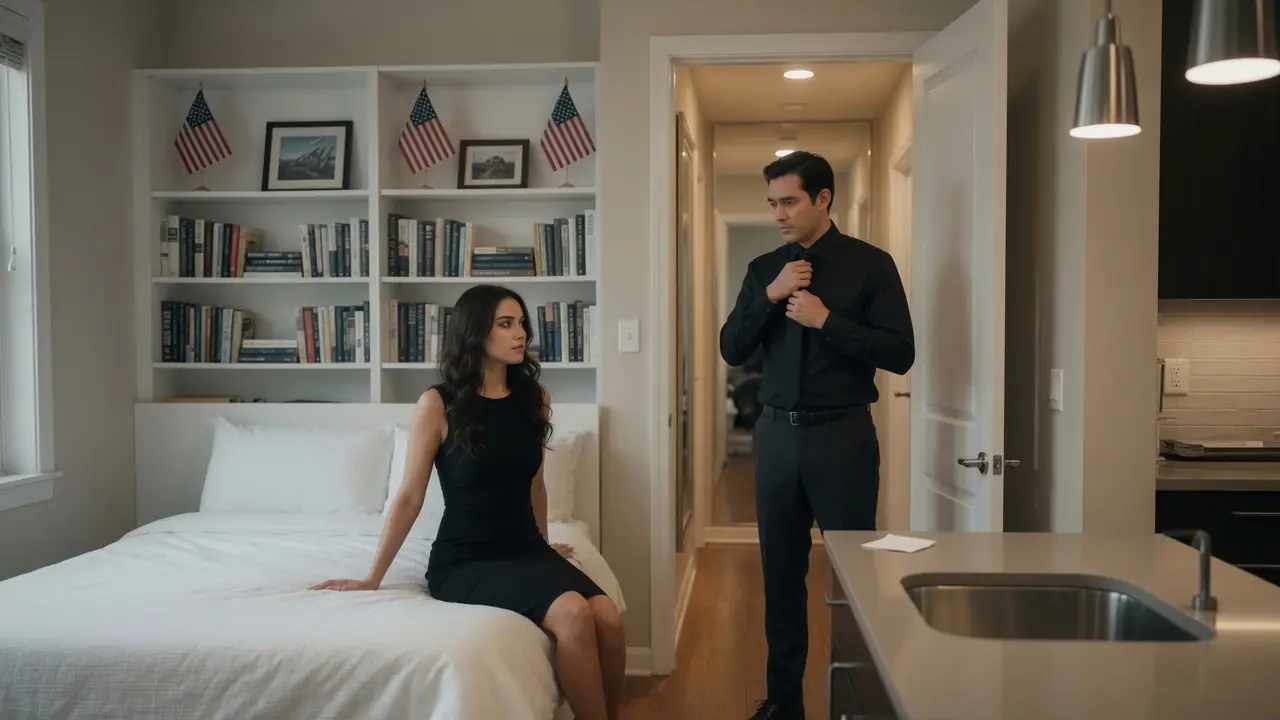
Chloe Harper was sitting on the edge of our white bed when she told me not to come. The room looked calm in a way that almost felt insulting, with beige walls, a narrow bookshelf behind her, two little American flags on the top shelf, and the hallway mirror catching my reflection as I stood in the doorway. I was wearing the dark suit she had asked me to press that morning, one hand still near my tie because five minutes earlier I thought I was going with her. She looked me up and down, not with love, not even with irritation, but with quiet disappointment.
Her black sleeveless dress was simple, expensive, and perfect for the reunion dinner she had been talking about for months. She had spent all afternoon doing her hair, checking her makeup, changing earrings, and rehearsing casual answers to questions no one had asked yet. I had watched from the doorway, smiling like the supportive boyfriend I had always tried to be. I thought she was nervous, and I thought my job was to steady her.
Then she sighed and said, “Mark, maybe you should stay home tonight.” At first, I thought she was joking. I even smiled a little, waiting for the rest of it. But she did not smile back.
I stood in the doorway, still adjusting my cuff, and asked, “Why?” Chloe looked away as if the answer was difficult for her, but not because it would hurt me. It was difficult because she knew how ugly it would sound out loud. She brushed a strand of hair behind her ear and said, “It’s just a very specific crowd.”
I knew what that meant before she explained it. Her high school friends had become lawyers, consultants, startup founders, doctors, people with titles that looked impressive on name tags and LinkedIn pages. For weeks, Chloe had been scrolling through their posts, studying their lives like she was preparing for a final exam. She cared about what they drove, where they lived, how they dressed, and who they had married.
“You know Jessica’s husband is a partner at that investment firm now,” she said. “And Amanda married a surgeon. Tyler Briggs is coming too, and he started some advisory company. Everyone there is successful, Mark.” She said my name softly, but it landed like an insult.
I looked down at my suit, the one I had bought for her cousin’s wedding the year before. It was not designer, but it was clean, sharp, and paid for by me. I worked in IT support, and I was studying for a cloud security certification after work. It was not flashy, but it was honest, and it had helped pay half the rent on the apartment she was sitting in.
Chloe folded her hands on her lap. “I just don’t want to spend the whole night explaining you.” That was the first sentence that truly cut. She did not say my job, or my plans, or my career path. She said me.
“Explaining me?” I repeated. She finally looked at me then, and her face had that polished pity she used when she thought she was being kind. “You know what I mean. They’ll ask what you do, and then I’ll have to say you’re still figuring things out.”
I almost laughed because I had not been figuring things out alone. I had figured out how to fix her laptop at midnight before her marketing presentation. I had figured out how to stretch our grocery money when she quit her first job after a bad manager criticized her campaign. I had figured out how to keep our apartment calm whenever her ambition turned into panic.
I stared at her reflection in the mirror. “So I would make it difficult?” She pressed her lips together. “You’re making me sound cruel.”
“No,” I said quietly. “I’m asking if my being there would embarrass you.” The room went silent.
She did not answer right away, and that was answer enough. The air conditioner hummed above us, and from somewhere outside, a car passed along the street. Chloe lowered her eyes, then said, “I don’t want to walk in with someone they’ll look down on.”
The sentence did not explode. It sank. It moved through my chest slowly, coldly, like water finding every crack.
I waited for anger to rise, but what came instead was clarity. I saw the apartment in a new way, not as our home, but as a place where I had been useful until I became inconvenient. The bed I had helped assemble, the bookshelf I had carried upstairs, the little decorations she bought with my card and called ours. All of it suddenly looked temporary.
Chloe stepped toward me with a soft smile, believing the worst was over because she had finally said it. “Mark, don’t look like that. I’m just being honest.” She touched my sleeve, the way she did when she wanted me to calm down before I embarrassed her further. “We’ll do something tomorrow, okay? Just us.”
I looked at her hand on my sleeve. Once, that touch would have been enough to make me swallow my own hurt and protect her from the consequences of her words. I would have told myself she was stressed, insecure, under pressure. I would have forgiven her before she apologized.
But this time, I simply nodded. “Absolutely,” I said. Chloe blinked, surprised by how easy it was.
Relief spread across her face so quickly it almost made me feel foolish for ever believing she loved me carefully. She thought my calm meant I accepted my place. She thought I understood that she could put me away for the night like an old jacket that did not match her outfit. She smiled and leaned up to kiss my cheek.
“You’re the best,” she said. The words sounded cheap now. “I knew you’d understand.”
I watched her walk to the dresser, pick up her clutch, and check her phone. She was already leaving me emotionally before her ride even arrived. She glanced back once and said, “Don’t wait up. It might go late.”
“I won’t,” I said. And for the first time that night, I meant every word.
When the apartment door closed behind her, I stood still for a full minute. The silence did not feel peaceful. It felt like the exact moment after a judge reads a verdict and the room realizes nothing can be undone. I walked to the window and watched her ride share pull away from the curb.
Then I took off the suit jacket, folded it over the back of the chair, and called my brother. Jake answered with noise in the background, probably a game on television. “Hey, aren’t you supposed to be at that reunion thing?” he asked.
“I need your truck,” I said. The background noise lowered immediately. “What happened?”
“Chloe told me to stay home because I’m embarrassing,” I said. My voice sounded strange to me, flat and steady. “She’s meeting her successful friends, and I don’t fit.”
Jake was silent for one long second. Then he said, “I’m on my way.”
That was all he asked, and that was why I called him first. I did not need someone to tell me to calm down, or to make sure I really wanted to leave. I needed someone who understood that a person could reach the end of something without yelling. Jake arrived thirty minutes later in old jeans and a hoodie, his expression tight with anger he was trying to hide.
He stepped inside, looked around the apartment, and said, “Tell me what’s yours.” I pointed to the desk, the chair, the mattress, the TV, half the kitchenware, my clothes, my books, and the boxes in the closet. It sounded like a lot until we started moving it. Then it felt like I had been living lightly in a life that was never really built for me.
We worked fast and quietly. I packed my documents first, passport, birth certificate, insurance papers, bank information, certification notes, and the small box with my grandfather’s watch. Then I packed my clothes, not carefully, just cleanly. Work shirts, jeans, jackets, shoes, the gray hoodie Chloe hated because she said it made me look like I had given up.
The bedroom emptied in layers. The nightstand on my side went first, then the lamp, then my laundry basket, then the mattress I had bought before we moved in together. Jake helped me carry it through the hallway while I tried not to remember Chloe laughing on it the day it arrived. Memory was not useful, so I put it down.
The living room changed faster. The TV came off the stand, my game console went into a box, and my books left the shelves one stack at a time. Chloe had once called my books “tech clutter,” though she kept three decorative books on the coffee table that she had never opened. I packed the books that had taught me, helped me, and waited patiently while I forgot myself trying to support her.
Jake stopped once while carrying a box of kitchen things. “You okay?” he asked. I looked around at the apartment, now half hollow. “I feel clear,” I said.
He nodded slowly. “Clear is good.” Then he picked up the box again, and we kept going.
By midnight, the apartment looked like a stage after the main actor had disappeared. Chloe’s things remained in perfect little islands: her candles, her throw pillows, her framed photos, her makeup on the dresser, her expensive shoes lined under the closet rack. My absence was already louder than any argument I could have made. Every empty space said what I was too tired to say.
The last thing I did was sit at the kitchen counter with a sheet of printer paper. I did not want to write a speech. Speeches invite responses, and I was done building doors for Chloe to walk through. I wanted one note, simple and final.
I wrote, “Chloe, you don’t need to be embarrassed anymore. I took what was mine. My half of the rent is paid through the end of the month. The key is on the counter. Do not contact me. Mark.”
I read it once, then folded it carefully. The fold mattered. It made the note look calm, intentional, almost polite. I placed it on the counter and set my key beside it.
Jake and I carried the last box down to the truck. The night air felt cooler than I expected. He closed the tailgate and looked up at the apartment window. “That’s everything?”
“That’s everything,” I said. I did not look back when we drove away.
At 2:17 a.m., Chloe came home to the note. I know the time because Jake’s phone lit up with a call from her three minutes later. Mine did not ring because I had blocked her before we reached the highway. Jake looked at me, eyebrows raised, but I shook my head.
He let it ring until it stopped. Then it rang again. And again. By the fifth call, he turned the phone over and said, “She found the museum.”
I slept on Jake’s couch that night. Sleep was too generous a word, really. I lay there staring at the ceiling while the apartment I had shared with Chloe replayed itself in broken pieces. Her laughing over takeout, her crying after interviews, her falling asleep on my shoulder during bad movies, her voice saying she did not want to walk in with someone they would look down on.
By morning, the sadness arrived. It was not loud. It sat beside me like a patient visitor.
Jake made coffee and said nothing until I spoke first. “I keep waiting to feel stupid.” He set a mug in front of me. “For leaving?”
“For not leaving earlier.” He sat across from me. “That part comes later. Right now, just drink the coffee.”
The first week was quiet and strange. I went to work, answered help desk tickets, reset passwords, fixed network issues, and acted normal because the world did not pause when your heart got publicly classified as insufficient. After work, I studied for my cloud security exam from Jake’s couch. The silence after each module felt better than any conversation I had been having with Chloe.
She tried to reach me through other people by the third day. A mutual friend named Derek texted that Chloe was worried and confused. I replied, “I left because she told me she was embarrassed by me. There is nothing to discuss.” Derek answered with only, “I’m sorry, man.”
By the second week, Chloe’s version began spreading. According to her, I had overreacted. According to her, she had been anxious about the reunion and said something badly. According to her, I abandoned her over a misunderstanding.
That word amused me more than it hurt. Misunderstanding. People loved that word when the truth sounded too cruel.
Then the reunion story reached me. Derek sent a message late one evening while I was studying firewall rules. He said Chloe had shown up alone and tried to look confident, but people kept asking where I was. Apparently, one of her classmates remembered her old posts about me, how I had helped her through difficult years and supported her career changes.
When someone said, “I thought Mark was your rock,” Chloe had frozen. Derek said she went red, stumbled through an excuse, and spent half the night near the bar looking miserable. The successful crowd she had feared so much did not admire her. They watched her unravel.
I did not feel joy reading that. I expected to, maybe. But all I felt was confirmation that Chloe had sacrificed something real to impress people who were not even paying attention properly. She had hidden me to protect her image, and her image cracked anyway.
A month later, I got my own small apartment. It had one bedroom, one quiet kitchen, and windows that faced a row of maple trees. There was no shared history in the walls. No one had told me I did not belong there.
I bought a desk first. Then a mattress. Then a cheap bookshelf that looked almost exactly like the one I had taken from the old apartment. On the top shelf, I placed my certification books, my grandfather’s watch box, and a small framed photo of me and Jake from a hiking trip years before Chloe.
My life became smaller, but it belonged to me. I studied before work, went to the gym after, met Jake for dinner on Wednesdays, and reconnected with friends Chloe had once dismissed as boring. Boring, I discovered, was often just peaceful people refusing to perform. Peace looked dull to someone addicted to applause.
Chloe appeared outside my gym six weeks after I left. She stood near my car in leggings and a long coat, her hair tied back, her face pale and bare in the morning light. For a second, seeing her like that hurt me. Then I remembered her sitting on the bed, telling me she did not want to explain me.
“Mark,” she said, stepping toward me. “Please. Just five minutes.”
I stopped a few feet away. “You shouldn’t be here.”
Her eyes filled with tears immediately, but I could not tell if they were for me or for the life she had lost. “I didn’t mean it like that,” she said. “I was nervous. Everyone from my old life was going to be there, and I panicked.”
“You meant it exactly like that,” I said. My voice was calm, and that seemed to scare her more than anger would have. “You just didn’t expect me to believe you.”
She wrapped her arms around herself. “I miss you.” I looked at her carefully, searching for the part of me that used to melt when she sounded fragile. It was still there somewhere, but it was behind glass now.
“You miss being forgiven,” I said. “That’s different.” Her face crumpled. “That’s not fair.”
“No,” I said. “What wasn’t fair was being treated like a secret in a suit.” I walked around her, unlocked my car, and got in. She stood there as I drove away, and this time, I did look back once.
Not because I regretted leaving. Because I wanted to remember that I had.
Six months later, I passed my certification exam. The promotion came two weeks after that. Security analyst was not a title that made people gasp at reunions, but it was mine, and I had earned it with early mornings and quiet nights. I framed the certificate and hung it above my desk.
I also met Elena in a study group. She was sharp, funny, and brutally honest in a way that never felt cruel. We started grabbing coffee after Saturday sessions, talking about networks, bad instructors, movies, and the strange relief of adult life when nobody was grading your worth out loud. I did not rush anything.
One afternoon, while Elena and I sat by the window of a coffee shop, Chloe walked in. She saw me before I saw her. When I looked up, she was standing near the door holding a to-go cup, wearing a beautiful coat and the same stunned expression she had worn in the parking lot. Her eyes moved from me to Elena.
Elena noticed and asked quietly, “Someone you know?” I took a sip of coffee. “Someone I used to know.”
Chloe walked over anyway. “Mark,” she said, voice soft and careful. “Hi.”
“Chloe,” I replied. I did not stand. I did not smile. I gave her the basic courtesy one gives to a stranger who knows your name.
She glanced at Elena again. “Can we talk privately?” Her voice carried hope, but also entitlement. She still believed private access to me was something she could request and receive.
“There’s nothing to talk about,” I said. Chloe’s mouth tightened, and for the first time, I saw anger break through the sadness. “So that’s it? You just erase me?”
I looked at her then, really looked at her. She was still beautiful, still polished, still capable of making people think she had everything under control. But I no longer felt chosen by her attention, or wounded by her disappointment. She had become someone from a previous version of my life.
“You erased me first,” I said. “You just didn’t expect me to stay gone.”
Her eyes flashed. “I made one mistake.” I shook my head. “No. You revealed one truth.”
The coffee shop moved around us, cups clinking, people talking, the world continuing without caring about our little history. Chloe looked at Elena again, maybe hoping to embarrass me, maybe hoping to make a scene I would feel forced to fix. I felt no panic. I felt only the steady weight of my own peace.
“I left because you told me who you were,” I said. “And for once, I believed you.” Chloe’s expression folded inward. There was nothing dramatic left for her to grab.
I turned back to Elena and picked up the napkin diagram we had been drawing on. “Sorry,” I said. “Where were we?”
Elena studied me for a second, then smiled slightly. “You were explaining why the server architecture was terrible.”
“Right,” I said, and continued.
Chloe stood there for another moment, waiting for me to look back. I did not. Eventually, she walked away, the door chiming softly behind her as she left the coffee shop.
Elena waited until Chloe was gone before asking, “Are you okay?” I looked out the window, watching the afternoon light move over the sidewalk. I thought about the empty apartment, the folded note, the suit, the bedroom doorway, the sentence that had ended us. Then I thought about my new desk, my framed certificate, my quiet mornings, and the fact that I no longer had to shrink myself to make anyone else feel taller.
“Yeah,” I said. This time, it was the whole truth.
That night, I went home to my small apartment and cooked dinner in my own kitchen. Nothing about the place was impressive. The chairs did not match, the bookshelf leaned slightly to one side, and the couch was secondhand. But every object in that room had entered my life honestly.
I placed my keys on the counter and stood there for a moment, remembering the key I had left beside that folded note months earlier. Chloe had told me I would embarrass her in front of successful people. In the end, she was the one who had to explain why she came home to empty rooms.
I was not rich. I was not famous. I was not the kind of man her reunion crowd would whisper about with envy.
But I was free. And after loving someone who made me feel small, freedom felt like the most successful thing in the world.