The little girl had been counting crackers for almost five minutes before Claire Bennett realized she was not playing with them. She was rationing them. The girl could not have been older than eight. She sat in a corner booth at Willow Creek Diner with six wrapped crackers arranged in a perfect row beside her paper napkin, opening only one at a time while her parents studied a menu they clearly could not afford.
Around them, the Friday lunch crowd barely noticed. Forks clinked against plates, phones buzzed on tabletops, a truck driver laughed too loudly near the counter, and the kitchen bell kept ringing every few seconds. Claire noticed because she had once been that child. At twenty-nine, Claire had spent enough years working around hungry people to know the difference between someone waiting for food and someone pretending not to need it.
The girl was pretending. She broke each cracker into four pieces, chewed slowly, drank water between bites, and never once asked her parents when lunch was coming. Her father kept turning the menu over as if the prices might be lower on the back, while her mother smiled too often in the strained way people smiled when they were trying to protect a child from the truth. Claire tucked her order pad into her apron and walked over.
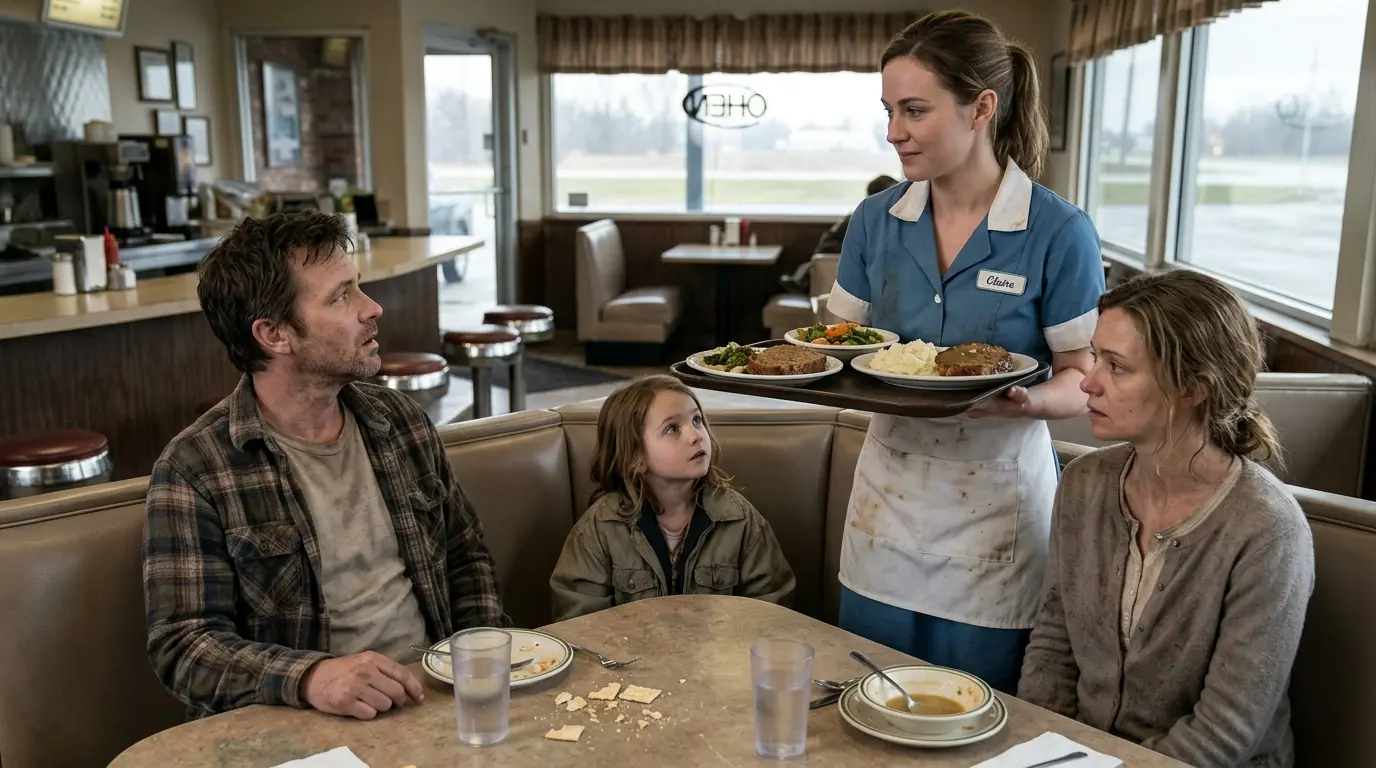
“Hi. I’m Claire. Can I start you with anything besides water?” The father looked up quickly.
He was maybe thirty-eight, with work-worn hands, a faded denim shirt, and the exhausted face of someone who had been losing sleep for weeks. “We’re still deciding.” The mother gave him a brief glance. “We can order now.”
He hesitated, then nodded. “One bowl of chicken noodle soup,” the mother said. “And one grilled cheese.” Claire looked at the three of them.
The father noticed. “We’ll get extra plates,” he added. “That’s enough.” The little girl kept her eyes on the crackers.
Claire had served people who split meals before. There was nothing shameful about it. But something about the father’s expression told her this was not thrift or preference. It was arithmetic.
He knew exactly how much money was in his wallet, exactly how much gas was left in their car, exactly how many nights remained before another bill came due. “Anything else?” Claire asked softly. “No, thank you,” the mother said.
Claire wrote the order, then glanced at the girl. “What’s your name?” “Sophie.” “You like grilled cheese, Sophie?”
The girl nodded. “What about pie?” Sophie’s eyes flickered toward the glass dessert case near the register before returning to the table. “I’m okay.”
That answer stayed with Claire all the way to the kitchen. Willow Creek Diner sat off State Route 18 outside Dayton, Ohio, in a low brick building with green awnings, a chrome-edged counter, and booths that had been reupholstered so many times nobody remembered the original color. Claire had worked there for six years. She knew which regular wanted decaf before he sat down, which construction crew tipped in cash, which elderly couple shared one slice of lemon meringue every Wednesday, and which customers came in mainly because they needed somewhere warm to sit.
She also knew exactly how much money she had in her apron pocket. Thirty-seven dollars in tips from the morning shift. Rent was due in nine days. Her old Honda needed front brake pads.
The electric company had sent a notice she was pretending not to worry about. Claire was not poor in the dramatic sense, but every month was a careful bridge she crossed without looking down. Still, she remembered being twelve and watching her mother tell a grocery cashier to put back milk because there was not enough money for both milk and the electric bill. She remembered pretending she did not want cereal for the rest of the week.
She remembered her mother eating toast for dinner three nights in a row and insisting she simply liked toast. Claire looked through the kitchen window toward Sophie. The girl had opened a second cracker. “Tom,” Claire called.
The cook glanced over. “What?” “I need a favor.” Tom Reynolds had worked the grill at Willow Creek longer than Claire had been alive.
He was sixty-one, broad as a refrigerator, permanently skeptical, and secretly incapable of saying no to anyone who genuinely needed help. Claire explained. Tom looked through the window. “Corner booth?”
“Yeah.” He stared for a second, then wiped his hands on a towel. “What are you thinking?” “Three chicken dinners.