By the time Lillian Parker reached Great Bend, Kansas, she had seven quilts left, fourteen dollars hidden in her boot, and nowhere in the world she could go without being afraid. The road behind her was a long brown ribbon of hunger, dust, and doors closing in her face. The road ahead looked worse, because she could no longer pretend it led somewhere certain. Still, she sat straight on the wagon bench, holding the reins with tired hands, because if defeat ever came for her, she meant to meet it upright.
Her old mare, Juniper, moved slowly beneath the July sun, each step raising pale dust around the wagon wheels. The prairie shimmered around them, wide and merciless, stretching so far that the horizon looked like it might swallow a person whole. Lillian wore a faded blue traveling dress, a gray-blue bonnet, split gloves, and the expression of a young woman who had learned not to ask the world for gentleness. Behind her, tied beneath a canvas tarp, lay the last seven quilts her mother had ever made.
Those quilts were not just bedding. They were pieces of dresses worn to church, scraps from flour sacks, strips from her father’s shirts before sorrow changed him, and bits of Lillian’s childhood pinafores. Every patch had passed beneath her mother Eleanor Parker’s needle, and Eleanor had never sewn anything without putting a prayer into it. Selling them felt like cutting up her own heart and handing the pieces to strangers for coins.
Lillian had started with twenty-two quilts after her father died in Missouri that spring. Caleb Parker had once been a laughing man who carried his daughter on his shoulders through the corn rows, but grief had turned him into someone smaller and meaner. After Eleanor died, he drank away seed money, borrowed against tools, signed bad notes, and left behind debts that men came smiling to collect. By the time the creditors finished with the farm, Lillian owned one wagon, one mare, one sewing basket, her mother’s Bible, and the quilts.
Men had been advising her ever since, which usually meant telling her how to surrender. One widower suggested she marry him because he needed a young wife to tend his house and his grown sons. A shopkeeper offered half what the quilts were worth and told her a woman alone should learn not to be proud. Lillian walked out hungry that day, but she walked out with her head high, because pride was cheaper to carry than shame.
Great Bend rose from the prairie in a rough line of wooden storefronts, hitching rails, wagons, and men watching from shaded porches. The town smelled of horses, dust, hot boards, and new money trying to become respectable. Lillian stopped near the general store and climbed down from the wagon slowly, every muscle aching from the road. She untied the tarp and pulled out one quilt, a red, blue, and cream star pattern her mother had finished the winter before the sickness came.
For a moment, she held it against her chest and closed her eyes. She could almost hear her mother’s voice beside the stove, saying that a quilt remembered every sorrow survived beneath it. Lillian pressed her fingers into the stitches, then forced herself to unfold it over the wagon side. If memory had to be sold, she would at least make sure it was seen properly before it went.
The first man who stopped looked at the quilt as if judging a horse’s teeth. He rubbed the fabric between two fingers, pulled at one corner, and asked if she would take three dollars. Lillian told him the price was ten, though even ten felt like an insult to her mother’s hands. He laughed and said no quilt was worth that unless it came with a wife to spread it.
Lillian folded the quilt before her anger could show too plainly. “Then you may go find yourself a cheaper blanket and a poorer joke,” she said. The man’s smile vanished, and two nearby boys snickered before pretending not to. Lillian’s knees trembled under her skirt, but her voice had stayed steady, and that mattered more than anyone else knew.
Jonas Harlan saw her from across the street while leaving the blacksmith’s shop. He was twenty-nine, tall, sun-browned, and broad from years of ranch work, with a hat pulled low over thoughtful eyes. The Harlan ranch sat six miles outside town, not the richest in the county but one of the steadiest. Jonas had come for horseshoe nails and a repaired bit, but the sight of the young woman standing beside the quilt-covered wagon stopped him before he reached his horse.
At first, he noticed the quilts. They hung from the wagon like pieces of stained glass made soft, their colors faded but carefully matched, their stitching too exact to be careless work. Then he noticed the woman standing beside them with both hands clasped in front of her, her face calm in a way that looked practiced rather than natural. Men had been bargaining at her like she was desperate, and Jonas could tell from twenty feet away that desperate was exactly what she was trying not to look.
He crossed the street slowly, not wanting to startle her. Lillian saw him coming and straightened, her fingers tightening at her waist. Jonas removed his hat before speaking, which surprised her enough to make her blink. “Afternoon, miss,” he said. “Are these yours?”
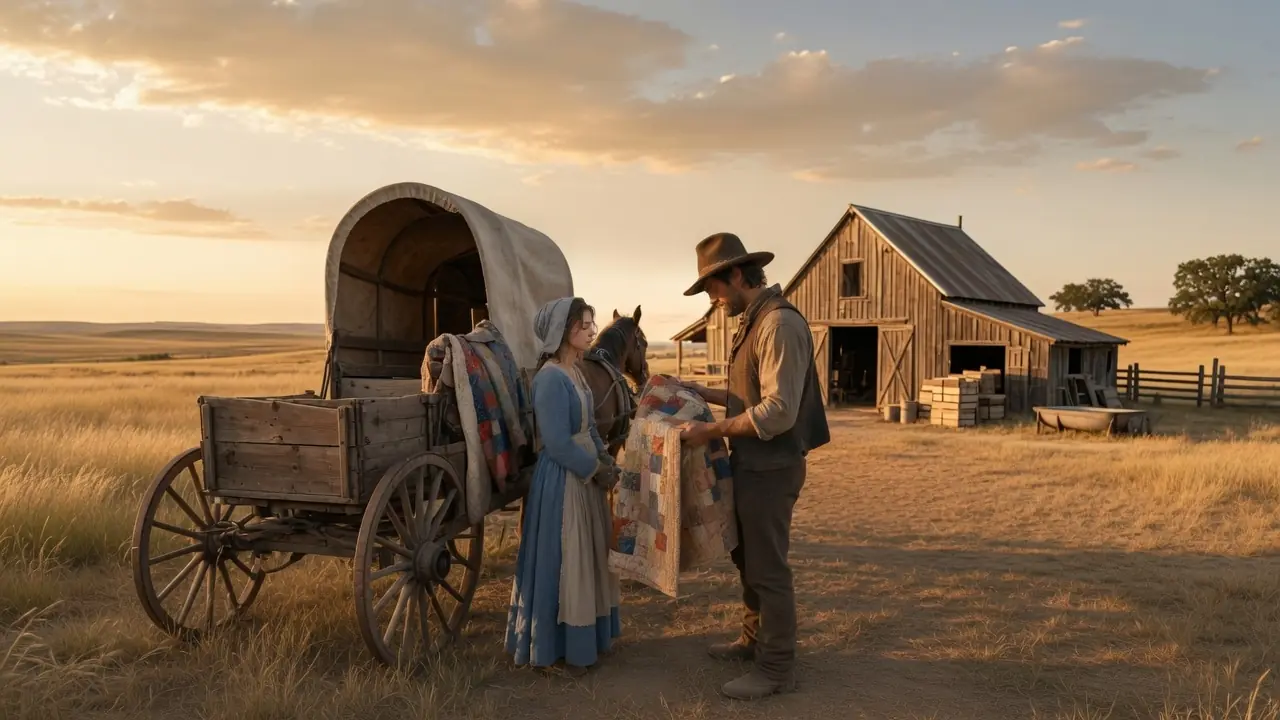
“My mother’s work,” Lillian replied. “Mine to sell now.” Her voice held a small warning, the kind a woman uses when she has already been cornered too often in one day. Jonas understood enough not to touch the quilt without permission. He looked at the star pattern draped over the wagon and said, “May I?”
Lillian hesitated, then nodded. Jonas lifted the quilt with both hands, careful not to drag it against the wagon wheel. The cloth was worn but clean, its seams small and even, its colors arranged with a patience that made his throat tighten unexpectedly. He had slept beneath factory blankets, army blankets, ranch blankets, and rough wool that scratched like burrs, but he had never held anything that felt so much like someone had meant comfort on purpose.
“Who stitched this much sorrow into something so beautiful?” he asked softly. Lillian’s mouth tightened, and her eyes dropped to the dust. “My mother did, sir,” she said. “They’re all I have left.” Jonas looked at her then, really looked, and saw the exhaustion beneath her pride.
“How many?” he asked. Lillian swallowed and glanced at the wagon. “Seven.” Jonas folded the quilt against his chest as if holding something breakable. “What are you asking for them?” he said.
Lillian gave the number before fear could lower it. “Ten dollars each.” A man behind them laughed under his breath and muttered that she must think she was selling silk from Paris. Jonas turned his head just enough to make the man find sudden interest in his boots. Then Jonas reached into his coat and pulled out his money pouch.
“I’ll buy every one,” he said. Lillian stared at him. For a second, the street sound seemed to fade, leaving only the creak of the wagon and Juniper’s slow breathing. “Every one?” she whispered.
“Every one,” Jonas repeated. Lillian’s face went pale, not with joy but with alarm. She took one step back, her hands twisting together. “If there is some condition tied to that kindness, say it before I take your money.”
Jonas did not look offended. He only nodded once, as if her suspicion deserved respect. “No condition,” he said. “I have a ranch house with empty beds, cold rooms, and hired men sleeping under thin covers when winter comes.” He looked down at the quilt again. “But I will not pretend I am only buying cloth.”
Lillian’s eyes sharpened. “Then what are you buying?” Jonas folded the quilt carefully and handed it back so she could decide whether to continue. “A woman’s work,” he said. “A mother’s memory. And maybe a chance to keep both from being mocked in this street.”
That answer broke something in her, though she tried to hide it. Her lashes lowered, and her mouth trembled before she pressed it flat. She turned to the wagon and began unfolding the other quilts with hands that would not stay steady. Jonas did not rush her, did not reach over her, and did not bargain.
One by one, Lillian showed him the quilts. There was a wedding-ring pattern made from flour sacks and dress scraps, a blue and white piece her mother had called Winter River, and a small child’s quilt Lillian almost could not unfold. She explained none of them at first, but as Jonas listened without interrupting, small pieces of their history slipped out. That square was from her mother’s Sunday dress; that strip came from her father’s work shirt; that pale blue patch had once been part of Lillian’s baby blanket.
When the last quilt was folded, Jonas counted out seventy dollars. Lillian stared at the money in his palm as if it were something dangerous. It was more than she had held at one time since the farm sale. It was enough to buy food, repairs, lodging, and a few more days of believing she might survive.
She took it slowly. Her gloved fingers brushed his palm, and Jonas felt the tremor in them. “Thank you, Mr…” she began. “Harlan,” he said. “Jonas Harlan.”
“Lillian Parker,” she replied. She tucked the money into the small inner pocket she had sewn beneath her bodice, not trusting the purse at her waist. Then she looked at the empty wagon side where the quilts had hung and seemed suddenly smaller. The sale had saved her, but it had also stripped the last color from her journey.
Jonas saw it. “Where are you headed, Miss Parker?” he asked. Lillian lifted her chin, but her eyes moved away from his. “West,” she said. “That is not a place,” Jonas replied gently. “It is a direction.”
A flicker of pain crossed her face. “A direction is more than some people have.” Jonas accepted the correction because it was true. He looked toward the livery, then back at Juniper, whose ribs showed faintly beneath her hide. “Your mare needs rest,” he said. “So do you.”
Lillian’s shoulders tightened. “I can pay for lodging now.” “I did not say you could not,” Jonas answered. “I said you need rest.” He paused, choosing the next words carefully. “My ranch is six miles out. There is a small back room off the kitchen, clean and unused, and my housekeeper left last spring to live with her sister.”
Lillian’s eyes narrowed, and Jonas knew exactly what she thought. Too many men had wrapped bad intentions in practical offers. “I am offering paid work,” he said before she could speak. “Cooking if you know it, sewing if you prefer it, accounts if you can keep them, and no locked doors except the one on your own room.”
She looked at him for a long moment. Dust moved between them, and a wagon rolled past with a clatter of wheels. “Why?” she asked. Jonas looked at the quilts now stacked carefully in his arms. “Because a woman carrying home on her wagon deserves a place to stay,” he said. “And because I know what empty rooms can do to a person.”
Lillian should have refused. Every lesson the road had taught her told her to keep moving, because a roof offered too quickly could become a cage. Yet Juniper’s head hung low, and Lillian’s own bones felt hollow with exhaustion. More than that, something in Jonas Harlan’s face did not reach for her weakness; it stood beside it and waited.
“I will work for wages,” she said. “I will not be kept.” Jonas nodded. “Good. I have no use for anyone who can be kept.” The corner of his mouth shifted, almost a smile. “Come see the place, and if it does not suit you, I will drive you back myself.”
They reached the Harlan ranch as the sun lowered over the prairie. The house was larger than Lillian expected, weathered but sturdy, with a wide porch, a stone chimney, and cottonwoods leaning near the well. The barns stood clean, the fences straight, and cattle moved like dark shapes in the distance. It looked like a place built by people who expected tomorrow to arrive.
Jonas carried the quilts inside himself. He did not hand them off to a ranch hand or toss them over a chair. He laid them one by one across the backs of empty beds, over trunks, and across a long bench beneath the sitting room window. As the colors spread through the house, the rooms changed. What had felt plain and masculine suddenly looked remembered.
Lillian stood in the doorway, watching him handle her mother’s work with reverence. Her throat tightened so painfully she had to look away. “You do not need to place them like that,” she said. “They are yours now.” Jonas looked up from smoothing the edge of the blue quilt. “Paid for does not mean stripped of meaning.”
That night, Lillian slept in the small back room off the kitchen with a bolt on the inside of the door. She placed her mother’s Bible on the washstand, her sewing basket beside the bed, and her fourteen dollars from the boot beneath the mattress out of habit. The room smelled of clean sheets, pine boards, and unfamiliar safety. She lay awake a long time, afraid to trust the quiet.
Morning came with roosters, hoofbeats, and the smell of coffee. Lillian rose before anyone called, braided her hair, and went to the kitchen. She found flour, cornmeal, bacon, dried apples, beans, coffee, and enough supplies to feed a proper table if someone cared to do it right. Caring was one thing she still knew how to do.
By seven, biscuits browned in the oven, bacon snapped in the pan, and coffee filled the kitchen with steam. The ranch hands came in slowly, stopping at the door as if they had entered the wrong house. Jonas followed them, hat in hand, and his eyes moved from the table to Lillian. She stood beside the stove with flour on her sleeve and a guarded expression on her face.
A young hand named Caleb Pike grinned. “Boss, did we get rich overnight?” The older foreman, Martin Vale, nudged him hard enough to quiet him. Jonas sat down without taking his eyes off the table. “No,” he said. “We got fed properly.”
Lillian served them without smiling, but she watched every plate. Men who had eaten too fast for years slowed down without realizing it. Jonas took one bite of biscuit, then looked toward the hallway where the quilts lay in the sitting room. He understood then that the same hands that stitched memory into cloth had now put warmth into his kitchen.
The days began to find a rhythm. Lillian cooked breakfast and supper, mended shirts, patched saddle blankets, organized pantry shelves, and repaired two torn quilts that had belonged to Jonas’s mother. She was careful to earn every dollar before it was paid, because pride was not something she could afford to lose. Jonas paid her every Saturday in exact coins and never once called it charity.
The quilts became part of the house. The red star quilt lay across the bed in the guest room, where traveling cattle buyers slept and woke surprised by comfort. Winter River hung over the back of the sitting room settle. The child’s quilt, the one Lillian could barely look at, Jonas placed folded inside a cedar chest after asking permission to keep it safe from dust.
That asking mattered to her more than he knew. Men had taken decisions from Lillian for months, sometimes with smiles, sometimes with threats, and sometimes with the law on their side. Jonas asked before moving her mother’s work, before changing the kitchen shelves, before hitching Juniper to a lighter cart so the mare could rest. Each question put one small brick back into the wall of her dignity.
In town, talk came quickly. Some said Jonas Harlan had bought more than quilts that day. Some said Lillian Parker must have known how to catch a rancher’s eye, and others said a young woman alone never stayed innocent for long. Lillian heard the whispers at the mercantile while buying salt and yeast, and each word struck like grit under the skin. She returned to the ranch pale and silent, holding herself together with both hands.
Jonas found her in the pantry counting flour sacks twice because her mind had slipped. “What happened?” he asked. She did not answer at first. Then she said, “A man can offer work and still keep his good name. A woman accepting it risks hers every day.”
Jonas went still. He had known people would talk, but he had not understood the full weight of it until her voice forced him to see it. “Tell me who spoke,” he said. Lillian shook her head. “If I name every mouth that wounds me, I will spend my life pointing.”
The next Sunday, Jonas drove her into town in the good wagon. Lillian wore her clean blue dress and sat straight beside him, though her gloved hands were locked together in her lap. At the church steps, several women turned to stare, and one man smirked near the hitching rail. Jonas helped Lillian down as if she were a lady arriving at a governor’s dinner.
Mrs. Ada Finch, who ruled most town opinions from the shade of her church bonnet, lifted her chin. “Mr. Harlan,” she said, “how generous of you to bring your sewing girl to service.” Lillian’s face tightened. Jonas kept his voice calm, but every man nearby heard the steel beneath it. “Miss Parker is not my sewing girl. She is the woman whose work keeps my ranch clothed, fed, and decent.”
The words traveled farther than the church bell. By evening, half of Great Bend knew Jonas Harlan had corrected Ada Finch in public. Some laughed, some disapproved, and some quietly admired him for it. Lillian said nothing on the ride home, but once they reached the ranch, she stood beside Juniper and wiped her eyes with the heel of her hand.
“You should not have done that for me,” she said. Jonas unhitched the mare slowly, giving her time to steady herself. “Yes,” he said. “I should have done it sooner.” Lillian looked at him then, and something between them shifted so softly that neither dared name it.
Summer deepened, and the ranch grew around her presence. The hands became cleaner at meals, the accounts sharper, the pantry fuller, and the house less hollow. Jonas came in earlier from the range and found reasons to linger in the kitchen doorway. Sometimes Lillian would catch him looking at one of the quilts and then at her, as if trying to understand how one person could carry so much loss and still make beauty.
One evening, a storm gathered over the prairie while Lillian sat on the porch mending a tear in the red star quilt. Jonas came out and sat on the steps, leaving space between them. The wind smelled of rain, and lightning flickered far off beyond the cattle pens. For a while, the only sound was needle through cloth.
“My mother made that after my father sold our good cow,” Lillian said suddenly. Jonas turned his head but did not interrupt. “She had no money for new fabric, so she used scraps from things we had already worn out. She told me poor people had to be careful not to believe worn-out meant worthless.” Her fingers paused over the stitches. “I think she was talking about more than cloth.”
Jonas looked out at the darkening fields. “She sounds wise.” Lillian’s smile broke quickly and vanished. “She was tired,” she said. “But sometimes tired women become wise because no one else will save the day.”
That was the night Jonas began to fall in love with her in a way that frightened him. Not because she was pretty, though she was, especially when concentration softened her mouth. Not because she could cook, sew, count, and manage a house better than anyone he had known. He loved her because she stood in the ruins of what life had taken and still insisted on making something warm.
The trouble came in September, when a man named Silas Bruner arrived from Missouri. He rode into the Harlan yard with dust on his coat, a curled lip, and a folded paper he claimed gave him legal interest in Lillian’s remaining property. Jonas was near the barn when Lillian stepped onto the porch and went white. Silas smiled when he saw her fear.
“Miss Parker,” Silas called. “You left debts behind.” Lillian gripped the porch rail so hard her knuckles blanched. “My father’s debts were settled when the farm sold,” she said. Silas waved the paper. “Not all of them. Those quilts belonged to his estate, and I have a claim.”
Jonas came forward before Lillian could answer, but she lifted a hand slightly to stop him. Her fear was visible, but so was anger. “You watched those men take everything,” she said. “You stood in my yard and offered two dollars for my mother’s wedding quilt.” Silas’s smile turned cruel. “And now I hear they brought a better price.”
The ranch hands gathered slowly, silent but attentive. Jonas looked at the paper in Silas’s hand and then at Lillian. “Do you know anything about this claim?” he asked her. Lillian swallowed. “It is false,” she said. “But false papers have beaten poor women before.”
Jonas took one step closer to Silas. “Not on my land.” His voice was low enough that no one mistook it for bluster. “Those quilts were sold lawfully by Miss Parker, and I have a bill of sale signed in town.” Silas blinked, surprised because men like him never expected careful paperwork from people they meant to frighten.
Lillian turned toward Jonas, stunned. “You kept it?” she whispered. Jonas looked at her. “I keep proof when something matters.” Then he sent Martin to fetch the document from his desk. Silas’s confidence cracked when the signed paper appeared, witnessed by the general store clerk and dated properly.
“You think this ends it?” Silas snapped. “A woman like her will cost you more than quilts.” Jonas stepped close enough that Silas took half a step back. “A man like you always says the price of decency is too high,” Jonas said. “That is because you have never paid it.”
Silas left with threats that sounded thinner the farther he rode. Lillian stood on the porch until the dust behind him disappeared. Then her knees weakened, and Jonas moved toward her but stopped short, letting her choose. She looked at him with tears in her eyes and stepped into his arms.
For the first time since they met, Lillian let someone hold her while she trembled. Jonas did not speak, because the moment had no need of words. The quilts behind them hung in the open windows, stirred by the wind, bright patches moving like small flags of memory. Lillian pressed her forehead against his vest and whispered, “I am so tired of being hunted for what little I kept.”
Jonas’s hand rested carefully against her back. “Then stop running,” he said. She closed her eyes. “I do not know how.” His voice softened. “Then learn here.”
After that day, the ranch no longer felt like temporary shelter to Lillian. She still kept wages in a hidden pouch, still checked the lock on her door, still folded her few belongings carefully in case leaving became necessary. But slowly, leaving stopped being the first plan her mind made. She planted late herbs in a box outside the kitchen, mended curtains, and moved her mother’s Bible from the washstand to the sitting room table.
Autumn came with cooler mornings and gold grass. Jonas began walking with her after supper, first to check on Juniper, then to the well, then along the fence where the prairie opened wide. Their conversations grew from practical matters into stories. He told her about his father’s sternness, his mother’s laughter, and the winter he nearly lost the ranch to debt before learning which neighbors could be trusted.
Lillian told him about Eleanor’s singing, Caleb’s goodness before grief, and the little farm in Missouri that had smelled of lilacs in spring. She did not hide the ugly parts, but she did not let them be the whole story either. Jonas listened as if every word mattered. That was what undid her most.
One evening, he brought the child’s quilt from the cedar chest and placed it in her hands. “I have kept this safe,” he said. Lillian’s breath caught when she saw it. “This was mine,” she whispered. “Mama made it when I was born.”
“I know,” Jonas said. “You told me without meaning to.” She looked at the soft worn patches, the little blue squares faded almost white, and the stitched border her mother had sewn by lamplight. Then Jonas said the words that changed everything. “I bought this one, but it belongs with you.”
Lillian shook her head, tears rising. “You paid fairly.” “I paid for all seven because you needed money and I wanted them protected,” Jonas said. “But a man can own a thing and still understand where its heart lives.” He placed the quilt fully into her arms. “Keep it, Lillian.”
She clutched it against her chest, and the grief came hard. Jonas stood quietly while she cried, not trying to fix what could only be honored. When she finally looked up, her face was wet but peaceful in a way he had never seen before. “You gave me back my mother,” she whispered.
“No,” Jonas said. “She never left you.” His own voice roughened as he looked at the quilt between them. “I only moved one piece of her closer.”
Winter arrived early that year, covering the prairie in pale frost and making the ranch house glow with lamplight. Lillian’s quilts warmed beds in every room, but the child’s quilt stayed folded at the foot of her own bed. Jonas never entered her room, but he knew it was there, and knowing made him glad. A memory returned to its rightful keeper had a way of blessing the whole house.
Near Christmas, Jonas asked Lillian to ride with him to the ridge beyond the north pasture. The air was cold enough to redden her cheeks, and Juniper moved beside Jonas’s gelding with renewed strength after months of good feed. They stopped where the land rolled open beneath them, the ranch spread below like a promise made in wood, smoke, cattle, and light. Lillian looked at it and realized she no longer saw a temporary stop.
Jonas removed his hat. “I have been trying to think of a proper way to say this,” he began. Lillian’s hands tightened around the reins, because his voice had gone careful in the way men speak before stepping off a ledge. He looked more nervous than he had facing Silas Bruner. That made her heart ache with tenderness.
“I bought your quilts because I saw beauty,” Jonas said. “I asked you to stay because I saw courage.” He turned toward her fully. “But I love you because you have made this ranch a home without ever once asking it to forget what hurt came before.”
Lillian’s eyes filled, and her breath trembled in the cold air. “Jonas,” she whispered. He reached into his coat and pulled out a small folded square of fabric. It was a piece from one of her mother’s quilts, a loose scrap she had kept in her sewing basket, now wrapped around a simple gold ring.
“I will not ask you to stay because you have nowhere else,” he said. “I will only ask if this is where you want to belong.” Lillian looked from the ring to the ranch below and then to the man who had never tried to buy her pride with kindness. Her tears slipped free, but she smiled through them. “Yes,” she said. “This is where I want to belong.”
They married in spring beneath the cottonwoods, with Juniper grazing nearby and the quilts hung along the porch rail like banners of every sorrow survived. The whole ranch came, and half the town stood quieter than usual, as if even gossip had enough sense to bow its head. Lillian wore a blue dress she had sewn herself, with a small patch from her mother’s wedding quilt stitched inside the hem where only she could feel it. Jonas held her hands as if they were worth more than land, cattle, or any treasure he had ever owned.
Years later, when children filled the Harlan house with noise, Lillian would tell them that quilts remember. She would show them the red star, Winter River, the wedding-ring pattern, and the child’s quilt that had once left and come back. Jonas would stand in the doorway listening, smiling quietly as she turned cloth into history and history into love. He never tired of hearing it.
The quilts were no longer all Lillian had left. They were the beginning of what she had found. They covered beds, warmed children, welcomed guests, and hung in sunlight as proof that broken lives could be stitched into something whole again. And every time Jonas touched one, he remembered the dusty edge of Great Bend, where a frightened young woman had tried to sell her last pieces of home, and he had been wise enough to buy them only so he could help her keep them.