Samuel Carter had spent most of Saturday morning trying not to look at the empty chair beneath the old oak tree. He had set out white tablecloths, blue hydrangeas, trays of fried chicken, collard greens, cornbread, deviled eggs, and the peach cobbler his wife Elaine had requested every birthday for almost forty years. Nine months had passed since cancer took her, and the lunch in his backyard was supposed to be a quiet gathering for the family on what would have been her seventieth birthday. Samuel had told everyone he was ready for it, although the untouched chair beside Elaine’s photograph suggested otherwise.
The house on Alder Ridge Lane was still new to him, even though he had owned it for nearly half a year. Samuel and Elaine had chosen it together because their daughter Renee lived twenty minutes away and because Elaine wanted a backyard large enough for grandchildren, flowerbeds, and Sunday meals that lasted until sunset. She became too sick to move in, leaving Samuel to enter the house alone after the funeral with boxes labeled in her handwriting. He had been learning ever since that a house could be full of belongings and still feel empty.
Samuel was sixty-seven, tall, broad-shouldered despite the slight stoop age had begun adding to him, and the silver in his closely cropped hair made strangers assume he was older than he felt. He dressed simply that morning in tan trousers, a pale blue shirt, brown shoes, and a charcoal cardigan Elaine had bought him because she said he wore too many dark jackets. Nothing about him suggested the kind of life he had lived before moving to Ashford Meadows, and Samuel rarely volunteered information people had not earned by asking. In retirement, anonymity had become one of the few luxuries he valued.
Most of the neighborhood had not bothered to learn much about him either. People had seen moving trucks, contractors, painters, and landscapers around the property, and because Samuel often worked beside them instead of watching from inside, several neighbors quietly assumed he was part of the hired crew. He heard about that misunderstanding only after a delivery driver once asked whether the owners were home while Samuel stood holding his own front-door key. Samuel had laughed then, because being underestimated was sometimes easier than being constantly examined.
Margaret Whitcomb did not laugh when she discovered the truth. She lived next door in a six-bedroom brick home and had served for years on the Ashford Meadows homeowners association, where she had developed a reputation for noticing trash bins left out too long, unauthorized fence stains, parked service vans, and holiday decorations that stayed up beyond the dates she considered tasteful. Margaret described herself as someone willing to protect standards when everyone else was afraid of confrontation. Several neighbors described her more quietly as someone who confused involvement with ownership.
The first time Margaret saw Samuel, he was carrying boxes from a rental truck while two Black movers worked beside him. She assumed he belonged to the moving company and waved without introducing herself. A week later she saw him trimming hedges and assumed the new owners had hired a groundskeeper. When she later saw him carrying a toolbox along the side fence, her mind did not revise the picture it had already built.
Their first actual conversation occurred when Margaret entered his side yard holding a clipboard. Samuel was replacing one weather-damaged board in the fence, and Margaret told him workers were not permitted to alter visible structures without owner authorization. Samuel rested the drill against his knee and said, “I am the owner.” Margaret stared at him long enough for the silence to become uncomfortable.
She eventually laughed as though he had made an unexpected joke. Samuel did not join her, so Margaret asked whether he meant he worked for the owner or represented the trust listed in county records. “The trust is mine,” Samuel explained, then returned to the fence. Margaret apologized, but her apology consisted mostly of explaining why her mistake had been reasonable.
After that, the relationship settled into a pattern Samuel found annoying but manageable. Margaret sent him emails about contractor parking, temporary trash containers, hedge height, a delivery van, and one landscaper who had eaten lunch on Samuel’s front steps. Every complaint either turned out to involve no actual violation or disappeared once Samuel supplied documentation. Margaret began telling other board members that Samuel was “difficult” because he always seemed to have an answer.
Samuel barely thought about her outside those exchanges. His life was already crowded by grief, grandchildren, paperwork, medical bills that kept arriving after the patient was gone, and the strange administrative business of dismantling a marriage without ending the love inside it. Elaine had been the person who remembered birthdays, mailed thank-you cards, argued with utility companies, kept track of relatives, and knew exactly which cupboard contained things Samuel had been looking at for ten minutes. Without her, he sometimes spent entire mornings completing tasks that she would have solved before breakfast.
That was partly why the birthday lunch mattered so much. Renee had suggested they gather at a restaurant, but Samuel wanted Elaine remembered inside the home she had chosen. His son Daniel arranged enlarged photographs, Elaine’s closest friend Patrice planned the menu, and grandchildren wrote short memories on blue cards that would be collected in a wooden box. Samuel’s only job was to let people come.
He almost canceled the night before. At two in the morning he walked downstairs, saw Elaine’s photograph waiting on the dining-room table, and decided that celebrating a birthday without the person seemed cruel rather than healing. He called Renee, expecting voicemail, but she answered on the second ring and listened without interrupting. “Dad,” she finally said, “you don’t have to enjoy tomorrow; you just have to let us miss her with you.”
By ten thirty the next morning, Samuel had accepted that advice. The caterer finished arranging food beneath the oak tree, the florist placed blue hydrangeas between the serving dishes, and Samuel moved Elaine’s framed photograph beside the lemon pound cake she used to pretend she had baked herself. The photograph showed her laughing on a beach in South Carolina with her hair blown across her face. Samuel touched the edge of the frame and whispered, “You would complain about the flowers being too expensive.”
Margaret saw the catering van from her kitchen window. She watched two employees carry trays through Samuel’s side gate, then noticed the canopy and folding tables appearing beneath the trees. Her first thought was that Samuel might be hosting some kind of paid event, which the association restricted under certain circumstances. Instead of calling the management company or checking whether any rule actually applied, Margaret walked next door to investigate personally.
She entered through the side gate without knocking. Samuel was adjusting a stack of plates when he heard her heels on the patio and turned. Margaret surveyed the tables and asked, “What exactly is happening here?” Samuel answered, “Family lunch.”
Margaret pointed toward the serving trays. “You can’t operate a commercial event from a residence.” Samuel looked at the photograph beside the cake, then back at her. “I’m not operating anything; this is for my wife.” Margaret barely looked at the photograph before asking how many guests he expected.
“Family,” Samuel said. Margaret asked again, more sharply, “How many?” Samuel counted mentally and replied, “Maybe twenty-eight if everybody comes.” Margaret folded her arms and said gatherings that size required notice.
Samuel knew the rules because Margaret’s previous complaints had motivated him to read them carefully. “No, they don’t,” he said. “Guest parking cannot block fire access, and amplified music has time limits, but a private lunch doesn’t require your permission.” Margaret’s face tightened because Samuel had answered too quickly for her to regain control of the conversation.
“You’re always determined to challenge the association,” she said. Samuel replied, “I’m determined to finish arranging this table before my family arrives.” Margaret took another look around and asked whether the homeowners had approved the event. Samuel stared at her for several seconds before saying, “Margaret, we have already had this conversation.”
She seemed confused until recognition finally returned. “Oh,” she said, then glanced toward the house as though some additional homeowner might appear to confirm it. Samuel noticed the hesitation and felt his patience thinning. “Yes,” he said quietly, “I live here.”
Margaret recovered by becoming more formal. She said long-term residents had a responsibility to protect the neighborhood from unauthorized activity and reminded Samuel that she had lived in Ashford Meadows for twenty-three years. Samuel answered, “And I own this property today.” Margaret told him he did not need to be condescending.
Samuel put down the stack of plates. “I’m going to say this once, because my family will be arriving soon and I’m not spending the morning arguing about my wife’s memorial lunch.” Margaret’s eyes moved toward Elaine’s photograph for the first time. Samuel continued, “There is no association violation here, and I would like you to leave my yard.”
Margaret’s expression changed. “You cannot order the HOA president away while I’m investigating a compliance issue.” Samuel remained still. “You are not conducting an official inspection, there was no notice, and this is private property.”
“You think because you bought your way into this neighborhood you can tell people who have lived here for decades how things work.” Samuel’s jaw tightened. “I think the deed allows me to decide who stands in my backyard.” Margaret stepped closer, and Samuel did not move.
There were moments in Samuel’s life when anger arrived loudly, and others when it became unusually quiet. This was the second kind. He looked at Margaret and said, “Please leave.”
She stared at him, perhaps expecting another argument. Samuel simply waited. After several seconds Margaret turned and walked through the gate.
He watched her disappear, then exhaled slowly. The entire exchange had lasted fewer than five minutes, but it left him more exhausted than he wanted to admit. Samuel picked up Elaine’s photograph and wiped an invisible mark from the glass.
He texted Renee that everything was ready. She sent back a photograph of the grandchildren crowded into her kitchen, followed by a message saying they would arrive after stopping briefly at the cemetery. Samuel responded with a heart, something he had learned to use only because Elaine once complained his messages sounded like military instructions. He placed the phone beside the cake.
Four minutes later, the side gate opened again. Samuel expected one of the catering employees to have forgotten something. Instead Margaret stepped into the yard holding an aluminum baseball bat.
Samuel stared at it before looking at her face. “Why are you carrying that?” Margaret answered, “Because I’m not letting you intimidate me.” Samuel looked around the empty yard as if someone else might understand the statement better than he did.
“You left my property,” he said. “You should have stayed gone.” Margaret told him she had contacted the association manager and would not allow him to proceed with an unauthorized event.
Samuel took one slow step backward. “Put the bat down.” Margaret gripped it with both hands.
“You don’t give orders here.” Samuel said nothing for a moment, then replied, “You are standing in my backyard holding a bat.”
Margaret insisted she had brought it for protection. Samuel asked, “Protection from what?” She said, “From you.”
He almost laughed, but the sound never came. “I have not touched you, followed you, threatened you, or entered your property.” Margaret raised the bat slightly.
Samuel moved farther away. “Do not come closer.” Margaret said, “See, there you go again.”
“What?” “Threatening me.”
Samuel stared at her. “I just told the person carrying a bat not to come closer.” Margaret’s breathing became heavier.
For several seconds neither moved. The birthday table stood between them, covered with food and flowers that made the scene feel even more absurd. Samuel considered reaching for his phone, but the device was lying near the cake on the opposite side of Margaret.
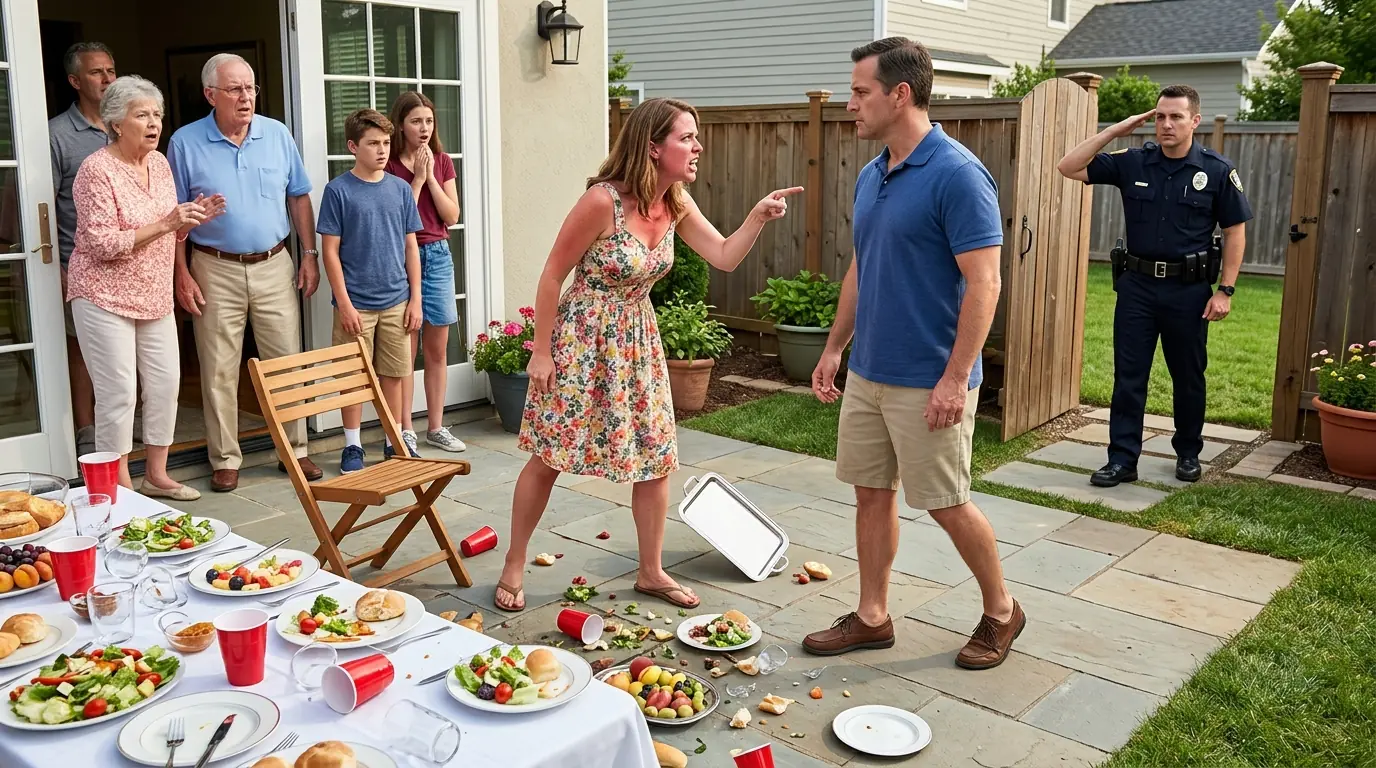
Then Margaret swung. The bat struck the edge of the buffet table with a metallic crack, shattered a ceramic serving dish, and sent pieces skittering across the patio.
Samuel stepped backward immediately. “Stop.” Margaret swung again.
The second strike landed directly in the peach cobbler. Aluminum folded, pastry burst across the tablecloth, and one of the hydrangea arrangements toppled onto the grass.
Samuel felt something inside him break in a place unrelated to the ruined food. Elaine had loved peach cobbler because her grandmother made it every summer, and Patrice had spent two days arguing with the caterer about getting the cinnamon right. Watching it collapse beneath a baseball bat felt strangely more personal than the threat against him.
“Margaret, stop.” His voice had changed now.
She knocked another tray from the table. “Maybe now you’ll listen.” Samuel stared at her.
“This was for my wife.” Margaret paused.
Samuel pointed toward the photograph. “She died nine months ago.”
For the first time, embarrassment crossed Margaret’s face. It lasted perhaps a second. Then pride covered it again.
“I didn’t know that.” Samuel replied, “You didn’t ask.”
Margaret said the memorial did not change neighborhood rules. Samuel looked at the broken dishes around her. “There was no violation before you arrived.”
“You’re twisting everything.” “No.”
“You’ve been difficult since you moved here.” Samuel answered, “You mean since I corrected you about who owns my house.”
Margaret raised the bat again. Samuel stepped behind the brick corner of the outdoor kitchen, placing solid masonry between them. “I am telling you to leave,” he said.
“You can’t threaten me and then hide behind the house.” Samuel’s eyes narrowed.
“What threat?” Margaret said his tone was threatening.
Samuel went silent. He realized there was no sentence he could produce that Margaret could not reinterpret once she had decided his resistance itself was dangerous.
She pulled out her phone. “Fine, we’ll let the police handle it.”
Samuel almost said that was the best idea she had offered all morning. Instead he stayed behind the brick island and watched her dial. Margaret placed the call on speaker unintentionally while moving the phone against her ear.
“911, what is the address of your emergency?” The dispatcher’s voice sounded calm.
Margaret gave Samuel’s address. “There’s a man here who does not belong on this property, and he’s becoming aggressive.”
Samuel closed his eyes. The transformation was complete.
The dispatcher asked whether Margaret lived at the address. She said, “I’m next door, but I’m the homeowners association president.” The dispatcher repeated the question.
“No, I don’t live in this house.” “Who does?”
Margaret looked toward Samuel. “I’m trying to determine that.”
Samuel nearly spoke but stopped himself. The dispatcher asked whether the man had entered the house.
“No.” “Is he trying to enter?”
“He says he lives here.” The dispatcher paused.
“Do you have information showing he doesn’t?” Margaret hesitated.
“He’s been causing issues with the HOA.” The dispatcher returned to the immediate situation.
“Does he have a weapon?” “I don’t know.”
Samuel looked down at his empty hands. The dispatcher asked whether Margaret had a weapon.
There was a longer pause. “I have a bat.”
The dispatcher’s tone changed slightly. “Ma’am, put the bat down and create distance from him.”
“I only brought it because he intimidated me.” “Put the bat down.”
Margaret lowered it but did not release it. The dispatcher repeated the instruction.
Finally Margaret placed the bat on the grass. Samuel remained where he was.
“Do not approach him,” the dispatcher said. “Officers are on the way.”
Margaret answered, “Good.” Samuel almost agreed.
He waited until she stepped toward the far edge of the patio, then retrieved his phone. He texted Renee, Small issue with neighbor, police coming, please wait before leaving cemetery. Renee responded almost immediately.
WHAT HAPPENED? Samuel wrote, I’m fine. Stay there until I call.
Three dots appeared. Then disappeared.
Samuel knew his daughter well enough to realize she had already called Daniel. He slipped the phone into his pocket and looked toward the ruined table.
A small blue card lay beneath a broken bowl. Samuel crouched carefully and picked it up.
The handwriting belonged to his granddaughter Ava. Grandma always let me have dessert before dinner when Grandpa wasn’t looking.
Samuel smiled despite everything. He folded the card and placed it inside his shirt pocket.
Margaret watched him. “Don’t start moving evidence.”
Samuel looked at her. “It’s a note from my granddaughter.”
“You should wait until police arrive.” Samuel stared at the woman standing inside his yard after destroying his wife’s memorial lunch.
“I have waited patiently for you to become reasonable all morning.” Margaret’s face reddened.
“There, that attitude again.” Samuel looked away.
A white SUV slowed on the street. Samuel recognized his neighbor Robert Kim behind the wheel.
Robert saw police had not yet arrived, noticed Margaret in Samuel’s backyard, and pulled over. He walked toward the gate and stopped when he saw the broken tables.
“What happened?” Margaret said, “Stay out of this, Robert.”
Samuel answered, “Margaret came back with a bat.”
Robert looked down. “That bat?”
“Yes.” Margaret immediately said Samuel had threatened her.
Robert looked toward Samuel. “Did you?”
“No.” Margaret raised her voice.
“Of course he says no.” Robert stepped into the yard only after Samuel nodded.
He looked around at the damage. “Margaret, why are you on his property?”
“I’m handling a violation.” Robert stared.
“With a baseball bat?” Margaret told him not to be ridiculous.
Robert took out his phone. “I’m going to record until police get here.”
Margaret turned away. Samuel said, “Please stay back from both of us.”
Robert nodded. “Gladly.”
The first police cruiser arrived seven minutes later. A second turned onto the street just behind it.
Samuel watched them park near his driveway and felt an old instinct tell him to keep his hands visible. He did so without thinking about where the habit had come from.
Two officers stepped out. The first was a woman in her thirties with dark hair pulled into a tight bun, and the second was a broad-shouldered man perhaps several years older.
The female officer approached Margaret first because she was standing closest to the gate. “Who called?”
“I did.” Margaret pointed toward Samuel.
“That man has been threatening me and refusing to leave.” The officer looked toward the house.
“Whose property is this?” Margaret answered, “That is part of the issue.”
The officer frowned. “Do you live here?”
“Next door.” “Does he?”
“He claims he does.” Samuel said nothing.
The male officer noticed the bat on the grass. “Who owns that?”
Margaret replied, “It’s mine.”
“Did you bring it here?” “For protection.”
He looked toward the destroyed buffet. “Who did that?”
Margaret’s confidence weakened slightly. “Things got heated.”
The female officer asked again. “Who broke the table?”
“I hit it.” “With the bat?”
“Yes, but—” The officer raised one hand.
“We’ll get to the explanation.” Margaret looked irritated.
The male officer began walking toward Samuel. Samuel could see nothing unusual about him at first: county police uniform, body camera, wedding ring, closely shaved hair, an expression that looked more tired than aggressive.
“Sir, keep your hands where I can see them.” Samuel answered, “They are.”
The officer nodded. “Your name?”
“Samuel Carter.” “Do you live here?”
“Yes.” “Can you prove that?”