Arthur Bennett stood beside the entrance of the Grand Regency Hotel in Beverly Hills with his white hair neatly combed and his black vest buttoned perfectly. At seventy-two years old, he moved slower than he once had, but there was still a quiet strength in the way he stood. He wore the hotel valet uniform like it mattered, because to him, every honest job mattered. Guests passed him with designer luggage, expensive watches, and distracted smiles, most of them never realizing that the old man holding car keys had once built the entire hotel group from nothing.
Arthur had not worked as a valet because he needed the paycheck. He had returned to the hotel entrance after retirement because he wanted to see the business at ground level, where real hospitality either lived or died. In boardrooms, executives talked about service standards, guest experience, and luxury values. At the curb, Arthur saw the truth in seconds. He could tell who treated people well when no reward was waiting.
That afternoon, the hotel entrance was crowded with guests arriving for a charity gala. Black cars rolled beneath the canopy, photographers waited near the lobby doors, and hotel staff moved quickly to keep the driveway clear. Arthur greeted every guest with the same calm courtesy, whether they stepped out of a limousine or a rideshare car. He believed dignity should never depend on the price of a vehicle.
Then Evelyn Cross arrived in a black Rolls-Royce that gleamed under the clean afternoon light. She stepped out wearing a fitted black designer dress, high heels, and a gold chain purse resting against her shoulder. Her face was sharp with impatience before anyone even spoke to her. She handed Arthur the keys without looking directly at him, as if he were part of the pavement.
“Be careful with it,” Evelyn said coldly. “That car costs more than you’ll make in a lifetime.” Arthur accepted the keys with both hands and nodded. He had heard cruel remarks before, and age had taught him not every insult deserved an answer. Still, his fingers tightened slightly around the key fob.
Arthur moved toward the driver’s side, but a shuttle van pulled in too closely, forcing him to pause for safety. The delay lasted only a few seconds, but Evelyn turned instantly. “What are you doing?” she snapped, her voice cutting across the driveway. Several nearby guests glanced over, sensing trouble before they understood what had happened.
Arthur turned back toward her. “I’m waiting for the lane to clear, ma’am,” he said evenly. Evelyn stepped closer, anger flashing across her face. “I didn’t ask for a lesson,” she said. “I asked why an old valet is standing there wasting my time.”
The words struck the air hard enough to stop nearby conversations. Arthur lowered his eyes, not from shame, but from discipline. He had spent decades learning that wealthy people often confused volume with authority. Evelyn mistook his silence for fear and took another step toward him.
“You people always move like the world should wait for you,” she said. Arthur’s jaw tightened, but he kept his voice gentle. “I’m only trying to protect your vehicle.” Evelyn laughed in disbelief, the sound sharp and ugly. “Protect it? From what, your own incompetence?”
A few guests shifted uncomfortably, but no one stepped forward. One woman raised her hand to her mouth. A man near the curb looked away as if not seeing it made him innocent. Arthur noticed all of them, and the silence of the crowd hurt more than Evelyn’s words.
Evelyn reached out and grabbed his arm, pulling him slightly toward her. “Look at me when I’m talking to you,” she said through clenched teeth. Arthur did look at her then, his eyes steady and tired. He did not pull away, though the grip was humiliating in front of the entire entrance. He simply said, “Please let go, ma’am.”
Instead, Evelyn’s anger rose even higher. She moved too quickly, and the next moment left a visible red mark across Arthur’s cheek. A collective gasp moved through the hotel entrance. Arthur lowered his head, one hand briefly touching his face before falling back to his side. For one long second, nobody did anything.
Evelyn stood there breathing hard, as if she expected applause for defending her status. “Maybe now you’ll pay attention,” she said. Arthur remained silent, and that silence seemed to reveal the cruelty of the moment more clearly than any protest could have. The guests around them looked stunned, but still frozen. Power, Arthur knew, often survived because decent people waited too long to act.
Then the hotel doors burst open. Daniel Bennett rushed outside in a dark suit, his face changing the instant he saw Arthur. He had been inside the ballroom reviewing final details for the gala when a young employee ran in and told him there was a situation at the valet stand. At first, Daniel thought it was a guest complaint. Then he saw the red mark on his father’s face.
“Stop!” Daniel’s voice rang across the driveway. The entire entrance froze. Evelyn turned toward him with irritation, expecting another employee to apologize to her. Daniel crossed the space quickly and stopped beside Arthur, his eyes locked on the older man’s cheek. His hands curled into fists, but he forced them open.
Evelyn lifted her chin. “And who are you supposed to be?” she asked. Daniel slowly turned to face her. His voice was low, controlled, and shaking with anger. “That is my father.”
A ripple moved through the crowd. Evelyn looked at Arthur, then back at Daniel, and gave a sharp, nervous laugh. “Your father?” she said, backing away slightly. “Then why is a man like him touching my Rolls-Royce?” The words shocked the crowd almost as much as the slap had.
Daniel’s expression hardened. “A man like him?” he repeated. Evelyn tried to recover, but the phrase had already exposed her. Arthur gently touched Daniel’s sleeve, silently asking him not to lose control. Daniel looked at his father’s hand and swallowed the anger rising in his throat.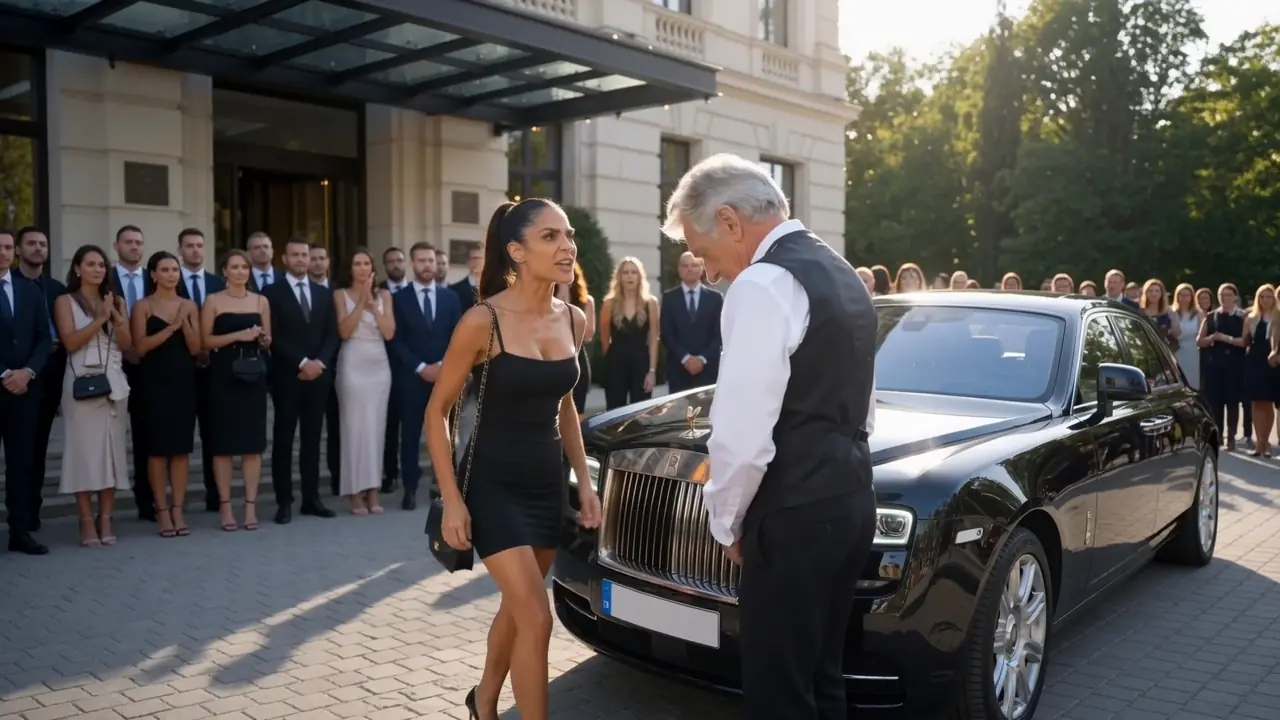
Before anyone else could speak, the hotel general manager hurried outside with two senior staff members behind him. His face went pale when he saw Arthur standing by the car. He did not rush to Evelyn, and he did not ask Daniel what happened. Instead, he went straight to Arthur and said, “Mr. Bennett, are you all right?”
Evelyn’s eyes narrowed. “Mr. Bennett?” she repeated. The manager turned to her with a seriousness that made her posture change. Around them, guests began whispering, suddenly aware that something far bigger than a rude valet dispute was unfolding. Daniel stood beside Arthur like a shield.
Arthur gave the manager a small nod. “I’m fine, Martin.” His calm voice carried more authority than any shout. Martin Caldwell, the general manager, looked deeply relieved, then deeply ashamed. He had worked for the Bennett family for fifteen years and knew exactly who Arthur was.
Evelyn glanced from face to face, confused by the respect suddenly surrounding the old valet. “What is going on?” she demanded. Daniel looked at her coldly. “You wanted to know why he was parking cars.” He stepped slightly closer, keeping his hands at his sides. “Because my father believes no job is beneath a decent person.”
Arthur sighed softly. “Daniel.” His son turned toward him, but this time Arthur did not stop him completely. The old man looked at Evelyn and the crowd, then lowered his hand from his cheek. There was no rage in his face, only disappointment.
Martin finally spoke. “Ms. Cross, this is Arthur Bennett, founder of the Bennett Regency Group.” Evelyn blinked once, as if the words had failed to reach her. Martin continued, each word clearer than the last. “He founded this hotel, this brand, and the company that owns the property you are standing in front of.”
The silence became absolute. Even the photographers stopped moving. Evelyn’s face drained of color as she stared at Arthur, the man she had insulted, grabbed, and humiliated. The valet uniform suddenly looked different to everyone watching. It was no longer a sign of smallness, but proof that greatness sometimes chooses humility on purpose.
Daniel looked at Evelyn. “He built this hotel before you were old enough to know what luxury meant,” he said. Evelyn’s lips parted, but no words came out. Her confidence had been built on the idea that people in uniforms existed below her. Now that idea was collapsing in front of dozens of witnesses.
Arthur stepped forward before Daniel could continue. “Enough,” he said quietly. Daniel stopped instantly, because he had respected that voice his entire life. Arthur turned to Evelyn, his face calm despite the mark still visible on his cheek. “I don’t need him to defend my pride.”
Evelyn swallowed hard. “I didn’t know who you were,” she whispered. Arthur nodded slowly. “That is the problem.” His answer was gentle, but it struck harder than an accusation. “You believed you did not need to know before deciding how little respect I deserved.”
Several guests lowered their eyes. Arthur looked around at them, and many seemed ashamed. He knew Evelyn had been the one speaking, but the crowd had been part of the moment too. Their silence had given cruelty room to breathe. He had seen that pattern too many times in his life.
“If I were only a valet,” Arthur said, “would your behavior have been acceptable?” Evelyn looked down at the pavement. She had no answer because the truth was obvious. Arthur continued, “That question matters more than my name.” His voice stayed soft, and somehow that made everyone listen harder.
Daniel stood beside him, still furious, but proud. His father could have destroyed Evelyn socially in one sentence. He could have ordered her banned, embarrassed her publicly, and turned the crowd against her completely. Instead, Arthur was teaching the entire entrance a lesson about dignity.
Evelyn’s hands trembled around her purse chain. “I’m sorry,” she said, but the apology sounded small and frightened. Arthur studied her carefully. “Are you sorry because you hurt someone,” he asked, “or because you discovered who that someone was?” Evelyn’s eyes lifted, glossy with shock and humiliation.
The question left her exposed. For once, there was no designer label, luxury car, or social confidence strong enough to protect her from herself. She looked at Arthur, and something in her expression changed from panic to shame. “I’m sorry because I was cruel,” she said quietly. “And because I thought I had the right to be.”
Arthur nodded once. “That is a beginning.” Daniel exhaled slowly, still not satisfied but no longer ready to explode. Martin turned toward security, preparing to remove Evelyn from the property. Arthur raised one hand slightly. “No,” he said.
Everyone looked at him. Arthur handed Evelyn her keys. “You may leave when you are ready,” he said. “But you will not attend tonight’s gala.” Evelyn stared at him. The punishment was quiet, public, and complete.
Martin immediately nodded. “Understood, Mr. Bennett.” Evelyn closed her fingers around the keys, her eyes still lowered. The Rolls-Royce no longer looked like power beside her. It looked like a mirror reflecting everything she had mistaken for worth. She turned toward the vehicle without another word.
Before she got in, Arthur spoke again. “Ms. Cross.” She stopped. He waited until she turned around fully. “A person who serves you is not beneath you. They are giving you a chance to show who you are.”
The words settled over the driveway like a final judgment. Evelyn nodded once, her face pale and humbled. She entered the car slowly, and this time no one rushed to open the door for her. She drove away under the silent gaze of guests who would never forget what they had witnessed.
After she left, the entrance remained still. Arthur looked at the crowd, then at his son. Daniel’s jaw was still tight, and his eyes were still bright with anger. Arthur placed a hand on his shoulder. “I’m all right,” he said.
Daniel shook his head. “You shouldn’t have to be all right after that.” Arthur smiled faintly. “No, I shouldn’t.” He looked toward the lobby doors. “But sometimes a painful moment teaches more people than a comfortable speech ever could.” Daniel wanted to argue, but he knew his father was right.
Martin approached carefully. “Mr. Bennett, I should have had more staff watching the entrance.” Arthur looked at him. “You should have had more staff prepared to step forward.” Martin lowered his head. That correction was worse than anger because it was true.
Within the week, Arthur changed the hotel’s training program. Every executive, manager, valet, concierge, housekeeper, server, and security employee attended a new hospitality session personally led by him. He did not begin with policies or procedures. He began with the question he had asked Evelyn: “If the person had no title, would your behavior still be acceptable?”
The story spread quietly at first, then widely. Some told it as a shocking tale of a rich woman humiliating the wrong old man. Arthur disliked that version because it made the lesson too small. To him, the point was not that Evelyn had chosen the wrong target. The point was that no target should ever have been acceptable.
Months later, Daniel asked his father why he still returned to the valet stand. Arthur smiled and adjusted his black vest. “Because the front door tells the truth,” he said. Daniel looked at him, understanding more than he wanted to admit. “And because people reveal themselves before they know anyone is watching.”
Arthur continued working occasional shifts beneath the hotel canopy. Guests who knew the story treated him with unusual reverence, but he treated them exactly as before. He opened doors, carried keys, offered directions, and greeted everyone with the same calm courtesy. His humility was not an act; it was the foundation of everything he had built.
Evelyn Cross did not disappear from the story either. Months later, she sent Arthur a handwritten letter, not through an assistant, but by mail. She wrote that she had joined a volunteer hospitality program and had begun working anonymously at a shelter kitchen once a month. Arthur read the letter twice, then placed it in his desk drawer without showing anyone.
Daniel found out later and asked if Arthur believed she had changed. Arthur thought for a long moment. “People can change when shame becomes responsibility,” he said. “But only if they stop performing regret and start practicing respect.” Daniel nodded, holding onto those words.
Years later, the Grand Regency entrance still carried the memory of that afternoon. Staff members told new employees the story during training, but not as gossip. They told it as a warning and a promise. A warning that arrogance could destroy a reputation in seconds, and a promise that dignity would always be protected at the front door.
Arthur Bennett eventually stopped valet shifts when his knees grew too tired for long afternoons. On his final day outside the hotel, the entire staff lined the driveway. Valets, housekeepers, managers, chefs, servers, security guards, and executives stood shoulder to shoulder. Arthur looked at them and laughed softly, embarrassed by the attention.
Daniel stood beside him, holding the same black vest his father had worn for years. “You built more than hotels,” Daniel said. Arthur looked at the faces around him, many of them young workers who had learned from his example. He shook his head gently. “No,” he said. “I just tried to make sure people felt welcome before anyone asked who they were.”
That became the sentence engraved near the Grand Regency staff entrance years later. Not in gold letters for guests to admire, but in simple black lettering where employees could see it every day. “Make people feel welcome before anyone asks who they are.” It was Arthur Bennett’s rule, and it outlasted him.
The world often mistakes uniforms for status and silence for weakness. Arthur knew better. He had worn the uniform by choice and carried silence like strength. The woman who humiliated him thought she was standing above an old valet, but she was really standing in front of the man who understood hospitality better than anyone she had ever met.
And that was why the moment stayed with everyone who saw it. Not because Evelyn was humbled, not because Daniel revealed the truth, and not because Arthur owned the hotel. It stayed with them because an old man who could have answered cruelty with power chose to answer it with character. Sometimes the most important person in the room is the one everybody overlooks.