Harold Johnson walked into Miller’s Market on a Saturday morning with a short grocery list folded neatly in his coat pocket. He was seventy-four years old, a retired school principal, and a man who believed small routines kept a person steady. He wore a brown cardigan over a cream shirt, khaki pants, and polished shoes that had been repaired more than once. The store was bright, busy, and full of weekend noise, with carts rattling, children laughing, and checkout scanners beeping in steady rhythm.
Harold liked shopping early because the produce was fresh and the cashiers had not yet been worn down by the day. He selected a loaf of bread, a carton of milk, a can of beans, and a small bag of apples. Nothing about his basket was unusual. He moved slowly because his knees no longer trusted sudden movements, but he moved with the quiet dignity of a man who had spent decades guiding children through difficult lives.
At checkout lane five, Harold placed his groceries on the belt one item at a time. Behind him, a blonde woman in a gray hoodie pushed her cart forward with obvious impatience. Her name was Karen Miller, and her face tightened the moment she saw Harold moving carefully. She sighed loudly, tapped her fingers on the cart handle, and leaned to one side as if his presence offended her personally.
“Move faster,” Karen said sharply. “People like you always act like the whole store owes you patience.” Harold paused with the carton of milk in his hand, then set it gently on the belt. The cashier froze for half a second, unsure whether she had heard correctly. Harold did not turn around at first.
He had heard cruelty before, sometimes louder, sometimes more polished, sometimes hidden inside false politeness. Age had not made those words painless, but it had taught him not to hand his peace to strangers. He looked toward the payment screen and kept his voice calm. “Ma’am, I’m only paying for my groceries.”
Karen scoffed and pushed her cart closer. “Then hurry up and stop pretending you belong here,” she said. A silence moved through the lane like cold air. Two customers in the next line looked over, and a young woman named Emily Tran lowered the cereal box in her hand. She had seen Harold enter the store with kindness, and now she watched Karen’s face twist with open contempt.
Harold’s hand trembled slightly as he reached for his wallet. He hated that the tremor showed. Not because he was ashamed, but because cruel people often mistook restraint for weakness. He lifted his chin and said, “I have shopped here for twenty years.”
Karen laughed under her breath. “That doesn’t mean people want you here.” The cashier’s eyes widened, but fear held her still. Harold looked down at the bread, the milk, the apples, and the can of beans. Somehow the smallness of the purchase made the insult feel even uglier.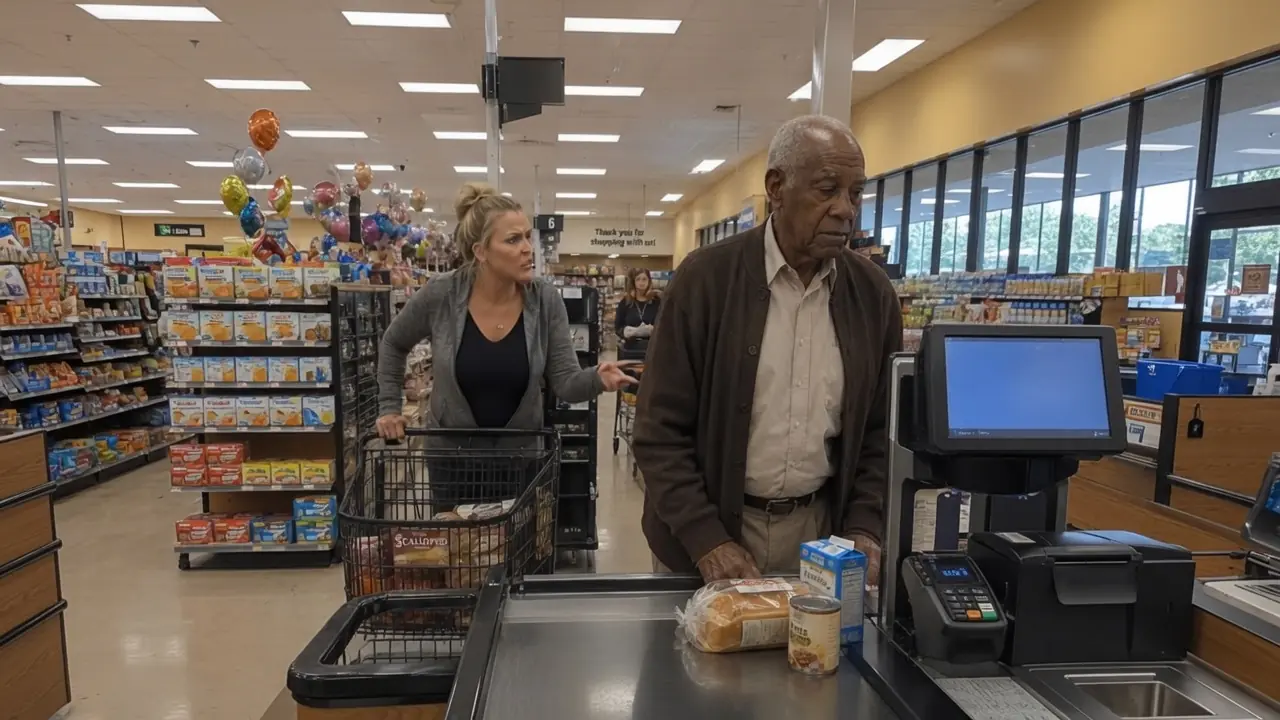
Emily stepped slightly out of her lane and raised her phone. “He does belong here,” she said firmly, “and now everyone can see exactly who doesn’t.” Karen turned sharply toward her. “Mind your business,” she snapped. Emily’s grip tightened around the phone, but she did not step back.
Karen suddenly pointed at Harold’s groceries. “Look at him,” she said loudly, making sure nearby shoppers could hear. “Holding up the line with a few cheap items like he owns the place.” Harold closed his wallet slowly, every movement controlled. The cashier whispered, “Sir, I’m sorry,” though the apology sounded like it came from helplessness rather than action.
Karen’s voice rose. “Don’t apologize to him. He’s the one causing trouble.” Then she shoved her cart forward hard enough that it bumped the back of Harold’s leg. Harold caught the edge of the counter with one hand. The apples rolled slightly on the belt, and the milk carton tipped against the bread.
A gasp came from the next lane. Emily moved forward immediately. “You hit him with your cart,” she said. Karen’s face flushed. “No, I didn’t. He stepped back into me.” Harold finally turned and looked directly at her.
His eyes were tired, but steady. “I did not step back,” he said. Karen’s mouth tightened, and then she did what people like her often do when truth turns against them. She raised her voice higher and tried to become the victim.
“He threatened me,” Karen shouted. “He got in my way and tried to intimidate me.” The store manager, Mr. Patel, hurried over from the service desk, his face tense with concern. Customers had begun gathering around the checkout area. Some held phones, some whispered, and some looked ashamed of their own silence.
Mr. Patel looked from Karen to Harold. “What happened here?” he asked. Karen immediately began speaking over everyone. “This man was blocking me, acting aggressive, and now everyone is pretending I did something wrong.” Harold stood quietly beside the belt, one hand still resting near his groceries.
Emily stepped closer, her phone visible in her hand. “That is not what happened,” she said. “She insulted him, told him he didn’t belong, and pushed her cart into his leg.” Several shoppers nodded. A mother holding a little girl’s hand said, “I heard it too.”
Karen spun toward them. “You’re all lying,” she snapped. Her face turned redder as more people refused to look away. For the first time, she seemed to understand that the crowd was no longer passive. The silence she had counted on was breaking.
Mr. Patel’s expression changed. He knew Harold well from years of Saturday visits, school charity events, and quiet conversations near the produce section. Harold had once helped Mr. Patel’s nephew apply for college, reviewing essays without asking for anything in return. The idea that Harold had threatened anyone was almost impossible to believe. Still, Mr. Patel knew belief was not enough.
He turned toward the cashier. “Call security and pull the lane footage.” Karen’s confidence cracked for one quick second. “Footage?” she repeated. Mr. Patel nodded. “Every checkout lane is recorded.”
Emily lowered her phone slightly but kept recording. “Good,” she said. “Because my video caught most of it too.” Karen looked between Emily, the camera above lane five, and the customers now watching her carefully. Her hands tightened around the cart handle. The power she thought she had was beginning to slip away.
Harold remained calm, but inside, the moment hurt deeply. He had spent thirty-eight years as a school principal teaching children that their worth was not decided by other people’s ignorance. He had comforted students who were mocked, bullied, excluded, and told they did not belong. Now, at seventy-four, he was standing beside bread and milk being forced to live the lesson again.
A security guard arrived and asked Karen to step aside. She refused at first, insisting she had done nothing wrong. Then Mr. Patel returned from the small office near the customer service desk with a tablet in his hand. His expression was no longer uncertain.
“I reviewed the footage,” he said. The entire checkout area went quiet. Karen crossed her arms. “Then you saw him backing into me.” Mr. Patel looked at her with disappointment. “No, Ms. Miller. I saw you move your cart into him.”
Karen’s mouth opened, but no words came out quickly enough. Mr. Patel continued, “I also heard enough from witnesses to understand what was said.” He looked toward Harold. “Mr. Johnson, I am deeply sorry this happened in my store.” Harold nodded once, accepting the apology but not pretending it erased the wound.
Karen’s anger returned in panic form. “This is discrimination against me,” she shouted. “You’re all ganging up on me.” Emily looked at her in disbelief. “No. People are finally telling the truth.” Several shoppers murmured agreement.
Mr. Patel asked Karen to leave the store immediately. She refused again, grabbing her cart and claiming she had a right to shop. The security guard stepped in front of her path. Karen knocked several items from a nearby display with her cart while shouting that everyone would regret embarrassing her. That was when Mr. Patel called the police.
Harold quietly paid for his groceries while they waited. The cashier’s hands shook as she scanned the bread, milk, beans, and apples. “I should have said something sooner,” she whispered. Harold looked at her gently. “Next time, say it sooner for someone who may not be able to stay calm.”
The words made her eyes fill with tears. “I will,” she said. Harold believed her. Sometimes shame could become courage if a person let it teach them instead of burying it. He picked up his grocery bag and remained near the service desk because the officers would need his statement.
When two officers arrived, Karen rushed toward them with a dramatic expression. She spoke first, loudly and quickly, painting herself as a frightened shopper surrounded by hostile strangers. The officers listened, then spoke to Mr. Patel, Emily, the cashier, and several witnesses. Finally, they reviewed the security footage.
Karen’s story collapsed in minutes. The video showed her leaning into Harold’s space, pointing, speaking aggressively, and shoving the cart forward. Emily’s recording captured the words clearly enough for everyone to understand the motive behind the harassment. Karen’s face changed when the lead officer returned from the office.
“Ma’am,” he said, “you are being cited for disorderly conduct, and we are documenting the cart contact as assault for review.” Karen began protesting immediately. The officer held up one hand. “The store has video. Witnesses have statements. This is not the time to keep making things worse.”
As Karen was escorted outside, the store remained silent. Harold did not smile. He did not celebrate. He had no interest in seeing anyone destroyed, but he did believe people should face the consequences of what they chose to do. Accountability, he had always told his students, was not cruelty.
After the police left, Mr. Patel insisted on carrying Harold’s groceries to his car. Harold allowed it, though he usually preferred doing things himself. At the entrance, Emily approached with her phone lowered. “Mr. Johnson, I’m sorry you had to go through that,” she said.
Harold smiled gently. “You stepped forward when others were still deciding whether to.” Emily looked embarrassed. “I was scared.” Harold nodded. “Courage is not the absence of fear. It is deciding that fear does not get the final vote.”
The video spread through the neighborhood by evening. Emily posted it with a caption asking people to stand up when someone is targeted in public. Within hours, the clip had thousands of views, and the comments filled with support for Harold. Former students recognized him and began sharing stories about how he had helped them, protected them, fed them, tutored them, and believed in them.
By Sunday morning, Harold’s phone would not stop buzzing. Messages came from former teachers, parents, students, neighbors, and people he had not heard from in years. They called him Principal Johnson even though he had been retired for more than a decade. Each message reminded him that one hateful voice could be loud, but it was not the whole story.
The next week, Miller’s Market placed a sign near the entrance that read, “Respect is required here.” Mr. Patel also organized staff training on bystander response and de-escalation. The cashier from lane five attended the first session and spoke honestly about freezing when Harold was insulted. “I don’t want silence to be my response ever again,” she said.
Harold was invited to attend a community meeting at the local high school auditorium. At first, he wanted to refuse because he disliked being turned into a symbol. But Emily visited him with a printed flyer and told him that young people needed to hear from someone who had stayed dignified under pressure. Harold looked at the flyer for a long moment, then agreed.
The auditorium was full on Thursday evening. Harold stood at the microphone wearing a navy blazer and the same polished shoes from the grocery store. He looked out at students, parents, business owners, teachers, and neighbors. For a moment, he saw not a crowd, but a classroom.
“What happened to me was painful,” he began. “But what concerns me most is not only what one woman said.” He paused, letting the words settle. “What concerns me is how many people waited for someone else to decide whether I was worth defending.”
The room went still. Harold did not speak with anger, but with the patient firmness of a principal correcting a hallway full of children who knew better. He explained that hate often grows in the space between the first insult and the first person brave enough to interrupt it. He told them that neutrality becomes permission when someone is being humiliated.
Emily sat near the front with tears in her eyes. Mr. Patel sat beside his employees. The cashier from lane five wiped her cheeks quietly. Harold saw all of them and softened his voice.
“I do not want revenge,” he said. “I want responsibility.” He looked across the room. “Responsibility from stores, from neighbors, from witnesses, and from each of us when we see another human being treated as less than human.” The applause that followed was slow at first, then filled the auditorium.
In the months after the incident, the grocery store changed. Employees greeted Harold warmly, but not with pity. Customers began speaking up faster when arguments started. Emily helped organize workshops on how to safely intervene as a bystander. Mr. Patel funded the first workshop himself and invited other local businesses to send staff.
Karen Miller’s case moved through court quietly compared to the public storm around the video. She was ordered to pay a fine, complete community service, and attend anti-bias education. Some people thought the penalty was too small. Harold said only that punishment without change was incomplete.
Several weeks later, Harold received a letter from Karen. He left it unopened on his kitchen table for two days. When he finally read it, the words were shaky, apologetic, and uncomfortable. Karen wrote that she had been forced to watch the video during her program and had barely recognized herself.
Harold did not forgive her immediately because forgiveness was not a performance. But he wrote back with one sentence that he hoped would stay with her. “Do not become a better person because you were caught; become one because you finally understand who you hurt.” He mailed it the next morning.
A year later, the grocery store held its first community day. Tables were set up outside with food, music, school donation bins, and information booths from local organizations. Harold arrived early and helped arrange chairs, even though everyone told him he was the guest of honor. He laughed and said old principals never stopped setting up rooms.
Emily stood beside him near the entrance. “You changed this place,” she said. Harold shook his head. “No. The truth changed it. We only decided not to hide from it.” He looked toward lane five through the front windows, where new employees were being trained under the respect sign.
Harold continued shopping at Miller’s Market every Saturday. He still bought bread, milk, apples, and sometimes a can of beans. He still moved slowly, still checked produce carefully, and still greeted the cashier by name. But now, when he walked through the doors, people did not just see an elderly man doing errands.
They saw a man whose dignity had exposed a community’s silence and taught it how to speak. They saw a retired principal still teaching, not from a classroom, but from a checkout lane. They saw someone who had been told he did not belong and answered by becoming the reason others felt safer belonging. And that was a lesson no camera could fully capture, though the cameras had helped the truth finally be seen.