The shotgun came up before the old woman had time to think about it.
Nora Bell stood behind the counter of Bell’s Last Stop with both hands wrapped around the worn walnut stock, the barrel leveled at a man in a camel-colored overcoat who had no business being inside her diner at three in the morning. Snow blew through the open door behind him in hard white sheets, skittering across the black-and-white tile. The man stopped beside the pie case, one polished shoe already wet with melted snow, and stared at the seventy-six-year-old woman as if the sight of her holding a twelve-gauge offended him personally.
“Put that down, Nora,” he said.
“No.”
Behind her, somewhere near the kitchen, someone breathed through clenched teeth. Another person whispered for everyone to stay still. Nine motorcycles lay buried outside beneath the worst blizzard northern Idaho had seen in years, and nine bikers—one badly hurt, two half-frozen, the rest exhausted—were trapped inside her diner with the man who had just walked through the storm to find them.
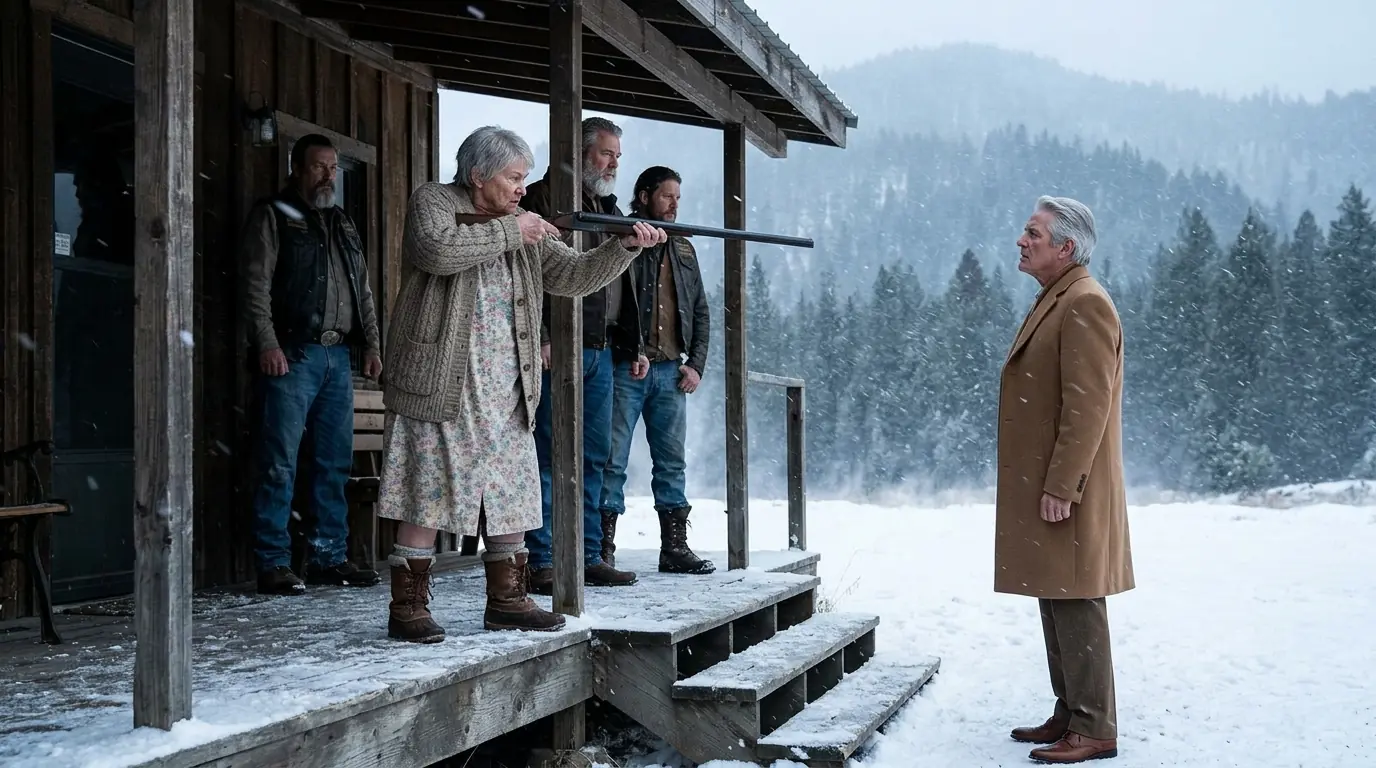
The stranger’s eyes narrowed.
“You don’t know what you’re protecting.”
Nora tightened her grip. Her arms were not as strong as they had been twenty years earlier, but the gun stayed steady.
“That makes two of us,” she said. “Because you don’t know whose diner you just walked into.”
Twelve hours earlier, Bell’s Last Stop had been nearly empty.
The diner sat beside an old state road north of Coeur d’Alene, where dense pine forest pressed close to the highway and winter could erase the world in less than an hour. Nora’s husband, Samuel, had built the place in 1978 with money saved from logging and a loan no bank wanted to give them. He built the booths himself, laid the tile himself, and carved the words BELL’S LAST STOP into a cedar sign that still hung over the entrance, cracked by forty-eight winters but stubbornly intact.
Samuel had been dead eleven years. Their only son, Daniel, had been gone much longer.
Nora still opened the diner six days a week.
People in town told her she should sell. Her daughter-in-law’s cousin had offered to help her move into a senior apartment. The pharmacist suggested she stop driving at night. Her doctor told her the pain in her left hip would not improve if she kept standing behind a grill ten hours a day.
Nora listened politely to all of them.
Then she went back to work.
That Wednesday, the storm warning arrived just after lunch. The radio said heavy snow after sunset, wind gusts above fifty miles an hour, whiteout conditions over the passes, travel discouraged unless absolutely necessary. Nora looked through the front window at the dull gray sky and knew the forecast was late.
She had spent seventy-six winters in Idaho.
She could smell snow before the weather service found it.
At four, she sent her only waitress, Elena Ruiz, home early.
“You too,” Elena said, tying her coat.
“I live upstairs.”
“You know what I mean.”
Nora smiled. “I’ll lock up at six.”
Elena stared at her.
“Five-thirty.”
“Nora.”
“Fine. Five.”
Elena pointed two fingers at her own eyes, then at Nora.
“I’m serious.”
“So am I. Go before the hill freezes.”
The bell over the door jingled as Elena left. Ten minutes later, Nora turned the sign to CLOSED, though she kept the lights on. She cleaned the grill, wrapped the lemon meringue pie, counted the register, and started a pot of coffee she did not need.
By six, the highway had vanished.
Snow moved sideways across the glass. The parking lot lights created pale circles that disappeared three feet beyond the windows. Nora climbed halfway up the narrow stairs to her apartment, then stopped when something vibrated through the building.
At first she thought it was thunder.
Then she heard engines.
Not one.
Many.
The sound rose beneath the wind, uneven and strained, the low mechanical growl of motorcycles trying to move through snow that no motorcycle should have been in.
Nora went back down.
Headlights materialized out of the white.
One.
Three.
Five.
Nine.
The first motorcycle slid sideways into the parking lot and nearly dropped. Its rider caught it with one boot, fought the weight, then limped the machine toward the building. The others followed in a scattered line, tires cutting crooked trenches through the snow.
Nora stared through the glass.
“Idiots,” she muttered.
Then the last bike fell.
Two riders went down with it.
She unlocked the door.
The first biker reached her just as she stepped outside. He was in his late fifties, broad through the shoulders, gray beard crusted white with ice. His black leather vest was barely visible beneath a heavy riding coat. A patch across the chest read WARDEN.
“Ma’am,” he said, breathing hard. “We need shelter.”
Nora looked past him.
One rider was on his knees beside the fallen motorcycle. Another lay in the snow without moving.
“How many?”
“Nine.”
“Any head injuries?”
The biker blinked.
“Excuse me?”
“Did anyone hit their head?”
“Our youngest did. Bike went sideways. He clipped the edge of the drainage ditch.”
Nora stepped around him.
“Bring him inside. Everyone else too.”
The man hesitated.
“We’re not looking for trouble.”
“I’m not offering trouble. I’m offering heat. Move.”
Something in her voice ended the discussion.
The nine men stumbled into Bell’s Last Stop carrying cold, snow, and one unconscious rider between them. Nora locked the door, pulled the blinds halfway down, and pointed at the booths.
“Wet coats off. Hang them by the kitchen. Boots stay on unless your socks are soaked. Nobody sits directly against the heater if they can’t feel their fingers.”
The gray-bearded man stared at her.