The rain had stopped an hour before, but the smell of it stayed in the stones. The lingering scents were wet straw, tallow smoke, and the sourish green of hay gone a little too long in the loft. It was the smell of Wrenmore at the tail end of a wet autumn, and Nell Farrow had learned to walk into it without flinching, the way she had learned to walk into most things. She was the kind of woman a house barely noticed had come in.
She was not pretty enough to be remarked on, not clumsy enough to be scolded, and not proud enough to be resented. She scrubbed pots in the scullery from before light until after dark. If she vanished from a room, it took the other maids a full minute to say who had gone missing. She had buried her mother at fifteen and her father at twenty-two.
Between those two burials, she had learned exactly one thing worth knowing. Horses did not care what a woman looked like, or what she owned, or whether her hands were red to the wrist from lye. They only cared whether she was telling the truth with her body when she stood near them. Her father had been a groom for thirty years before he was anything else, and he had taught her that truth before he taught her her letters.
It was not supposed to matter here. Mr. Pruitt, the steward, had made that plain enough on her first morning. Women did not go near the horses at Wrenmore. Women scrubbed and swept and kept to the kitchen wing, and if she wanted her position, she would remember it.
She had remembered it for eleven weeks. She was not going to remember it tonight. The mare was going to be shot before Sunday if nothing changed. She had heard it from the under-footman, who had heard it from Mr. Pruitt, who did not trouble himself to keep his voice down in front of maids. The old gray mare in the end stall had stopped eating six days running.
She would not stand steady. She trembled when touched, and twice she had gone down in the straw and had to be hauled up by four men with ropes under her belly, which was no way for anything living to end its days. The house's own horse doctor had come and gone and pronounced her past mending. Old Tam Lock, who had cared for her every day of the eleven years he'd been at Wrenmore, sat by her stall each evening now like a man keeping vigil, and everyone knew, though no one said it, that if the mare went, Tam would not be far behind her out the gate. He was too old and too slow for anything else the estate needed doing.
Nell had gone to see the mare once on an errand that was not really an errand, and the animal had looked at her sideways with an eye gone dull and wet, and something in Nell's chest had folded over on itself. She had not gone back on purpose after that. She told herself she had not. But it was near midnight now, and the house was asleep, and she was standing at the foot of the servants' stair with her shawl already around her shoulders, and a heel of bread wrapped in a cloth in her pocket. It was bread she had not eaten at supper, though she had been hungry.
She told herself she was only going to look. She was not only going to look. She knew that, too. The yard was black and silver, puddles holding what moon there was. The stable smelled of liniment and old leather, and something underneath that she did not have a name for and did not want one.
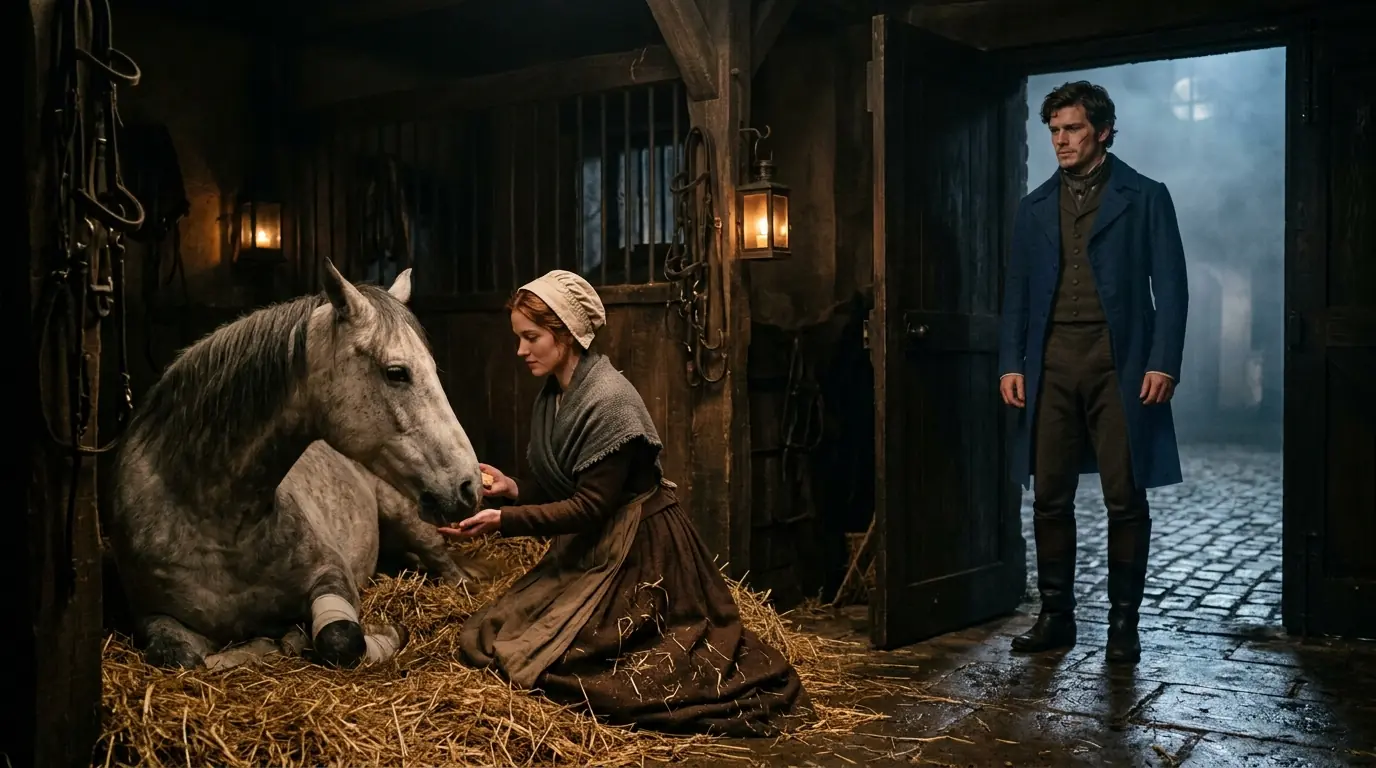
Willow, they called the mare, though Nell did not know why, since there was not a willow tree within two miles of Wrenmore that she had ever seen. She let herself in at the small door at the end, the one that stuck, and stood a moment letting her eyes learn the dark. The mare was down, not fallen, down on purpose, the way an old creature lies down when it has decided something, legs folded under her in the straw, head low. Her breath came ragged. She did not lift it when Nell came near.
“I don't believe you are finished.” The mare's eye rolled toward her, wet and old and unconvinced. Nell had never told a soul that her mother used to sing while she worked, tuneless little things half remembered, no more than four lines that circled back on themselves. She did not think of herself as a woman who sang, but there was no one to hear her, or so she believed with her whole plain heart, and the mare's breathing was so ragged that Nell could not sit beside it in silence one moment longer. So she sang, not well, not loud, a thin unsteady thread of a tune about a boat and a river and a girl waiting on a bank.
She barely remembered the words and filled them in where she had forgotten them. And she did not stop even when her voice cracked on the low notes because there was no one to be ashamed in front of. She was wrong about that, though she would not learn it until later. She sang and she worked the bread into small pieces and held them flat on her palm the way her father had taught her. She remained patient and unhurried, asking nothing.
She rubbed liniment into the mare's foreleg with slow circles, the way you would work a knot from a child's hair. She talked to her in between the verses, nonsense, comfort, the kind of talk that means nothing and everything. Twice the mare's ear flicked toward the door of the stable, toward the yard, and twice Nell paid it no mind, thinking it only the wind working at the loose shutter above the loft. It was not the wind. She did not know then that a man had come down from the house an hour before her, restless in the particular way grief makes a man restless, unable to sleep in rooms that still held his father's smell of pipe tobacco and boot polish.
She did not know he had meant only to walk the grounds and had found himself, without entirely choosing to, standing at the stable door instead. She did not know that the mare in the end stall had belonged to his own father before it was ever given to him as a boy of nine, half broken already and impossible for anyone, and that his father had said, watching him fail and fail and finally succeed in gentling her, that a man's character showed plainest in what he did with a creature too frightened to thank him for it. She did not know that he had stood in the shadow of the doorway for the better part of twenty minutes now, unmoving, unannounced, listening to a scullery maid sing a tuneless song to a dying horse she believed no one on earth could hear. She would learn all of it eventually. For now, she only sang and worked the bread into the mare's mouth piece by piece and did not once look toward the door.
The mare took the last piece of bread from her palm with lips gone soft and slow, swallowed it, and, for the first time in six days, put her head down not in surrender but in something closer to rest. Nell sat back on her heels and her hands, she noticed distantly, were shaking. Though she had not cried and did not intend to, it was only then, rising to go, that she saw the shape in the doorway. She went very still. He was tall and plainly dressed in a dark coat with no ornament to it, the kind a steward or a senior groom might wear, and his face was half in shadow, and she could not, in that light, have told a duke from a drover.
He did not move toward her. He did not speak. For a long moment, neither of them said anything at all. And the mare's breathing filled the space between them, slower now, even than it had been an hour before. “Forgive me,” Nell said finally, getting to her feet, brushing straw from her skirt with hands that would not quite hold steady.
I was told not to come to the stables. I'll not do it again if you'll not report it. I heard singing, the man said. It wasn't singing worth the name. No, he agreed.
But she stopped shaking. Nell looked down at the mare whose eye had closed, whose breath had gone from a rattle to something almost peaceful. She's not out of danger, she said. But she took food. That's more than she's done in a week.
The man in the doorway said nothing for a moment. Then, does anyone know you come here? No one, Nell said. And I'd ask you not to be the first to tell it. He looked at her a moment longer.
In a way she could not read in the dark. And then he stepped back from the doorway without another word. And was gone into the yard before she could see his face plain. And she told herself he was likely the new horse doctor. Sent for at last.
Or some man of Mr. Pruitt's hiring she hadn't yet been introduced to below stairs. She did not think herself important enough to wonder further. She gathered her shawl and let herself out the small door and went back up to her cold bed and slept better than she had in a week, though she could not have said why. She did not know then that the man who had stood in the doorway owned every stone of the house she slept in. And the stable she had trespassed in.
And the mare whose breathing had eased under her hands. She did not know that he had gone back to his own rooms that night and sat a long while at the window with a candle unlit beside him. Turning over the plain, unlovely, unremarkable fact that a woman with nothing to gain had sat in a stall in the middle of the night and sung to a dying animal she believed no living soul could hear her sing to. She did not know that he had, before he slept, already decided three things, quietly, the way he decided most things, and told no one. The first was that the mare would not be shot.
The second was that Tamlock would keep his place at Wrenmore for the rest of his natural life, whether or not the mare lived to see spring. The third, and this one he did not examine too closely, even in the privacy of his own mind, was that he intended to find out, without announcing who he was or why he wished to know it, exactly what kind of woman Nell Farro was when she believed herself unwatched. The house woke the next morning to news that traveled below stairs before the porridge was served. The horse doctor from Thistledown had been sent for again, this time by a note in the Duke's own hand, though no one below stairs had seen the Duke's hand on anything in the eleven weeks since his father's funeral. And the note had specified, oddly, that the mare's stall was to be widened and banked with fresh straw twice a day instead of once, and that a brazier was to be kept lit through the cold nights, an expense Mr. Pruitt grumbled over at length while making certain it was done exactly as ordered.
Nell heard all this from the kitchen maid, Sarah, while scrubbing a pot she had already scrubbed twice, and said nothing, and felt something in her chest that she did not examine too closely, either, a small foolish gladness that had no business belonging to a scullery maid over the fate of a horse that was not hers and never would be. She did not go back to the stables that second night. She told herself it was because she had been seen once already and did not wish to press her luck. It was not the whole truth and she knew it was not, but it was the part of the truth she was willing to look at. She went back on the third night instead because the not going had felt worse than any risk of being caught.
The mare was better. Not well, but better. Standing now instead of down. Her head up when Nell came in, ears pricked toward the door in a way that made something loosen in Nell's chest before she had even crossed the yard. She did not sing that night.
She talked instead. Low, foolish talk and combed the tangles out of the mare's mane with her fingers because there was no comb to hand and did not notice how long she stayed until the stable clock in the tower struck one and startled her into leaving. She did not see the man in the doorway again that night or the next, but she began, without quite admitting to herself that she had begun, to notice small things that did not add up the way Mr. Pruitt's accounting usually added things up. An extra scuttle of coal appeared at Tam Lock's cottage door with no note and no name attached at a week when Tam's chest had been bad and everyone below stairs had said, in the flat unkind way servants sometimes discuss each other's futures, that he'd not last the winter in that cough and Mr. Pruitt would be glad of the excuse to pension him off cheap. A new horse doctor came from two counties over instead of the usual man from Thistledown and stayed three full days at the estate's expense.
And when Nell asked Sarah who had sent for him, Sarah only shrugged and said it must have come down from his grace himself. Though his grace had not been seen by half the staff since his father's burial, and was thought by some below stairs to keep almost entirely to two rooms in the library. Nell thought of the man in the doorway more than she meant to. She decided he must be the new horse doctor's assistant, or some steward brought in from the duke's other properties, dressed too plainly for a gentleman, and too easy in his silence for a servant. She did not think of him as anything more than that.
Because she had long ago trained herself not to think certain thoughts through to their ends, the way a woman learns not to reach for a shelf she knows is out of reach. She was wrong about who he was. She would go on being wrong about it for some weeks yet. And in that wrongness, without her knowing it, the whole shape of what was to come was already being quietly built around her, stone by uncredited stone. She met him again on the ninth night, and this time neither of them pretended it was an accident.
She had come to change the mare's dressing, a habit Tamlock had shown her though he was too proud and too tired most nights to do it himself. And the man was already there when she arrived, crouched at the mare's off foreleg with a lantern set low, and a bandage half undone in his hands, working with the unhurried competence of someone who had done such work before and did not need to be told how. “You've done that before,” Nell said, before she could think better of saying anything at all. “When I was a boy,” he said, not looking up. This mare, as it happens.
She threw a shoe and cut herself on a stone the summer I was nine, and there was no one about to see to it but me. Then you know her? Better than most people know most things, he said. And there was something under the plainness of it that made Nell look at him a moment longer than was strictly proper. They worked together in a silence that was not uncomfortable, passing the roll of linen back and forth.
And it was some time before either spoke again. You're not the horse doctor, Nell said finally. I asked after him below stairs. He's a stout man, gone gray. And you are not him.
No, the man agreed. I am not the horse doctor. Then what are you? He considered the question with a seriousness that seemed out of proportion to it, or so she thought at the time. A man who was fond of this mare before he was fond of very much else, he said.
That will have to do for now if you don't mind. She did mind a little. But she did not press it. Because she had learned early that questions pressed on gentlemen, or men who spoke like gentlemen even in plain coats, rarely ended well for the person doing the pressing. Instead, she said, Tam thinks she's past saving.
He hasn't said it to me, but I've seen his face when he looks at her. And what do you think? I think she stopped trying to die, Nell said. That's not the same as getting well, but it's not nothing. He looked at her then, straight on in the lantern light, and she saw for the first time that his face was not a young man's face, not exactly, though he could not have been much past 30.
There was a hard set to his jaw and a tiredness around his eyes that had nothing to do with the hour. And a scar, thin and old, along one cheekbone that she had not seen in the dark of the first night. “You come here against orders,” he said. It was not quite a question. “I do.”
“Why?” “Because someone had to sit with her,” Nell said, “and it did not seem to me that anyone else was going to.” “And if you're found out?” “If it costs you your place?” Nell considered this honestly, because she had considered it every night she'd made the walk across the yard.
“Then I'll have lost a place scrubbing pots,” she said, “and kept something else instead. I think I'd call that a fair trade.” He did not answer that at once. When he did, his voice had gone quieter. “Most people would not think so.”
“Most people,” Nell said, “have not sat with something dying and watched it decide not to.” He was quiet a long moment after that, and when he spoke again, it was of ordinary things, the mare's feed, the cold coming early this year. And she thought nothing more of the strange stillness that had come over him at her words, not knowing that she had, without meaning to, described exactly the choice his own father had made in his last illness, and exactly the kind of daughter-in-law his father would have wished for him. And that the man crouched beside her in the straw was doing a great deal of private, careful arithmetic behind his plain, unreadable face. Before she left that night, he asked, almost as an afterthought, whether the old groom Tam Lock was well looked after, whether his cottage was warm, whether anyone troubled to ask after him besides the animal he tended.
“No one asks after Tam.” Nell said. “Except the mare, and now perhaps you. That will want mending.” The man said, half to himself, and said no more about it. And it was 3 days later that a proper doctor came from the county town to see to Tam's chest, at no charge Tam could account for, and a second load of coal arrived at his door before the first was half burned through.
And still no name was ever given, and still Nell did not let herself guess whose hand was behind it. Though a small persistent voice in her had begun, very quietly, to wonder. It was at the harvest supper, held each year in the long barn for the tenants and the household staff together, that Nell first came face to face with Lady Cressida Vane, and learned what it was to be despised by someone who had never spoken a single unkind word that could be repeated as unkind. Lady Cressida was the late duke's niece by his sister, and had kept the house at Wrenmore in the eleven weeks since the funeral while her cousin, as she put it to anyone who would listen, recovered himself sufficiently to attend to his own affairs. She was handsome in the particular chill way that made servants straighten their aprons when she passed, and she had a laugh when something amused her of exactly three notes, practiced and precise as a bell struck three times, that Nell had learned to dread hearing directed anywhere near her.
The supper was crowded and warm, and Nell had been sent with a tray of cups to the high table where the household's better sort sat with the senior tenants. And it was there, reaching past Lady Cressida's shoulder to set down a cup, that her sleeve caught the edge of the lady's own gown. And though no harm was done and no mark left, Lady Cressida turned with the three-note laugh already forming. “Careful,” she said to the table at large, rather than to Nell directly, which was its own kind of cruelty, speaking of a person as though they could not hear being spoken of. “One forgets, in a house so short of proper staff this year, that the scullery must occasionally be let out among decent linen.”
“Look at her hands.” She said it lightly, as though remarking on weather. “Red to the wrist. One can always tell the ones who've come up from nothing. It shows in the hands long after it's stopped showing anywhere else useful.” There was a small silence at the table, the kind that waits to see which way a moment will break.
Nell did not set the tray down too fast, and she did not apologize more than the accident required, and she did not let her face do anything at all. “They're red from lye, my lady,” she said evenly, “and from cold water in November, and I'd wager they'd go the same color on any hand set to the same work. I don't think they show where a person's come from. I think they only show what a person's been doing lately.” The three-note laugh did not come.
Lady Cressida's eyes narrowed very slightly, the way a cat's will when a thing it expected to run does not run. “How quaint,” she said, “that the scullery has opinions.” “Only the one, my lady,” Nell said. “And I'd have kept it to myself if I hadn't been asked to look at my own hands in front of a full table.” She set the last cup down and took up her tray and walked back toward the kitchen with her spine very straight and did not once look to see who at the table had heard, though she felt, without turning, that someone near the far end had gone very still and very quiet in a way that was not embarrassment on her behalf so much as something closer to attention.
It was the man from the stables. She had not known he would be at the supper at all, dressed a little better than she'd seen him, but still plain enough that she had taken the seat near him for a senior steward's. And she caught his eye for half a second on her way past and saw, or thought she saw, something in his face that was not pity, which she would have hated, but was not quite nothing either. She did not cry in the kitchen afterward, though Sarah, who had heard the whole exchange repeated to her within the hour by three separate people, patted her shoulder and told her not to mind it, that Lady Cressida had a tongue that had flayed better women than either of them. Nell only shook her head and went on with the washing up because she had long ago decided that crying over Lady Cressida's opinion would be giving that opinion more room in her life than it had earned.
It was later that same night, sitting with the mare, that the man asked her about it, without preamble. “She spoke to you badly at supper.” “She spoke about my hands,” Nell said. “There are worse things to be spoken about. You didn't flinch.”
“I've had a great deal of practice not flinching,” Nell said. “It gets easier.” “Not painless?” “Easier.” He was quiet a while, working at a knot in the mare's mane with more attention than the knot strictly required.
“She will not apologize,” he said finally. “It isn't in her nature to think an apology owed where she believes she's only spoken the truth plainly.” “I didn't ask for an apology.” “No,” he said. “I noticed that you didn't.”
And something in the way he said it made Nell think, though she could not have explained why, that she had passed some manner of test she had not known she was sitting. Winter closed in hard after that, the kind of cold that cracked the water buckets in the yard overnight, and it was in the deep of it, near the turn of the year, that everything Nell had built for herself at Wrenmore came apart in the space of a single afternoon. She had gone on seeing the man some nights and not others, always at the mare's stall, always speaking of ordinary things, the weather, the estate, the small griefs and small kindnesses of people she worked among, and she had come, without ever naming it to herself, to treasure those hours more than any others in her week. She still did not know his name. She had stopped asking, partly from pride and partly from a fear that naming the thing between them would somehow break it, the way naming a wish is said to unmake it.
She learned his name from Lady Cressida instead, and in the worst possible way. She was summoned to the small parlor on a Tuesday afternoon, an occurrence rare enough that she went with her stomach already knotted and found Lady Cressida seated with Mr. Pruitt standing uneasily by the door. On the table between them lay a torn glove that Nell recognized with a lurch as her own, lost some nights before in the stable yard and never missed until this moment. “This was found,” Lady Cressida said, “in His Grace's private stable, in the section reserved for his own use, where no servant of this house has business being, at an hour when only His Grace himself is known to walk.” The room seemed to tilt very slightly.
“His Grace?” Nell repeated, and heard her own voice come out strange and flat. “You did not know,” Lady Cressida said, and there was something almost pleased in the observation, as though she had been waiting some time to deliver it. “How delicious. You have been meeting the Duke of Wrenmore by night in a stable for some weeks now, and you did not know who he was. Or perhaps, and here the three-note laugh arrived at last, precise as ever, you knew perfectly well, and thought a duke's loneliness since his father's death might be turned to some use by a clever girl with red hands and a fine voice for singing where she thinks no one hears her.”
“I never sought him out,” Nell said, and her voice, to her own relief, held steady even as her hands, folded before her, had begun very slightly to shake. “I went to sit with a dying horse because no one else would. If he came and stood in the doorway, that was his choosing, not mine, and I did not know his face from any other man's until this moment.” “How convenient that you cannot prove it,” Lady Cressida said.
“And how convenient too that a scullery maid found alone at night with a duke, whatever the intentions on either side, is a scandal that touches only her name and never his. You will be gone from Wrenmore by morning. Mr. Pruitt will see to your wages owed and no more.” Nell did not weep, though something in her chest had gone very cold and very still, colder than the cracked water in the yard buckets. She thought of the mare and of Tam Lock and of the man whose name she had learned at last in the cruelest possible room.
And she found, to her own surprise, that what she felt most was not fear of what would happen to her, but a kind of quiet grief that the hours in that stable, which she had come to think of as the one true thing in her days, had apparently never been what she believed them to be. “I'll go tonight,” she said, “if it's all the same to you. I've no wish to wait for morning to be looked at.” She went back to her small room and began, with hands that had finally begun to shake in earnest, to fold the few things she owned into a bundle. And it was there that Mrs. Odell, the housekeeper, found her not an hour later, having heard the whole business from Mr. Pruitt, with an expression that suggested she believed very little of Lady Cressida's version of events.
“Sit down, girl,” Mrs. Odell said, “before you fold that shawl into a knot you'll never untie.” “I have to be gone by morning,” Nell said. “I don't want to make trouble for anyone by staying past what's owed me.” “You'll make more trouble leaving without hearing me out than staying five more minutes,” Mrs. Odell said. And something in her made Nell stop and sit and look at her.
“You think he used you,” Mrs. Odell said without softening it. “I can see it on your face plain as print. You think a duke found himself a lonely winter's amusement in a scullery maid too foolish to know better. And now you mean to go off and never think of him again and call that dignity.” Nell said nothing because it was near enough the truth that she could not trust her voice to argue it. “Then let me tell you what I know,” Mrs. Odell said, “and you may do as you like with it afterward.”
She told her then, in the plain unhurried way she told most things, of the mare that had been due to be shot the very week Nell first crept down to sing to her, and of the order that had come from the duke's own hand the morning after, quiet, unexplained, to spare her. She told her of the coal that had gone to Tam Lock's cottage with no name on the note. And the doctor sent from the county town at the estate's expense, both ordered the same week the duke had first stood in a stable doorway and heard a woman singing to a horse she thought no one could hear. She told her further of things Nell had never so much as suspected. A debt quietly forgiven for a tenant family two farms over who'd lost a season's crop to blight.
A girl in the village sent to a proper school in the county town with her fees paid by a benefactor who had asked each time not to be named, going back to before his father's death and continuing after it in the same quiet unremarked way as though credit were a thing he had never once wanted for himself. “He does not tell people,” Mrs. Odell said. “That is the whole of it. He has never once, in the eleven years I've served this house, wanted a soul to know what his own hand has done. His father was the same, and it near broke the old duke's heart that half the county thought him a cold man for it, when the truth was the opposite entire.”
“You were not used, girl. You were watched. Because he wished to know what a person does when she believes there's no reward waiting, and no rank watching, and nothing at all to be gained by being kind. And you passed a test you never knew you were sitting, night after night, without once trying to pass it.” Nell sat very still with the shawl half folded in her lap, and something in her chest that had gone cold an hour before began slowly, painfully to thaw, though she was not yet ready to trust the thawing.
“Then why,” she said finally, “did he let me hear it from her and not from himself?” “That,” Mrs. Odell said, rising and smoothing her apron, “you had best ask him yourself. I believe you'll find he's waiting in the small parlor off the stable yard this very hour, and has been for longer than is good for his dignity, working up whatever nerve requires to say a thing plainly.” The small parlor off the stable yard was a room Nell had passed a hundred times without ever once being asked inside it. A low room with a fire already lit, and a single lamp turned low, warm in a way that made the cold outside seem like something from another season entirely.
He was standing when she came in, not seated, as though sitting had felt to him like presuming on an ease he had not yet earned. “You know now,” he said. No greeting. No title offered for himself. Just that.
“I know your name,” Nell said. “I'm not certain yet that I know you.” He accepted this without flinching, which she noticed, and which she would think of later as the first true thing he did in that room. “Then let me tell you what I ought to have told you a long while ago,” he said. “And you may judge for yourself after whether the two match.”
He told her, standing very straight, his hands not quite steady at his sides, though his voice held even, of the night he had walked down from a house grown too full of his father's ghost to sleep in, and found himself at a stable door he'd meant only to pass, and stood there twenty minutes listening to a woman sing badly and beautifully to a horse he had loved since he was nine years old, and had believed that same evening past any saving. “I did not come forward and tell you who I was,” he said. “I told myself it was because I did not wish to frighten you, or embarrass you, or make you feel you'd trespassed on something you'd every right to be proud of. That was true as far as it went. But it was not the whole truth, and I think you've earned the whole of it before you decide anything about me.”
“Then tell me the whole of it,” Nell said, and did not move toward him, and did not move away. “The whole of it,” he said, “is that I wanted to see what a person does when she believes no one of any consequence is watching her. Not what she does for a duke's approval, or a duke's reward, or because she has learned that a duke's notice can be turned to some advantage if a woman is clever about it. I have had a great deal of that kind of attention in my life, Miss Farrow, since I was old enough to be worth attending to.”
“And I have learned to trust almost none of it. My father taught me, before he died, that a man's true measure is what he does for a creature that can never repay him, and never even knows to be grateful. And I did not fully understand what he meant until I watched you sit in the straw at midnight and sing to a horse who could offer you nothing at all for it, not even the knowledge that you'd been kind.” “You tested me,” Nell said, and there was no accusation in it, only the plain statement of a plain fact she was still turning over. “I did,” he said.
“I will not pretend otherwise to make it sound gentler than it was. I tested you without your consent, and I let it go on longer than was fair to you, because each time I meant to tell you I found I did not want the thing between us to change into what it becomes the moment a duke's name enters it. I wanted, selfishly, a little longer of being only a man in a stable who spoke plainly to a woman who spoke plainly back. I am telling you now because you were made to hear it from someone cruel instead of from me, and that failure is entirely mine. And I am sorry for it in a way I do not know how to say better than plainly.”
Nell was quiet a long moment, and the fire popped once in the grate, and somewhere out in the yard a rook called, oddly for the hour, one flat note into the cold dark. “I don’t know what you want of me now,” she said finally. “I've no dowry, no name worth mentioning, and a lady in your own house who's told the whole staff already what she thinks I am.” “I don’t want anything of you tonight,” he said.
This seemed to cost him something to say, as though the wanting were the easier part and the not asking the harder. “I don't want an answer tonight, or this week, or before the spring, if you need until the spring. I have watched what happens to a woman who is made to say yes because she feels the weight of a name pressing on her, and I will not be the second person in your life to make you feel you owed a debt you never asked to owe. I would rather have your no freely given whenever you're ready to give it than a yes wrung out of you by gratitude or by fear of what refusing a duke might cost you.” “And if my answer is no?”
“Then Tam Lock keeps his cottage,” he said. “And the mare keeps her stall, and you keep whatever position in this house you wish to keep, or a better one, or a letter of character good enough to take you wherever you'd rather be instead. None of it was ever offered as payment for an answer. It was offered because it was owed, whatever you decide.” Nell looked at him a long while in the low lamplight, at the tiredness around his eyes, and the old, thin scar along his cheekbone, and the hands that were not, for all his stillness, entirely steady.
And she thought of Lady Cressida's three-note laugh, and of her own red hands laid out for judgment on a supper table, and of a mare who had stopped shaking under her palm on a night she had believed herself entirely alone. “I'm not ready tonight,” she said, and watched something in his face brace itself gently for what it expected to come next. “But I don't want to leave Wrenmore either. Not yet. I find I've grown fond of a great many things here that I did not expect to grow fond of.”
It was not a yes. He did not treat it as one, and did not press her for more than she had given. And something in the careful restraint of that, more than anything he had said, was what began quietly to settle the last cold place in her chest. She stayed at Wrenmore through the turning of the year, and the mare grew stronger through the same weeks Nell did, until by the first thin green of the following spring Willow could be led out into the paddock of a morning, and stood there blinking in sunlight she had not been expected to see again.
Tam Lock wept the first time he saw her graze on new grass, and did not trouble to hide it, and no one below stairs thought the less of him for it. Lady Cressida left for Bath in the third week of March on a visit that had been announced as a fortnight's stay, and quietly extended by whose arrangement no one below stairs was ever quite certain, into something that looked a great deal more permanent. She was not spoken of unkindly in her absence. She was simply, gradually, not spoken of at all, which Nell came to understand was its own kind of sentence for a woman who had built her whole self around being remarked upon.
Julian, for she had begun by then to call him Julian in the small parlor off the stable yard, though never anywhere else, did not press her again for an answer through all those months. He came to the stable most evenings still, and they spoke of ordinary things, and some evenings he brought a horse doctor's report to share with her, as though she were the estate's own steward on the matter, which, in all but name, she had become. He asked her opinion on the mare's feed and on a lame gelding two stalls down, and once, hesitantly, on a matter of tenant business that had nothing to do with horses at all, and listened to her answer as carefully as he'd have listened to any man of business he paid to advise him. It was on an evening in late April, with the paddock gone green and the mare grazing sound and whole in it, that Nell found him waiting by the stable door in the last of the light. Something in the particular stillness of him told her he had not come only to speak of feed.
“I am not going to ask you tonight, either,” he said before she could speak. “I promised you the spring, and it is only just spring. And I meant what I said.” “You may ask,” Nell said. “I find I've had my answer ready some weeks now, and have only been waiting for the asking.”
He was very still a moment, the way a man goes still when he does not yet trust what he has heard. “Then I am asking,” he said. “Not as a duke—though I cannot entirely put the title down, however much I'd like to for this one question—but as a man who watched a woman sing to a dying horse at midnight, believing no one in the world could hear her, and understood in that hour that he had found the one truth he could build the rest of his life upon.” “Will you marry me, Nell Farrow, of your own free choosing, with nothing owed and nothing pressed, because you want to and for no better reason than that?” “Yes,” Nell said, and found she needed no more words than the one, and did not weep, though her hands, when he took them in his, were shaking at last, openly, without shame.
He drew her glove off then, slowly, finger by finger, as though it were a thing that deserved patience, and pressed his mouth to her bare knuckles, red still from years of lye and cold water, in a way that made plain he had never once, in all the weeks of watching her, thought those hands anything but fine. “I would have loved you,” he said, “if you had never once set foot in that stable. But I am glad, more than I know how to say plainly, that you did.” They were married quietly in June, in a ceremony grand only in the single sentence the vicar of Thistledown used afterward to describe it. It was a duke's wedding dressed down to the plainness of the two people standing in it, with Tam Lock given the seat of honor nearest the front and Mrs. Odell weeping without apology through the whole of the register's signing.
A year later, almost to the week, Nell stood again at the paddock fence at dusk. The mare's head rested heavy and warm against her shoulder, the way it had come to rest most evenings since the horse had learned that this particular hand at the fence meant safety and nothing asked in return. Julian came to stand beside her, his coat still plain, though everyone at Wrenmore now knew exactly whose coat it was, and took her bare hand in his and did not let go of it, not when the light went, not when the first star showed, not for a long while after. It is still said in the country, wherever the story of the Duke of Wrenmore is told, that a person’s true worth is never proven in the rooms where they know themselves observed. It is proven in the small cold hours when they believe themselves entirely alone doing a kindness that asks for nothing and expects no witness at all.