Daniel Carter sat at the marble island in his kitchen with his arms crossed, staring at the ultrasound photo in Rebecca’s hand like it belonged to a stranger’s life. The pendant light above them glowed softly over white cabinets, a stainless-steel refrigerator, a bowl of apples near the sink, and a black coffee mug sitting untouched by his elbow. Rebecca stood on the other side of the island in a cream long-sleeve top and beige pants, her wavy light-brown hair falling over one shoulder, her smile nervous but almost proud. She held the ultrasound picture between two fingers, as if the little black-and-white image gave her power over every word about to leave his mouth.
“I’m pregnant,” she said. “But it might be yours or Jason’s.”
Daniel did not move.
For a moment, the only sound in the kitchen was the quiet hum of the refrigerator and the faint tick of the stove cooling behind him. Rebecca watched his face carefully, waiting for shock, anger, maybe even fear, but what she got was stillness. His jaw tightened once, then relaxed into something colder than rage. He looked from the ultrasound to her face and asked, “You say that like I should congratulate you.”
Rebecca’s expression flickered.
“Don’t make this ugly, Daniel,” she said, gripping the photo tighter. “We wanted a family.”
“No,” he said quietly. “We wanted a marriage.”
That was the first sentence that truly frightened her.
Until then, Rebecca had believed the worst part was over. She had spent weeks rehearsing this kitchen conversation, adjusting her tone, choosing the right moment, deciding whether to cry or stay calm. She had convinced herself Daniel would be hurt but manageable, angry but ultimately responsible. In her mind, he was the kind of man who would absorb pain quietly if the alternative made him look cruel.
Daniel had always been steady. At thirty-seven, he was the practical one in every room, the man who remembered car insurance, fixed loose cabinet hinges, handled taxes early, and made pancakes on Sunday mornings without being asked. Rebecca had married that steadiness because it made life easier. She had mistaken his patience for weakness, and that mistake had finally arrived in the kitchen with an ultrasound in her hand.
Jason’s name hung between them.
Jason Monroe was Rebecca’s college ex, the man she had always described as “complicated” with a softness Daniel should have questioned sooner. He was a professor now, cultured, charming, and always just present enough to stay in Rebecca’s orbit. Daniel had met him at dinners, birthdays, and gatherings where Rebecca insisted the past was harmless. Every time Daniel felt the slight pressure in his chest when Jason smiled too comfortably at his wife, he told himself he was being insecure.
He was not insecure.
He was observant, and he had ignored himself.
Rebecca lowered the ultrasound slowly. “It just happened,” she said. “It wasn’t planned.”
Her eyes narrowed. “That’s not fair.”
“Neither is standing in our kitchen telling me I might be raising another man’s child.”
Rebecca looked away, irritation flashing across her face before she could hide it. “You’re acting like I did this to hurt you. I messed up, yes, but we have to think about the baby now.” She placed the ultrasound on the island between them and pushed it slightly toward him. “Jason said he doesn’t want to be involved if it turns out to be his. So honestly, the best thing for everyone is for us to handle this together.”
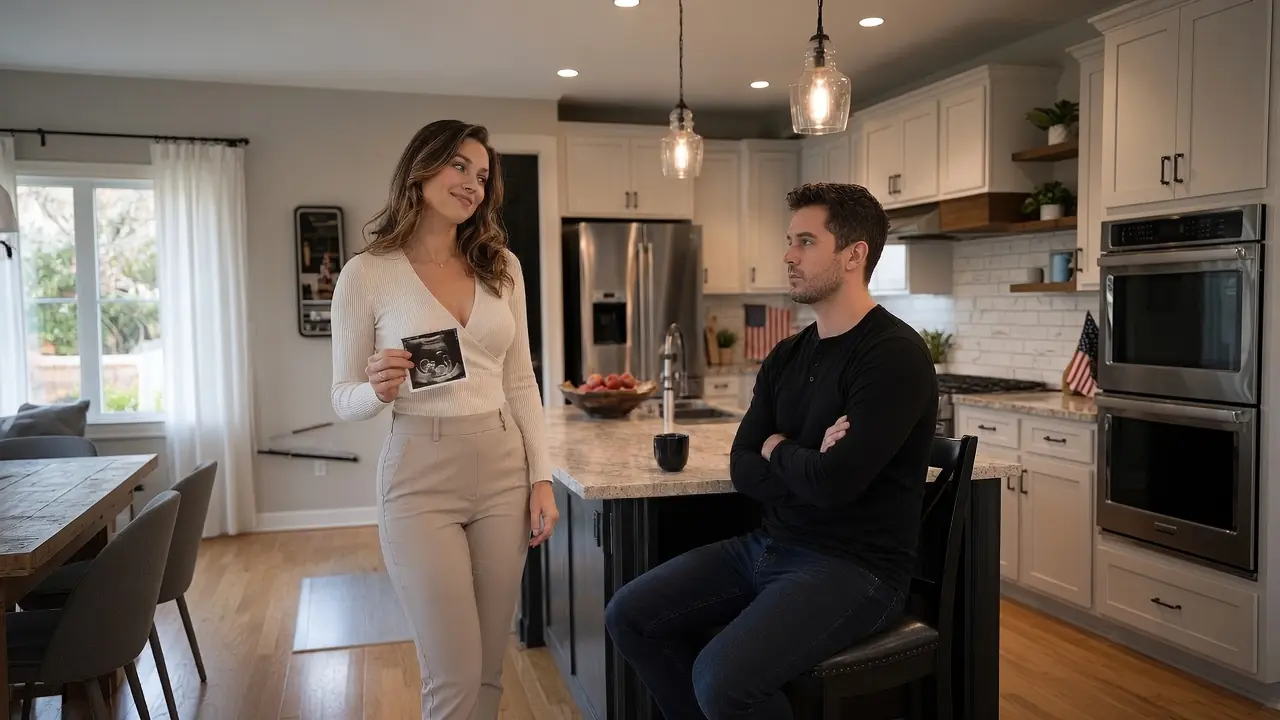
Daniel stared at her.
That sentence changed everything.
Not because of the betrayal itself, though that was enough. Not because she had slept with Jason, lied, and carried on as if Daniel were too blind to notice. It was the casual structure of her plan that finished the marriage in his mind. She had already spoken to Jason, already discussed responsibility, already measured Daniel’s usefulness, and now she was presenting the result as if it were a family decision.
He stood from the stool.
Rebecca’s shoulders relaxed slightly, as if she believed he was about to come around the island and hold her. Instead, he picked up the black coffee mug, carried it to the sink, and poured the untouched coffee down the drain. His movements were slow, precise, and terrifyingly calm. When he turned back, his face held no warmth.
“Congratulations,” he said.
Rebecca blinked. “What?”
“Congratulations,” he repeated. “I need air.”
He walked past her toward the hallway.
“Daniel,” she called, voice sharp now. “Don’t walk away from me.”
He stopped but did not turn around. “You walked away from me months ago. I’m just catching up.”
Then he left the house.
He drove for hours without knowing where he was going. Neighborhood streets became highways, highways became back roads, and eventually he pulled into the parking lot of a closed grocery store and sat beneath a flickering light. His hands rested on the steering wheel, but he could not feel them. In his head, Rebecca’s voice repeated again and again: It might be yours or Jason’s.
The words were cruel, but the shrug in her voice was worse.
She had not confessed like a person devastated by guilt. She had announced a complication. She had spoken as if Daniel’s love, money, home, name, and future were resources to be redistributed after her mistake. She had not asked whether he could survive the betrayal. She had asked him to make the fallout convenient.
When he returned home that evening, Rebecca was on the couch scrolling through baby names.
That image stayed with him for years.
She looked up with cautious relief, as if his return meant surrender. “I know today was emotional,” she said. “But I think if we stay calm, we can figure this out.”
Daniel stood in the living room doorway. “You’ve been seeing Jason for months?”
Rebecca sighed, as if the detail bored her. “A few months. It became confusing.”
“Confusing?”
“I still love you.”
Daniel almost smiled at the absurdity. “That wasn’t my question.”
She set her phone down. “Yes, a few months. But it didn’t mean what you think it meant.”
He looked around the living room they had decorated together, the framed vacation photo on the wall, the blanket his mother had given them folded over the chair, the houseplants Rebecca always forgot to water. It all looked suddenly staged, like evidence from a marriage that had existed only on his side. “And Jason knows about the pregnancy?”
“Yes.”
“What did he say?”
Rebecca crossed her arms. “He said he doesn’t want to disrupt his career over something uncertain.”
Daniel nodded slowly. “So if the baby is his, he disappears, and I become the plan.”
“That’s not what I said.”
“That’s exactly what you said.”
Her face hardened. “You’re being cruel.”
Daniel wanted to shout. He wanted to throw the nearest lamp into the wall, demand every date, every lie, every night she had touched him after touching someone else. Instead, he heard a calm voice inside him, clear and protective. Do not give her your explosion. Give yourself your exit.
So he sat down across from her.
“You’re right,” he said quietly. “We should take time to process.”
Rebecca relaxed.
That was her first mistake.
The next morning, while she showered, Daniel checked her phone. He hated doing it, hated the way his hand shook as he entered the passcode he knew because they were married and had shared everything. But after the kitchen confession, privacy no longer felt like a shield. It felt like the place where the truth was hiding.
What he found was worse than the affair.
There were messages with Jason going back over a year. Flirting at first, then emotional dependence, then hotel plans, then the careful arrangement of lies Rebecca used on Daniel. There were photos of gifts she bought Jason using money from the joint account. There were messages about a weekend she had called a girls’ trip.
Then Daniel found the pregnancy messages.
Jason wrote, “Are you sure it could be his?”
Rebecca replied, “Technically, maybe, but I think it’s yours.”
Jason answered, “Then tell him it’s uncertain. He’s stable. He’ll do the right thing if you frame it right.”
Daniel read the line three times.
Then Rebecca wrote, “Daniel would be a better father anyway. He has money, patience, insurance, and he actually wants a family.”
That was the moment the last thread snapped.
Daniel took screenshots of everything, emailed them to himself, then sat at the kitchen island while the shower ran upstairs. The ultrasound photo was still on the counter where Rebecca had left it. He looked at it without hatred. The child was innocent. That made what Rebecca had done even worse, because she was already using innocence as leverage.
At nine-thirty that morning, Daniel called in sick to work.
At ten-fifteen, he was sitting in the office of Diane Mercer, a divorce attorney in her fifties with silver glasses, sharp eyes, and a voice that never wasted time. She listened without interrupting as Daniel explained the confession, the affair, the messages, and the pregnancy. When he handed her printed screenshots, she read them with no visible shock. That frightened him in a different way.
“You’ve seen worse?” he asked.
Diane looked up. “I’ve seen people do almost anything when they think someone else will carry the consequences.”
Daniel leaned back, exhausted. “What do I do?”
“You get evidence. You do not threaten. You do not warn. You do not confront until we decide timing.” She tapped the screenshots. “And we address paternity immediately before the law decides convenience for everyone else.”
Over the next few weeks, Daniel became a quiet detective in his own marriage.
He found hotel charges hidden inside vague credit card descriptions. He found expensive restaurant receipts from nights Rebecca claimed she worked late. He discovered sick days she used to meet Jason and gift purchases from their shared account. Every piece went to Diane.
At home, he became calm.
That calm confused Rebecca. She mistook it for acceptance, then for weakness, then for victory. She talked about nursery colors, baby names, and how “modern families” were complicated. She patted his hand one night and said, “I was afraid you’d freak out, but I’m glad you’re being mature.”
Daniel smiled.
“What matters is that we figure out the truth,” he said.
Rebecca heard what she wanted to hear.
By Christmas, she had begun to show. Her parents were thrilled, her friends were excited, and everyone treated Daniel like a stunned but supportive husband. He attended one prenatal appointment because Diane told him visible cooperation would matter if Rebecca later tried to portray him as cruel or unstable. He sat beside Rebecca while the doctor spoke, smiling when expected, all while knowing his marriage had already ended.
The divorce papers were ready by January.
Diane asked when he wanted Rebecca served. Daniel thought about the kitchen, the ultrasound photo, the smug tilt of Rebecca’s smile, and the way she had said, “We wanted a family.” He thought about the messages where she and Jason had discussed him like a financial option. He did not want revenge, not exactly. He wanted the truth to arrive somewhere Rebecca could not immediately control it.
Then Rebecca mentioned the baby shower.
“My friends want to do it early,” she said one evening. “Megan is hosting. My mom is coming, obviously. It’ll be small, but meaningful.”
“How early?” Daniel asked.
“February.”
He nodded. “Sounds nice.”
That was her second mistake.
On the day of the shower, Rebecca left the house glowing. She wore a soft pink dress, carried a gift bag for the hostess, and kissed Daniel’s cheek as if the world were exactly where she wanted it. “Wish you could come,” she said, though she had never invited him. Daniel smiled and told her to enjoy herself.
Two hours later, when he knew the party would be full of friends, family, gifts, cake, and performance, he texted Diane one sentence.
Green light.
He spent the next hour sitting in a quiet bar downtown, staring at a glass of whiskey he barely touched. His phone buzzed at first, then rang, then exploded. Rebecca called twelve times. Her mother called twice. Unknown numbers appeared. Texts filled the screen.
He did not answer.
When he finally listened to Rebecca’s voicemail, she was sobbing and screaming. “How could you do this to me today? In front of everyone? Do you know how humiliating it was to be served divorce papers while opening gifts for my baby?”
Daniel closed his eyes.
Yes, he knew exactly what humiliation felt like.
The following weeks were chaos.
Rebecca alternated between begging, blaming, and threatening. One day she said she had made a terrible mistake and wanted counseling. The next day she accused him of abandoning a pregnant woman. Jason vanished almost immediately, blocking her number and refusing to discuss anything without a lawyer.
Rebecca’s family split in ways Daniel did not expect.
Her mother called him heartless. Her father asked to meet for coffee and spent most of the time staring into his cup. “I love my daughter,” the older man said eventually, “but what she did was wrong. No man deserves to be used like that.” It was not enough to fix anything, but it gave Daniel one small piece of dignity back.
Diane pushed hard for paternity testing.
Rebecca resisted, delayed, cried, and claimed stress was bad for the baby. But the messages were clear, the timeline mattered, and the court had no patience for emotional fog when legal responsibility was at stake. Eventually, Rebecca agreed to a prenatal paternity test.
The week waiting for results nearly broke Daniel.
He told himself biology did not change betrayal, but it changed consequences. If the baby were his, he would have responsibilities that connected him to Rebecca forever. If the baby were Jason’s, the escape would be cleaner, though not painless. He tried not to imagine either future too clearly.
Diane called him on a rainy Thursday morning.
“You are not the father,” she said.
Daniel sat down on the edge of his bed.
He did not cheer. He did not laugh. He did not feel victory. What came over him was relief so intense it almost hurt, followed by grief for the version of himself who had once been excited in the kitchen before the sentence finished destroying him.
With paternity established, the divorce moved quickly.
Rebecca’s leverage collapsed. There were no children between them, no major shared assets beyond their home, and a prenuptial agreement protected Daniel’s family inheritance. He agreed to a fair settlement just to end the matter. Diane told him he was being more generous than required.
“I don’t want to fight forever,” he said.
The divorce was finalized in May.
Daniel moved into a smaller apartment across town, where the walls were bare and the silence felt clean. He bought one couch, one bed, and a kitchen table that did not hold any memories. For the first time in years, he slept without wondering where Rebecca had really been. Some mornings were still brutal, but they belonged to him.
Then the baby was born.
Two weeks later, Rebecca called from a number he had not blocked yet. Her voice was hysterical. “The baby looks like you,” she sobbed. “The test must have been wrong. You need to help us.”
Daniel stood by his apartment window, watching rain run down the glass. “Rebecca, we already have the test.”
“Jason won’t help. He blocked me. His lawyer says he won’t pay anything until there’s another court order.” Her voice sharpened. “You made vows to me.”
“You broke them.”
“I’m the mother of a newborn.”
“And Jason is the father.”
She went quiet for one second. Then she said, “You’re punishing an innocent baby because you hate me.”
Daniel’s hand tightened around the phone. “No. I’m refusing to let you use an innocent baby to keep me trapped.”
She hung up.
More messages came from her friends, calling him cruel, selfish, and a deadbeat. Most of them did not know the full story, because Rebecca had reached them first with her version. She positioned herself as a vulnerable mother abandoned by a bitter husband. Daniel let Diane respond when necessary and blocked everyone else.
Eventually, Jason was legally established as the father.
Rebecca fought him, then chased him, then publicly complained about deadbeat fathers without naming him. Jason paid child support because the court required it, not because conscience found him. Rebecca’s carefully arranged plan had failed in every direction. Daniel watched from a distance and felt nothing but exhaustion.
The final confirmation came from Rebecca’s younger sister, Laura.
She messaged Daniel one evening and wrote, “I thought you should know Rebecca admitted she believed the baby was Jason’s from the beginning. She tried to keep it uncertain because she thought you’d be a better father and provider. I’m sorry. You deserved better.”
Daniel stared at the message for a long time.
Then he replied, “Thank you. Please don’t send me updates unless it’s something I truly need to know. I’m trying to move on.”
And he meant it.
Months passed.
Daniel started therapy. He changed jobs to avoid colleagues who had chosen sides without asking questions. He went on a few careful dates, though trust still felt like a language he had forgotten how to speak. He reconnected with an old college friend named Claire, who listened to the full story and said, “You didn’t dodge a bullet. You dodged a house fire and still got out with your keys.”
That made him laugh for the first time in weeks.
One Sunday morning, nearly a year after the kitchen confession, Daniel made pancakes in his apartment. The first one burned because he forgot to lower the heat, and the smell dragged him back to the morning Rebecca first told him she was pregnant. For a moment, he stood frozen with the spatula in his hand, grief rising sharp and unexpected.
Then he turned off the burner, threw the burned pancake away, and started again.
The second one came out fine.
He sat at his small kitchen table with coffee, pancakes, and quiet sunlight coming through the blinds. No lies waited upstairs. No phone was hiding messages. No one was smiling at him while planning to use his kindness as a trap.
He thought about the ultrasound photo, the baby shower, Diane’s office, the paternity result, and the version of himself who had once believed trust meant ignoring discomfort. He knew better now. Trust was not blindness. Love was not payment for betrayal. Being a good man did not mean volunteering for a life built on someone else’s deception.
Rebecca had wanted a fool with a wallet.
Daniel had become a man with a boundary.
That was the difference.
And for the first time since the night he drove away from his own house, he looked around his quiet apartment and felt no shame in starting over.