On my daughter’s wedding day, I handed her an envelope with a gift, hoping for gratitude. But instead of smiling, she raised her glass and said she had always dreamed of having a different father. She hugged her father-in-law and I left the hall. But when my daughter opened the envelope, the wedding turned into a nightmare.
“$45,000.” Leticia’s voice cut through the pristine air of her Bloomfield Hills townhouse like a blade through silk. I stood in her designer living room, my worn cap clutched between calloused hands, feeling like a stain on her perfect white furniture. The floor-to-ceiling windows showed off manicured lawns that probably cost more to maintain than my monthly pension. Everything gleamed — glass coffee table, chrome fixtures, artwork that looked expensive enough to feed a family for months.
“Tia, sweetheart,” I started, but she was already spreading wedding magazines across that spotless table, each one thick as a phone book and twice as glossy. “Look at this venue, Dad.” She jabbed her manicured finger at a photo of some mansion with columns. “The Townsend Hotel ballroom. This is where successful people have their weddings.”
I’d brought my best hopes that night, dressed in my least faded button-down shirt, even polished my old work boots. The drive over, I had practiced what to say about helping with her special day. Maybe contribute a few thousand, help set up tables, whatever she needed. But $45,000. The flowers alone were $8,000, she continued, flipping pages with aggressive enthusiasm. The photographer was $5,000. The dress she wanted was $3,500, but it was perfect.
I fumbled with my phone trying to calculate. My savings account held $12,000 — every penny I’d managed to scrape together over 40 years at the Ford plant. Social Security barely covered my mortgage and groceries. “I have $12,000 in savings,” I said quietly. “That’s everything I can manage, but maybe with a small loan.”
Leticia’s face transformed. The excitement died, replaced by something cold and sharp. “$12,000? Seriously?” She stood up, her voice rising. “Other fathers take out loans, sell cars, re-mortgage houses. What are you willing to do for your own daughter?”
The words hit like physical blows. I’d raised this girl after Elena died, worked double shifts so she could have new clothes for school, sacrificed everything so she could go to college and become the successful marketing professional she was today.
“Tia, I could try for a loan, but $45,000…” I gestured helplessly around her expensive living room. “You’re doing well for yourself. Maybe we could find something more reasonable.”
“More what? Cheap?” She threw a magazine onto the table so hard it scattered others. “You know what Marcus’s father is paying for his sister’s wedding? $60,000. And that’s considered modest in their family.”
Marcus, her fiancé, whose father owned half the restaurants in downtown Detroit. “I’m 35 years old, Dad. This is my one chance to have the wedding I deserve. My friends’ fathers would move heaven and earth for their daughters. But you?”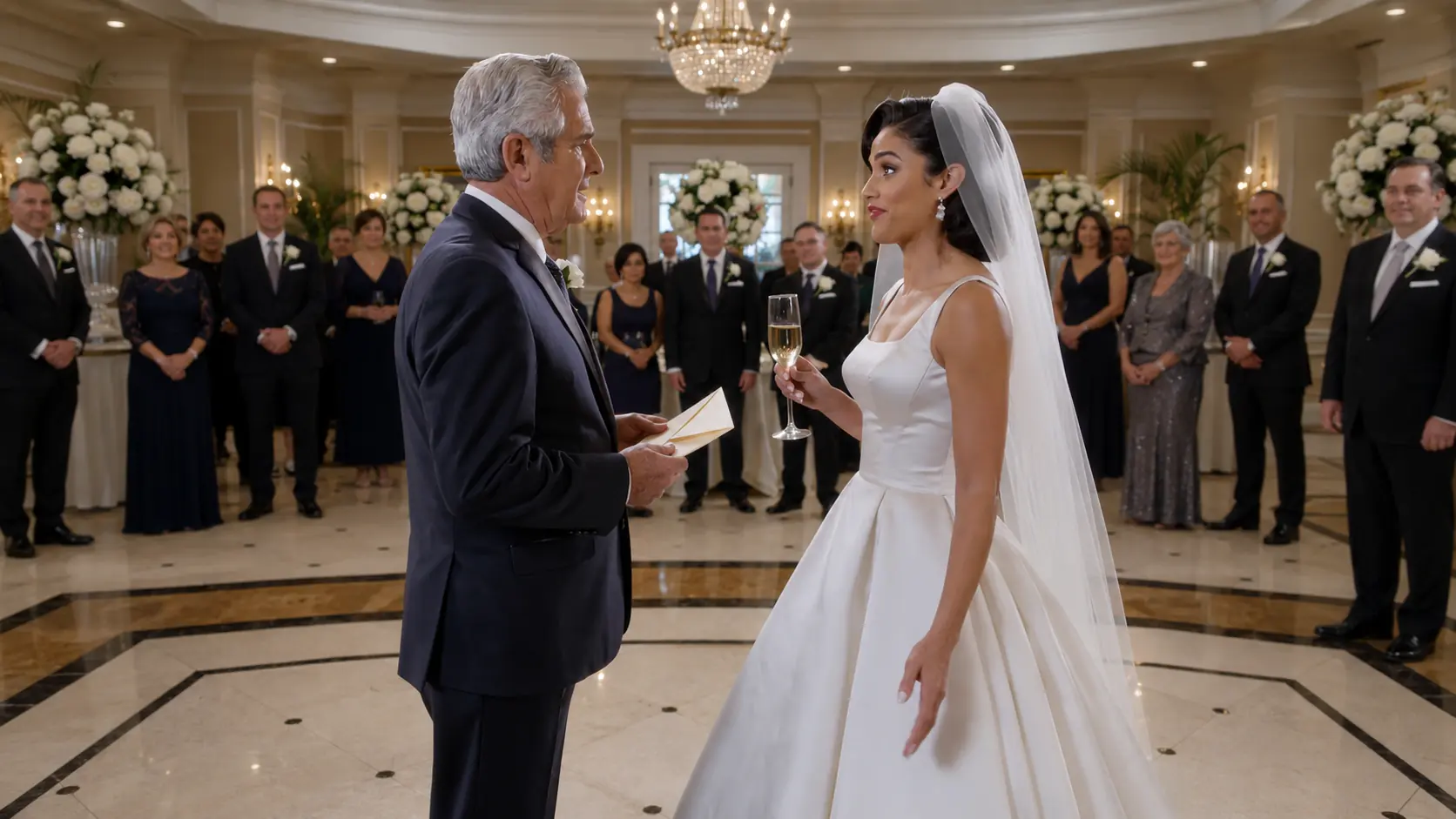
She looked me up and down, taking in my worn jacket, my nervous fidgeting. “You’re just a failure.” The word hung in the air like smoke from a house fire. “All my friends will have perfect weddings and I have to settle for some backyard barbecue because my father can’t provide what every other parent manages. Do you know how embarrassing that is?”
I wanted to speak, to explain about the plant closing early, about medical bills from Elena’s cancer, about doing my best with what life gave me, but my voice wouldn’t come. “You’ve had 35 years to figure out how to be successful, and this is what you have to show for it. $12,000.”
She walked to the door, her heels clicking on hardwood that probably cost more than my truck. “Just leave, Dad. I can’t look at you right now.” The door slammed with a sound that seemed to echo through my chest.
I stood there for a moment in her perfect driveway, keys heavy in my hand, staring at my beat-up Ford surrounded by her neighbors’ luxury cars. The evening air felt thick, pressing down on my shoulders. The truck engine ticked as it cooled in my driveway later, but I couldn’t bring myself to get out. Through the windshield, my house looked smaller than usual — a modest 1960s ranch with paint that needed touching up.
When I finally went inside, the silence felt heavy. I turned on the lamp by Elena’s old reading chair. She used to sit there evenings planning Leticia’s future. The photos on the mantelpiece showed happier times. Leticia’s high school graduation, her college degree ceremony. In every picture, I looked proud. Had I been fooling myself all these years?
“Elena, what would you do?” I spoke to the empty room. “Our girl deserves happiness. Maybe I really am a failure if I can’t give her what she wants.”
The next morning, I drove to Chase Bank. The loan officer, Sandra, reviewed my documents carefully. “Given your age and fixed income, the maximum we can approve is $35,000 at 18% interest.” The numbers were daunting — monthly payments of around $870, more than half my pension. But I signed anyway. She’s worth every penny, I told myself.
I returned to Leticia’s house with the envelope containing $47,000 — my life savings plus the loan. “Tia, sweetheart,” I said, handing it to her with pride. “I took care of it.”
Her reaction wasn’t gratitude. “Oh, Dad. That’s not needed anymore. Dennis is paying for the whole wedding.” She waved her hand dismissively. “He said I deserve the best.”
The words crushed me. While I had risked everything, Dennis Hargrave had simply written a check and become the hero. “Dennis booked the Townsend Hotel for the whole weekend,” she continued excitedly, already turning back to her magazines.
I left with the heavy envelope still in my jacket, the weight of humiliation pressing on my chest. That night, I sat with Elena’s photo and began writing the letter that would change everything.
Weeks passed. Leticia excluded me from planning meetings, dress fittings, and even adjusted the wedding invitation time so I would miss the ceremony. “It’s just easier this way,” she said on the phone. The pattern was clear: I was an embarrassment in her new world of wealth and status.
On the wedding day, I arrived at St. Paul Church at what I thought was the correct time, only to discover the ceremony had started two hours earlier. Through the doors, I saw Dennis walking my daughter down the aisle — the man who had replaced me. The invitation I held listed 1:00 p.m., while others showed noon. It was deliberate.
I sat in a nearby park, watching guests celebrate, and sealed the envelope containing the adoption papers and my letter. The truth: Leticia was not our biological daughter. After Elena and I couldn’t have children, we adopted her at age three following her birth parents’ tragic death. We had chosen her, loved her, sacrificed for her every single day.
At the reception, Leticia raised her glass. “I’ve always dreamed of having a different father,” she announced proudly, hugging Dennis. “And finally that dream has come true.”
The room fell silent. Guests shifted uncomfortably. I stood quietly among them, then approached with the envelope.
“Tia, this is my gift to you,” I said calmly. “Open it privately later. It’s very important.”
She took it absently and handed it to Marcus to place with the other gifts. I slipped away without drama, driving home with a strange sense of peace.
Later that evening, my phone exploded with calls. “Dad, what is this? You’re lying!” Leticia’s voice cracked with panic as she read the letter revealing her adoption. “This can’t be true!”
I didn’t answer. The truth she had demanded through her cruelty was finally hers. She had chosen money and status over the father who had given her everything. Now she would live with the consequences.
I packed my truck that night, taking only what mattered — Elena’s ring, our old photos, my tools. At 68, I was finally free. The modest house where I had raised someone else’s daughter as my own no longer felt like home. The road ahead held quiet dignity and peace I hadn’t known in years.
Leticia had traded 35 years of unconditional love for a richer stranger’s check. She learned too late that the greatest gift a father can give is not money, but the quiet choice to love and raise a child as his own. Some truths hurt more than any loan or humiliation ever could.
As I drove into the sunset, Elena’s photo glowing on the dashboard, I whispered, “We did our best, love. Now it’s time for me.”
The nightmare she created on her perfect day was only beginning. For me, it was the start of freedom.