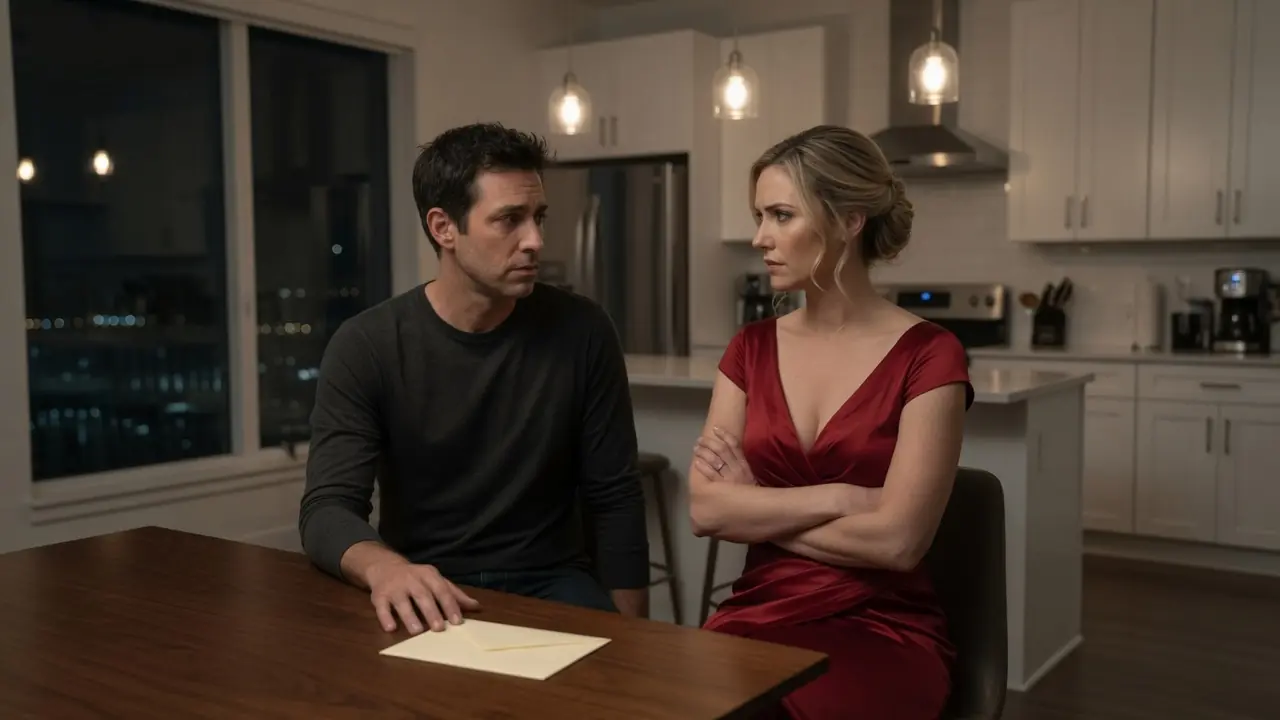
Nathan Hayes sat at Amy Patterson’s dark wooden dining table with one hand resting beside a plain cream envelope, watching the woman he planned to marry fold her arms across her red satin dress as if she were preparing for a business negotiation instead of a conversation about their future. The apartment around them was spotless, modern, and carefully arranged, with white kitchen cabinets, a stainless-steel refrigerator, pendant lights over the island, and not one object out of place. Amy’s blonde hair fell in polished waves over one shoulder, and her eyes held the kind of defensive brightness Nathan had learned to recognize when she already knew she was about to hurt him. The Thai food he had brought over sat cooling between them, untouched now, because the appetite had left the room before either of them knew it.
For most of dinner, Amy had been distracted. She checked her phone under the table, answered him with half sentences, and stared past him toward the kitchen as if she were rehearsing something in her head. Nathan had tried to keep things easy at first, asking about her day, her client presentation, and the wedding appointments she had mentioned earlier that week. Each answer came thinner than the last, until finally he set his fork down and asked the simplest question a person can ask someone they love. “What’s wrong?”
Amy sighed as though he had forced the answer out of her instead of waiting patiently for it. She looked down at the placemat, then toward the envelope near his hand, then back to him with a small tightening of her mouth. “I had lunch with the girls today,” she said. “They asked about the wedding, about our future, about you.” Nathan nodded slowly, feeling the first cold thread of warning move through him.
“What about me?” he asked. Amy leaned back, her arms crossing tighter, and her posture changed from uneasy to prepared. “They just think I should be realistic,” she said. “They think I might be settling. They think you’re not exactly the kind of man people expect me to marry.” Nathan stared at her, waiting for a smile, a correction, some sign that she understood how cruel the sentence sounded.
None came.
He had been with Amy for four years. He knew her laugh, her coffee order, the way she pretended not to cry during old movies, and the exact face she made when she was lying to herself. He had proposed six months earlier with an eight-thousand-dollar ring he had saved for quietly, carefully, proudly. He had paid most of the wedding deposits because Amy said she was saving for the honeymoon, and he had never once thought to resent that. Now she sat across from him as if love had become a résumé she was not sure he had filled out correctly.
“So your friends think you’re settling,” Nathan said, keeping his voice low. Amy’s eyes flashed with irritation. “They didn’t say it like that exactly.” He gave a small, humorless nod. “Then how exactly did they say it?” She looked away for half a second. “They said I should aim higher.”
The sentence stayed between them like a glass dropped on tile.
Nathan’s hand tightened near the envelope, but he did not reach for it. He had brought it because inside were final notes from the venue, a payment schedule, and a list of decisions they still needed to make before the wedding. An hour ago, it had represented a life they were building. Now it looked like evidence in a case he had not known was being tried.
Amy continued because silence made her uncomfortable. “I want a bigger life, Nathan. First-class trips, a better neighborhood, private schools someday, people who look at us and think we really made it. You’re stable, and that’s good, but you’re comfortable where you are.” Her voice softened slightly, but not with kindness. “Sometimes I wonder if I’ve been thinking too small.”
Nathan let out one breath through his nose. He was a project manager for a midsized construction company, not a celebrity, not a hedge fund partner, not the kind of man who made strangers jealous at cocktail parties. But he made good money, saved carefully, treated people well, and had spent four years believing those things mattered. Amy had once said they did. Apparently, her friends had taken one lunch to convince her otherwise.
“Am I embarrassing to you?” he asked.
Amy’s expression shifted. “Don’t twist this.”
“I’m asking you a direct question.”
Nathan looked at her then, really looked. He saw the woman he loved, but also the woman who had allowed a table of friends to weigh him like a handbag, a vacation, a status symbol. He saw a future in which he would spend years proving himself to an audience that had never loved him in the first place. He saw children someday watching their father audition for respect in his own home.
He stood slowly.
Amy blinked. “What are you doing?”
“I’m leaving.”
Her face changed from defensive to startled. “Nathan, don’t be dramatic. I’m trying to have an honest conversation.” He picked up the envelope and held it at his side. “No, you’re telling me I’m not good enough while expecting me to convince you that I am.” His voice stayed calm, and that seemed to frighten her more than anger would have.
Amy uncrossed her arms. “You’re breaking up with me over one conversation?”
“I’m breaking up with you because you listened when people told you to look down on me.” Nathan pushed in his chair gently, almost carefully, because he refused to make the moment messier than it already was. “If you think you can do better, go ahead. I won’t sit here and audition for your approval.” Amy stood too, her mouth open, her confidence suddenly cracking under the weight of consequences she had not expected.
“You can’t just end our engagement like this,” she said.
“I can,” Nathan replied. “And I am.”
He left before she could cry, argue, or soften the insult into something more acceptable. Outside, the night air felt too cold against his face, though it was early spring and not cold enough to explain the chill in his chest. He sat in his car for several minutes with both hands on the steering wheel, staring at the apartment building where their future had just collapsed. Then he drove home in silence, the envelope on the passenger seat like something that belonged to someone else.
At his apartment, Nathan sat on the couch without turning on the lights. The room was small, ordinary, and suddenly peaceful in a way that made him feel both grateful and hollow. He thought anger would come first, but it did not. What came first was disbelief, then grief, then a hard clean line inside him that said he must not give Amy time to turn insult into negotiation.
He opened his laptop and began making calls.
The venue was first. He lost the deposit, and when the coordinator asked if he was sure, he said yes without explaining. The caterer came next, then the photographer, then the florist, then the rental company. Every cancellation hurt financially, but each one felt like pulling a nail from a board before it became a coffin.
The next morning, Nathan took the engagement ring back to the jeweler. The man behind the counter recognized him and smiled, then stopped smiling when Nathan placed the box on the glass. There was a return policy, but not a generous one, and Nathan accepted the loss without arguing. He walked out with a partial refund and an empty pocket where the promise had been.
Then he texted Amy.
The ring is returned. The vendors I paid for are canceled. You’re free to aim higher now.
Her first call came in less than a minute.
Nathan watched the phone ring until it stopped. Then it rang again. By noon, she had called seventeen times, sent messages ranging from furious to frightened to pleading, and accused him of humiliating her. He blocked her number after the final message said he was being cruel for taking her words seriously.
The first week after the breakup felt unreal.
Mutual friends began reaching out, some gentle, some curious, some openly judgmental. A few told him Amy was saying they were “taking space,” which was not the same thing as broken up. Others said she still talked about dress fittings and floral arrangements as if nothing had changed. Nathan realized with a strange calm that Amy had not accepted the ending because accepting it would require admitting why it happened.
He refused to correct every rumor.
He went to work, answered emails, handled site issues, and let normal tasks hold him steady. At night, he cooked simple dinners, ignored social media, and went to the gym because moving his body was better than sitting with the same thoughts until dawn. He missed her, which angered him, because missing someone did not mean they deserved to return. Love, he was learning, could ache even after respect had been withdrawn.
Two weeks later, his friend Jake called.
“Did you know Amy still went to Nashville?”
Nathan rubbed his forehead. “Nashville?”
“Bachelorette weekend,” Jake said. “My girlfriend saw pictures from one of the bridesmaids. They’re acting like the wedding is still happening.”
Nathan stared across his living room. “The wedding is not happening.”
“I know that. I’m not sure Amy does.”
Nathan tried to dismiss it as denial. People handled shame strangely, and Amy had always cared too much about appearances. If she wanted one final weekend pretending her choices had not cost her anything, he told himself that was no longer his problem. He went to bed early that Saturday, exhausted from thinking about someone he was trying to release.
At 2:47 a.m., his phone rang.
The number was unknown, and he almost ignored it. Something made him answer. For a second, all he heard was crying and club music muffled in the background. Then a woman’s voice broke through, trembling so hard he barely recognized it.
“Nathan, it’s Jessica,” she said. “Amy’s maid of honor.”
Nathan sat up immediately. “Jessica? What happened?”
“I’m so sorry,” she said, words tumbling over sobs. “I should have called sooner. I need to tell you what she’s planning.”
The coldness returned to Nathan’s chest, sharper this time. Jessica spoke in broken pieces, explaining that Amy was drunk, emotional, and still insisting the wedding would happen. She had rebooked vendors with her parents’ money and credit cards. She had told the bridesmaids that Nathan would show up on the wedding day because he would not want to embarrass her in front of everyone.
Nathan stood and turned on a lamp.
“What?”
Jessica cried harder. “She thinks if she keeps everything moving, you’ll come back. She says you were just hurt and stubborn.”
“That’s not denial,” Nathan said quietly. “That’s manipulation.”
“There’s more,” Jessica whispered.
The room seemed to shrink around him.
Jessica told him Amy had threatened to blame him if he refused to appear. Not just blame him emotionally, not just call him cold or unreliable, but accuse him of being controlling and cruel, of giving her a reason to call off the wedding. Amy had said her friends would back her because people liked her more. Jessica said some of the bridesmaids laughed as if it were a joke, but she knew it was not.
Nathan’s hand tightened around the phone until his knuckles hurt.
“Can you prove any of this?” he asked.
Jessica took a shaky breath. “There are group messages. She’s been texting us about how you’ll come around. Melissa heard everything tonight too. We’ll send screenshots.”
“Send all of it,” Nathan said. “Now.”
Twenty minutes later, his phone filled with screenshots.
The messages were worse than he expected. Amy had written that Nathan was being stubborn, that he would not let her stand alone at the altar, that he still loved her and would fold when the pressure became public. Then came the line that made him sit down slowly on the edge of his bed. If he doesn’t show, I’ll tell everyone he was controlling and I called it off. No one will blame me.
Nathan read the message three times.
The woman who once cried when he surprised her with tickets to her favorite concert had written those words. The woman who wore his ring had planned to use his decency as a trap and his absence as a weapon. He did not sleep again that night. By morning, grief had been replaced by strategy.
At eight, he called a lawyer.
At nine-thirty, he sent the screenshots to a secure email folder. At ten, he called Amy’s father, Richard Patterson, a calm man Nathan had always respected. Richard answered warmly at first, clearly under the impression that the couple was working through a rough patch. Nathan ended that illusion in the first thirty seconds.
“Mr. Patterson, Amy and I broke up three weeks ago,” he said. “There is no break. There is no wedding.”
Silence filled the line.
Then Richard said, “She told us you needed time.”
“She told you what protected her from consequences,” Nathan replied. He hated how harsh it sounded, but he was done softening truths for people who had sharpened lies. He explained the dinner, the insult, the canceled vendors, the rebooked wedding, and the threat Amy made in Nashville. When Richard asked for proof, Nathan sent everything.
Two hours later, Richard called back.
His voice sounded older.
“I spoke to Amy,” he said. “She admits she has been refusing to accept the breakup. She says the comments about accusing you were drunk nonsense.”
“With respect,” Nathan said, “I can’t build my safety on her saying she probably wouldn’t ruin my life.”
Richard was quiet.
“You’re right,” he said finally. “We are bringing her home today. Her mother and I will cancel everything ourselves. I am sorry, Nathan. You deserved better than this.”
Nathan closed his eyes.
“Thank you for taking it seriously.”
Amy’s parents followed through.
The vendors were canceled. Her parents confronted her. Jessica later told Nathan that Amy had to admit to the bridesmaids that the engagement had ended weeks earlier, that she had misled them, and that the Nashville weekend was built on denial. The friend group fractured immediately. Jessica and Melissa distanced themselves, while the others tried to pretend they had not encouraged a disaster.
Four days later, Amy sent Nathan a long email.
It began with apology and ended with excuses. She said she had been confused, influenced by shallow friends, terrified of embarrassment, and not herself. She claimed she never would have truly accused him of anything. She asked to meet for coffee because they deserved closure.
Nathan did not respond.
Closure, he realized, was often a word people used when they wanted access after losing trust. He had all the closure he needed. Amy had looked at him across a table and told him he was not enough. Then she had tried to rewrite reality so she would not have to face what happened when he believed her.
In the following weeks, the story spread.
Nathan did not tell people, but bridesmaids talked, friends talked, and Amy’s sudden transfer to another city only made the whispers travel faster. Messages came from people he barely knew, saying they were sorry, saying they had always thought Amy cared too much about image, saying he had handled it with more grace than most men would have. Nathan appreciated the kindness, but it also disturbed him. How many people had seen the cracks while he was busy building the house?
One afternoon, he ran into Lauren, one of Amy’s friends from the lunch that had started everything.
She approached him at a coffee shop with both hands wrapped around a paper cup and shame written across her face. “Nathan, can I say something?” He looked at her for a moment, then nodded. Lauren swallowed hard. “I’m sorry. I said some judgmental things about you to Amy. I asked if you were ambitious enough for the life she wanted, and I hate that I said it.”
Nathan studied her.
“Did you believe it?”
Lauren looked down. “I was projecting. I was insecure about my own relationship and status and all that shallow stuff. Amy listened because part of her wanted permission to think it.” She looked back up, eyes wet. “But I never thought she’d do what she did.”
Nathan took a slow breath.
“Do you understand what almost happened to me?”
Lauren nodded. “Yes. And I’m ashamed I helped push her toward that mindset.”
He did not forgive her exactly, but he accepted the apology. He had learned the difference. Forgiveness did not always mean restoring access. Sometimes it meant releasing the need to make someone suffer in proportion to the damage they caused.
Two months after the breakup, Nathan stood in his apartment holding the refunded ring money statement.
The balance sat untouched in savings. At first, he thought he might use it for a trip, maybe somewhere quiet where he could breathe without explaining himself to anyone. Then he decided to leave it alone for a while. It was not just money anymore. It was proof that he had chosen self-respect before marriage turned disrespect into a life.
Jessica remained in touch, gently and without expectation.
She apologized often for not seeing Amy clearly sooner, but Nathan never blamed her. She had called when it mattered most, and that call had protected him from something ugly. Their friendship became one of the few good things to survive the wreckage. It reminded him that not everyone close to a bad decision was a bad person.
Amy moved away three weeks later.
Nathan heard about it through Jake, then through Jessica, then through the inevitable social media updates people sent him even when he did not ask. She had taken a job transfer and started therapy, apparently at her parents’ insistence. Nathan hoped therapy helped her. He also hoped never to be part of her healing.
One evening, he found the wedding envelope in a drawer.
He had forgotten to throw it away. The paper was still clean, the edges still sharp, the inside still full of old schedules for a day that would never happen. He sat at his table, in his own quiet apartment, and opened it one last time.
There was the venue timeline.
There was the balance due.
There was a note in his handwriting that said: ask Amy if she wants string lights outside.
That small note hurt more than the rest.
Because he had wanted the wedding to be beautiful for her. He had wanted the life after it even more. He had wanted grocery lists, school pickups, ordinary jokes, bills paid on time, family dinners, and the quiet pride of being chosen by someone who knew exactly who he was. He had not been trying to impress her friends.
He had been trying to build a home.
Nathan tore the envelope in half.
Then he tore it again, not angrily, but completely. He dropped the pieces in the trash and stood there until the last bit of imagined future loosened its grip. The pain did not vanish. But something inside him stood taller without it.
Months later, when friends asked if he was ready to date, he gave honest answers.
Not yet at first.
Then maybe.
Then eventually, yes.
But he knew he would never again confuse being tolerated with being loved. He would pay attention not just to how a woman treated him alone, but how she spoke of him when her friends asked questions. He would not marry someone who saw him as a compromise, a placeholder, or a man who needed polishing before he could be shown off.
Nathan had learned that the right person would not need him to become more impressive.
She would already understand what mattered.
A steady heart. A loyal partner. A man who showed up, paid attention, kept his word, and refused to turn love into performance. Those things were not flashy. They did not make shallow people jealous over lunch. But they built lives that did not collapse under the pressure of someone else’s opinion.
Amy had told him to aim higher without realizing what higher meant.
Higher was not first-class flights.
Higher was not a wealthier neighborhood.
Higher was not being admired by people who measured love in status.
Higher was walking away from a table where your worth was being debated and refusing to spend one more second proving what should have been obvious. Higher was canceling the wedding quietly instead of letting humiliation turn him cruel. Higher was protecting himself with proof, then choosing peace over revenge.
On the first Saturday that would have been their wedding day, Nathan woke early.
He made coffee, went for a long walk, and watched the city slowly open around him. His phone stayed quiet. No altar waited. No guests wondered where he was. No woman stood in white pretending love could be forced by public pressure.
He bought breakfast at a small diner, sat by the window, and felt the strange mercy of an ordinary morning.
The ring was gone.
The venue was gone.
Amy was gone.
But Nathan was still there, whole enough to begin again.
And for the first time since the night Amy crossed her arms across that polished table and told him her friends thought she could do better, Nathan smiled. Not because she had lost. Not because the truth had come out. But because he finally understood that when someone tells you they are settling for you, the strongest answer is not to beg them to stay.
It is to let them go and make sure they never get the chance to settle for you again.