“Good evening.”
The man’s voice was calm.
Warm, even.
He stood beneath the crystal chandeliers of the Beaumont Grand Hotel ballroom with one hand extended.
The woman facing him looked at that hand.
Then at his face.
Then at the room around them.
Seven hundred guests in black tie.
Champagne.
White tablecloths.
Orchids.
Politicians, investors, executives, and donors whose names appeared on buildings.
Her mouth tightened.
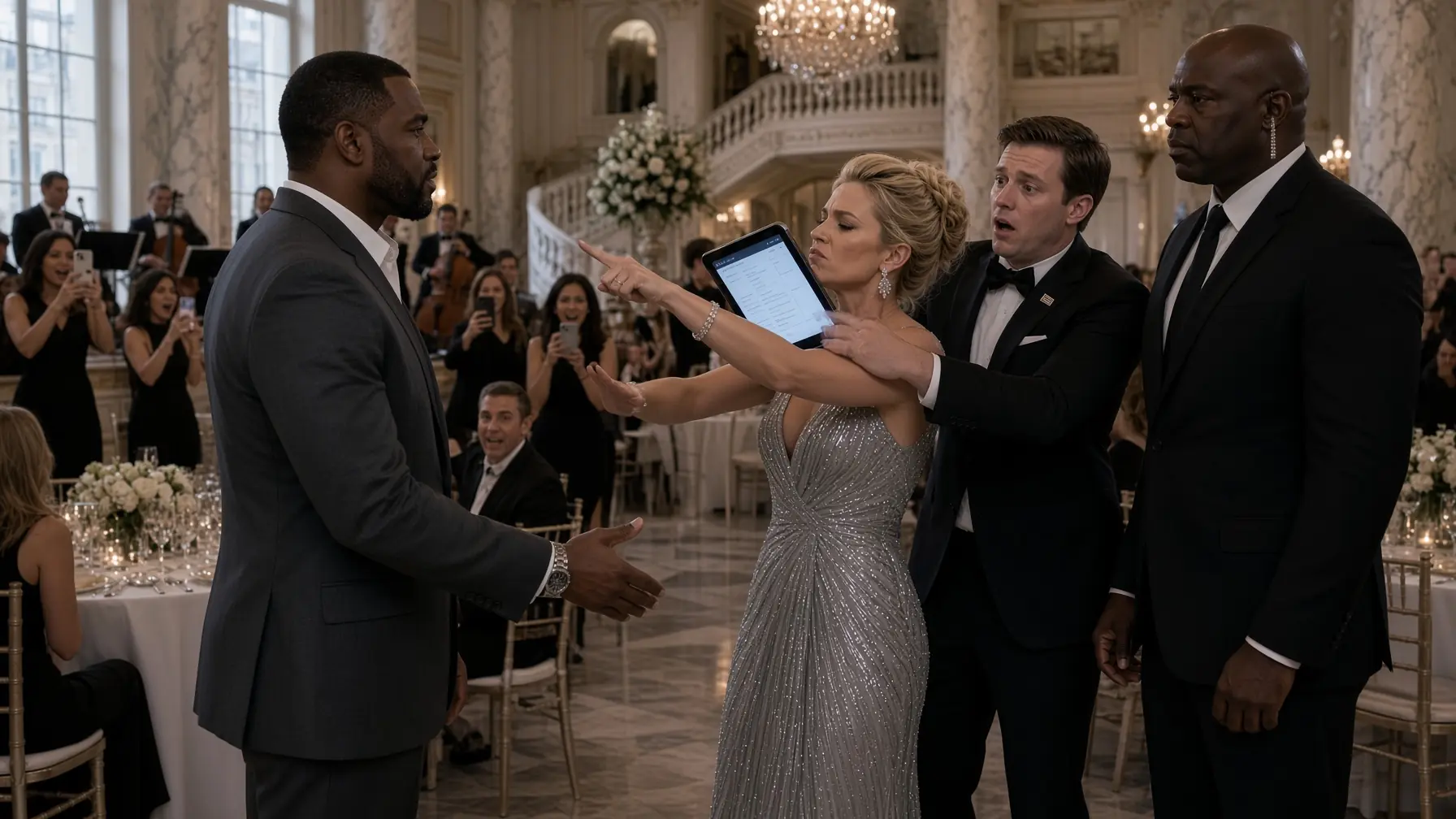
“Get your hand away from me.”
The man did not move immediately.
“I was only introducing myself.”
“I know exactly what you were doing.”
Her eyes traveled slowly over his dark skin, charcoal suit, plain white shirt, and unadorned watch.
Then her expression hardened.
“You do not belong here.”
Several conversations nearby stopped.
Someone lifted a phone.
The man lowered his hand.
“My invitation says otherwise.”
She laughed.
Not loudly.
Worse.
The small, contemptuous laugh of someone certain the room belonged to her.
“Invitation?”
She stepped closer.
“Look around you.”
He did.
Then back at her.
She continued.
“This is a private gala.”
“I know.”
“For Sinclair Bell Advisory.”
“I know.”
“And you expect me to believe you simply wandered in through the front door with a legitimate invitation?”
The man’s face did not change.
“Yes.”
She looked toward security.
“Remove him.”
A murmur moved through the nearest tables.
The man glanced toward the head of security.
The security director did not move.
That hesitation irritated her.
“I said remove him.”
The man finally withdrew his hand completely.
He adjusted one cuff.
Then said:
“My name is Adrian Brooks.”
She did not ask anything else.
Did not search her memory.
Did not ask the assistant standing behind her to verify the invitation.
She simply said:
“I don’t care what your name is.”
That sentence would be replayed thousands of times later.
But at the moment, Adrian Brooks only nodded.
“Understood.”
Then he walked away.
It was the first time that evening his handshake had been refused.
It would not be the last.
Adrian had spent most of his life learning what people revealed when they believed he could do nothing for them.
At forty-four, he was chairman and largest voting shareholder of Northbridge Capital Group, an investment company controlling businesses in commercial real estate, logistics, energy systems, software, and professional services.
Northbridge managed billions.
Adrian rarely appeared in magazines.
He disliked television interviews.
He avoided conferences unless attendance served a purpose.
His philosophy was simple.
Visibility attracted performance.
If people knew a powerful person was watching, they behaved for the powerful person.
Adrian preferred observing what happened before anyone knew they needed to perform.
Three weeks earlier, Northbridge had completed its acquisition of Sinclair Bell Advisory, a Washington consulting and corporate-events company.
The transaction had been months in preparation.
Sinclair Bell had valuable contracts.
Strong institutional relationships.
Excellent mid-level talent.
And a serious internal problem.
Turnover among Black and Latino senior employees was more than twice the company average.
Promotion data showed a similar pattern.
Three executives had left in fourteen months.
Two women had filed formal complaints.
One senior account director alleged that CEO Evelyn Sinclair repeatedly redirected prestigious client assignments away from minority employees because certain clients “wanted a more traditional face.”
The complaints went nowhere.
Internal HR marked them closed.
No independent interviews.
No meaningful findings.
No board review.
Adrian read every page during acquisition diligence.
His legal team recommended post-closing investigation.
Adrian agreed.
But he did not plan the gala as a trap.
The annual Sinclair Bell Foundation Dinner had already been scheduled.
The company’s directors wanted to introduce Northbridge leadership there.
Adrian agreed to attend without entourage.
He had one request.
Do not announce him before he arrived.
He wanted to meet people.
Listen.
Understand the company he had just purchased.
That was all.
At 7:12 p.m., he walked into the Beaumont Grand.
By 7:16, he knew the culture report had understated the problem.
The first group he approached stood beside the champagne bar.
Two investment bankers.
A lobbyist.
A woman Adrian recognized as the spouse of a former cabinet official.
They were discussing a yacht race.
“Good evening,” Adrian said.
They stopped.
“Beautiful event.”
The older banker looked him over.
“Can I help you?”
“Just introducing myself.”
Adrian extended his hand.
“Adrian Brooks.”
The banker looked at the hand.
Did not take it.
Instead he glanced toward the lobbyist.
“I thought invitations were checked downstairs.”
The woman beside him suddenly became fascinated with her champagne glass.
Adrian kept his hand there for another second.
Then lowered it.
“Enjoy your evening.”
Nobody answered.
As he walked away, he heard:
“Who is he?”
“No idea.”
“Probably somebody’s driver.”
Adrian continued walking.
He had heard worse.
What bothered him was not the insult.
It was how naturally it had been said.
No hesitation.
No concern that anyone important might hear.
Near an ice sculpture, he tried again.
A husband and wife were speaking with two Sinclair Bell directors.
Adrian waited for a pause.
“Good evening.”
One director smiled automatically.
Then looked more closely at him.
“Yes?”
“Adrian Brooks.”
He extended his hand.
The director did not shake it.
“Are you with the hotel?”
“No.”
“Catering?”
“No.”
“I’m attending.”
The director’s wife touched his sleeve.
A warning.
The man smiled tightly.
“Of course.”
Still no handshake.
Adrian lowered his hand.
That made two.
Across the ballroom, Evelyn Sinclair noticed.
Thirty-nine years old.
Elegant.
Silver gown.
Hair pinned perfectly.
Evelyn had inherited the company’s controlling interest after her father died.
Her grandfather founded it.
Her father expanded it.
Evelyn believed she had modernized it.
Her employees described something different.
She rewarded people who anticipated her preferences.
Punished disagreement indirectly.
Turned informal social access into career currency.
And treated the company’s old prestige as something close to nobility.
Her executive assistant, Nathan Pierce, leaned toward her.
“There’s a man circulating without a badge.”
“Who?”
“Black gentleman. Charcoal suit.”
Evelyn looked.
There he was.
Adrian.
She watched him speak with guests.
“Is he on the list?”
“I’ll check.”
“Have security watch him.”
Nathan hesitated.
“He came through the main checkpoint.”
“So?”
“He would’ve needed an invitation.”
Evelyn gave him a look.
Nathan immediately nodded.
“Right.”
She turned back to her donors.
“Just make sure he doesn’t create a problem.”
Head of security Michael Torres disliked the request.
He had worked hotel security for seventeen years.
He knew the difference between suspicious behavior and a client’s discomfort.
Adrian Brooks had entered normally.
Presented a valid digital invitation.
Passed screening.
Ordered sparkling water.
Spoken politely.
Done nothing remotely concerning.
Still, Michael was contracted by the event organizer.
He told two guards:
“Maintain awareness. No contact unless there’s an actual reason.”
One asked:
“What’s the concern?”
Michael looked toward Evelyn.
“Apparently existing.”
That was all he said.
Adrian noticed the surveillance almost immediately.
Not because it was sophisticated.
Because it was clumsy.
One guard repositioned near the bar.
Another shadowed the east side of the ballroom.
Nathan Pierce checked his tablet while glancing repeatedly toward Adrian.
Adrian said nothing.
He crossed toward Evelyn.
She stood near the grand staircase telling a story about Aspen.
Six people surrounded her.
Everyone laughed at the right moment.
Adrian waited until she finished.
Then stepped into the edge of the group.
“Ms. Sinclair.”
She looked at him.
Her expression changed before he said another word.
“I don’t think we’ve met.”
“We haven’t.”
“I’m Adrian—”
“I’m speaking.”
He stopped.
“Of course.”
Evelyn looked toward the people around her, almost inviting them to share her irritation.
Adrian waited.
When the conversation paused again, he extended his hand.
“My apologies. Adrian Brooks.”
That was the second time Evelyn looked at his hand.
She did not take it.
“I don’t shake hands with people who haven’t been introduced properly.”
Adrian looked at her.
“I’m introducing myself.”
The lobbyist beside her almost smiled.
Evelyn did not.
“Then perhaps you don’t understand how these events work.”
Adrian lowered his hand.
“Perhaps.”
She turned away.
The group closed around her again.
Nathan appeared at Adrian’s side.
“Sir, perhaps I can help you find your table.”
“I know where it is.”
“Of course.”
Nathan remained beside him.
Adrian looked at him.
Nathan smiled uncomfortably.
“Just doing my job.”
Adrian nodded.
“That phrase gets used for many things.”
Nathan did not answer.
Adrian’s assigned table was near the ballroom’s western wall.
Eight seats.
Four occupied.
The guests shifted subtly when he sat.
One woman moved her clutch onto the empty chair beside her.
Another man leaned toward his wife.
“Do you know him?”
“No.”
Adrian heard.
He placed his napkin across his lap.
Dinner arrived.
He ate alone while the four guests at the other side of the table talked about private schools and ski property.
Nobody asked his name.
Nobody asked who had invited him.
Nobody asked what he did.
That mattered more than open hostility.
Curiosity was natural.
Exclusion required decision.
Across the room, Evelyn was laughing.
Adrian watched her occasionally.
Not with anger.
With attention.
Northbridge had paid hundreds of millions of dollars for Sinclair Bell.
Financial reports could tell him revenue.
Contracts.
Margins.
Debt.
What they could not tell him was what happened when a person believed nobody important was watching.
Tonight was answering that.
At 9:05 p.m., Evelyn took the stage.
The Sinclair Bell crest glowed behind her.
She spoke confidently.
“Tonight is about legacy.”
Applause.
“Standards.”
More applause.
“Excellence.”
Adrian listened.
Then she said something that made him put down his glass.
“Excellence is selective.”
Evelyn smiled.
“We cannot be everything to everyone. Great institutions survive because they understand who fits their culture and who does not.”
Several guests nodded.
Adrian thought about the complaints in the due-diligence file.
A Black vice president described as “not client-polished.”
A Latino director told he was “too aggressive” after challenging a budget decision.
A Black woman reassigned from a luxury account because Evelyn allegedly said the client would “connect better” with someone else.
Maybe the gala was not revealing a contradiction.
Maybe it was revealing the philosophy beneath the pattern.
Evelyn finished to applause.
She descended the stairs.
Adrian stood.
He had not planned to approach her again.
Then he decided he wanted one thing before the announcement.
Certainty.
Not about whether she knew his identity.
About whether she would behave differently when given every reasonable opportunity to correct herself.
He crossed the ballroom.
Evelyn saw him coming.
Her expression hardened.
Adrian stopped two feet away.
“Ms. Sinclair.”
“What now?”
“I’ve tried twice to introduce myself.”
“I noticed.”
He extended his hand.
Third time.
“My name is Adrian Brooks.”
Evelyn stared at it.
A woman several feet away lifted her phone.
Adrian saw the movement.
Evelyn did not.
“I don’t care.”
Her voice carried.
Several nearby conversations died.
“I have spent the evening being patient with you.”
Adrian remained still.
She continued.
“You have inserted yourself into conversations.”
“Approached guests who clearly had no interest in speaking to you.”
“Repeatedly approached me.”
“And now you’re doing it again.”
“I was invited.”
“I don’t care what piece of paper got you through the door.”
Her voice became colder.
“You do not belong in this room.”
People were openly watching now.
Adrian kept his hand extended.
Evelyn leaned closer.
“Take your hand.”
“Take your cheap suit.”
“And take whatever fantasy made you think you belong among these people.”
Then:
“Leave before I have security drag you out.”
The room went very still.
Adrian looked at her.
Five seconds.
Maybe less.
Long enough.
Then he lowered his hand.
“I understand.”
He turned away.
Behind him, hedge-fund manager Robert Kendall laughed.
“Somebody finally told him.”
Another man said:
“Security should’ve done it an hour ago.”
Adrian returned to his table.
Sat.
Folded his napkin once.
Then smiled.
Not because he had won anything.
Because uncertainty was gone.
His phone vibrated.
A message from Northbridge’s corporate secretary.
We can announce whenever you’re ready.
Adrian typed:
Proceed as planned.
Nothing more.
At 9:28, the lights dimmed.
The quartet stopped.
A veteran master of ceremonies named Samuel Wright walked onto the stage.
“Ladies and gentlemen, before we continue…”
The room settled.
“I have one additional announcement concerning the future of Sinclair Bell Advisory.”
Evelyn looked up.
Her smile returned automatically.
She assumed she would be involved.
Samuel continued.
“As many of you know, three weeks ago Sinclair Bell completed a strategic transaction with Northbridge Capital Group.”
A murmur moved through the room.
“Northbridge now serves as the controlling parent organization of Sinclair Bell.”
Evelyn’s smile disappeared.
The timing was not what she had expected.
Samuel looked toward the side of the ballroom.
“It is my privilege to introduce the chairman of Northbridge Capital Group.”
Pause.
“Mr. Adrian Brooks.”
The ballroom froze.
No gasp.
No immediate applause.
Just silence.
Adrian stood.
He buttoned his jacket.
Then walked toward the stage for the fourth time that night.
Guests watched him pass.
The banker who had refused his handshake looked down.
The couple near the ice sculpture stopped breathing.
Robert Kendall’s expression emptied.
Nathan Pierce stared at his tablet as though it had betrayed him personally.
Evelyn did not move.
Adrian climbed the steps.
Samuel Wright extended his hand.
Adrian shook it.
The first returned handshake of the evening.
Then he stepped to the microphone.
“Good evening.”
Seven hundred people waited.
“My name is Adrian Brooks.”
Nobody needed the introduction now.
“I had prepared remarks about the acquisition.”
He looked around.
“I’m not going to give them.”
Evelyn sat rigidly at the head table.
Adrian continued.
“I came tonight hoping to understand the people and culture of a company Northbridge has just acquired.”
His tone remained measured.
“I learned more than I expected.”
A few people shifted.
“I learned how quickly some people decide who belongs.”
“How quickly assumptions become treatment.”
“And how differently dignity is distributed when someone is believed to be unimportant.”
Nobody moved.
Adrian did not look directly at Evelyn.
“That concerns me.”
He placed one hand on the podium.
“Not because anyone here failed to recognize me.”
A pause.
“Recognition should not be the price of respect.”
That sentence settled across the ballroom.
Adrian continued.
“If the only reason someone deserves courtesy is because they later turn out to be wealthy, connected, or powerful, then we have learned the wrong lesson.”
Now he looked toward Evelyn.
“Beginning tomorrow morning, Northbridge will commission an independent review of Sinclair Bell’s workplace culture, executive conduct, discrimination complaints, promotion patterns, and complaint-handling procedures.”
Evelyn went pale.
“This review will report to the parent-company board and outside counsel.”
“No Sinclair Bell executive will control it.”
Adrian stepped back slightly.
“That is all I will say tonight.”
Then:
“Enjoy the rest of your evening.”
He left the stage.
The applause came late.
Uneven.
Uncomfortable.
Adrian preferred that.
Evelyn reached him before he returned to his table.
“Mr. Brooks.”
He stopped.
Her voice had changed completely.
Gone was the contempt.
Now it trembled.
“I had no idea who you were.”
Adrian looked at her.
“I know.”
“If I had known—”
He raised one hand.
“Stop.”
She did.
That was new.
Adrian studied her.
“You were about to say if you had known who I was, you would have treated me differently.”
Evelyn’s eyes filled.
“I misunderstood the situation.”
“What situation?”
“I thought you had come in without authorization.”
“I had a valid invitation.”
“I didn’t know.”
“You could have asked.”
She looked down.
Adrian continued.
“You refused my name before you heard it.”
“I was under pressure.”
“From whom?”
Nothing.
“You told security I was a threat.”
“I was protecting the event.”
“From what?”
Silence.
Adrian’s voice never rose.
“Evelyn, the issue is not that you insulted the chairman of Northbridge.”
She looked at him.
“The issue is that you believed the man you were insulting had no power.”
Her face changed.
Adrian continued.
“If I were a waiter…”
“A junior analyst…”
“A guest’s driver…”
“Or somebody who wandered into the wrong room…”
He paused.
“Your behavior would still have been wrong.”
“I’m sorry.”
“Maybe.”
She flinched.
Adrian looked toward the ballroom.
“But tonight is no longer the most serious concern.”
Her eyes widened.
“What do you mean?”
“I read the complaints filed under your leadership.”
Now the fear became real.
Evelyn whispered:
“Those were resolved.”
“That is what the files say.”
“I followed HR recommendations.”
“We’ll find out.”
Adrian stepped away.
She grabbed his sleeve instinctively.
He looked at her hand.
Evelyn released him immediately.
“Am I fired?”
“No.”
She seemed almost relieved.
“Then—”
“You’re placed on administrative leave effective tomorrow morning pending independent review.”
Her face collapsed again.
“You can’t do that based on one evening.”
“I’m not.”
Adrian looked directly at her.
“I’m doing it because we already have unresolved complaints, unusual turnover, promotion disparities, and now conduct that makes those records harder to dismiss as coincidence.”
She stared.
“That is why investigations exist.”
The video appeared online before midnight.
Someone had captured the third handshake.
Evelyn’s words.
Adrian’s response.
The announcement.
By morning, millions had seen it.
Adrian hated that part.
Public outrage moved faster than evidence.
Sinclair Bell employees arrived at work surrounded by reporters.
Former employees began posting stories.
Some were credible.
Some impossible to verify.
Some clearly exaggerated.
Northbridge released a short statement.
It confirmed Evelyn’s administrative leave.
Confirmed the independent review.
Asked current and former employees to use a confidential outside reporting channel.
It did not announce conclusions before investigators had reached them.
Adrian insisted on that.
One board member argued:
“The video is enough.”
Adrian said:
“No.”
“She humiliated you.”
“Yes.”
“She humiliated herself.”
“Yes.”
“Then terminate her.”
“No.”
The director stared.
“Why not?”
“Because I want the company to learn that procedure matters even when the person under investigation is someone we dislike.”
That ended the discussion.
The review took six weeks.
Not eleven days.
Six weeks of interviews.
Emails.
Performance evaluations.
Promotion records.
Compensation data.
Exit interviews.
HR notes.
Client assignments.
The findings were worse than the gala.
A Black senior vice president named Monica Ellis had repeatedly been removed from high-profile presentations after Evelyn described her as “too forceful.”
A white male colleague known for shouting during meetings had been praised for “command presence.”
Latino employees were significantly underrepresented in promotion pipelines despite comparable performance ratings.
Two discrimination complaints had been closed without interviewing the complainants.
Nathan Pierce had marked one matter resolved after receiving explicit instructions from Evelyn to “keep it from becoming a board issue.”
A former executive, Angela Morris, had written in an exit email:
I can survive being underestimated by clients. I cannot stay in a company where leadership turns that underestimation into policy.
Adrian read that sentence twice.
Then forwarded it to the board.
Evelyn was invited to respond.
Outside counsel presented the findings.
She arrived with attorneys.
For four hours, she disputed nearly every interpretation.
The promotion patterns were coincidence.
The complaints lacked context.
The client assignments reflected preferences.
The comments had been misunderstood.
The gala had been stress.
The video lacked what happened before.
Then counsel showed her an email.
Three years earlier.
Evelyn to Nathan:
Do not elevate Angela’s complaint. She is already difficult and will turn this into a race issue if we give her room. Close it.
Evelyn stared at the screen.
Her lawyer stopped taking notes.
That email did what outrage could not.
It connected attitude to action.
The board terminated Evelyn for cause.
Not because Adrian wanted revenge.
Because the investigation concluded that she had participated in discriminatory management practices, interfered with complaint handling, and violated post-acquisition conduct obligations.
Nathan Pierce was dismissed too.
Several HR managers received discipline or were replaced.
Others were cleared.
That mattered.
The review was not designed to punish everyone who happened to work near Evelyn.
It was designed to determine who had done what.
The distinction protected innocent employees as much as guilty ones.
Robert Kendall faced a different consequence.
His comments at the gala circulated publicly.
His own firm investigated.
Institutional clients asked questions.
He eventually resigned from a leadership committee.
Adrian had nothing to do with it.
He did not call Robert’s firm.
Did not threaten business.
Did not need to.
Some actions created their own invoices.
Sinclair Bell’s rebuilding took much longer than the scandal.
A new CEO was hired.
Danielle Grant.
Forty-six.
Former chief operating officer of another Northbridge company.
Known for being demanding, disciplined, and unusually good at remembering the names of junior employees.
Her first companywide meeting was not inspirational.
She put several charts on a screen.
Turnover.
Promotion.
Pay.
Complaint resolution.
“These are our numbers,” she said.
“No speeches will change them.”
Then:
“We change the system, and eventually the numbers should change.”
Anonymous complaint reporting moved outside normal management lines.
Promotion panels gained independent reviewers.
Client-assignment decisions required written criteria.
Exit complaints involving discrimination automatically went to board-level oversight.
Managers were trained.
Some complained.
Danielle told them:
“If basic documentation feels oppressive, you probably enjoyed the old ambiguity too much.”
Adrian liked her immediately.
One year after the gala, Sinclair Bell returned to the Beaumont Grand.
Same ballroom.
Same chandeliers.
Same marble.
Different atmosphere.
A twenty-four-year-old analyst named Marcus Dean arrived in a rented tuxedo slightly too large at the shoulders.
It was his first corporate gala.
He stood near the entrance pretending not to be nervous.
Danielle Grant was greeting guests.
Marcus approached.
“Ms. Grant?”
She turned.
“I’m Marcus Dean. Analytics. Started eight weeks ago.”
He extended his hand.
Danielle took it.
“Marcus.”
She smiled.
“I know your forecasting memo.”
He froze.
“You read that?”
“I did.”
“Good work.”
She shook his hand once.
Then said:
“I’m glad you’re here.”
Marcus walked away trying not to grin.
Three ordinary words.
No dramatic lesson.
No viral moment.
That was what progress looked like most of the time.
Ordinary dignity becoming so normal nobody thought to film it.
Adrian did not attend that second gala.
He declined.
He was in Baltimore instead.
The old apartment building where he grew up had been converted into affordable housing after years of neglect.
Northbridge had nothing to do with the project.
Adrian liked that.
Not every good outcome needed his name.
He stood across the street remembering his mother.
Helen Brooks.
Night cleaner.
Bad knees.
Strong hands.
When Adrian was fourteen, he once asked why she said good morning to security guards, janitors, receptionists, and executives exactly the same way.
She looked at him as though the question were strange.
“Because they all heard me.”
“That’s it?”
“What else would there be?”
Years later, Adrian understood how rare that simplicity was.
People remembered the gala as the night Evelyn Sinclair refused the wrong man’s hand.
Adrian disliked the phrase.
The wrong man.
As though there might have been a right one.
A man poor enough.
Unknown enough.
Powerless enough.
Someone she could insult without consequence.
That was not the lesson.
She had not lost her position because Adrian Brooks secretly outranked her.
She lost it because the gala exposed behavior already reflected in decisions affecting employees who had far less power than he did.
The handshake was only visible.
The real damage had happened quietly.
In assignment meetings.
Performance reviews.
Emails.
HR closures.
Promotions that never came.
People who left rather than spend another year proving they belonged.
Adrian knew that because years earlier he had been the person outside the circle.
The scholarship student at Howard.
The young founder whose bank application barely received a glance.
The Black investor asked whether he was “with the building.”
The man whose hand remained extended while someone decided touching it offered no advantage.
He remembered every time.
But he also remembered his mother.
She had never taught him that success would make people respect him.
She taught something more useful.
Success revealed who had only respected power.
Character revealed who respected people.
Several months after Evelyn’s termination, Adrian received a letter.
No return address.
Handwritten.
Evelyn.
He considered giving it directly to counsel.
Then read it.
The first page frustrated him.
She described humiliation.
Loss.
The cruelty of social media.
Friends who stopped answering.
Invitations that disappeared.
Then, halfway through, the letter changed.
For months I believed my punishment was that I treated the wrong person badly.
Adrian stopped.
Continued.
I understand now that this belief was another version of the same problem.
I keep thinking about the employees whose names never appeared on a stage.
People who told me what I was doing and whom I dismissed because they did not have enough power to make dismissal expensive.
Adrian read the paragraph again.
Near the end she wrote:
I do not expect forgiveness. I am trying to learn the difference between regret over consequences and remorse over conduct. I am not certain I have learned it yet.
That sentence felt more honest than the rest.
Adrian folded the letter.
He did not respond.
Some apologies were not requests requiring an answer.
Sometimes the work belonged entirely to the person making them.
Years later, Adrian spoke to a graduating class at Howard University.
He almost never accepted commencement invitations.
This one he did.
Near the end, he told them about an outstretched hand.
He did not name Evelyn.
Did not name the company.
Most people already knew the story anyway.
“I spent much of my youth believing I needed to become powerful enough that nobody could treat me as invisible again.”
The graduates listened.
“I succeeded.”
A few laughed.
“So I learned something disappointing.”
He paused.
“Power does not cure disrespect.”
“It only reveals which disrespect was afraid of consequences.”
The room became quiet.
“Do not build your dignity around eventually becoming important enough that people regret mistreating you.”
He looked across the crowd.
“You were already important before they knew your résumé.”
Then:
“And when you gain power, pay attention to how you treat people who cannot improve your life.”
“That is where your character stops being strategy.”
He stepped away from the podium to applause.
Adrian never forgot the three handshakes.
The first refused by a guest who assumed he was staff.
The second by Evelyn before she heard his name.
The third after she had every opportunity to slow down and reconsider.
But in time he stopped thinking of them as humiliations.
They became information.
Not proof that he belonged.
He had never needed proof of that.
Information about the room.
About the company.
About the people inside it.
The most revealing moment had not come when the spotlight hit the stage and Samuel Wright announced Adrian as chairman.
It came earlier.
When nobody thought the quiet Black man in the charcoal suit could affect their lives.
That was when they behaved freely.
And freedom, Adrian had learned, revealed character faster than fear ever could.
Evelyn Sinclair believed the worst thing that happened that night was discovering the man she had insulted owned the company.
She was wrong.
The worst thing was discovering that if he had not owned anything at all, she would have believed every word she said was acceptable.
The title did not make her conduct wrong.
It only made it impossible for everyone in that ballroom to keep pretending they had not seen it.