The stagecoach arrived late at Ridgeback Trading Post, dragging itself through the frozen road as if the mountain itself had tried to stop it. Gideon Cole had been waiting outside for nearly two hours, standing still beneath a gray sky with his hands tucked into his coat and his eyes fixed on the bend in the road. Men in town often said Gideon waited like the mountains waited, without complaint and without movement. At thirty-eight, he was broad through the shoulders, weathered by high timber winters, and known more for steadiness than for words.
He had not written to the matrimonial agency out of romance. He had written because the last winter had taught him that silence could become heavier than snow. His cabin above the Bitterroot had kept him alive for eleven years, but it had not kept him company. When the agency sent him a name, Maeve Callahan, widow, thirty-four, from east of the Missouri, he had studied her photograph until the paper softened at the edges.
The woman who stepped down from the stagecoach looked smaller than the photograph. She carried a single carpet bag against her chest like a shield, and her wool coat was worn thin at the elbows. Her dark hair was pinned neatly, but everything about the way she stood seemed pulled inward, as if she had learned to make herself take up less space. She looked first at the road, then the trading post door, then Gideon, measuring every distance before speaking.
“Mrs. Callahan,” Gideon said. He stopped a few feet away and did not offer his hand, though he did not know exactly why. Something in her eyes told him that reaching too quickly would be wrong. She nodded once. “Yes.”
“I’m Gideon Cole,” he said. “You had a long ride.” “It was fine,” she answered. Her voice was low and flat, giving nothing away. She did not smile, and she did not ask any questions. She simply waited.
Inside the trading post, Gideon ordered stew and coffee. Maeve sat across from him near the stove, removed her gloves, folded them carefully, and waited until he lifted his spoon before touching hers. He noticed that. He noticed too much, maybe, but men who survived alone in mountain country survived because they noticed what others missed. The way she watched the door. The way she sat with her back near the wall. The way she seemed surprised when he did not fill the silence with demands.
“The cabin has two rooms,” he said after several minutes. “Main room with the stove and work space, and a sleeping room in the back. I built a proper wall between them last summer.” She looked up for the first time. Gideon continued, “You’ll have the sleeping room. I’ll take the cot in the main room until things are settled between us.”
Maeve stared at him for a moment, then looked back at her bowl. “That’s decent of you.” “It’s practical,” he said. “We’re strangers. No use pretending otherwise.” Something in her shoulders loosened, almost too small to see. Gideon saw it anyway and pretended not to.
“Yes,” Maeve said. “I know.” But Gideon did not think she had known. He thought she had learned that sudden sounds were never harmless. He said nothing because saying something would only make her retreat farther into herself. By the time they reached the cabin, darkness had nearly swallowed the mountain.
He settled the horses and came inside to find Maeve had already located the lanterns and lit them. She stood in the main room, studying the stove with calm efficiency. “The firebox is low,” she said. “I’ll get it.” “I can,” she answered. Gideon stepped back. “All right.”
She built the fire quickly, with no wasted motion. She found the kindling box, fed the stove, checked the draft, and had heat rising into the room within minutes. She moved like a woman who had done hard things all her life and had never expected praise for any of them. When she finished, she wiped her hands on her skirt and asked, “What needs doing before sleep?”
“Nothing tonight,” Gideon said. “You’ve been traveling three days. Rest is what needs doing.” She looked unsure, as if rest were a rule she did not know how to follow. He pointed toward the back room. “Blanket chest at the foot of the bed. Window latch works. Door latches from the inside.” Maeve picked up her carpet bag. “Thank you, Mr. Cole.”
“Gideon,” he said. “If you’re willing.” She repeated the name quietly, as if testing whether it was safe. “Gideon.” Then she went into the room and closed the door. A moment later, he heard the latch settle into place.
In the days that followed, Gideon learned Maeve through habits rather than conversation. She woke before him every morning, sometimes while the sky was still black, and by the time he rose, the stove was fed and coffee was ready. She never asked to sit idle. If no task was given, she invented one. She mended, cleaned, organized, repaired, and moved through the cabin like usefulness was the only way she knew to earn air.
She rarely spoke unless spoken to. Even then, her answers were clipped to their smallest possible shape. She never sang while working. She never hummed. She never let a chair scrape loudly without freezing for half a breath before returning to herself. Gideon saw all of it and asked no questions.
On the fourth day, he dropped a tin pan. It crashed against the floor, echoing through the cabin. When he turned, Maeve was pressed against the far wall with her arms raised before her face. She lowered them slowly, her breathing controlled through effort, and then looked down in shame. “I’m sorry,” she said.
“Don’t apologize,” Gideon said. His voice came out rough, and she flinched at the sound. He softened immediately. “I dropped it. My fault.” She nodded without meeting his eyes and returned to the bread dough. Gideon picked up the pan and set it aside. “Maeve,” he said. She stopped. “You don’t have to explain anything to me.”
She stood with her back turned for several seconds. Then she pressed her hands into the dough and kept working. It was not trust, not yet. But it was the first time she did not flee the room after being seen. Gideon counted that as something.
On the sixth day, Maeve asked to walk the property line. Gideon pointed out the boundary markers and warned her about the creek ice. She was gone for two hours and returned with color in her cheeks and pine sap on her sleeve. “The south fence post is leaning,” she said. “I can straighten it if you have a post pounder.” Gideon looked at her with surprise. “You know fence work?”
“I know how to do most things,” she said simply. “I had to.” He found the tool, and she set the post cleanly, testing the line with her palm before calling it done. Gideon watched without interrupting. When she finished, he said only, “Good work.” She seemed more startled by that than by any question he could have asked.
That night, while he cleaned his rifle and she sat with mending in her lap, Maeve spoke without prompting. “I came here because there was nowhere else to go.” Gideon set the rifle down. She did not look at him. “I don’t want you thinking I deceived you about what I can offer.”
“What can you offer?” he asked. She stared at her hands. “Work. Care. Trouble, probably.” Gideon shook his head once. “I paid a fee to an agency. I did not buy a person.” Maeve looked up then, sharply. “That is a fine distinction.”
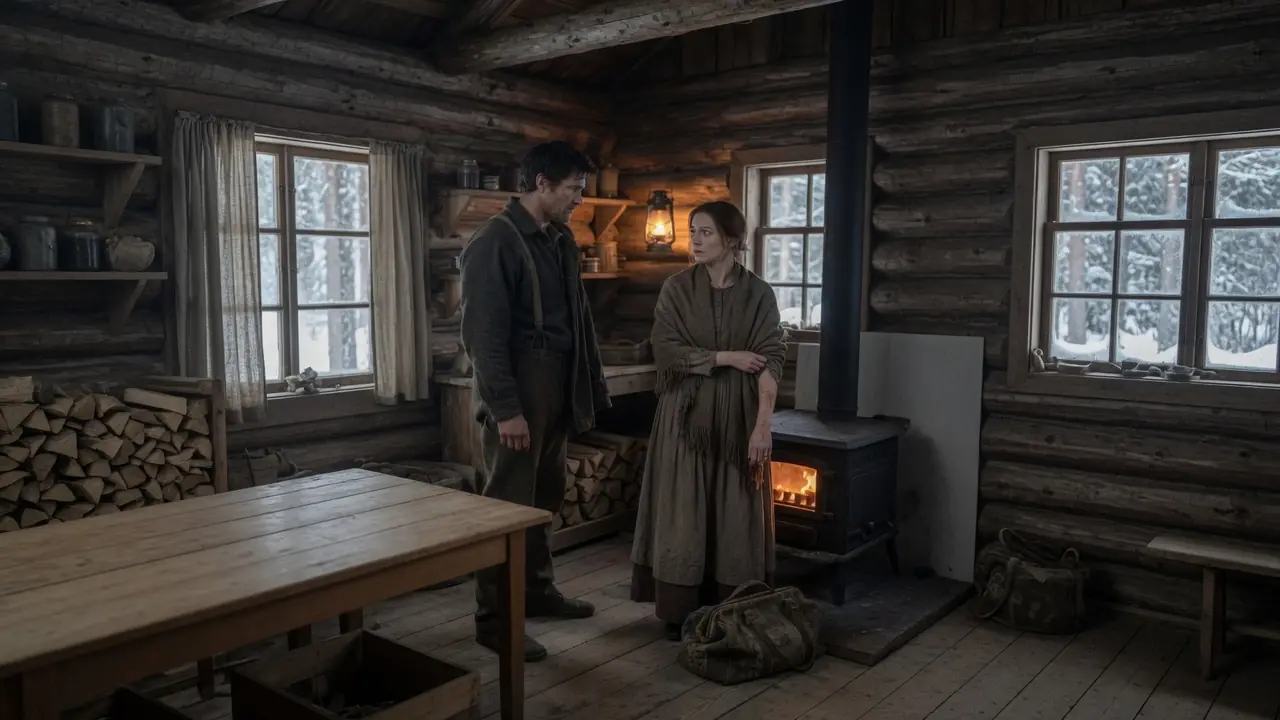
“It is the only distinction that matters,” Gideon said. “You are not property. If this arrangement does not suit you, we figure something else out. You are not trapped here.” Maeve held his gaze for longer than she ever had before. Then she looked away. “You may feel differently once you know me.” Gideon leaned back in his chair. “Maybe. But I do not think so.”
On the ninth day, everything changed. Gideon came in from checking traps to find Maeve at the stove with her sleeve pushed above her elbow as she scrubbed a cast iron pot. He was hanging his coat when he saw the faint old marks along her forearm. They were not new, and they were not random. They looked like the history of a woman who had spent years hiding what others had done and what others had ignored.
Maeve heard him stop moving. She turned just enough to see his eyes, then pulled her sleeve down with swift, practiced precision. Not slowly. Not casually. With the speed of someone who had done it too many times to count. Her body went rigid, but her voice stayed even. “Supper will be ready in an hour.”
Gideon stood still by the wood bin. In that instant, every small thing arranged itself in his mind. The latched door. The flinching. The careful eating. The way she watched exits. The way she walked the property boundary before dawn. The way she seemed to expect punishment for being noticed.
He filled the wood box before speaking. He wanted her to hear that he was not rushing toward her. He wanted her to know he was not turning the moment into a weapon. When he finally looked at her profile, his voice was quiet. “Maeve.” She did not turn. “Who hurt you?”
She kept her hand pressed flat against her sleeve. The stove ticked softly between them. “Supper will burn if I don’t watch it,” she said. Gideon nodded once, though she could not see it. “All right.” Then he went to the table and sat down, and he said nothing else.
That evening passed like an ordinary meal from the outside. She served the food. He passed the bread. She thanked him. He washed the dishes afterward, not asking if she wanted help, simply doing it. Maeve stood in the middle of the cabin watching him, puzzled by kindness that did not demand repayment.
“You don’t have to do that,” she said. “I know,” Gideon answered, and kept washing. She went to her room, and the latch dropped. Gideon stood at the basin long after the water cooled, staring at nothing. He knew now that he had not brought home a fragile woman. He had brought home a survivor who had learned to disappear in plain sight.
The next morning, Maeve looked as though she had not slept. Still, she came with him to check the north fence. She moved through the snow with steady, capable steps, watching the tree line and the ground as if both might speak if she paid attention. At one post, she crouched and tested the base. “This one won’t last until spring,” she said.
“You walk the whole line every morning?” Gideon asked. “Before you wake,” she said. “Why?” She looked toward the trees. “I need to know the edges.” Gideon understood more than she knew. Some people needed walls. Maeve needed distance, boundaries, the certainty of where things began and ended.
That evening, after supper, she told him the first name. “Amos,” she said softly. “My late husband.” Gideon did not move. “He kept a small house. Small rooms, narrow doors. I learned every wall, every distance.” Her hands folded tightly in her lap. “I still need to know the spaces before I can settle into a day.”
“Take all the time you need,” Gideon said. She looked at him strangely. “You’re not going to ask about him?” “Not unless you offer.” Her throat moved. “That is strange in a man.” Gideon thought of the life she must have known and said, “Maybe it should not be.”
A few days later, a rider appeared on the south road. Maeve saw him first and went so pale that Gideon set down his tools at once. It was only Harker from Ridgeback, coming to mention the supply route before the next storm. But Maeve stood with both hands flat on the shelf, breathing carefully after he left. Gideon set coffee near her and said, “There is nothing wrong with careful.”
“Why are you so patient?” she asked. Gideon thought before answering. “I had a horse once. Good animal, but mishandled before I bought her. Took near a year before she trusted me enough to stand still.” Maeve stared at him. “You are comparing me to a horse.” “No,” he said. “I am comparing patience to patience.” For the first time, something almost like a smile touched her mouth.
That night, she began speaking from across the room. “He never marked what people would see,” she said. Her voice was flat, distant. “Amos was respected. An elder in his church. People brought him disputes to settle.” Gideon set down his pencil and listened. Maeve continued, “Nine years. When I say I am tired, I do not mean from the journey.”
“I believe you,” Gideon said. She closed her eyes briefly, as if those three words had gone somewhere no apology ever had. “He died in February,” she said. “A stable incident. That is what everyone called it. At his funeral, people told me they were sorry. I stood there and felt relief.” Her eyes opened. “Then I spent months thinking that made me a monster.”
“You are not a monster,” Gideon said. “You do not know enough to say that.” “I know enough.” She studied him. “You have known me two weeks.” Gideon nodded. “In two weeks, I have seen you reset fence posts, tend a stove through frozen nights, calm horses, read weather, and make a cabin better by being in it. A monster does not do those things. A woman who survived does those things.”
The room went quiet. Then Maeve slowly pushed up her sleeve. This time, it was not reflex. It was choice. Gideon looked at what she allowed him to see, old traces of pain written across skin and memory, and he did not recoil, did not pity her in a way that made her smaller. He looked back into her eyes. “Thank you for showing me.”
She blinked. “Amos said I should be ashamed.” “He was wrong,” Gideon said. “It reflected on him. Not you.” Her hands trembled then, not with fear exactly, but with the exhaustion of setting down something too heavy after carrying it too long. “I don’t know what to do if I’m not carrying it,” she whispered.
“You do not have to decide tonight,” Gideon said. “Tonight, sitting here is enough.” Maeve closed her eyes and breathed. Outside, wind moved against the cabin, but inside, for the first time, she did not pull her sleeve down. She let herself be seen and nothing terrible followed.
The storm came three nights later. It slammed into the cabin with snow and wind that rattled the walls and forced them into two days of shared labor. Gideon and Maeve banked snow against the north wall, fed the stove in shifts, checked the horses, melted snow for water, and worked without complaint. Maeve did not merely endure the storm. She met it.
On the second night, with the wind pressing hard outside, Gideon spread his maps on the table. Maeve studied them across the lantern light. “Do you love this country?” she asked suddenly. Gideon thought about it. “Yes. Not because it is easy. Because it asks much and gives honestly.” Maeve looked down at the map. “I do not think I have ever loved a place.”
“What did you love?” he asked. “Quiet mornings,” she said. “Books when I could get them. Bread when it came out right. Small things.” “Those are not small,” Gideon said. Maeve’s eyes lifted to his. “Amos thought they were.” Gideon’s jaw tightened. “That was his failure.”
During that storm, Maeve told him about Caleb Amos, her late husband’s brother. Caleb sat on the church board back east and wanted control of the land Maeve had inherited. She had left with documents sewn into the lining of her carpet bag because she suspected he might try to follow her. Gideon was not surprised by her caution anymore. He was only impressed by how deeply she had protected herself.
She unpicked the lining and laid the papers on the table. Marriage records. Land records. Letters from Caleb. A doctor’s signed statement confirming a long pattern of mistreatment that no one had wanted to name while Amos lived. Gideon read each page carefully. Maeve watched him, waiting for judgment, but he offered only attention.
“If Caleb comes up this mountain,” Gideon said, “we know what ground we stand on.” Maeve looked at him. “You said we.” “Yes,” he answered. “You are in my house. What comes at you comes at me.” She stared at him, fighting the old instinct to refuse help. Finally, she nodded. “All right.”
Caleb Amos came on a Tuesday. Maeve saw him from the boundary line before Gideon did. He rode like a man carrying authority, dressed in black wool, his posture straight, his expression already arranged into concern. Maeve did not run. She walked back to the cabin with steady steps and said, “He is here.”
Gideon reached toward his rifle, but Maeve stopped him. “Not yet. Let me answer him first. I need this to look like what it is.” “What is it?” Gideon asked. Maeve placed the documents on the table in order. “A woman with proof and nothing left to be afraid of.”
When Caleb knocked, Maeve opened the door. He greeted her with the false warmth of a man who expected the room to bend around him. He spoke of community, obligations, church authority, and proper counsel. Maeve let him speak until he finally named the land. Then she placed the deed in front of him and told him the succession arrangement Amos made without her signature held no legal weight.
Caleb tried to interrupt. Maeve did not let him. She placed the doctor’s statement beside the deed. Her voice remained even as she explained that any claim he brought would make the past public. The board would have to explain why it accepted property arrangements from a man whose conduct had been quietly documented for years. Caleb’s face lost its gentle mask.
For several seconds, the cabin was perfectly still. Gideon stood near the stove, silent and steady. Maeve stood at the table with both hands on the documents. Caleb looked from her to Gideon and back again, calculating the cost of continuing. At last, he stood.
“Go home, Caleb,” Maeve said. “Tell the board the land is mine.” Caleb placed his hat on his head, opened the door, and left without another word. Maeve listened to his horse move down the south road until the sound disappeared into timber.
Then she sat down as if her body had finally realized the danger had passed. Gideon moved close but did not touch her. He placed his hand open on the table. Maeve looked at it for a long moment, then placed her hand over his. He closed his fingers gently, and neither of them spoke.
“I wasn’t afraid of him,” she said after a while, astonished by her own voice. “I was afraid I would not say it right.” Gideon looked at her with quiet pride. “You said it exactly right.” Maeve looked at the documents. “I need to file the land claim formally.” “When the road clears, I will take you to Ridgeback,” Gideon said. She nodded, already planning the next step.
Three days later, she signed the territorial claim in her own name. Maeve Callahan Cole. When she came out of the notary’s office with the filed paper folded inside her coat, Gideon asked, “How does it feel?” She considered the question honestly. “Like something that was mine,” she said, “that I got back.”
Winter deepened after that, but the cabin changed. Maeve still woke early, but no longer as if fleeing sleep. She still walked the boundary line, but now she noticed the trees, the animal tracks, the color of morning light on snow. She still latched her bedroom door sometimes. Then one night, she did not.
When Gideon returned from a hard hunt half-frozen and worn down, Maeve took command without hesitation. She brought him inside, warmed his hands carefully, fed the stove, and told him when to sit still. He listened. Later, she mentioned it almost shyly. “I left the door open last night.” Gideon went very still. “That is good, Maeve.” She nodded. “Yes. It is.”
In spring, she asked him to teach her to shoot properly. He said yes without asking why. She asked to add her own marks to his property maps. He handed her a pencil. She asked whether partnership meant she could argue with him when he was wrong about fence repair. He answered, “I hope so. Saves me from being wrong alone.”
One evening, after a day of work and melting snow, Maeve sat across from him at the table, oiling a leather strap while he mended harness. “When you wrote to the agency,” she said, “you said you wanted a partner.” “I did.” “What does that mean to you?” Gideon thought for a long moment. “Someone who tells me when the fence post is leaning. Someone who builds the fire when I forget. Someone who knows the edges of the land and comes back to tell me what she found.”
Maeve looked at him. “I am not easy.” “I was not looking for easy,” Gideon said. “I was looking for real.” Something in her expression settled then, carefully, like a door opening from the inside. “I am staying,” she said. “Not because I have nowhere else to go. Because I want to.”
Gideon nodded once. “All right.” He did not make the sentence smaller by celebrating it too loudly. Maeve understood that and loved him a little for it, though she did not yet say the word. They returned to the harness, sitting in the lamplight with the mountain dark around them.
Later, she went to her room and left the door unlatched. She woke once in the night, heard the stove settling, the horses shifting in the lean-to, and Gideon breathing quietly in the main room. She felt the size of the space around her, wide and real and generous. No narrow walls. No careful steps. No one waiting to punish her for existing too fully.
She breathed in and went back to sleep.
That was not a small thing.
That was everything.