The first spray hit Malcolm Avery across the left side of his face before he understood what the woman was doing.
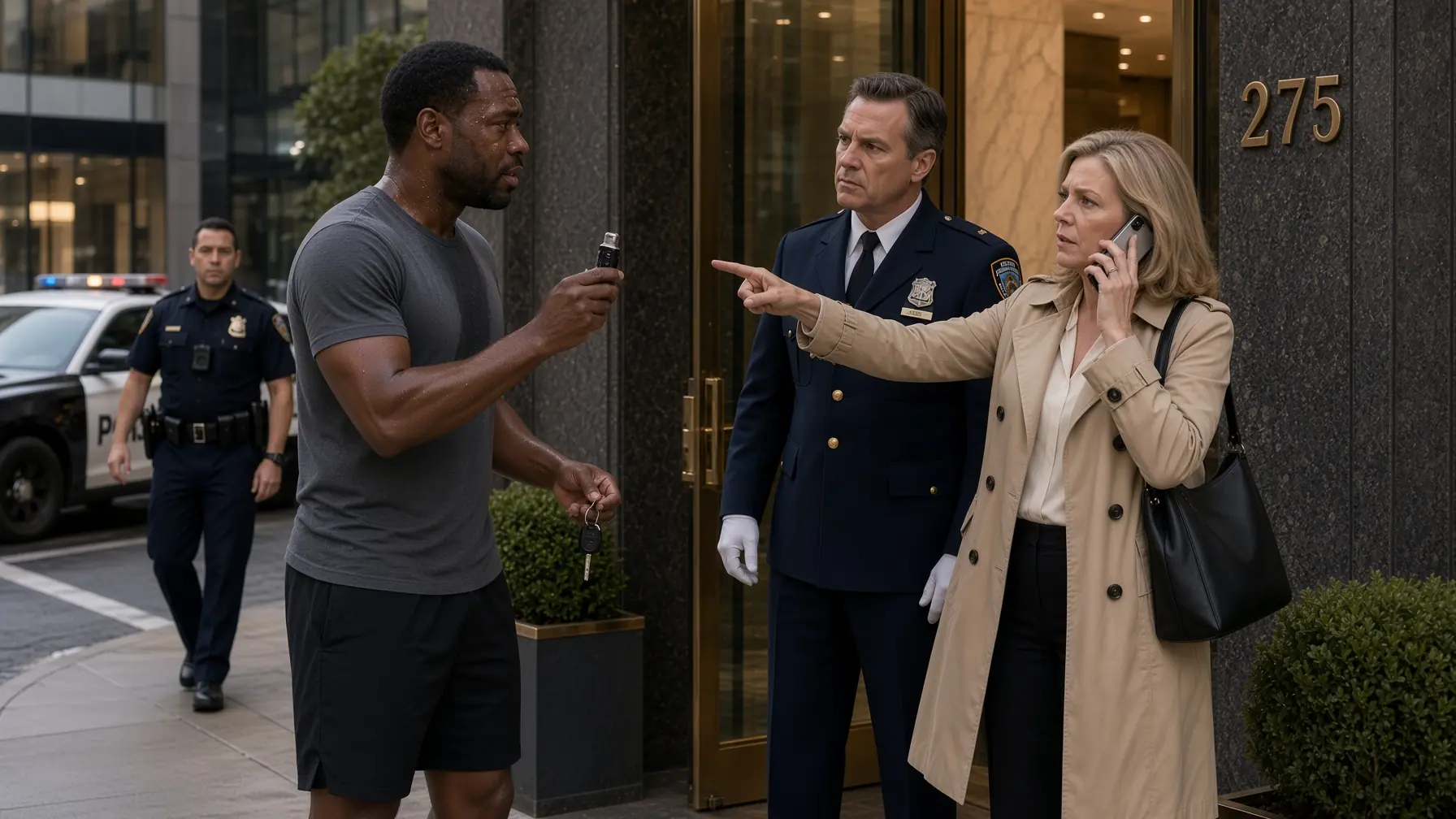
His eyes closed instantly.
Heat tore through them.
His lungs tightened.
He stumbled backward onto the stone walkway outside the Halstead, one of the most expensive condominium buildings in downtown Portland.
“Stay back!”
The woman screamed.
“I’ll spray you again!”
Malcolm raised both hands.
“I’m not coming toward you.”
“You followed me!”
“No.”
“You were right behind me for two blocks.”
“I was jogging.”
“Toward my building.”
Malcolm blinked hard, fighting the chemical burning his eyes.
“Yes.”
“Because I live here.”
The woman laughed.
Not nervously.
Disbelievingly.
“Please.”
She stood between Malcolm and the glass entrance doors, one hand gripping a small canister of pepper spray.
Late forties.
Camel-colored coat.
Pearl earrings.
Expensive leather handbag.
Malcolm recognized her vaguely.
He had seen her in the elevator once during the previous week.
She apparently had not seen him.
Or had not remembered.
He wiped tears from his cheek.
“Lady, put that thing down.”
“Don’t tell me what to do.”
“I have a key.”
He reached slowly toward the pocket of his running jacket.
Her arm shot up.
“Don’t reach!”
Malcolm stopped.
Both hands visible again.
“I’m getting my key.”
“You were reaching for a weapon.”
“No.”
“I saw you.”
“You saw what you expected to see.”
She stared at him.
“What is that supposed to mean?”
Malcolm took a breath.
The pepper spray made it painful.
“It means I was trying to enter my home.”
The woman shook her head.
“No, you weren’t.”
“How would you know?”
“Because I know who lives here.”
Malcolm looked up at the twenty-one-story glass-and-stone building.
“You know all one hundred and twelve residents?”
Her expression changed.
Just slightly.
Then hardened again.
“I know enough.”
Malcolm reached into his pocket slowly.
He removed a brass key fob stamped with the Halstead emblem.
“Here.”
She did not lower the spray.
“That proves nothing.”
“It opens the front door.”
“For all I know, you stole it.”
Malcolm stared at her.
“Stole it from whom?”
“I don’t know.”
“Exactly.”
Her cheeks flushed.
She took out her phone.
“Fine.”
“What are you doing?”
“Calling the police.”
Malcolm almost laughed.
“Please do.”
She paused.
Criminals were not supposed to ask for police.
That confused her.
Only briefly.
Then she dialed.
“911?”
Her voice changed immediately.
Frightened.
Breathless.
Performative.
“There’s a man trying to break into my building.”
Malcolm stared.
“No, there isn’t.”
She turned away.
“Yes. He followed me home.”
“He rushed the entrance.”
“No.”
“I had to defend myself.”
Malcolm closed his eyes.
This was getting worse faster than he expected.
The front doors opened.
A uniformed doorman hurried outside.
“Ms. Fenwick?”
The woman turned.
“Martin!”
Her relief was immediate.
“Thank God.”
Martin Alvarez stopped when he saw Malcolm.
His face changed.
“Mr. Avery?”
Malcolm raised one hand.
“Morning.”
Martin looked at his watering eyes.
Then at the pepper spray.
“What happened?”
The woman pointed.
“He followed me.”
Martin stared.
“He what?”
“He tried to get inside.”
Malcolm said:
“No.”
She continued over him.
“He was reaching for something.”
“I stopped him.”
Martin took two steps toward Malcolm.
“Sir, are you all right?”
The woman’s expression twisted.
“Why are you helping him?”
Martin looked at her.
“Because he’s been sprayed.”
“He is the threat.”
“No.”
Martin shook his head.
“He isn’t.”
“How would you know?”
Martin looked from her to Malcolm.
Then back.
“Because Mr. Avery lives here.”
Silence.
Traffic moved behind them.
A delivery truck passed.
The woman blinked.
“No.”
Martin frowned.
“Yes.”
“No, he doesn’t.”
Malcolm said:
“I have been saying that.”
She ignored him.
“I know everyone in this building.”
Martin replied:
“Apparently not.”
Her face reddened.
“I have lived here ten years.”
“He moved in last week.”
She looked at Malcolm.
Then at Martin.
Then back again.
“That does not explain why he was following me.”
Malcolm said:
“I was jogging home.”
“You expect me to believe you live here?”
Martin’s expression hardened.
“Ms. Fenwick.”
“He owns unit 17C.”
That stopped her.
Not completely.
People deeply committed to an assumption rarely abandon it because of one inconvenient fact.
Instead, they rearrange the assumption.
“Well…”
She looked at Malcolm.
“Even if he lives here, he approached me aggressively.”
Malcolm almost smiled.
“I was behind you.”
“You were closing the distance.”
“I was running.”
“Exactly.”
Martin said:
“He runs most mornings.”
She spun toward him.
“How would you know?”
“I work the door.”
“You are supposed to protect residents.”
“I am.”
“Then why weren’t you outside?”
Martin stared.
“Because I was helping a delivery driver in the lobby.”
“You should have been here.”
“To stop him.”
Martin’s patience began disappearing.
“To stop a resident from entering his own building?”
She lifted her chin.
“You don’t know what happened.”
Malcolm looked toward the black dome above the entryway.
“I think that camera does.”
Everyone followed his gaze.
A security camera pointed directly at the sidewalk.
For the first time since the incident began, fear appeared in the woman’s face.
Only for a fraction of a second.
Then it disappeared.
“Good.”
She said.
“Then the footage will prove I was defending myself.”
Malcolm nodded.
“Perfect.”
Her name was Laura Fenwick.
Malcolm learned that officially seven minutes later when the condominium association president came downstairs after receiving multiple calls.
Patricia Yates was sixty-two, retired from commercial banking, and the kind of woman who wore reading glasses on a chain because she had accepted long ago that paperwork would follow her everywhere.
She stepped outside.
Stopped.
Looked at Malcolm.
Then Laura.
Then Martin.
“What happened?”
Laura spoke first.
“Security failure.”
Patricia frowned.
“I need more than that.”
“This man followed me.”
“He tried to get into the building.”
“I had to protect myself.”
Malcolm said nothing.
Martin looked at him.
“Sir?”
Malcolm shook his head slightly.
Let her talk.
Patricia asked Laura:
“Did he touch you?”
Laura hesitated.
“He came toward me.”
“That isn’t what I asked.”
“He was threatening.”
“How?”
“You weren’t there.”
Patricia looked at Malcolm.
“Mr…”
“Avery.”
“Do you live here?”
“Yes.”
“Unit?”
“17C.”
Patricia’s expression changed.
“Oh.”
Laura noticed.
“You know him?”
Patricia replied:
“I know the closing documents.”
“Unit 17C transferred last Monday.”
Malcolm nodded.
Laura’s face tightened.
“That still does not mean he didn’t attack me.”
Malcolm finally spoke.
“I never touched you.”
Laura turned.
“You rushed me.”
“I jogged toward the entrance.”
“After following me.”
“We happened to be walking in the same direction.”
“You’re lying.”
Malcolm looked at Patricia.
“Can we review the security footage?”
Laura immediately said:
“No.”
Everyone looked at her.
She corrected herself.
“I mean, not without police.”
Malcolm nodded.
“That’s fine.”
Sirens could already be heard.
The first patrol car arrived two minutes later.
Officer Rachel Mendoza stepped out.
Her partner, Officer Ben Walsh, followed.
Laura rushed toward them.
“Officer!”
“Thank God.”
“That man assaulted me.”
Mendoza looked beyond her.
Then froze.
Malcolm was still trying to rinse his eyes using bottled water Martin had brought.
“Detective Avery?”
Laura stopped.
Officer Walsh looked toward Malcolm.
“Sir?”
Malcolm raised one hand.
“Morning.”
Mendoza walked over immediately.
“What happened to you?”
Laura stared.
“Detective?”
Malcolm looked toward her.
There was no satisfaction in his face.
That disappointed her more than anger might have.
Mendoza said:
“Detective Malcolm Avery?”
“Yes.”
Laura laughed once.
A short, desperate sound.
“That can’t be right.”
Officer Walsh looked at her.
“Why?”
She opened her mouth.
Nothing came out.
Mendoza turned toward Malcolm.
“Do you need EMS?”
“No.”
“Probably just irrigation.”
“Martin’s helping.”
Mendoza looked at Laura.
“You called 911?”
“Yes.”
“You reported a home invasion attempt?”
“Yes.”
“By him?”
Laura pointed.
“He was following me.”
Mendoza looked toward the building.
“Detective Avery transferred here from Oakland last month.”
Laura stared.
Mendoza continued.
“He’s the new commander of our major crimes squad.”
Silence.
Laura’s face lost color.
The title changed everything for her.
Malcolm noticed.
That mattered more than he wished it did.
She looked at him again.
Really looked now.
Not as a suspicious Black man in running clothes.
Not as someone who must not belong.
As a police detective.
A person with institutional authority.
Her voice softened immediately.
“Detective…”
Malcolm said:
“Don’t.”
She stopped.
“You did not know my job five minutes ago.”
“No, but—”
“And you shouldn’t have needed to.”
Officer Walsh looked toward Patricia.
“Security camera?”
Patricia nodded.
“Direct view.”
“Can someone pull it?”
Martin said:
“I can.”
Laura stepped forward.
“I want to explain.”
Mendoza held up a hand.
“You will.”
“But first we’re going to establish what happened.”
Laura’s voice rose.
“I already told you what happened.”
Mendoza replied:
“And another person says something different.”
“He works here.”
Laura pointed at Martin.
“They know each other.”
Martin looked offended.
“I met Mr. Avery four days ago.”
Laura continued.
“He could be protecting him.”
Malcolm almost laughed.
Officer Walsh asked:
“Why?”
Laura turned.
“What?”
“Why would the doorman risk his job protecting a man he met four days ago?”
She said nothing.
Patricia led the officers inside.
Malcolm followed after rinsing his face again.
Laura came last.
The lobby was suddenly crowded.
Residents had gathered near the mailroom.
One elderly man whispered:
“What happened?”
Nobody answered.
Martin opened the building’s security system.
Scrolled to 11:08 a.m.
Camera one.
Front entrance.
The footage began.
Laura appeared first.
Walking briskly.
Shopping bag in one hand.
Malcolm entered the frame behind her.
Running at an easy pace.
At least thirty feet away.
He slowed as he approached the building.
Laura turned.
Stopped.
Waited.
Malcolm removed one earbud.
She spoke.
No audio.
Then pointed at him.
Malcolm raised both hands.
She moved closer.
Malcolm did not.
He took out the key fob.
Laura sprayed him.
Everyone in the lobby watched.
No chase.
No lunge.
No attack.
No attempt to sneak through the door.
Just a man coming home.
Patricia covered her mouth.
Martin muttered:
“Oh, Laura.”
Officer Mendoza replayed it.
Then again.
She paused at the moment Laura sprayed.
“Ms. Fenwick.”
Laura folded her arms.
“He was frightening me.”
Mendoza looked at the frozen screen.
“He is standing approximately eight feet away with both hands visible.”
“You weren’t there.”
“No.”
“We have video.”
“He had been following me before the camera picks up.”
Malcolm said:
“We walked the same route for two blocks.”
“You were watching me.”
“I was running.”
“You can’t prove what you were thinking.”
Malcolm nodded.
“That is correct.”
He pointed toward the screen.
“But you can see what I did.”
Laura tried another explanation.
“I saw him reaching for something.”
Walsh rewound.
Malcolm reaching into his jacket.
Removing the brass building key.
Walsh held up the actual key fob.
“This?”
Laura said nothing.
Patricia looked devastated.
“Laura.”
“You told us he tried to break in.”
“He did.”
“No.”
Patricia pointed toward the screen.
“He had a key.”
Laura turned on her.
“And if I had been right?”
That sentence changed the room.
Malcolm looked at her.
Laura continued:
“If he had been some criminal and I did nothing, everyone would blame me.”
Mendoza asked:
“Based on what did you believe he was a criminal?”
Laura stopped.
“No.”
Mendoza continued.
“He had no weapon visible.”
“He did not touch you.”
“He did not threaten you.”
“He had a building key.”
“The doorman recognized him.”
“And after all that, you continued telling us he was an intruder.”
Laura stared at Malcolm.
Her answer came quietly.
“He didn’t look like someone who lived here.”
Nobody spoke.
Laura seemed to realize too late that she had finally said the part she had been avoiding.
Malcolm asked:
“What does someone who lives here look like?”
Laura looked away.
“That’s not what I meant.”
“It’s exactly what you meant.”
Patricia sat down.
For ten years she had known Laura socially.
Holiday parties.
Board meetings.
Fundraisers.
Shared wine on the rooftop terrace.
Laura had complained about delivery drivers.
Teenagers.
Guests making noise.
She called herself vigilant.
Patricia had sometimes admired it.
Now she saw that vigilance from the other side.
Martin said quietly:
“He told you he lived here.”
Laura snapped:
“Stay out of this.”
“No.”
That surprised everyone.
Martin straightened.
“You wanted me fired ten minutes ago.”
“Because you weren’t doing your job.”
“My job is not to make your assumptions true.”
Laura stared.
Martin continued.
“You asked me to protect residents.”
He looked at Malcolm.
“He is a resident.”
That landed.
Officer Mendoza asked Malcolm:
“Do you want to make a report?”
“Yes.”
Laura looked shocked.
“You’re pressing charges?”
Malcolm turned.
“I said I’m making a report.”
Mendoza nodded.
“Any charging decision will go through the normal process.”
Laura looked toward Malcolm.
“Detective.”
He did not respond.
“I made a mistake.”
“Yes.”
“I was afraid.”
“Yes.”
“You understand that.”
Malcolm’s expression hardened.
“I understand fear very well.”
“Then—”
“Fear explains behavior.”
“It does not automatically excuse it.”
She looked toward the officers.
“You’re going to arrest me because he’s a detective?”
Malcolm answered before Mendoza could.
“No.”
“And I will not be involved in deciding whether you are arrested.”
Mendoza looked at him.
Malcolm continued.
“I am a witness and an alleged victim in this incident.”
“I am not acting as a detective.”
“I’m not calling the precinct commander.”
“I’m not telling anyone what charge to file.”
“You will receive the same process anyone else would.”
Laura stared at him.
Perhaps she expected revenge.
That expectation revealed something too.
Paramedics arrived and flushed Malcolm’s eyes.
No lasting injury.
The police collected the spray canister as evidence.
Statements were taken.
Security footage preserved.
911 audio requested.
Laura was not dragged out in handcuffs.
After consultation with a supervisor, officers issued her a citation and referred the case for prosecutorial review based on the circumstances and local law.
The false statements in the 911 call would be reviewed separately.
Reality moved through paperwork.
Not instant justice.
Malcolm preferred that.
Before leaving, Officer Mendoza asked:
“Sir, you sure you don’t want us to handle this through the department?”
Malcolm shook his head.
“Handle it like I fix everyone else’s cases.”
“Evidence first.”
Mendoza nodded.
“Yes, sir.”
“And Rachel?”
“Yes?”
“Stop calling me sir.”
She smiled.
“Still new.”
The condominium issue was separate.
That mattered too.
Patricia called an emergency board meeting that afternoon.
Laura owned her condo.
The board could not simply “evict” an owner because residents were angry.
Property law did not work that way.
But the Halstead’s bylaws prohibited harassment, violence in common areas, interference with other residents’ access, and misuse of building security procedures.
The board’s attorney recommended formal notice and hearing.
Laura received one.
For the first time that day, the process slowed down.
That was good.
Slow process gave everyone room to distinguish outrage from authority.
The hearing took place two weeks later.
Malcolm attended only because he was asked to provide a statement.
Laura sat with counsel.
So did the board.
Security footage played again.
Her attorney argued she had genuinely believed herself threatened.
Malcolm did not dispute that she might have felt fear.
He said:
“I cannot tell you what she felt.”
“I can tell you what she did.”
“I was approaching my home.”
“I identified myself as a resident.”
“I showed a building key.”
“The doorman confirmed I lived here.”
“She continued accusing me of being a criminal.”
One board member asked:
“Do you believe this was racial bias?”
Malcolm paused.
He had testified in enough courtrooms to know the danger of pretending to know another person’s mind.
“I believe race influenced how quickly she decided I did not belong.”
“Why?”
“Because she told the police I did not look like someone who lived here.”
Laura shifted.
Malcolm continued.
“I don’t know everything inside her head.”
“I don’t need to.”
“The behavior is enough for the board to evaluate.”
That answer frustrated people who wanted a dramatic condemnation.
Malcolm had spent his career learning that precision mattered more than applause.
The board imposed the strongest sanctions available under its governing documents short of trying to force a sale through court.
Laura was removed from her volunteer security committee role.
Her common-area privileges were restricted temporarily.
She was prohibited from confronting residents over access and required to route security concerns through staff.
The association also adopted a rule making clear that volunteer residents had no authority to demand identification from other residents or physically block them from entering.
More importantly, the Halstead changed how it handled new residents.
Photographs, with consent, were added to staff-only access records.
Doormen received updated rosters.
New-owner introductions became optional but encouraged.
Security training included one line Patricia insisted be placed at the top:
Suspicion is not identification. Verify before escalating.
Laura hated the phrase.
Martin loved it.
The criminal case took longer.
The prosecutor reviewed video.
911 audio.
Witness statements.
Medical documentation.
Laura’s attorney argued self-defense.
The prosecutor ultimately filed a misdemeanor assault charge and a separate count related to knowingly inaccurate information during the emergency call.
No automatic prison sentence.
No special treatment because Malcolm was a detective.
Malcolm requested that prosecutors outside his normal working chain handle the matter.
He did not want anyone later saying his badge had decided the outcome.
Laura eventually entered a diversion agreement on one count after accepting responsibility, paying medical costs, completing community service, and attending a court-approved bias and conflict-management program.
The second count was dismissed under the agreement.
Some people in the building were furious.
“She should go to jail.”
Malcolm disagreed.
“What would that accomplish?”
Martin asked him that in the lobby one morning.
Malcolm answered:
“Consequences are supposed to reduce harm.”
“Not satisfy spectators.”
“You don’t think she deserves worse?”
“I think she deserves exactly what can be justified.”
“That’s less fun.”
“Yes.”
“Justice usually is.”
Malcolm had moved to Portland because of a promotion.
He had spent sixteen years in Oakland.
Patrol.
Robbery.
Homicide.
Major crimes.
Two officer-involved shooting investigations.
Dozens of murder scenes.
Hundreds of family notifications.
He had watched people decide who victims were based on clothing.
Neighborhood.
Race.
Prior arrests.
Income.
Addiction.
He hated shortcuts.
Then, one week after becoming the new head of major crimes, he was pepper-sprayed outside his own home because someone decided his existence did not fit the building.
The irony would have been funny if his eyes had not burned for eighteen hours.
The incident spread through the department.
Some officers teased him gently.
“Commander, should we verify your condo key?”
Malcolm gave them looks that ended the joke quickly.
But the experience changed his leadership.
During case reviews he began asking investigators a new question.
“What do we know?”
Not:
What do we think?
Not:
What does this look like?
What do we know?
Then:
“What are we assuming?”
At first detectives found it irritating.
Eventually they understood.
One robbery investigation centered on a teenager seen running from a convenience store.
Easy suspect.
Young.
Known to police.
Prior theft arrest.
Witness said he ran immediately after the alarm.
One detective wrote:
Subject fled scene.
Malcolm crossed it out.
“How do we know he fled?”
“He ran.”
“From what?”
“The store.”
“Or the gunshot?”
The detective stopped.
Later video showed the teenager had been buying a drink.
When the robber entered, he ran.
Not away from police.
Away from a gun.
One word could have changed his entire role in the report.
Malcolm thought about Laura Fenwick.
Following.
That was the word she used.
He had been moving in the same direction.
Her mind supplied intent.
Three months after the incident, Laura saw Malcolm in the elevator.
They were alone.
She froze.
Malcolm pressed seventeen.
Laura pressed twenty.
The doors closed.
For eleven floors, neither spoke.
Then Laura said:
“I owe you an apology.”
Malcolm stared at the numbers.
She continued.
“I know I already said that during the hearing.”
“That was through your attorney.”
“Yes.”
“This is different.”
He said nothing.
Laura took a breath.
“When I saw you behind me, I got scared.”
Malcolm nodded.
“I know.”
“I had been mugged years ago.”
He looked at her.
That was new.
“Seattle.”
She continued.
“Parking garage.”
“A man came up behind me.”
“I never got over it.”
Malcolm listened.
She looked at him.
“That doesn’t excuse what I did.”
“No.”
“I know.”
The elevator passed fourteen.
Laura continued.
“I’ve spent months trying to understand why I believed you didn’t live here even after you showed me the key.”
Malcolm said:
“And?”
She swallowed.
“Because I had already decided who you were.”
The elevator stopped at seventeen.
Doors opened.
Malcolm did not step out immediately.
Laura said:
“I am sorry.”
He looked at her.
“I believe you.”
Relief appeared.
Then Malcolm added:
“That doesn’t mean everything goes back to normal.”
The relief faded.
“I know.”
“Good.”
He stepped out.
Before the doors closed, Laura said:
“Detective?”
Malcolm turned.
She corrected herself.
“Malcolm.”
“Yes?”
“Thank you for not destroying my life.”
Malcolm looked at her.
“I wasn’t entitled to.”
The doors closed.
Months later, Malcolm saw Laura volunteering at a neighborhood food pantry.
Not because a judge ordered that exact placement.
She chose it after completing required service elsewhere.
Martin saw her too.
“You think she changed?”
Malcolm shrugged.
“Ask me in ten years.”
Martin laughed.
“That’s cold.”
“No.”
Malcolm looked through the lobby windows.
“Change is easy for a week.”
“Character needs repetition.”
Martin Alvarez became Malcolm’s friend.
That surprised both of them.
They watched basketball together.
Martin’s wife invited Malcolm to Thanksgiving.
Malcolm helped Martin’s son prepare for the police academy.
One night, over beer, Martin admitted:
“I almost stayed inside.”
Malcolm looked at him.
“The day she sprayed you.”
“Why?”
Martin stared into his glass.
“Laura had complained about me before.”
“She had influence with the board.”
“I thought if I went outside and told her she was wrong, I might lose my job.”
“But you came.”
“Yes.”
“Why?”
Martin shrugged.
“You were hurt.”
Malcolm smiled.
“That simple?”
“It felt complicated at the time.”
That stayed with Malcolm.
Doing the right thing often looked obvious afterward.
Beforehand, it arrived mixed with rent payments, bosses, reputation, fear, and uncertainty.
Martin had walked outside anyway.
That mattered.
A year after the incident, the Halstead held its annual meeting.
Patricia was stepping down as board president.
She asked Malcolm to say a few words about community safety.
He refused at first.
“I investigate murders.”
“That doesn’t make me a condo expert.”
Patricia said:
“You became one the hard way.”
So Malcolm agreed.
He stood before seventy residents.
Laura sat near the back.
Martin stood near the door.
Malcolm said:
“I have one request.”
People waited.
“If you see something that concerns you, verify before you invent the rest.”
A few people smiled.
Malcolm continued.
“Security matters.”
“Doors should lock.”
“Suspicious conduct should be reported.”
“People should look out for one another.”
“But there is a difference between behavior and identity.”
“A person forcing a door is behavior.”
“A person displaying a weapon is behavior.”
“A person threatening somebody is behavior.”
“A person simply being unfamiliar is not.”
He looked around.
“And belonging is not something you can reliably identify by clothing, age, occupation, race, accent, or what you imagine somebody can afford.”
Laura lowered her eyes.
Malcolm continued.
“You can be cautious without turning your first impression into a verdict.”
“That is not weakness.”
“That is discipline.”
He finished there.
No applause line.
People applauded anyway.
Later that night, Malcolm returned to unit 17C.
He changed clothes.
Made tea.
Stood beside the window overlooking the city.
On a shelf near the door sat the same brass key fob he had tried to show Laura.
Nothing special.
Piece of metal.
Encoded chip.
Proof of access.
For weeks after the assault, Malcolm had carried it in his hand whenever he approached the building.
He hated that.
It made him feel as though he had to prove he belonged before anyone asked.
Eventually he stopped.
He went back to keeping it in his pocket.
That felt important.
The story traveled outside the building after a local journalist obtained the police report.
The headline bothered Malcolm.
Woman Pepper-Sprays Black Detective Outside Luxury Condo
People loved the final word.
Detective.
It gave the story a twist.
Malcolm thought it gave people an escape.
Because once readers learned he was a police commander, they could say:
She picked the wrong guy.
That was not the lesson.
He told the reporter:
“She didn’t pick the wrong guy.”
The reporter frowned.
“What do you mean?”
“She shouldn’t have needed my job title to reconsider.”
“But surely your position makes the story unusual.”
“It makes the story marketable.”
“What makes it important?”
Malcolm looked at him.
“She believed a Black man approaching an expensive building was evidence of a crime.”
“My badge did not make that belief wrong.”
“It was wrong before she knew I had one.”
That quotation became the most shared line from the article.
Malcolm wished Martin’s name had received more attention.
The doorman had understood the principle faster than anyone.
He lives here.
Three ordinary words.
No speech.
No politics.
No courtroom language.
He lives here.
Years later, when Malcolm trained new detectives, he sometimes showed them the security video.
No names.
No context at first.
A woman walking.
A man jogging behind.
She turns.
He stops.
She raises the spray.
Malcolm paused the video one second before it happened.
“What do you know?”
A recruit would say:
“She thinks he’s following her.”
Malcolm shook his head.
“That is what she thinks.”
“What do you know?”
Another recruit:
“They’re moving in the same direction.”
“Good.”
“What else?”
“He’s jogging.”
“Yes.”
“He slows down.”
“Yes.”
“Hands visible.”
“Yes.”
Malcolm nodded.
“Now tell me the danger.”
Silence.
Then he played the rest.
Key.
Spray.
Accusation.
Doorman.
Police.
Camera.
Finally the revelation that the man in running clothes was the detective teaching them.
Recruits always reacted.
Someone inevitably said:
“No way.”
Malcolm stopped the video.
“That reaction is why I show this.”
They looked at him.
“You are relieved when you learn I am police.”
“Why?”
Nobody answered.
“Would the facts change if I worked construction?”
“No.”
“If I cleaned the building?”
“No.”
“If I was unemployed?”
“No.”
“If I had a prior conviction?”
The room became quieter.
Malcolm nodded.
“That one gets harder.”
“Good.”
“Think about why.”
He pointed toward the frozen image.
“Investigation begins when you stop allowing identity to substitute for evidence.”
Malcolm eventually retired from police work.
When he did, Martin attended the ceremony.
Patricia too.
Even Laura sent a card.
Malcolm read it privately.
Inside she had written:
Thank you for allowing the worst thing I did to become something I had to learn from instead of something I could hide from.
Malcolm kept the card.
Not because they became friends.
They did not.
But because accountability did not require permanent hatred.
Laura had done something harmful.
She faced consequences.
Then she had a choice about what kind of person she became afterward.
Malcolm believed people should be allowed that choice.
Otherwise, his entire profession made little sense.
The security camera outside the Halstead was replaced years later.
Higher resolution.
Wider angle.
Better nighttime image.
The old footage remained archived because the association used it in training.
Malcolm watched it one final time before moving out.
There he was.
Fifty-two.
Sweatshirt.
Running shoes.
Earbuds.
Coming home.
Laura turns.
Points.
He raises his hands.
She sprays.
Every time Malcolm watched it, he noticed something different.
At first he saw her aggression.
Later he saw his own confusion.
Then Martin opening the door.
Eventually, what caught his attention most was the two seconds before Laura sprayed him.
Nothing happened.
That was the point.
There was no attack hidden between frames.
No threatening movement.
No weapon.
No attempt to force the entrance.
There was only a gap.
A tiny empty space between what Laura saw and what Laura believed.
Into that empty space, she had poured a story.
Dangerous.
Thief.
Does not belong.
Criminal.
Once the story existed, every new fact became something to explain away.
The key must be stolen.
The doorman must be helping him.
The condo ownership must not matter because he still “attacked” her.
Only the camera finally made the story impossible to maintain.
Malcolm understood that problem better than ever.
People rarely experience their assumptions as assumptions.
They experience them as reality.
That was why evidence mattered.
Why questions mattered.
Why slowing down mattered.
When Malcolm handed over the keys to unit 17C years later, the new owner was a twenty-seven-year-old software engineer named Kevin Cho.
Martin, now the building’s head of security, introduced them.
Kevin laughed.
“I’ve heard the story.”
Malcolm sighed.
“Of course.”
“They use it in orientation.”
“Wonderful.”
Kevin held up the brass fob.
“This thing?”
“The very one.”
Kevin smiled.
“What did you learn?”
Malcolm thought.
He could have given the polished answer.
Bias.
Verification.
Belonging.
Evidence.
Instead he said:
“That being right about who you are doesn’t guarantee anybody else will see you correctly.”
Kevin waited.
Malcolm continued.
“And when somebody sees you incorrectly, you still have to decide who you’re going to be in response.”
He looked toward Martin.
“That part belongs to you.”
Not the camera.
Not the police.
Not the board.
You.
Malcolm had been furious that morning.
He had every right to be.
But the most important thing he did was not revealing his badge.
It was refusing to use the badge once everyone knew it existed.
He filed a report.
Asked for independent review.
Stepped out of charging decisions.
Let the condo board use its process.
Let prosecutors use theirs.
Because a person cannot demand fairness while secretly wanting privilege.
That lesson had stayed with him longer than the burn in his eyes.
People still told the story as a dramatic reversal.
A racist woman attacks a Black stranger.
Then discovers he is a powerful detective.
Malcolm always disliked that ending.
It suggested the surprise was his rank.
It wasn’t.
The real surprise should have been much simpler.
He lived there.
That was all Laura ever needed to verify.
And even if he had not?
Even if Malcolm had been delivering food?
Visiting a friend?
Repairing a pipe?
Waiting for a ride?
He still would not have become a criminal simply because someone could not imagine him belonging near an expensive building.
Years later, Malcolm reduced the entire experience to one sentence he wrote on a whiteboard during his final detective training class:
Never let what you expect to see become more important than what actually happened.
Then he capped the marker.
Looked at the young officers in front of him.
And added:
“That mistake is dangerous for everybody.”
“For cops, it can be catastrophic.”
He walked out of the classroom.
No badge reveal.
No applause.
No twist.
Just a lesson earned outside a condominium door by a man trying to come home.