In the middle of July, when every experienced grower in the valley had already stopped thinking about planting onions and started thinking about lifting them, Marisol Kintania paid eighty dollars for two hundred and fifty pounds of onion sets that a produce supplier had been trying to throw away.
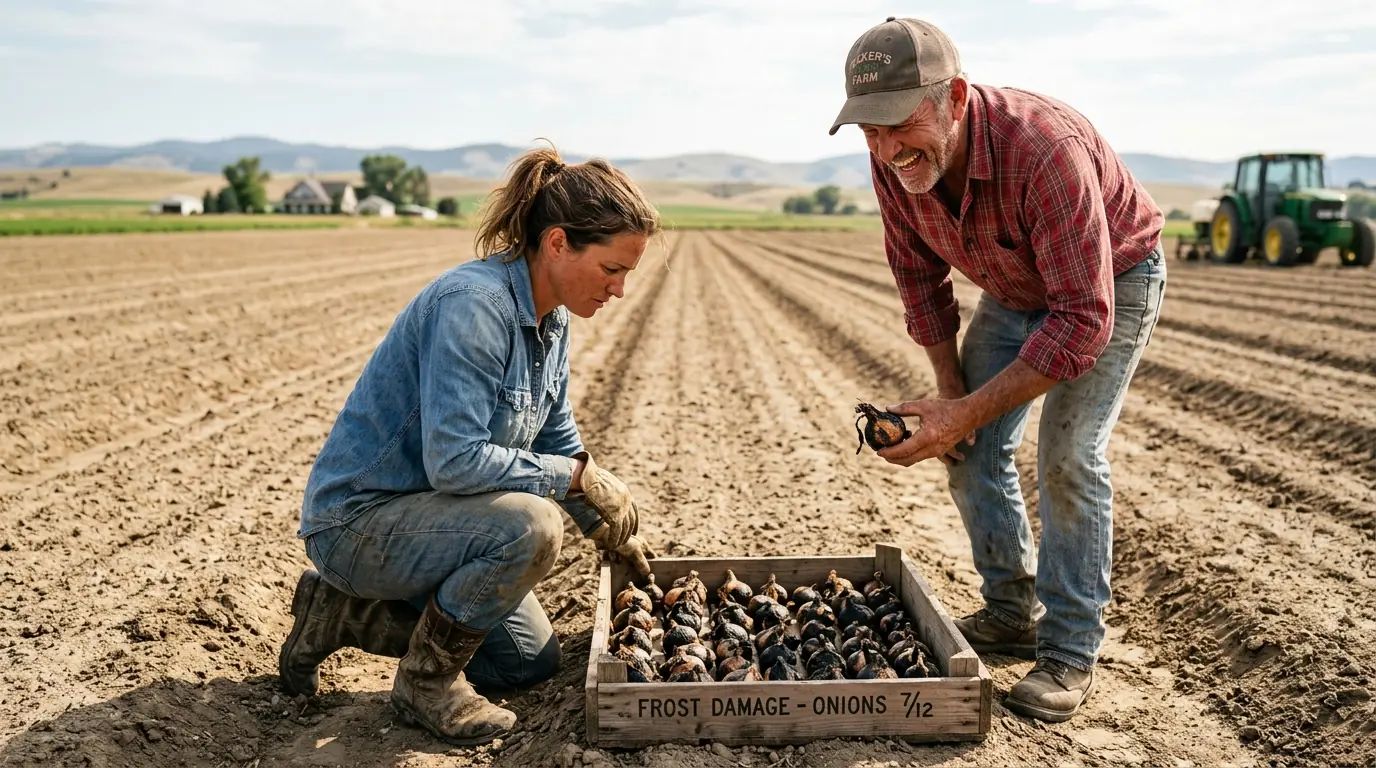
The sets did not look promising.
Some were blackened around the edges. Others were wrinkled so badly they felt almost hollow beneath the skin. Several had soft outer layers from condensation, and the whole batch carried the stale, earthy smell of bulbs that had spent too much time inside a warehouse nobody had intended to use as cold storage.
The supplier, Owen Pike, stood beside the loading dock with both hands on his hips while Marisol opened the third burlap sack.
“You understand these got frozen.”
“Cold,” she corrected.
“Frozen enough.”
“When?”
“Second week of May. Warehouse heater failed during that cold snap.”
“How many nights?”
Owen stared at her.
“Marisol, I’m selling you onions, not weather records.”
“How many?”
He thought about it.
“Four. Maybe five.”
“How cold?”
“Twenty-something at night. Building stayed warmer than outside, but not by much.”
“And they’ve been here since?”
“Because nobody wants them.”
Marisol lifted another set, pressed it gently between two fingers, and peeled away one damaged outer scale. Beneath the blackened surface, the tissue was pale and firm.
Alive.
Not healthy in the conventional sense.
But alive.
Owen watched her place it back into the sack.
“You’re thinking about planting them.”
“Yes.”
He laughed.
Not cruelly.
He simply believed she had made a joke.
When she did not laugh with him, his expression changed.
“You’re serious.”
“I am.”
“It’s July eighteenth.”
“I know the date.”
“You grow onions.”
“For fifteen years.”
“Then you know better than anybody that this is stupid.”
Marisol tied the sack closed.
“That depends.”
“On what?”
“On whether the cold did what I think it did.”
Owen stared at the sacks as though expecting them to explain her.
“They’re frost damaged.”
“That’s what makes them interesting.”
“Interesting?”
“Yes.”
He shook his head.
“How much were you thinking?”
“For all of them?”
“I was planning to dump them.”
“Eighty dollars.”
Owen laughed again.
“You’re bargaining with garbage.”
“Then you should be thrilled.”
He looked at her.
Then at the sacks.
Then back at her.
“Cash?”
“Cash.”
“You haul them today.”
“I will.”
“If they rot in your field, I don’t want a phone call.”
“You won’t get one.”
“And if Franklin Doss asks where they came from, tell him I tried to stop you.”
That made Marisol smile.
“Now I definitely won’t.”
Two hours later, the sacks were stacked in the bed of her old Chevrolet pickup as she turned onto the gravel road leading into San Espera Valley.
The valley was not large enough for secrets.
It was six miles from the river to the northern foothills and maybe twice that from east to west, a patchwork of vegetable ground, hay fields, orchards, and small cattle operations pressed between two ridges that trapped cold air every autumn.
Farmers there argued about irrigation schedules, fertilizer prices, school-board elections, and which mechanic could rebuild a pump without charging for three parts he had not replaced.
But there were certain things nobody argued about.
Onions went into the ground in March or April.
Early May if weather had been particularly ugly.
By June, you were already late.
By July, you were not late.
You had missed the season.
Marisol knew that as well as anybody.
Her nine acres lay at the coldest northern end of the valley where heavier night air rolled down from the foothills and settled against her lower field. The same geography that gave Franklin Doss nearly two additional frost-free weeks on his property three miles south routinely took ten to fourteen days away from hers.
She had spent years learning how to work inside that disadvantage.
Raised beds warmed more quickly in spring.
Black irrigation line helped.
Windbreak placement mattered.
Variety selection mattered more.
She kept records.
Not the loose kind most farmers kept in their heads, where “wet spring” or “good peppers that year” became enough information after a decade.
Marisol wrote everything down.
Planting date.
Soil temperature.
Night lows.
Emergence.
Irrigation.
Leaf count.
Harvest date.
Average bulb size.
Anything she could measure went into a notebook.
Her late husband, Tomas, used to tease her about it.
“You farm like the onions are going to testify against you.”
“They might.”
“About what?”
“Neglect.”
He had been gone five years.
The notebooks remained.
So did the joke.
Marisol pulled into the equipment shed just before three in the afternoon.
Her hired hand, twenty-four-year-old Luis Ortega, came out carrying a grease gun and stopped when he saw the sacks.
“What did you buy?”
“Onions.”
He looked toward the field.
“Why?”
“To plant.”
Luis checked the sky as though perhaps July had vanished while he was repairing the cultivator.
“Today?”
“Tomorrow.”
He climbed onto the pickup bed and opened one sack.
His expression became more concerned.
“These are bad onions.”
“Some.”
“No, Marisol. These are onions you apologize to pigs for feeding.”
“Not all of them.”
Luis squeezed one.
“This one looks like it survived a war.”
“It survived a warehouse.”
“Same face.”
Marisol laughed.
“Start separating anything completely soft or moldy. Keep the firm ones even if the outer scales are damaged.”
Luis watched her for a moment.
“You’ve got that look.”
“What look?”
“The one from when you tried grafting tomatoes onto wild rootstock.”
“That worked.”
“After killing forty plants.”