Victoria Ashford believed The Sovereign belonged to her because her name was printed on the ownership papers, the marina account, the private registry, and the polished brass plate beside the gangway. The superyacht rose over the Miami dock like a white floating mansion, with glowing deck lights, chrome rails, tinted windows, and a crew trained to lower their voices whenever she entered. It was the pride of her regional luxury charter division, a vessel used to entertain investors, politicians, foreign clients, and anyone else she needed to impress. To Victoria, owning that yacht meant standing above everyone on it.
That illusion began to crack at 6:14 p.m., just before sunset, when the engines refused to start. The departure schedule had already been confirmed, the champagne had already been chilled, and a private dinner cruise for twelve elite guests was supposed to leave the dock in less than an hour. Three engineers had spent ninety minutes inside the engine bay, running digital checks, replacing minor parts, restarting the console, and sweating through their pressed uniforms. Each of them had failed.
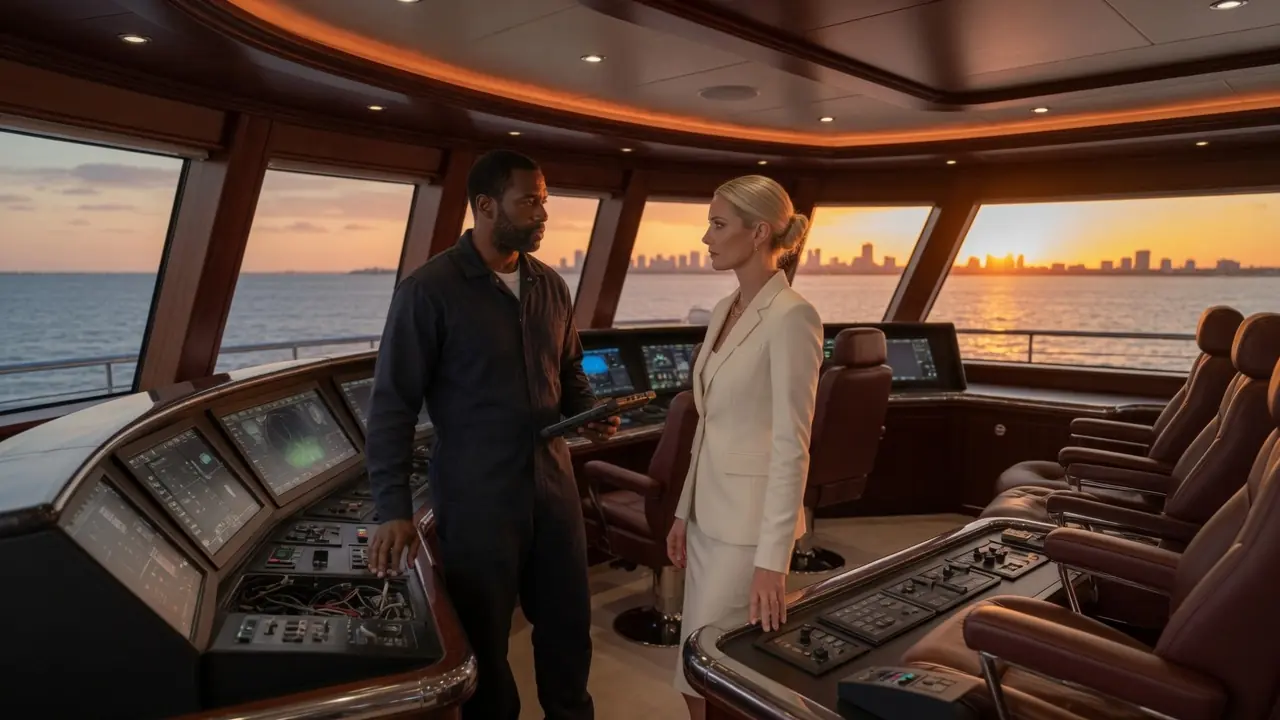
Victoria stood inside the glass-walled owner’s lounge, her ivory designer blazer sharp against the polished wood walls, her platinum blonde hair pinned in a sleek low bun, her white heels planted on the glossy floor like she could command the vessel to obey by posture alone. Outside the panoramic windows, the marina water reflected orange light, and the city skyline glowed in the distance. Inside, the command console sat frozen, its screens flashing system errors in expensive silence. The Sovereign, the boat she used as proof of power, had become a dead object beneath her feet.
The engineers tried to explain that the main propulsion system was locked under a fleet-level software safeguard. Victoria hated that phrase immediately. Fleet-level sounded like authority above hers, and she had not built her life around being told that anyone stood above her. She reminded them that she owned The Sovereign, that this was her vessel, her guest list, her schedule, and her reputation on the line.
They told her the system required master access from Webb Sovereign Fleet Group. The name meant little to her except as one of the corporations printed somewhere in the ownership documents she had never bothered to read fully. She knew there were management layers, licensing contracts, propulsion systems, fleet rules, and maintenance agreements, but those things had always felt beneath her. She owned the yacht, and that was the only fact she cared about.
Then the crew called Marcus Webb. He arrived without ceremony, walking across the dock in dark navy work coveralls, worn boots, and a weathered leather tool case in one hand. His coveralls carried a small Webb Fleet Systems logo, subtle enough for Victoria to dismiss at first glance. He was a Black American man in his mid-forties, tall and strong, with deep brown skin, calm dark eyes, a broad serious face, short black hair, and a neatly trimmed beard.
Victoria watched him enter the lounge and decided what he was before he spoke. He looked like dock help to her, like the kind of man brought in after the expensive men failed, someone practical, useful, and forgettable. She saw grease marks on his hand, the old tool case, the plain work clothes, and the quiet way he studied the room. She did not see power because she had trained herself to recognize power only when it arrived in tailored suits and polished accents.
Marcus stopped beside the dead navigation console and looked at the warning screen. He did not rush, apologize, or ask permission to stand where he stood. He simply set down his tool case, lifted a diagnostic tablet, and studied the frozen system like a doctor reading a pulse. That calm irritated Victoria more than panic would have.
The insult landed in the room and stayed there. Victoria expected embarrassment, maybe resentment, maybe the familiar lowering of eyes she had seen from people who needed her approval or her money. Marcus gave her none of that. He stood with the stillness of a man who had walked through worse rooms and had stopped asking arrogant people to recognize him before doing what needed to be done.
He connected his tablet to the console port. The screen flickered, rejected the first access layer, then requested a founder-level command code. Victoria noticed that and frowned. Founder-level access was not something a dock mechanic should even know existed.
Marcus entered the code without hesitation. His fingers moved quickly, not like someone guessing, not like someone following instructions over the phone, but like someone opening a door he had built himself. The frozen control board flashed once, then shifted from red warnings to a dark authorization screen. Victoria leaned closer despite herself.
The tablet displayed his name first. Marcus Elijah Webb. Beneath it appeared his portrait ID, corporate seal, and title: Founder and Chief Executive Officer, Webb Sovereign Fleet Group. Then the screen expanded into a global fleet dashboard. Dozens of luxury vessels appeared across the map, each listed under Webb command authority.
Victoria’s breath caught before she could stop it. The Sovereign appeared as Vessel 17. It was not an independent kingdom, not truly. It was one yacht inside a much larger chain, and Marcus Webb was not below her in that chain. He was above every regional owner, every operator, every charter partner, and every executive who touched the vessels bearing his company’s systems.
Marcus finally looked up. “On this yacht, maybe you own a room.” His voice was calm, almost quiet, but every word carried the force of a door closing. He turned the tablet slightly so she could see the fleet interface more clearly. Vessel 17, Sovereign-Class Luxury Fleet, Regional Ownership: Ashford Holdings, Global Control Authority: Webb Sovereign Fleet Group.
Victoria’s face changed in layers. First came disbelief, then calculation, then the first pale flash of fear. She stared at the screen, then at Marcus’s face, then back at the screen, as if the technology itself had betrayed her by telling the truth. The man she had treated like someone lucky to stand on her deck was the man whose company controlled the ship beneath her feet.
She tried to recover because pride was the only reflex she trusted. Her hand tightened on the glossy console, her diamond bracelet catching the ceiling light. She lifted her chin, but the motion looked weaker now, less like authority and more like defense. The room had shifted, and everyone inside it could feel the change.
The crew members who had watched her insult him now watched her discover him. That made it worse. Private humiliation can be swallowed and rewritten later, but public humiliation has witnesses. Victoria had spent years building a reputation for control, and in less than two minutes, Marcus had exposed the one thing she hated most: she had misjudged the hierarchy.
She owned one yacht. Marcus owned the fleet system that made her yacht move, dock, communicate, navigate, unlock emergency protocols, and pass regulatory command checks. The Sovereign carried her name on the registry, but the lifeblood of the vessel ran through his company’s technology. The distinction had never mattered to her before because she had assumed the people behind the systems were invisible.
Marcus returned his attention to the console. He opened the propulsion diagnostic panel, bypassed the regional owner lockout, and traced the failure through the fleet network. The issue was not in the engine itself. It was a corrupted command relay inside the central operating stack, triggered by an unauthorized manual override attempted by one of Victoria’s private engineers.
The discovery made the air tighter. Victoria’s engineers had not merely failed; they had interfered with a protected system and nearly forced the yacht into a deeper safety lock. Marcus documented it with two taps. The tablet saved the record under his executive audit account.
Victoria knew enough about corporate systems to understand what that meant. An audit account was not a repair note. It was a permanent record. Her ownership division, her staff, and possibly her board would see exactly what happened: her engineers broke protocol, her vessel froze, and she insulted the CEO who arrived to fix it.
Marcus opened the control panel beneath the navigation screen. Organized cables, chrome-trimmed modules, and coded relay ports glowed behind the console. His hands moved with the confidence of someone who did not just understand the machine but had designed the logic that governed it. He removed a sealed data relay, checked the burn pattern, and set it on a cloth beside the tablet.
The room remained painfully quiet. Victoria wanted to speak, but she could not find words that would restore the version of herself that existed ten minutes earlier. Every sentence available to her sounded either defensive or foolish. Apology felt impossible because it would require admitting the insult before anyone else said it aloud.
Marcus replaced the relay, reset the locked command route, and entered a new authorization. The yacht shuddered softly beneath them as the engine-control network came alive. Warning lights turned amber, then green. The central console hummed back into operation, and somewhere below, the dormant engine system began warming.
The crew reacted first. A young deck officer exhaled audibly near the doorway. Someone whispered that the system was back. The sound of relief moved through the lounge like wind across water, but Marcus did not smile. He simply watched the readings settle into safe range.
Victoria stared at the green lights. Minutes ago, she had believed the yacht’s failure was an embarrassment caused by incompetent workers. Now she understood the failure had become something else entirely: proof that the man she dismissed controlled the very power beneath her feet. He had not needed to raise his voice because the ship itself had answered for him.
The engines roared to life at 6:37 p.m. The vibration rolled through the floor, deep and controlled, making the glass walls tremble faintly. Outside, dock workers turned toward The Sovereign as its running lights brightened. Inside, Victoria stood rigid, her face drained of color.
Marcus closed the panel and wiped his hands with a clean cloth from his tool case. That small action humiliated her more than a speech would have. He looked composed, professional, almost bored. She had wanted him to be small, and instead he stood there as the only steady person in the room.
Victoria finally managed to speak, but her voice had lost its sharpness. “Founder and CEO… you own the whole fleet?” The question sounded almost childish once it left her mouth. Marcus looked at her without pity. The silence before his answer made the truth heavier.
“Including the ship you just used to look down on me.” That was all he said. No lecture, no victory laugh, no dramatic flourish. The statement did not need decoration because the yacht, the screen, the crew, and Victoria’s own expression had already done the work.
The words struck harder because they were exact. She had used the ship as a throne, a symbol of superiority, a floating proof that she belonged above people like him. But the ship was not the crown she thought it was. It was an asset inside Marcus’s empire, and she had been standing in his system while calling him beneath her.
Victoria looked away first. It happened quickly, but everyone saw it. She turned toward the marina windows, pretending to check the dock, but Marcus knew the movement for what it was. A retreat.
For most of her adult life, Victoria had learned to survive embarrassment by converting it into anger. When challenged, she grew colder. When corrected, she made someone else pay for the discomfort. But this was different. Marcus had not challenged her socially, emotionally, or publicly for sport. He had simply revealed reality, and reality had placed him above her.
Her mind ran through consequences. The regional contract. The fleet licensing terms. The safety protocol violation. The fact that Webb Sovereign Fleet Group could suspend operational clearance until after a full review. Her dinner cruise, her investors, her reputation, and her control were all now dependent on the decision of the man she had insulted.
Marcus seemed to understand the calculation passing through her face. He picked up his tablet and reviewed the audit file. His calm was not mercy. It was discipline. Victoria saw that now.
He had the power to end the evening completely. He could lock the vessel, cancel the departure, file a breach report, and send her guests home before they ever stepped onboard. He could damage her reputation with a few official lines written in the language of safety compliance. He could do to her professionally what she had tried to do socially: reduce her to someone waiting outside a door.
Instead, he left the engine running. That unsettled her most of all. She could understand retaliation. She could respect punishment. Restraint, especially from someone she had harmed, left her with nowhere to hide.
Marcus saved the diagnostic report and disconnected the tablet. Then he placed the old relay into a sealed evidence pouch from his tool case. The pouch bore the same Webb Fleet Systems logo she had dismissed on his coveralls. Now the small emblem seemed to stare back at her.
The deck officer asked quietly whether departure clearance was restored. Marcus did not look at Victoria. He reviewed the status feed, confirmed the safety checks, and nodded. The yacht was technically cleared to depart, pending one condition: the unauthorized override procedure had to be acknowledged by the regional owner.
Victoria understood that meant her signature. She also understood that signing would document her engineer’s mistake and Marcus’s intervention. It would preserve the truth inside the corporate record.
A few minutes earlier, she might have refused out of pride. Now she accepted the tablet with stiff fingers. Her signature appeared beneath the audit summary, smaller than she expected, fragile-looking against the official interface. When she handed the tablet back, Marcus gave no reaction.
That lack of reaction cut deeply. Victoria was used to people wanting something from her: approval, access, money, fear, forgiveness, attention. Marcus wanted none of it. He took the tablet because the procedure required it, not because her gesture mattered to him personally.
The power imbalance had reversed completely. She had begun the scene as the owner towering over a supposed mechanic. Now she felt like a regional operator standing before the global chief executive whose patience she had already wasted. The comparison was humiliating because it was true.
Outside the lounge, the marina staff prepared the yacht for delayed departure. The world continued moving. Ropes were checked, crew members resumed their duties, and the water darkened under the fading sunset. But inside the owner’s lounge, Victoria remained trapped in the moment she had created.
She looked at Marcus again, really looked this time. Not at the coveralls, not at the boots, not at the grease on his hands, but at the man himself. He carried exhaustion around his eyes, the kind built from responsibility, grief, and long years of proving competence to people determined not to see it. He had not arrived as a beggar or a servant. He had arrived as the person everyone should have called first.
The fact that he was a Black CEO made her insult uglier in retrospect. She knew that, even if she did not want to say it. Her words had not simply been about class, clothes, or occupation. They had carried the weight of every assumption she made the second he walked in: that he was beneath her, that he should be grateful, that his place was dockside until someone richer allowed him inside.
Marcus did not need her confession to know it. Men like him had spent entire lives reading rooms like hers. He had recognized the contempt before she dressed it in words. The only difference was that now she could not pretend he had misunderstood.
He collected his tools. Each movement was measured and final. Victoria suddenly feared he would leave without giving her a chance to repair anything, and that fear surprised her. Minutes ago, she had wanted him gone the moment the engine worked. Now she wanted time, explanation, some way to pull dignity from the wreckage.
But dignity, she realized, was not something Marcus could hand back to her. She had thrown it away herself. All he had done was let it land.
The lounge door opened, and the captain stepped in, visibly nervous. He addressed Marcus first, not Victoria. It was automatic, respectful, and devastating. The captain asked whether the vessel remained cleared for tonight’s route.
Marcus glanced at the route file. He confirmed the departure window, reduced the maximum engine load for the first twenty nautical miles, and instructed the captain to keep the secondary relay channel active until full inspection. The captain nodded like a man receiving orders from the highest authority onboard. Victoria watched, silent and burning.
That was when the hierarchy became undeniable. Her ownership gave her luxury. Marcus’s authority gave the ship life. She could host dinners, pose for photographs, sign charter papers, and choose champagne, but he controlled the systems that determined whether the vessel moved at all.
The captain left. The door closed. Only Marcus and Victoria remained in the owner’s lounge, facing each other across the restored console. The soft green glow from the screens reflected along the chrome edges, making the room look calmer than either of them felt.
Victoria wanted to apologize, but pride still stood in the way. Not because she believed she was right, but because being wrong so completely felt almost physically painful. Her whole identity had been built on command, polish, and superiority. Marcus had dismantled all three without raising his voice.
He lifted his tool case. The sound of its clasp closing was small but final. He turned toward the door, and the movement jolted her into speaking again, though not with the sharpness from before. She asked what would happen now.
Marcus paused. He looked back at her with an expression that held no cruelty, only clarity. The incident would go into the fleet record. Her regional operating privileges would be reviewed. Her engineer’s credentials would be suspended pending investigation. The Sovereign could sail tonight, but not because she had demanded it.
It could sail because he allowed it after verifying safety. That distinction mattered. Victoria heard it in every word he did not say.
For the first time that evening, she understood that Marcus Webb’s restraint had saved more than her schedule. He had saved her from a public disaster, a canceled event, a dock full of witnesses, and investors watching her authority collapse before dinner. He had every reason to humiliate her back, and he chose procedure instead.
That made him more powerful than she had imagined. Wealth could buy a yacht. It could buy champagne, white leather seats, designer clothes, and a name on a registry. But it could not buy the kind of authority Marcus carried into a room quietly, the kind built from knowledge, ownership, endurance, and self-control.
He opened the lounge door. The sounds of the working yacht entered the room: crew movement, engine vibration, radio checks, water against the hull. The Sovereign was alive again. Victoria stood beside the console, surrounded by proof that it had never been fully hers in the way she believed.
Marcus stepped into the corridor, then stopped once more without turning fully around. He told her the fleet review board would contact her office in the morning. His tone was formal now, clean and distant. The man she had insulted had become the executive she would have to answer to.
The door closed behind him. Victoria remained alone in the owner’s lounge, staring at the green console screen. The reflection in the glass showed her ivory suit, her pale face, her perfect hair, and the yacht lights behind her. She looked exactly like the woman who had walked in believing ownership made her untouchable.
But she no longer felt untouchable. She felt exposed. She had owned one superyacht and mistaken that for power, while Marcus Webb owned the chain that made her yacht part of something larger than her ego.
Outside, the crew prepared to welcome her guests as if nothing had happened. Inside, Victoria looked at the fleet dashboard still glowing faintly on the console, where Marcus’s name remained listed above hers in the command hierarchy. Founder. Chief Executive Officer. Global Control Authority.
The truth was impossible to soften. She had not insulted a mechanic. She had insulted the man who controlled the fleet, the system, the standard, and the future of her access to all of it.
And Marcus Webb had not needed to tell her he belonged in the room. The ship had done it for him.