“Sir, I need you to move to seat 32B.”
The flight attendant stood in the aisle with one hand resting on the overhead compartment. Her smile had disappeared several minutes earlier, and the firmness in her voice now carried a warning.
“We have a family that needs to sit together,” she continued. “Your seat is the only one available.”
Walter Hale looked up from seat 7C.
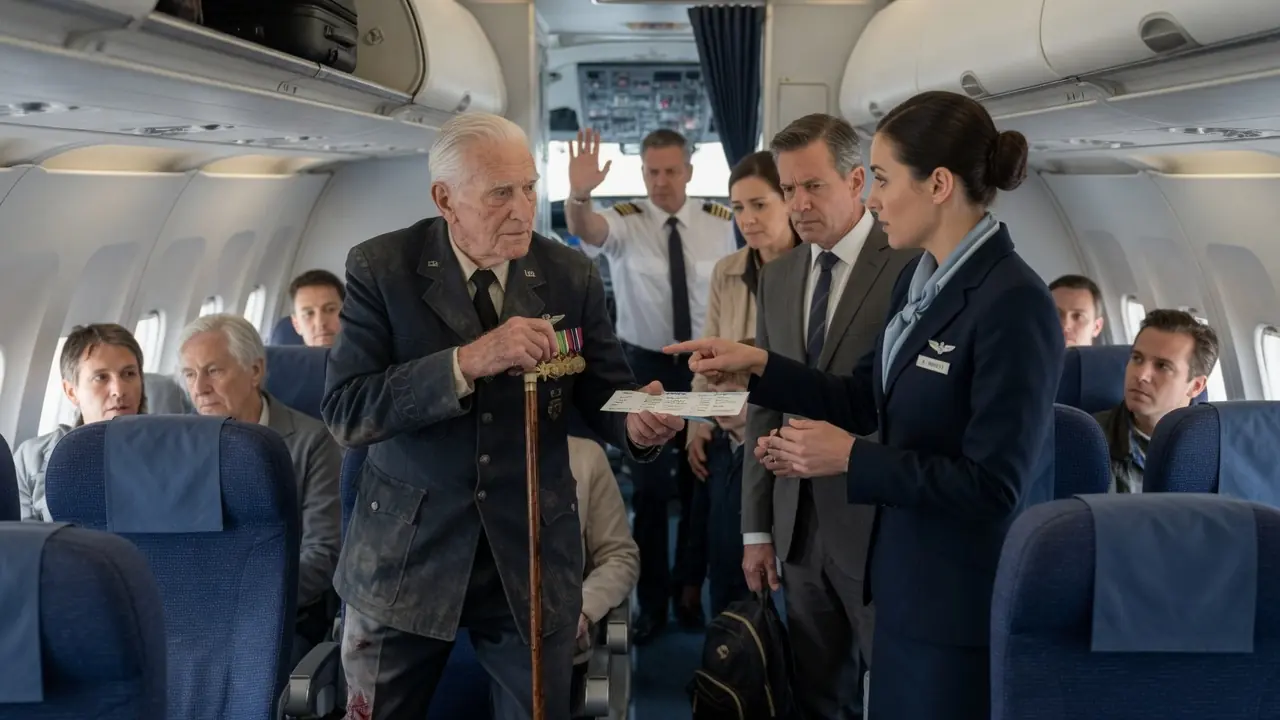
At eighty-seven, he moved slowly, but there was nothing confused in his pale blue eyes. He wore a simple charcoal suit with thinning fabric at the cuffs, a clean white shirt, and an old blue tie knotted carefully beneath his collar.
The clothes were not fashionable.
They were the best ones he owned.
“I booked this seat in February,” Walter said. “I paid for the aisle because of a service injury.”
The flight attendant glanced toward the front of the cabin.
Passengers were still placing bags into overhead compartments. A child was crying two rows behind Walter, and the departure clock was moving steadily toward a delay that would appear on the crew’s performance report.
“I understand that,” she said, though her tone suggested the opposite. “But seat 32B is available, and the family has requested to remain together.”
Walter looked past her.
A married couple stood beside row seven with an anxious boy of perhaps nine between them. The mother held a stuffed bear and a backpack covered in cartoon rockets. The father looked embarrassed.
The boy’s hands were pressed tightly over his ears.
Walter could see why they wanted to sit together.
“What seats do they have?” he asked.
“Seven A, seven B, and thirty-two B.”
Walter nodded toward the father.
“The boy can stay with his mother. His father can take thirty-two B.”
The man lowered his eyes.
The flight attendant’s name tag read ERICA GRANT.
Erica’s jaw tightened.
“The family requested all three seats together.”
“I’m not refusing to help the child.”
“Then please collect your belongings.”
Walter rested one hand on the top of his cane.
“I cannot sit in a middle seat for four hours.”
“Many passengers prefer the aisle, sir.”
“This isn’t preference.”
The people in the nearby rows had begun listening.
Walter disliked being watched.
He had spent most of his life avoiding attention, and he had not boarded Flight 482 expecting to explain his body to strangers.
He lowered his voice.
“There is metal in my left hip and lower spine. I need to extend my leg into the aisle periodically, or it locks.”
Erica crossed her arms.
“If the injury is severe enough to require special accommodation, it should have been documented with the airline.”
“It was.”
“Then it would be in the reservation.”
“It was when I booked.”
She checked the screen on the device in her hand.
“I don’t see anything.”
Walter reached into his jacket.
Erica immediately raised one palm.
“Please keep your hands where I can see them.”
The words changed the atmosphere.
Walter stopped.
His fingers remained inside the jacket for one second before he slowly withdrew them empty.
“I was getting the medical card.”
“You can show it to the gate agent after you move.”
A young man across the aisle lowered his phone slightly. He had begun recording without making it obvious.
Walter noticed.
So did Erica.
“Sir, I am giving you a direct crew instruction. If you refuse, you may be removed from the flight.”
The father beside the anxious boy finally spoke.
“Ma’am, I can take the other seat.”
His wife looked at him.
“We’ll be okay.”
Erica shook her head.
“We’ve already arranged this.”
“No,” Walter said quietly. “You decided it.”
Erica’s cheeks reddened.
She had worked for Northstar Airlines for six years. She had handled medical emergencies, frightened passengers, intoxicated businessmen, screaming children, and travelers who treated a boarding pass like permission to ignore every instruction.
She had also been awake since four that morning.
The previous flight arrived late.
The gate agent had handed her a seating problem moments before boarding and said, “Find the easiest solo passenger to move.”
Walter appeared to be that passenger.
An old man.
No companion.
No status displayed on the manifest.
No expensive briefcase.
No reason, in Erica’s hurried assessment, to make the situation difficult.
She leaned closer.
“Move to 32B, or leave the aircraft.”
The cabin went quiet around them.
Walter looked toward the window.
Beyond the glass, rain moved across the runway at Ronald Reagan Washington National Airport. Ground crews in reflective jackets hurried between vehicles beneath the gray morning.
The plane was scheduled to fly to San Antonio.
Walter had not visited Texas in forty-nine years.
Inside his jacket was a letter that had taken him six months to gather the courage to open.
The man who wrote it was already dead.
Walter had promised himself he would not miss the funeral.
Not after missing so many other things.
He looked back at Erica.
“I do not want to delay your flight.”
“Then stand up.”
Walter’s fingers closed around the cane.
He had survived pain far worse than the one waiting in his hip.
Pain itself did not frighten him.
What frightened him was falling in front of a cabin full of strangers and becoming exactly what the flight attendant had already decided he was.
A helpless old man causing trouble.
Still, he pushed himself upright.
The pain came immediately.
A sharp current moved from his left hip into his spine, followed by the familiar numbness down his thigh. Walter gripped the seatback with his right hand.
The anxious child stopped crying.
Everyone watched the old man struggle.
Walter reached toward the overhead compartment for his small leather bag.
His left leg failed.
His knee struck the edge of the seat.
The cane slipped.
A woman in row eight gasped as Walter fell sideways against the armrest.
The father caught his shoulder before he hit the floor.
Something small dropped from inside Walter’s jacket.
It landed in the aisle with a faint metallic sound.
The anxious boy lowered his hands from his ears.
He bent down before his mother could stop him and picked up the object.
It was a pair of old silver pilot wings.
The metal had darkened with age. One side was bent, and a tiny reddish stain remained inside a deep scratch near the center.
The boy held it out.
“You dropped this.”
Walter’s face changed.
He took the wings carefully.
“Thank you.”
“Were you a pilot?”
Walter closed his fingers around them.
“A long time ago.”
Erica retrieved his cane from beneath the seat.
“If you cannot walk safely, we may need airport medical staff to remove you.”
The young man filming finally spoke.
“He told you he couldn’t move because of an injury.”
Erica turned.
“This does not involve you.”
“It involves everyone you’re delaying.”
A few passengers murmured in agreement.
Another flight attendant appeared from the forward galley.
Nina Patel was the senior cabin crew member. She was in her early fifties and had learned long ago that problems became dangerous when people cared more about being obeyed than understanding what was happening.
“What’s going on?” Nina asked.
Erica explained quickly.
“Passenger in 7C is refusing reassignment. He claims a medical condition, but there’s no accommodation on my screen.”
“I am not refusing to help the family,” Walter said. “I asked to remain in an aisle seat.”
Nina looked at him.
“What is your name, sir?”
“Walter Hale.”
Her eyes moved to the pilot wings inside his hand.
Something about the name seemed familiar, though she could not place it.
She crouched slightly so Walter did not have to tilt his head.
“Are you able to remain standing?”
“Not for long.”
“Please sit back down.”
Erica started to object.
Nina raised one hand.
“Let him sit.”
The father helped Walter lower himself into 7C.
The old man’s breathing had become shallow.
Nina looked at Erica.
“Come with me.”
They moved toward the forward galley.
Erica whispered urgently.
“We need to close the door. Operations already called about the delay.”
“He has a documented injury.”
“He says he does.”
“You made him stand after he warned you.”
“He could be exaggerating because he doesn’t want a middle seat.”
Nina looked back at Walter.
He had placed the tarnished wings inside his palm and was staring at them.
“Did you ask the gate agent to verify his reservation notes?”
“There wasn’t time.”
“Make time.”
Erica’s mouth tightened.
Nina picked up the interphone and called the cockpit.
Captain Daniel Mercer answered.
“We’re almost ready,” he said. “What’s the delay?”
“Seating conflict in row seven.”
“Can you resolve it?”
“I think so. There’s an elderly passenger named Walter Hale. He booked an aisle for a service injury. His accommodation note isn’t displaying, and Erica tried to move him to 32B.”
The cockpit became silent.
Nina waited.
“Captain?”
Daniel Mercer’s voice returned, but it had changed.
“What name did you say?”
“Walter Hale.”
“Age?”
“Mid-eighties, maybe older.”
“Description.”
Nina glanced through the curtain.
“White hair. Blue eyes. Dark suit. Cane.”
Daniel spoke more slowly.
“Does he have anything military on him?”
“A bent set of silver pilot wings.”
The silence on the interphone deepened.
First Officer Caleb Morris looked toward Daniel from the right seat.
The captain’s hand had frozen over the preflight checklist.
Daniel’s father had kept a photograph inside his study for more than forty years.
Five men stood beside a damaged helicopter in the picture.
Three were smiling.
One had his arm in a sling.
The fifth stood slightly apart, thin and exhausted, with a bandage around his waist and a pair of pilot wings pinned crookedly to his shirt.
On the back, Daniel’s father had written:
MAJOR WALTER HALE. THE MAN WHO GAVE ME THE REST OF MY LIFE.
Daniel reached for the interphone.
“Nina, is Mr. Hale still in 7C?”
“Yes.”
“Keep him there.”
“We haven’t closed the main door.”
“Do not close it.”
“Captain, operations—”
“I said stop boarding procedures.”
Daniel removed his headset.
Caleb stared at him.
“You know him?”
Daniel looked toward the locked cockpit door.
“My father spent fifty years looking for him.”
In row seven, Walter unfolded the letter inside his jacket.
The paper trembled slightly in his hand.
It had been written by retired Air Force Brigadier General Robert Mercer six months before his death.
Walter had received it only two weeks earlier because it had passed through several old addresses and one veterans’ organization before finally reaching his small Maryland apartment.
Walter,
If this letter reaches you, then someone has succeeded where I failed for half a century.
I am dying.
Don’t be angry. I’ve had eighty-four years, a wife who stayed through everything, two children, five grandchildren, and more mornings than I deserved.
Every one of those mornings began because you came back for me.
My funeral will be in San Antonio on the twenty-second. I know you hate ceremonies. Come anyway.
My son Daniel flies for Northstar now. You met him once when he was a baby, though you probably don’t remember.
If you come, sit with my family.
You are part of it whether you like it or not.
Your brother,
Robert
Walter had read the letter seven times.
He remembered Daniel as an infant sleeping against Robert’s chest in a military hospital waiting room.
He did not know what the boy had become.
The cabin lights flickered as ground power changed.
A passenger checked his watch.
Erica stood near the galley, embarrassed and increasingly angry that the problem had reached the cockpit.
Exactly nine minutes after she first ordered Walter to move, the speakers came alive.
“Ladies and gentlemen, this is Captain Mercer.”
Conversations stopped.
“We are temporarily halting departure procedures. Please remain seated with the aisle clear.”
Walter looked up.
The cockpit door opened.
First Officer Morris remained inside while Captain Daniel Mercer stepped into the cabin.
He wore the dark uniform of a commercial airline captain, four gold stripes on each shoulder, and a silver wing insignia above his heart.
Passengers turned as he walked down the aisle.
Daniel passed the first row.
Then the second.
His eyes remained fixed on Walter.
Nina moved aside.
Erica stood near the galley, watching confusion spread through the passengers.
Daniel stopped beside row seven.
For several seconds, neither man spoke.
Walter studied the captain’s face.
He saw Robert immediately.
Not in the shape of the jaw or the uniform.
In the eyes.
Robert Mercer had looked at danger with those same steady gray eyes while pretending he was not afraid.
“Daniel?” Walter asked.
The captain’s throat tightened.
“Yes, sir.”
Walter began to stand.
Daniel raised one hand.
“Please remain seated.”
Then, in the center of the crowded commercial aircraft, Captain Daniel Mercer drew himself to attention.
His heels came together.
His shoulders straightened.
He raised his right hand in a precise military salute.
The cabin became completely silent.
“Major Hale,” Daniel said, his voice carrying from the cockpit to the rear galley, “my father told me that if I ever had the honor of standing in front of you, I was to salute first and thank you second.”
Walter’s lips parted.
No answer came.
Daniel held the salute.
“I had a father because of you, sir.”
A woman in row six covered her mouth.
The young passenger recording lowered his phone.
Even the anxious boy remained perfectly still.
Walter looked at the captain’s raised hand.
Then at the bent wings inside his own palm.
Slowly, painfully, he lifted his right hand to his brow.
The old salute was not as sharp as Daniel’s.
His fingers trembled.
It was enough.
Daniel lowered his hand only after Walter did.
Erica stood frozen.
Daniel turned slightly toward the passengers.
“In October 1971, my father was a twenty-seven-year-old Air Force lieutenant flying a reconnaissance mission over territory where official rescue operations were considered impossible.”
Walter lowered his eyes.
Daniel continued.
“His aircraft went down during a monsoon. Two crew members died on impact. The survivors spent thirty hours surrounded, injured, and without communication.”
He looked at Walter.
“Major Hale flew an unarmed rescue helicopter through weather that had grounded every other aircraft.”
Walter spoke quietly.
“It wasn’t unarmed.”
Daniel almost smiled.
“You had a sidearm.”
“And a stubborn crew chief.”
A small ripple of nervous laughter moved through the cabin.
Daniel continued.
“Major Hale landed under fire, loaded seven wounded men, and lifted out with one engine failing.”
He paused.
“The helicopter was hit again before crossing friendly lines. Major Hale crash-landed in a flooded field.”
Walter’s left hand moved instinctively toward his hip.
“He carried my father away from the wreck before the fuel tanks ignited. The injuries he suffered that day ended his flying career.”
The passengers looked toward Walter differently now.
The worn suit had not changed.
Neither had the cane.
Only their understanding had changed.
Daniel’s voice became quieter.
“My father lived another fifty-two years.”
He looked directly at Walter.
“He taught me to fly. He attended my graduation. He held my children. He grew old beside my mother.”
Daniel swallowed.
“Every part of my life exists because this man refused to leave him behind.”
Walter looked toward the letter.
“I did my job.”
“No, sir.”
Daniel shook his head.
“You went back after your commanding officer ordered you to abandon the extraction.”
Walter’s mouth tightened.
“Your father talked too much.”
“He spent fifty years trying to thank you.”
“He thanked me in the hospital.”
“He said it wasn’t enough.”
“It was.”
Daniel noticed the letter inside Walter’s hand.
“You’re going to his funeral.”
Walter nodded.
“I’m late.”
The captain looked toward Erica.
“No, sir. The funeral will wait for you if it has to.”
Walter’s eyes sharpened.
“Do not delay a plane full of people because two old men had unfinished business.”
Daniel smiled faintly.
“That sounds exactly like something my father said you would say.”
The mother of the anxious child stepped closer from row seven.
“Mr. Hale, I’m so sorry. We didn’t ask anyone to force you to move.”
Her husband nodded.
“I’ll take 32B.”
Walter looked at the boy.
The child still held his stuffed bear tightly.
“What’s his name?”
“Elliot.”
Walter extended the bent pilot wings.
Elliot looked toward his mother, then touched the metal carefully.
“Did those come from your helicopter?”
Walter shook his head.
“Robert gave them to me after the crash. Mine were lost.”
“Why are they bent?”
“So was the helicopter.”
Elliot smiled for the first time since boarding.
A man seated in first class stood.
He was perhaps fifty, wearing a navy business suit.
“I have 2C,” he said. “I’m traveling alone. The father can have my seat, and I’ll take 32B.”
The father stared.
“You don’t have to do that.”
“I know.”
The businessman looked toward Walter.
“Apparently that’s the point.”
Nina reorganized the seating.
The mother and Elliot remained in 7A and 7B.
Walter remained in the aisle seat he had purchased.
Elliot’s father moved to first class.
The volunteer took 32B without complaint.
The entire problem disappeared once people stopped treating Walter as the easiest person to inconvenience.
Daniel crouched beside 7C.
“My mother will be at the airport.”
Walter looked uncertain.
“She doesn’t know I’m coming.”
“She will when we land.”
“I don’t want a fuss.”
“She has been waiting to meet you since before I was born.”
“That sounds like a fuss.”
“It will be.”
For the first time that morning, Walter smiled.
Daniel stood and looked toward Erica.
“Ms. Grant, may I speak with you in the galley?”
The words were calm.
Erica followed him forward.
Her hands felt cold.
Inside the galley, Daniel lowered his voice.
“Did Mr. Hale explain the injury?”
“Yes.”
“Did you attempt to verify it?”
“There wasn’t time.”
“There were nine minutes.”
She looked down.
“The family needed—”
“The family proposed another solution.”
“I thought moving one passenger would be easier.”
“Easier for whom?”
Erica had no answer.
Daniel continued.
“You did not know who he was.”
“No.”
“That is not the problem.”
She looked up.
“The problem is that you believed he needed to be important before his pain deserved respect.”
Her eyes filled, partly from shame and partly from exhaustion.
“I was trying to keep the flight on schedule.”
“You made him stand after he told you standing could injure him.”
“I made a mistake.”
“Yes.”
Daniel’s tone remained controlled.
“And after we land, you will document it honestly.”
“Am I being fired?”
“That is not my decision.”
She swallowed.
Daniel glanced toward row seven.
“Major Hale saved my father. But even if he had spent his entire life repairing shoes, driving buses, or doing nothing anyone considered heroic, he still deserved to be heard.”
Erica nodded.
“I understand.”
“Not yet.”
Daniel opened the cockpit door.
“But you may.”
The flight departed twenty-two minutes late.
No passenger complained.
Once the aircraft reached cruising altitude, Nina brought Walter a pillow for his hip and a cup of coffee.
Erica remained near the rear galley for the first hour.
Each time she looked toward row seven, she saw Walter sitting quietly with Robert’s letter resting across his knees.
He did not appear angry.
That made the guilt worse.
Elliot eventually fell asleep against the window.
His mother read beside him.
Across the aisle, a retired schoolteacher named Margaret Lewis asked Walter whether Daniel’s story was true.
“Most of it,” Walter said.
“What part wasn’t?”
“The helicopter had two working engines when we entered the valley.”
Margaret waited.
“Only one when we left.”
She smiled.
“Why didn’t you stay in contact with General Mercer?”
Walter looked toward the clouds beyond the window.
“Life.”
“That isn’t an answer.”
“It’s the answer people use when the real one takes too long.”
Margaret accepted that.
After several minutes, Walter continued without being asked.
“Robert returned to flying. I didn’t.”
“Because of your injury?”
“Partly.”
The crash had shattered Walter’s pelvis and damaged several nerves near his spine. Doctors predicted he might never walk normally.
He proved them wrong.
But the Air Force would never clear him to fly operational missions again.
Robert visited every week during Walter’s rehabilitation.
Then assignments changed.
Families moved.
Letters became less frequent.
Walter’s wife developed cancer.
His son died in a construction accident at thirty-two.
Grief narrowed Walter’s world until old friendships felt like doors he no longer knew how to open.
Robert kept writing.
Walter answered less and less.
“I thought he had a full life,” Walter said. “I didn’t want him feeling responsible for mine.”
“Was he?”
“No.”
“But you let him think you were gone.”
Walter folded the letter.
“I was ashamed of becoming someone who needed a cane.”
Margaret looked at him.
“You flew into enemy fire, but you were ashamed of a cane?”
“Fear isn’t always logical.”
“No.”
She looked toward Erica in the rear galley.
“Neither is pride.”
Halfway through the flight, Erica approached Walter.
She stopped beside his row.
“Mr. Hale?”
He looked up.
“Major Hale,” she corrected.
“Mr. Hale is fine.”
She held a bottle of water and a folded blanket.
“I wanted to apologize.”
Walter waited.
Erica’s rehearsed sentence disappeared.
She had planned to say that the cabin was busy, the seating system failed, and she had been trying to help a child.
Standing in front of Walter, those explanations sounded like attempts to make herself feel better.
“I treated your pain as an inconvenience,” she said. “Then I spoke to you as though your age made you confused and your clothes made you unimportant.”
Walter studied her.
Passengers nearby pretended not to listen.
“I’m sorry,” Erica continued. “Not because Captain Mercer knows you. Because I was wrong before anyone knew you.”
Walter nodded once.
“That’s a better apology.”
She released a breath.
“I don’t expect you to forgive me.”
“Then why apologize?”
“Because you deserved to hear it.”
Walter looked toward Elliot.
“You were trying to help that family.”
“Yes.”
“You forgot help given to one person can become harm done to another.”
Erica’s eyes lowered.
“Yes.”
“Don’t forget again.”
“I won’t.”
“You probably will.”
She looked surprised.
Walter continued.
“Everyone forgets. Character is remembering sooner the next time.”
He accepted the water.
Erica placed the blanket beside him.
“Thank you.”
“Don’t thank me yet,” Walter said. “You still have three hours to prove you know how to make coffee.”
She laughed despite herself.
The tension in the nearby rows softened.
When Flight 482 landed in San Antonio, two airport fire vehicles waited near the gate with lights flashing.
Walter looked out the window.
“What is this?”
Daniel’s voice came over the speakers.
“Ladies and gentlemen, we have a small welcoming party at the gate. Please remain seated for one moment after the seatbelt sign is turned off.”
Walter closed his eyes.
“I told him no fuss.”
Margaret smiled.
“Men become pilots because they don’t listen.”
The aircraft door opened.
An Air Force honor guard stood inside the jet bridge.
Behind them waited Daniel’s mother, Eleanor Mercer.
She was eighty-one, dressed in black, with a folded flag held against her chest.
Daniel emerged from the cockpit and walked toward Walter.
“Ready?”
“No.”
“Good.”
Walter pushed himself upright with the cane.
This time, no one hurried him.
No one reached for him without permission.
Erica stood near the door.
As Walter passed, she touched two fingers lightly to her heart.
He nodded.
Daniel walked beside him through the jet bridge.
The honor guard came to attention.
Eleanor saw Walter and began crying before he reached her.
He stopped several feet away.
“I’m sorry I took so long.”
She crossed the distance and embraced him.
Walter’s cane slipped slightly, but Daniel caught it.
Eleanor held the old man who had given her more than five decades with her husband.
“Robert knew you would come.”
“I nearly didn’t.”
“He knew that too.”
She opened the folded flag just enough to reveal a small object tucked inside.
The other half of a broken set of pilot wings.
Walter stared.
Robert had kept one side after the crash.
Walter had carried the other.
Eleanor pressed the matching piece into his palm.
“He wanted them together.”
Walter placed the two halves side by side.
The broken edges still matched.
Daniel looked over his shoulder.
Passengers had begun entering the jet bridge, but none pushed forward. They formed a quiet line behind the aircraft door, watching from a respectful distance.
The businessman who gave up his first-class seat removed his hat.
Elliot stood between his parents.
The boy raised his hand in an imperfect salute.
Walter saw him.
Slowly, he returned it.
General Robert Mercer’s funeral took place that afternoon at Fort Sam Houston National Cemetery.
Walter sat beside Eleanor in the front row.
Daniel stood in uniform on her other side.
When the honor guard folded the flag, Eleanor asked that it be placed temporarily in Walter’s hands.
The chaplain spoke of Robert’s service, his commands, his family, and the lives shaped by his leadership.
Then Daniel stepped to the lectern.
“My father received many honors,” he said. “But the story he told most often was about a man who refused to leave him in a flooded valley.”
Walter lowered his head.
“For years, I believed the lesson was courage.”
Daniel looked toward him.
“It wasn’t.”
The mourners waited.
“The lesson was that no life becomes disposable simply because saving it is inconvenient.”
Walter’s fingers tightened around the flag.
Daniel continued.
“My father tried to build every command around that principle. Today, I watched the man who taught it to him nearly be removed from my flight because listening to him was less convenient than moving him.”
Erica had remained in San Antonio during the aircraft’s turnaround.
With the airline’s permission, she stood at the back of the funeral gathering.
Daniel did not name her.
He did not need to.
“The greatest failure was not that we failed to recognize a hero,” he said. “It was that recognition was required before dignity was restored.”
Walter looked toward the rows of graves.
He thought of men whose names never reached newspapers.
Mechanics.
Medics.
Loadmasters.
Young soldiers who had died before acquiring rank.
People did not become worthy when someone important told their story.
They had always been worthy.
After the funeral, Walter stood alone beside Robert’s grave.
The other mourners had moved toward the vehicles.
Daniel waited at a distance.
Walter placed the reunited pilot wings against the top of the headstone.
“You talked too much,” he said.
Wind moved softly through the cemetery.
Walter smiled.
“But you always did.”
He left the wings there for several minutes.
Then he placed one half inside his jacket and gave the other to Daniel.
“Your father carried this.”
Daniel closed his hand around it.
“So did you.”
“Now you will.”
“What should I do with it?”
Walter looked toward the sky.
“Remember what flying is for.”
In the weeks after Flight 482, Northstar Airlines reviewed the incident.
Erica was not fired.
Walter had written to the airline asking that punishment not become a substitute for learning.
She received formal discipline, additional training, and temporary removal from lead cabin duties.
More importantly, she helped develop a new procedure requiring crew members to verify medical seating accommodations before ordering a passenger to move.
The policy also prohibited cabin staff from threatening removal until reasonable alternatives had been considered and documented.
Inside the training department, the change became informally known as the Hale Rule.
Erica disliked the name at first.
It reminded her of the worst nine minutes of her career.
Later, she understood that discomfort was part of its value.
Six months afterward, Erica worked a morning flight from Chicago to Phoenix.
Boarding was nearly complete when a gate agent brought an elderly woman onto the aircraft.
The woman walked with difficulty and carried a paper boarding pass covered in handwritten notes.
Her assigned seat was a middle seat near the rear.
“I requested an aisle,” she said. “My oxygen concentrator tubing catches if I have to climb over people.”
The gate agent sighed.
“The flight is full.”
Erica looked toward the departure clock.
They were already four minutes behind schedule.
For one dangerous second, the old instinct returned.
Find the easiest passenger to move.
Solve it quickly.
Then she remembered Walter standing with one hand on his cane while the cabin watched him struggle.
“Give me a moment,” Erica said.
She checked the manifest.
She asked for volunteers.
She spoke privately with two passengers instead of announcing the woman’s medical information to the cabin.
Within three minutes, the woman had an aisle seat, a young couple had been upgraded, and no one was humiliated.
The elderly passenger touched Erica’s wrist.
“Thank you for listening.”
Erica looked toward the cockpit.
“Someone taught me.”
Years later, Daniel Mercer still carried half of the bent pilot wings inside his flight bag.
Walter attended one more Mercer family Christmas before his health declined.
Elliot, the anxious boy from row seven, sent him a drawing of a helicopter flying through rain.
Beneath it, he wrote:
THANK YOU FOR LETTING ME TOUCH THE WINGS. I WANT TO BE A PILOT TOO.
Walter framed the picture inside his small apartment.
He placed it beside Robert’s final letter.
When people later retold the story of Flight 482, they usually focused on the salute.
They described the shocked passengers, the four gold stripes on Daniel’s shoulders, and the moment the entire plane learned the quiet old man had once flown into enemy fire.
Walter believed they remembered the wrong part.
The salute was not what mattered most.
Neither was his rank, the rescue mission, or the name of the general whose life he saved.
What mattered was what happened before anyone knew those things.
An old man said he was in pain.
A person with authority decided his explanation was inconvenient.
Everyone watched while he was forced to prove that his dignity had been earned.
Nine minutes later, a pilot stopped the flight and saluted him.
But Walter Hale had been worthy of respect during every one of the nine minutes before that cockpit door opened.
He had been worthy when he was only an elderly passenger in a worn suit.
He had been worthy before anyone knew his name.
And so was everyone else.