The first knock came just after midnight, when the storm had already swallowed the road, the sky, and every sensible thing still moving in northern Minnesota.
Edith Bell did not answer it.
She sat in the back booth of Bell's Crossing Diner with a wool blanket over her knees, a candle trembling beside a chipped mug of coffee she had reheated three times and never finished. Outside, snow hammered the windows in thick, furious sheets. The diner sign above the roof buzzed once every few minutes, trying and failing to light the word OPEN in red glass letters. It had not truly been open for weeks, not since the bank notice went up beside the front door, not since the last regular told her gently that folks were driving to the new truck stop outside Pine County now.
The diner had once been the warmest place on Route 8. Loggers came in before dawn with ice on their beards. Truck drivers left photographs on the wall. Teenagers asked for extra fries and pretended not to be in love. Edith's husband, Ray, had cooked at the grill while Edith poured coffee and remembered every man's pie preference like it was scripture.
Now Ray had been gone seven years, the grill was cold, the fryer had a short in the wiring, and the bank had given Edith nine days to clear out before they auctioned the property.
The second knock hit harder.
Edith lifted her head.
The old building creaked around her. Wind forced itself through every loose seam in the door frame and hissed under the counters. The power had died two hours earlier, leaving the diner lit by candles and one kerosene lantern she had found in the pantry behind a box of Christmas decorations. Her cat, Pickle, opened one yellow eye from the seat across from her, then tucked his nose under his paw as if whatever stood outside could remain outside.
"That's what I say," Edith muttered.
Then came the third knock.
Not a knock this time.
A fist.
The front door rattled in its frame.
Edith's body went still. She was seventy-four years old, five feet tall on a generous day, with arthritis in both hands and one good knee that only worked when it felt like being kind. She had a twelve-gauge behind the counter, but she had not fired it since Ray was alive and a bear had wandered too close to the trash bins in 2009.
She gripped the edge of the booth.
"Who is it?" she called.
The storm answered first, screaming over the roof.
Then a man's voice came through the door, rough and nearly gone.
"Ma'am! Please! We need help!"
Edith did not move.
There were things a woman learned after living alone too long. You did not open doors after midnight. You did not trust voices you could not see. You did not let strangers know you were frightened. Her daughter in Fargo had told her a hundred times to sell the place, move closer, stop pretending Route 8 needed her.
But Edith heard another sound under the wind.
A groan.
Young. Hurt.
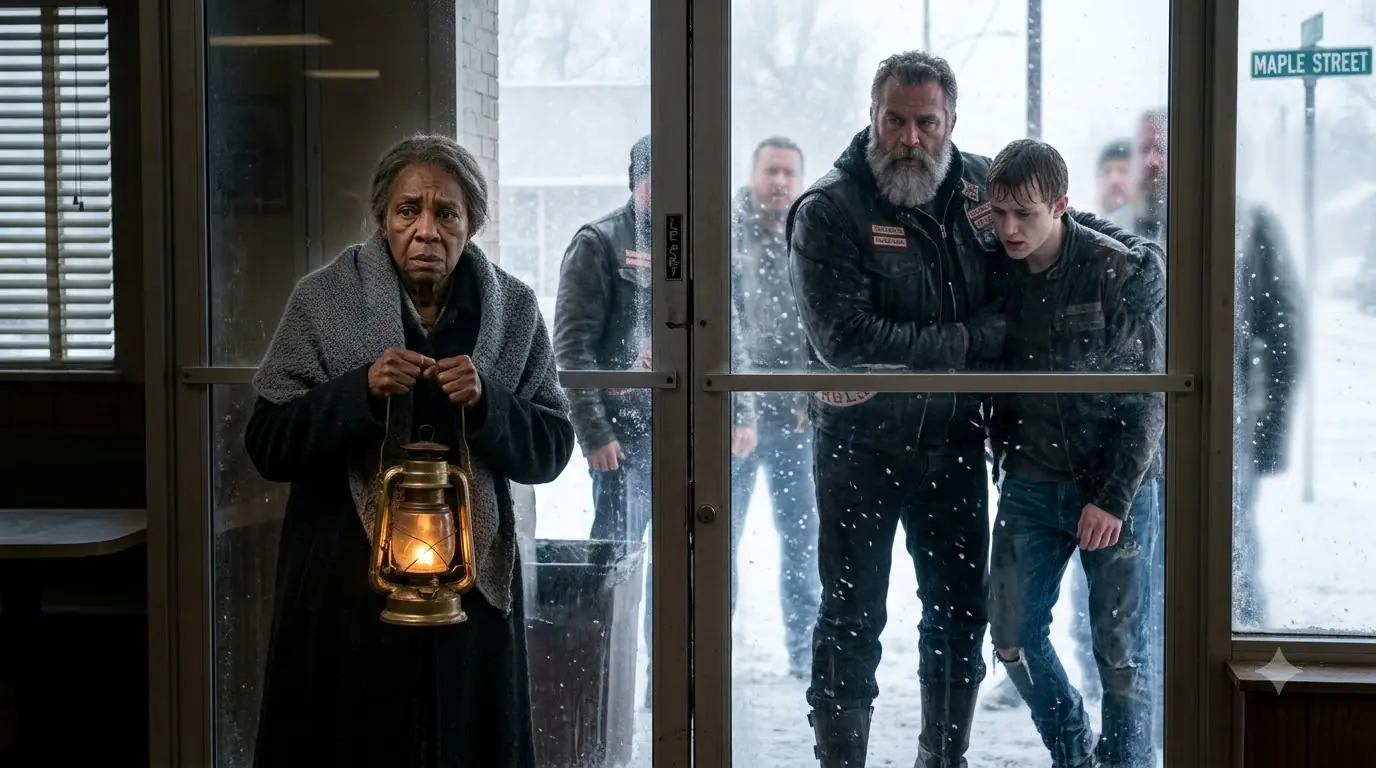
She stood so quickly that pain shot up her right hip. She grabbed the lantern from the table and shuffled toward the front window. Snow had pasted itself so thick against the glass that she could barely see the porch. Still, shapes moved outside. Huge shadows. Several of them.
Her breath caught.
The first man came into view beneath the swinging sign.
He was enormous, wrapped in a black leather vest over a winter coat, his beard packed with snow, his face raw from cold. Behind him stood more men, broad-shouldered, helmeted, covered in patches she recognized even before her eyes found the arched letters.
Iron Serpents Motorcycle Club.
Edith had heard of them. Everyone along Route 8 had. People said they ran guns out west. People said they broke bones for money. People said if you saw their colors after dark, you kept driving.
The man at the door slammed his palm against the glass.
"We have a boy down!" he shouted. "Please, lady!"
Edith saw it then.
Two of the bikers were holding a third between them. He was younger than the rest, maybe twenty, maybe less, his head lolling, one arm hanging wrong, blood dark against the snow near his ribs.
The fear in Edith's chest did not leave.
It simply made room for something stronger.
Ray's voice came back to her from every year they had run that diner together.
If a soul finds our door in a storm, Edie, we don't ask what road brought them. We feed them first.
"Damn you, Ray," she whispered, and turned the lock.
The wind nearly tore the door out of her hands.
Cold exploded into the diner, snuffing two candles and scattering napkins across the floor. The men outside lurched forward, carrying the injured young biker between them. Snow blew in around their boots. Leather, gasoline, blood, and winter filled the air all at once.
"Booth by the stove," Edith barked, pointing. "Lay him flat. Don't crowd him. Shut that door before the whole county comes in behind you."
The big bearded man obeyed without argument. That surprised her. All of them obeyed. One shoved the door shut with his shoulder. Another dragged a chair aside. The two carrying the injured boy lowered him onto the cracked vinyl booth like he was made of glass.
The big man turned to Edith, breathing hard.
"Name's Grady," he said. "That's Jonah. He went down near the bridge. Pickup slid into us and kept going. We tried to call 911, but there's no service. Road's gone white."
"I didn't ask for your life story." Edith set the lantern on the table and leaned over the boy. "Get his jacket open."
Grady blinked once, then nodded. "Do it."
The men moved. Snow melted from their sleeves and dripped onto the floor. Someone cursed softly when the boy's vest came open and the wound showed beneath his sweater. It was ugly, a deep tear across the side where broken metal or ice had cut him, still bleeding, not spurting but steady enough to scare anyone who understood how fast warmth could leave a body.
Edith understood.
She had kept Ray alive through three heart attacks before the fourth took him. She had wrapped burned hands, cleaned knife cuts from kitchen accidents, thawed frostbitten fingers, and once delivered a baby in the women's restroom while a blizzard trapped half the county inside her diner.
"Towels," she said. "Bottom shelf behind the counter. Clean ones, if mice haven't married in them. You, with the red beard, wash your hands. There's water in the blue jug. Don't touch him with road hands."
The red-bearded biker stared at her.
"Move," she snapped.
He moved.
For the next ten minutes, the diner became a field hospital made of candlelight and stubbornness. Edith pressed towels against Jonah's side until the bleeding slowed. She checked his pupils. She made Grady hold him still. She ordered another biker to find blankets in the storage room and a third to pull the tables away from the windows in case the glass blew in.
"He's freezing," Grady said, voice tight.
"So is everybody else," Edith said. "But he's bleeding and you're talking too much. Hold that pressure."
Jonah's eyes fluttered open.
"Grady?" he rasped.
The big man leaned closer. "I'm here, kid."
"My bike?"
"Still prettier than you."
A few men laughed, short and relieved.
Edith looked at the boy's face. Pale. Too pale. His lips were nearly blue, but he was aware. That mattered.
"Jonah," she said firmly.
His eyes shifted toward her.
"You listen to me. I'm Edith Bell, and this is my diner, which means if you die in here, I'll have to mop around you. I am too old for that kind of inconvenience. So you stay awake."
Jonah blinked.
Then, somehow, he smiled.
"Yes, ma'am."
Grady's expression changed when he looked at her. The hard suspicion he had worn at the door softened into something like respect.
"You run this place alone?" he asked.
"Not for much longer, according to First North Bank."
She had not meant to say it. The words fell out while she adjusted the towel under Jonah's ribs.
Grady's eyes moved to the foreclosure notice taped beside the door. He read it without turning his head much. Bikers noticed things, Edith realized. Maybe the dangerous ones noticed everything.
"They're taking it?" he asked.
"They already took it in every way but the lock." Edith reached for another towel. "Don't get sentimental. You're bleeding on my booth."