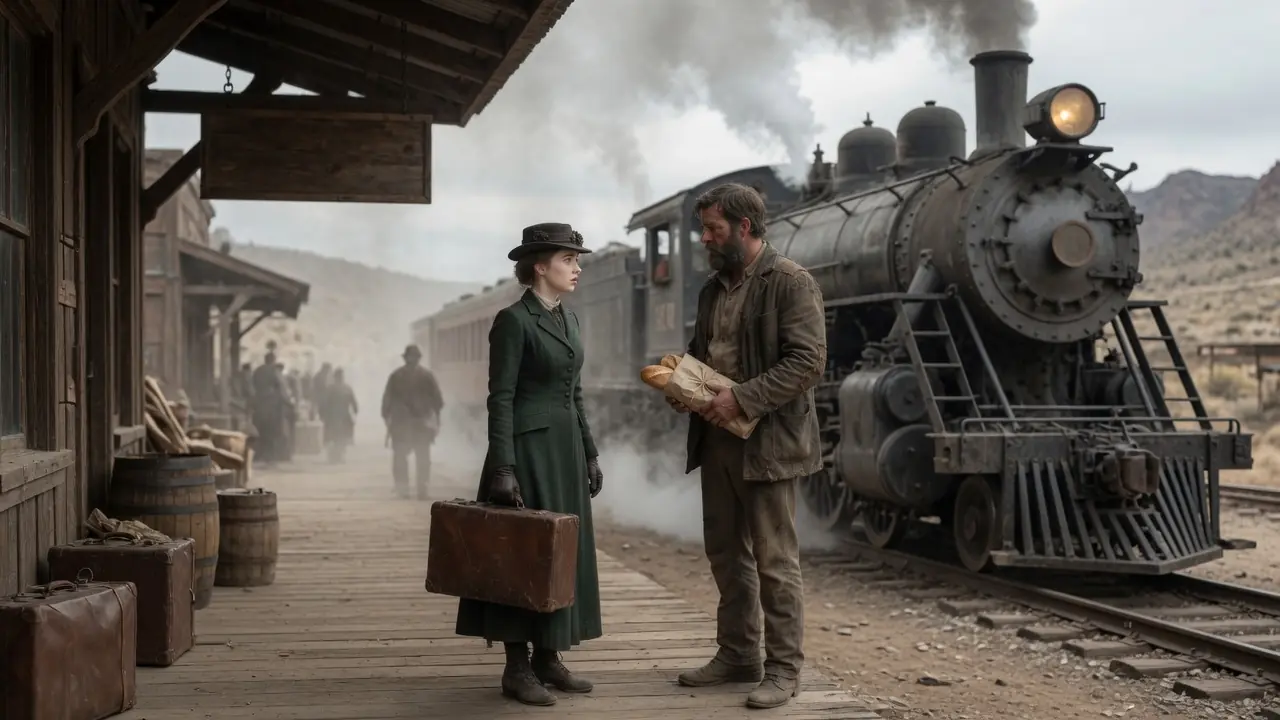
The steam from the Kansas Pacific locomotive rolled across the wooden platform like a gray curtain, carrying the smell of coal, hot iron, and cattle dust. Eliza Bennett stood near a stack of trunks with one gloved hand wrapped around the handle of her polished brown valise and the other crushing the letter that had brought her here. She had traveled from Philadelphia to Abilene, Kansas, in June of 1875, carrying one suitcase, one fading hope, and one decision that could not be undone. Two weeks earlier, she had still believed she was choosing a dignified future.
Now she was not so sure.
Her traveling dress was deep emerald, tailored beautifully, too fine for a town where dust seemed to own every surface. Her dark brown hair was pinned beneath a black hat with a little veil, a style that had made sense in drawing rooms and shaded streets. Here, under the open prairie sky, the elegance felt almost foolish. Men in rough coats glanced at her as they passed, and women in plain cotton dresses looked once, then looked away as if she were a misplaced ornament.
She had married a man by letter.
Not legally in the church yet, not before witnesses, but in every way that mattered to her future, she had already agreed. His name was Silas Thorne, a Kansas rancher with a thousand acres of grass and, according to his advertisement, a house too quiet for one man’s soul. For six months, his letters had crossed the country to her, written in a careful hand that made him seem thoughtful, educated, and strangely tender. He had written of sunsets, books, loneliness, hard work, and a life that might be honest if not easy.
Eliza had been raised to distrust desperation, but desperation had become her only companion.
Her father’s business had collapsed after the financial panic, and the elegant Bennett household had gone from dinner invitations to unpaid accounts almost overnight. Men who had once praised Eliza’s beauty suddenly remembered appointments elsewhere. Her dowry vanished, her social standing thinned, and the music lessons she taught to bankers’ daughters barely kept food on the table. When the matrimonial circular arrived in a friend’s parcel, Eliza read Silas Thorne’s advertisement three times before admitting she was tempted.
She imagined him from his letters.
A tall, refined widower perhaps, with silver at his temples and quiet sadness in his eyes. A man who owned land but loved poetry, who might walk beside her at dusk and quote Emerson while the grass moved around them. She imagined strong hands, yes, but clean ones, careful ones, hands that would offer wildflowers when she stepped from the train. She imagined a gentleman shaped by the frontier but not swallowed by it.
Then the crowd parted, and Silas Thorne stepped out from the shadow of the water tower.
He was not what she had imagined.
He was tall and broad in a rough way, his skin darkened by years of wind and sun, his jaw hidden beneath a short dark beard. He wore a black cowboy vest over a faded shirt, dusty trousers, worn boots, and a plain gun belt that made her stomach tighten. His eyes were gray and guarded, and when he walked toward her, his movements held the slow weight of a man who expected nothing to be gentle.
Eliza felt her heart sink.
This was the man who had written about the intricate needs of the soul?
He stopped three feet from her and looked at her face, then at the valise, then at the crumpled letter in her hand. “You’re Eliza,” he said. His voice was low, roughened by dust and distance, nothing like the soft gentleman’s voice she had given him in her imagination. It was not cruel, but it was plain, and plainness was suddenly unbearable.
“I’m Silas.”
He did not bow. He did not kiss her hand. He did not produce flowers, or poetry, or a tender welcome fit for the picture she had built across six months of reading. He simply reached for her valise and took it as if it weighed nothing.
“The wagon’s this way,” he said.
Eliza followed because she had no better choice.
Her silk-lined skirt brushed against the filthy edge of the street as they crossed toward a buckboard wagon pulled by two sturdy mules. She looked at his shoulders, his sun-browned neck, the careful but rough set of his hands around her luggage. He looked like a laborer, not a husband from letters. He looked like the kind of man Philadelphia society would have expected to enter through the back door.
By the time Silas loaded her valise into the wagon, regret had already started blooming in her chest.
She had sold her mother’s pearl combs to buy the ticket west. She had spent the last of her money on a trunk she could not afford to ship and dresses that now seemed useless. She had answered a stranger’s advertisement because she thought hope might be enough to cross a country. Standing in the dust of Abilene Station, she realized hope did not guarantee wisdom.
Silas helped her into the wagon without touching her more than necessary. Then he climbed up beside her, took the reins, and started toward the prairie road. The station faded behind them, along with the last visible shape of the life she had known. Eliza kept her hands folded tightly in her lap and stared ahead at a horizon so wide it frightened her.
For the first hour, Silas said nothing.
The silence was not hostile, but it was heavy. The mules pulled steadily, the wagon wheels rattled, and the vast Kansas plains opened around them like an ocean made of grass. There were no grand houses, no shaded lanes, no sound of church bells or piano practice floating through open windows. There was only wind, sky, insects, and the creak of harness leather.
“Is it always this empty?” Eliza asked at last.
Silas glanced at her. “It isn’t empty.”
She looked across the land and saw nothing but space. “What would you call it, then?”
“Alive,” he said.
The answer irritated her more than it should have. It sounded like something from his letters, but coming from his rough mouth, it felt almost dishonest. She turned toward him, heat and disappointment rising. “Why did you write the way you did?”
Silas kept his eyes on the trail. “What way?”
“Like a scholar,” she said. “Like a gentleman.”
His jaw moved once. “I didn’t know a man needed clean sleeves to read a book.”
The words stung because they were fair, and Eliza did not yet want fairness. “You wrote about poetry and sunsets and conversation,” she said, her voice shaking. “You did not say you looked like a man who belongs in the dirt.”
Silas pulled the reins and stopped the wagon.
The mules flicked their ears. The wind moved through the grass. For several seconds, Silas only looked at her, and Eliza felt the full force of what she had said. His expression did not twist with anger, but something in his eyes changed, as if a shutter had closed.
“I do belong in the dirt,” he said quietly. “It feeds me.”
Eliza looked down.
“I wrote no lie,” he continued. “I read books. I watch sunsets. I value conversation when it’s worth having.” He looked at his rough hands, then back at her. “But out here, a man who doesn’t work doesn’t eat. If you came looking for a parlor gentleman, Mrs. Bennett, I expect you came too far.”
He flicked the reins, and the wagon moved again.
Eliza faced forward and fought tears.
The ride to the ranch lasted four hours. By the time they arrived, the sun had lowered, and Eliza’s head ached from heat, dust, and dread. The house was not a manor, not even the charming frontier farmhouse she had hoped for. It was a modest limestone and cedar structure standing alone against the grass, with a barn, a well, a fenced corral, and no neighbor in sight.
“It’s small,” she said before she could stop herself.
“It’s paid for,” Silas answered.
Inside, the house was plain but clean. A heavy oak table stood in the main room, along with two chairs, a cast iron stove, a washstand, and a shelf of books. Eliza stopped when she saw them. Milton, Emerson, Virgil, Shakespeare, Thoreau, and several worn volumes of music theory lined the shelf, their spines creased from real use.
Silas noticed her looking.
“They’re yours to read,” he said.
She turned, embarrassed by the surprise on her face. “I did not expect…”
“I know what you expected.”
The quiet hurt in his voice made her look away.
He opened a door to a small bedroom. “This is yours. There’s a latch inside. I’ll sleep in the barn until the ceremony Sunday.” Eliza stared at him, startled by the respect in that offer. He did not look at her like a possession or a prize brought home from a distance. He looked tired, disappointed, and careful.
“Thank you,” she said.
Silas nodded. At the threshold, he paused. “I know I’m not the man you pictured,” he said. “But I try to be honest. That’s the only refinement I can promise.”
Then he left.
Eliza sat on the edge of the little rope bed and cried into her gloves.
The first week nearly broke her pride. She woke before dawn to the sound of Silas chopping wood, hauling water, and moving through chores with relentless discipline. She tried to cook, but the stove baffled her, and the biscuits she made came out hard enough to knock on the table. Silas ate them anyway, chewing slowly, saying nothing unkind.
That irritated her too.
Part of her wanted him to be cruel so her regret could remain clean. Cruel men are easy to resent. Silas, however, was not cruel. He was simply rough, quiet, observant, and far more patient than her injured pride deserved.
On the third morning, he showed her how to open the stove draft properly. He did not mock her burned bread or take over as if she were useless. He stood beside her, pointed to the iron lever, and said, “Fire needs air, same as people. Too much and it runs wild. Too little and it dies.” Then he stepped back and let her try again.
The next batch of biscuits was still poor, but edible.
Silas broke one open, tasted it, and nodded once. “Better.”
It was a small word, but Eliza carried it with her all day.
She learned to haul water without spilling half the bucket. She learned which hens pecked at fingers and which could be coaxed aside. She learned to wrap her hands before handling rope. She learned that the prairie wind found every weakness in clothing, skin, and spirit.
In the evenings, Silas read by lamplight.
At first, Eliza thought it was performance, something he did because she had discovered the books. But he read deeply, slowly, sometimes tracing a line with one finger as if speaking to an old friend. One night, she heard him quietly reciting a passage from Emerson while sharpening a tool. The words sounded strange and beautiful in his rough voice.
“You truly read them,” she said.
He looked up. “Did you think the books were decoration?”
“I don’t know what I thought.”
“That’s honest, at least.”
She almost smiled.
The wedding took place in a small frame church in Abilene the following Sunday. Eliza wore her emerald dress because she had no white gown, and she pinned her hair simply for the first time since leaving Philadelphia. Silas wore a clean shirt, a dark vest, and boots polished as well as frontier boots could be polished. He had trimmed his beard, and though he still looked nothing like the gentleman in her imagination, she saw now that care had been taken.
When he took her hand before the preacher, his palm was callused and steady.
Eliza felt afraid, but no longer deceived.
“I do,” she said.
And this time, she meant to try.
Marriage did not transform them overnight. Eliza still missed Philadelphia with an ache that came suddenly, often when the wind was high or when her hands hurt too badly to sew. She missed music rooms, polished floors, conversation, and the certainty that she knew how to behave. On the ranch, every day demanded skills she did not have.
Silas did not ask for affection she had not yet grown.
He worked, read, spoke when necessary, and left space where another man might have pushed. That space became important. In it, Eliza began to see him not as the disappointment from the train station, but as a man made complicated by grief, duty, loneliness, and restraint.
One evening, she found him on the porch with a small wooden flute. The sun was setting across the prairie, painting the sky in orange and violet. He played a rough melody at first, uneven and cracked by the wind. Then the tune shifted, and Eliza recognized it.
Mozart.
She stood in the doorway, unable to move.
“You know that?” she whispered.
“My mother played piano,” he said without turning around. “She taught me enough to remember badly.”
“You remember beautifully.”
He looked at her then, and for the first time, she saw the man from the letters completely. Not refined in the way she had imagined, but deep, wounded, and full of hidden rooms. He had carried culture not as decoration, but as survival. A piece of gentleness preserved in a brutal life.
“I’m sorry for what I said at the station,” Eliza said.
Silas lowered the flute. “You were afraid.”
“I was shallow.”
“Both can be true.”
She accepted that because it was fair.
The summer grew harsher. The rains weakened, the grass yellowed, and the crop began to suffer. Silas worked longer hours, digging, hauling, repairing, and calculating what they might save before winter. Eliza stopped worrying about her complexion. The sun changed her skin, work hardened her hands, and every day stripped away another layer of the woman who had stepped off the train.
She sold two fine dresses in Abilene to buy supplies. She taught music lessons to three local children in exchange for flour, dried beans, and bacon. She learned to preserve vegetables, mend harness leather, and read the sky for signs of weather. Survival, she discovered, had its own harsh elegance.
Then the insects came.
At first, the cloud on the horizon looked like weather. Eliza stood by the well, watching a dark shimmer move across the sky. The birds went quiet. The air changed. Then the sound reached her, a dry rattling roar that seemed to come from everywhere at once.
Silas rode in from the pasture fast, his horse restless beneath him. “Inside!” he shouted. “Eliza, inside now!”
The grasshoppers descended like a living storm.
They covered the walls, the ground, the fences, the small garden, the shed roof, the windows. Eliza slammed the door and stood beside Silas in the dim house as the sound of chewing filled the air. It was not loud like thunder; it was worse, constant and hungry. Through the window, she watched their hard-won garden disappear in minutes.
Silas sat at the table and put his head in his hands.
For the first time since she had known him, his strength seemed to leave him. “That was our winter,” he said. “That was seed, food, feed, everything.” His voice was flat, and that frightened Eliza more than despair would have. She walked to him and placed her hand on his shoulder.
“We still have the house,” she said.
He did not look up.
“We have the well. We have your hands. We have my lessons. We have books to sell if we must and pride to bury if it gets in the way.” Her voice steadied as she spoke. “And we have each other, Silas.”
He looked up then.
Tears had cut lines through the dust on his face.
Eliza did not turn away from them. She knelt beside him and held his head against her shoulder, feeling the weight of a man who had carried too much alone for too long. In that moment, she understood something fully: love was not the thrill of receiving the life she imagined. It was kneeling in the dust beside the life she had chosen and refusing to leave.
The grasshoppers stayed for three days.
When they rose and moved on, the land looked stripped and gray. Silas walked the fields in silence. Eliza walked beside him, her emerald skirt long replaced by a plain work dress, her hair braided simply down her back. She no longer looked like Philadelphia. She no longer wanted to.
They survived that winter by narrow margins and stubbornness. Silas took freight work during the cold months, hauling goods across dangerous roads while Eliza kept the house alive. She taught lessons, mended clothing, sold more fine things, and learned that hunger could be endured more easily than hopelessness. Their letters during his time away became the courtship they should have had before the wedding.
This time, there were no illusions.
He wrote of cold mornings, tired mules, and missing the sound of her voice. She wrote of the stove, her students, the small repairs she made, and how the house felt emptier when he was gone. Their affection grew not from fantasy but from evidence. Each letter proved they were thinking of each other through difficulty.
One February night, Silas returned unexpectedly, covered in frost and exhaustion. Eliza pulled him inside, wrapped him in a blanket, and warmed his hands between hers. After he could speak properly, he reached into his coat and gave her a small wrapped parcel. “Late Christmas,” he said.
Inside was a delicate gold locket.
When she opened it, she found a tiny square of emerald silk.
“I saved it before you sold the dress,” he said. “I wanted you to remember you were beautiful when you arrived.” He swallowed, his voice rough. “And that you became something finer after.”
Eliza began to cry.
“I don’t need silk anymore,” she said.
“I know,” Silas answered. “That’s why I saved it.”
The years that followed brought rain, children, and a kind of prosperity that seemed almost miraculous because it had been earned from ruin. The Thorn Ranch grew. Silas and Eliza built a larger stone house with a wide porch facing the grass. They had three children, and Eliza taught them music, reading, manners, and courage, while Silas taught them horses, weather, work, and humility.
People in Abilene remembered the woman in the fine dress who arrived at the station and looked ready to flee. They later spoke of her as a woman of iron, though Eliza always disliked the phrase. Iron was hard. She knew she had become something stronger than hardness. She had become rooted.
Every anniversary, she took out Silas’s first letter and read it aloud by lamplight. He always listened with a half-smile, embarrassed by his own younger words. Sometimes she teased him for sounding like a philosopher. Sometimes he reminded her that she had once called him a man who belonged in the dirt.
“And I was right,” she would say.
He would laugh. “You were.”
Then she would take his hand. “I just did not yet know dirt could grow a life.”
When Silas died many years later, he was sitting on the porch watching the prairie turn gold in the evening. Eliza sat beside him, holding his hand, as she had held it through drought, loss, harvest, childbirth, sickness, and age. His final words were not poetic in the way his letters had been. They were better.
“You were the best thing this land ever gave me,” he said.
Eliza lived ten more years. She watched the world change, watched automobiles come down roads where wagons once struggled, watched telephones arrive, watched Abilene become less wild and more certain of itself. But in her heart, the world remained a train platform, a rough man with storm-gray eyes, and her own foolish disappointment standing between her and the life waiting beyond it.
On her deathbed, her daughter asked if she had any regrets.
Eliza smiled faintly.
“One,” she whispered. “I regret that I wasted even an hour judging him by his boots.”
She was buried beside Silas on a rise overlooking the grass.
Her children placed the locket in her hand.
Inside it, the small square of emerald silk remained, faded but intact, proof of the woman who arrived and the woman who endured. The wind moved through the tall grass over their graves, making a sound almost like music. And if anyone stood there long enough, they might imagine a flute playing Mozart somewhere across the prairie.
Eliza had wanted a gentleman.
What she received was a rancher with rough hands, honest eyes, and a soul large enough to shelter hers until she grew strong.
At the train station, she thought she had made the greatest mistake of her life.
In truth, she had only mistaken the beginning for the ending.