Cordelia Vance had married a man through eleven letters and one photograph, and when she met him for the first time on the platform of the Union Pacific Depot in Cheyenne, she knew with perfect clarity that she had made the worst mistake of her life. The photograph had shown a clean-shaven, well-dressed rancher with intelligent eyes, a straight collar, and the kind of serious expression that suggested discipline, refinement, and order. The man standing before her on the platform had a beard like a thorn bush, mud on his boots, a worn brown coat with a hole in the elbow, and a paper sack of food clutched in one hand. He saw her, wiped his fingers on his trousers, extended his hand, and said, “You’d be Cordelia. I’m Amos. Hope the train wasn’t too hard on you.”
Cordelia shook his hand because manners had been drilled into her before pride had learned how to speak. She kept her expression still, but inside her mind, something collapsed. This was not the man from the letters, not the man she had built out of ink, argument, and the photograph he had sent. This was a rough Wyoming rancher who looked as if he had slept in a barn and eaten breakfast with coyotes. She had left Boston, crossed half the country, and married a stranger who did not even know enough to greet his wife with clean hands.
Cordelia was twenty-nine years old, the daughter of a Boston attorney, and widely considered difficult by every family who had ever invited her to dinner and regretted it by dessert. She read newspapers, understood politics, quoted legal opinions when men became careless with facts, and refused to pretend ignorance for the comfort of people who mistook silence for femininity. She had been engaged twice, and both engagements had ended when the men discovered that her mind was not a decorative object to be covered when guests arrived. By twenty-nine, Boston had decided she was proud, sharp-tongued, and unlikely to be improved by age. Cordelia had decided Boston was small.
She answered the matrimonial advertisement out of curiosity first and defiance second. Most advertisements from western men were little lists of demands disguised as loneliness. They wanted women who could cook, wash, mend, obey, bear children, and smile as if all of those things were gifts instead of labor. Amos Bricker’s advertisement was different. “Wyoming rancher seeks a wife who can think. Beauty optional. Conversation required.”
Cordelia had laughed when she read it. Then she wrote back. Amos’s first letter was grammatically rough but startlingly alive, full of cattle prices, territorial politics, dry humor, and questions that assumed she had answers worth hearing. He did not flatter her. He did not tell her she was pretty from an imagined distance. He argued with her, asked for her reasoning, disagreed honestly, and sometimes admitted when she had changed his mind.
Over eleven letters, Cordelia fell in love with a mind. She did not say it that way to herself, not then, but it was true. Amos wrote about grass, weather, railroads, debt, cattle fever, books, and whether a republic could survive its own appetite. His handwriting was rough, but his thinking had edges and depth. He seemed, on paper, like the first man who had ever asked her to bring all of herself into a room and stay there.
The photograph arrived with the seventh letter. It showed him clean-shaven, dressed in a proper dark suit, standing beside a wedding party with his hair combed and his boots polished. Cordelia did not know the image was four years old and taken on the only day Amos had worn that suit since buying it. She took the photograph and the letters and made a whole man out of them. By the time she agreed to marry him by proxy and travel west, she believed she knew exactly what waited for her.
Then she stepped off the train and saw the beard, the mud, the coat, the paper sack, and the fingers wiped on trousers. In one moment, the man of her imagination vanished. She saw not a partner of the mind, but a brute of the plains. She saw not an equal, but a mistake with kind eyes and poor grooming. Her disappointment must have shown, because Amos looked at her for a heartbeat too long before turning toward the wagon.
The ride from Cheyenne to the ranch was forty miles. Cordelia sat beside Amos with her gloved hands folded in her lap and composed, in her mind, the letter she would send to her father. She would explain that the arrangement had been foolish, that the man had misrepresented himself, that she would return to Boston as soon as travel could be arranged. She would endure the embarrassment because embarrassment was better than surrendering her life to a man who ate from a sack with his bare hands. Beside her, Amos drove the wagon in silence.
After half an hour, he pointed toward the sky. “Ferruginous hawk,” he said. “Rare this far north. They mate for life, which is more than most creatures manage.” Cordelia looked at him before she could stop herself. He kept his eyes on the road. “They like open country. Build low sometimes, depending on what the land gives them. Most folks see a hawk and stop there. But there’s a lot a bird can tell you if you pay attention.”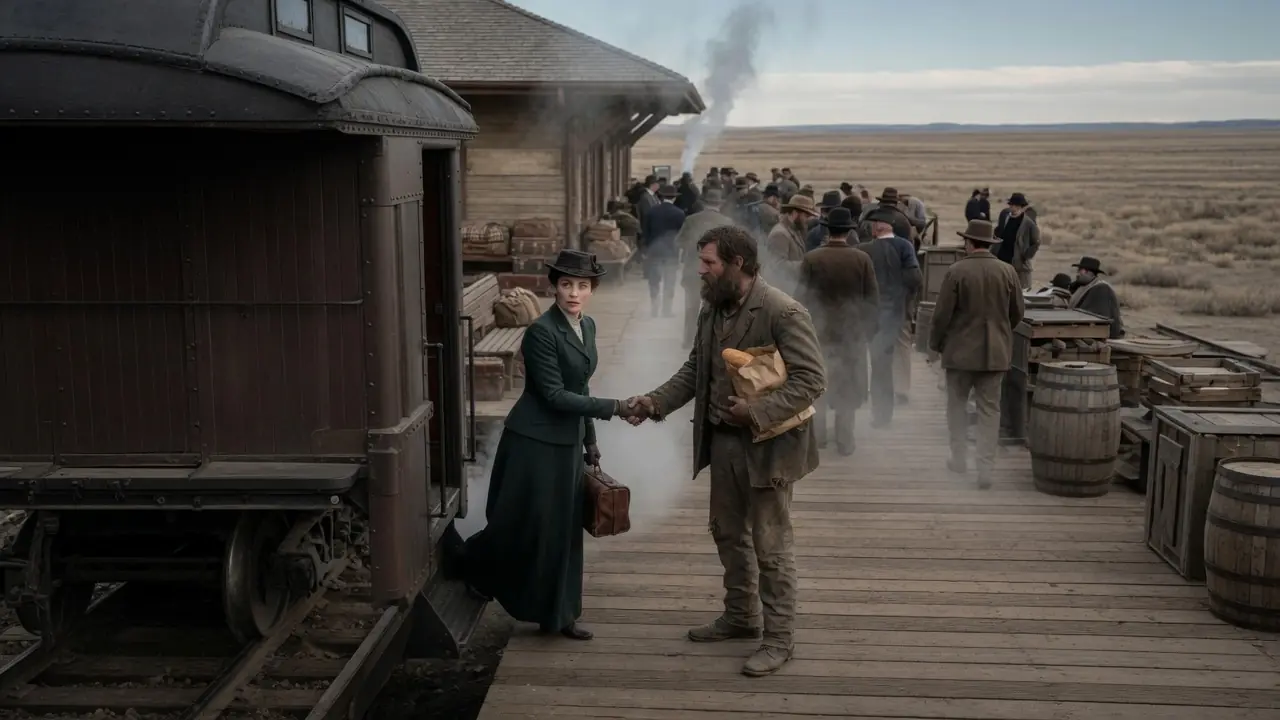
Cordelia said nothing, but Amos kept talking. Not constantly, and not to fill the silence. He seemed comfortable with silence in a way Boston men never were. They often treated quiet like a conversational wound that needed immediate bandaging. Amos let it exist, then spoke when he had something worth putting into it.
He named the plants they passed and explained which ones cattle avoided, which ones signaled good soil, which ones could be used for simple remedies, and which ones meant water might lie below a nearby draw. He described the ridgeline and said the territory had once been an inland sea, then told her how the rock had kept the memory of it long after the water was gone. He explained grass patterns, grazing lines, winter shelter, and why the cattle moved the way they did when the wind shifted. By the second hour, Cordelia understood something she did not want to understand. The man beside her was not ignorant.
He was one of the most knowledgeable people she had ever met. His knowledge was not polished for dinner tables. It was not the sort of learning people wore in Boston like cufflinks. It was deep, practical, and utterly unconcerned with applause. Amos Bricker had read widely, observed carefully, and remembered everything useful.
That made Cordelia uncomfortable because it disturbed her first judgment. The beard suddenly seemed less important. The hole in the coat became less a sign of laziness than evidence of a man who valued time and function above appearance. His muddy boots meant he had been working. His roughness, she began to suspect, had nothing to do with his mind.
Still, knowledge did not prove kindness. Cordelia had known many intelligent men who used their minds like fences and locked women outside them. Her deeper fear was not that Amos would be crude. Her deeper fear was that he would try to make her smaller. Marriage, in Boston, had always appeared to her as a slow narrowing, a polite enclosure built out of expectations, duties, and silence.
When they reached the ranch, Cordelia braced herself for that narrowing. The cabin was small but clean, with a swept floor, a sturdy table, a stone hearth, and two shelves crowded with books. She noticed agricultural manuals, a weather almanac, Shakespeare, Marcus Aurelius, a battered dictionary, and several newspapers tied into bundles. Amos carried her trunk inside and set it gently in a separate room. “This is yours,” he said. “Door has a latch.”
Cordelia turned to him, uncertain she had heard correctly. Amos rubbed the back of his neck, suddenly awkward. “We are married on paper, but I figure that’s a thing that happens at whatever pace it happens. No rush from me.” He looked at the floor, then back at her. “You came a long way. You ought to have a room where nobody comes in without asking.”
Cordelia had not expected that. She had expected a man who considered the marriage license a receipt. Instead, Amos handed her privacy as if it were obvious. She thanked him stiffly, unsure what to do with the unexpected decency. That night, she slept with the latch fastened and listened to the wind move around the cabin, waiting for regret to settle into certainty.
Over the following weeks, Cordelia waited for the other Amos to appear. The controlling one. The one who would tell her how the house must run, where she might go, what she might read, and how softly she should speak when men were present. She waited for him to call her opinions charming and then ignore them. She waited for the slow humiliation she had feared all her adult life.
He never appeared. When Cordelia said she wanted to learn to ride properly, Amos taught her without condescension. He corrected her posture, showed her how to read a horse’s ears, and never once laughed when she made mistakes. When she disagreed with him about cattle prices, he listened long enough to understand her argument. Two days later, he admitted she was right.
The ranch accounts were a disaster. Cordelia discovered that within a week of looking through Amos’s ledgers. Figures wandered across pages without order, receipts were tucked between books, and several buyers had underpaid him because he trusted memory where numbers should have been. She reorganized everything, made columns, copied dates, corrected balances, and presented the new system with the defensive tone of a woman expecting offense. Amos looked over the pages and said, “You’re smarter than me about this. From now on, you keep the books.”
He meant it. Within two months, Cordelia had identified three ways Amos had been losing money and corrected all of them. He was not embarrassed by this. He was delighted. He told a neighbor, in Cordelia’s hearing, “My wife is the best business decision I ever made, and I made it by mail.” The neighbor laughed, but Amos was not joking.
Cordelia began to understand something that contradicted all her experience. Amos Bricker did not want to own her. He wanted to be near her. He wanted her mind beside his the way a rancher wants a good horse under him and clear weather ahead. He had advertised for a wife who could think because he was lonely for conversation, not desperate for service. The surface she had judged on the platform had hidden exactly the man his letters promised.
That realization brought shame. She did not tell him she had judged him in the first minute. She did not tell him she had nearly written her father a letter begging for rescue. But the shame changed how she looked at him. It made her kinder, quieter in her judgments, more willing to wait for the second truth beneath the first impression. It also made her aware, with some alarm, that she had begun waiting for his voice at supper.
They argued constantly, but in a way Cordelia had never known arguments could exist. They argued about cattle markets, books, politics, weather predictions, statehood, coffee, and whether Marcus Aurelius was wise or merely exhausted. Amos never told her to stop. He never used volume as a weapon. If her argument was better, he said so. If his was better, she admitted it, though never quickly enough to satisfy him.
Winter came early and severe. Snow settled on the ridges, creek edges froze, and the wind became sharp enough to make even simple chores feel like negotiations with death. Cordelia refused to become a wife who stayed inside while Amos did everything beyond the door. She learned to check fence lines, carry feed, read weather signs, and ride across ground that had once frightened her. Amos taught her because she asked, and because he seemed to understand that refusing would wound her more deeply than any cold.
In January of 1885, Cordelia rode out alone to check a fence line along the creek. The morning looked clear enough, and she had grown confident enough to trust herself. The creek appeared frozen where she crossed. It was not frozen enough. Her horse broke through first, the ice cracking with a sound like a gunshot, and Cordelia plunged into water so cold it stole her breath before she could scream.
She fought her way out by instinct more than strength. Her horse scrambled free and bolted, reins flying. Cordelia dragged herself onto the bank, soaked to the skin, gloves stiffening, skirt heavy with freezing water. The cabin was four miles away. She began walking because stopping meant death.
At first, she counted steps. Then she counted breaths. Then she stopped counting and tried to keep moving by remembering Amos’s instructions about cold, distance, and the body’s betrayal. She knew the arithmetic. Four miles, wet clothing, below-zero wind, no horse. The numbers did not favor her.
By the time Amos found her, she had stopped walking. She was sitting in the snow two miles from the cabin, which some distant, rational part of her knew was very bad. People sat down in snow when the body had begun lying to the mind. Amos came over the ridge at a gallop, calling her name with a fear so raw that it tore through the white silence. He had seen her horse return without her and had ridden the fence line like a man chasing the edge of a nightmare.
He threw himself from the saddle and dropped beside her. “Cordelia.” His voice sounded far away. She tried to answer, but her mouth would not shape the word. Amos wrapped his worn brown coat around her, the very coat with the hole in the elbow she had judged at the depot. Then he lifted her onto his horse and swung up behind her, holding her against him with one arm while driving the animal hard toward home.
The cabin door burst open under his shoulder. He got her inside, stripped away the soaked outer layers with efficient urgency, wrapped her in every blanket he owned, and pulled her against his body to share heat. He did not hesitate, did not speak unnecessarily, and did not panic. Amos knew what to do because Amos knew everything practical. Cordelia shook for an hour.
He held her the whole time. His beard scratched her temple, his shirt smelled of smoke and horse and winter, and his heartbeat hammered steadily beneath her ear. She had never been so cold. She had never been so frightened. She had never felt so completely held without being possessed.
When the shaking finally slowed, Cordelia opened her eyes. Amos was sitting against the wall with her wrapped in blankets against his chest, his face gray with exhaustion and fear. His worn coat lay on the chair near the hearth, water darkening the fabric, the hole in the elbow visible in the firelight. The sight of it broke something in her pride. That coat had been one of the first things she despised about him, and it had been the first thing he used to save her life.
“You came,” she whispered.
Amos looked down at her as if the answer should have been plain to anyone with sense. “Of course I came.”
The words undid her.
Cordelia pushed herself upright with shaking effort, and before Amos could tell her not to move, she turned into him and wrapped both arms around his chest. She held him tightly, burying her face against him, not caring that she was trembling, not caring that pride had no graceful place to stand. Amos froze for one breath. Then his arms came around her, careful and firm, holding her as if she were something living and precious, not something claimed by paper.
“At the train,” she said against his shirt, her voice breaking, “I thought I had married the wrong man.”
“I know,” Amos said.
Cordelia pulled back just enough to look at him. “You knew?”
“I saw your face,” he said. “You’re not hard to read for a woman so smart.”
Shame burned through her more sharply than the cold had. “And you said nothing?”
Amos’s expression softened. “Figured you’d come around when you saw who I actually was. Same as I came around when I saw who you actually were. Letters only show a person so much. The rest takes a winter.”
Cordelia stared at him through tears. She had judged him in sixty seconds on a train platform. She had spent weeks waiting for him to become the brute she had decided he must be. She had fallen in love with him somewhere between ledger books, cattle arguments, riding lessons, and quiet suppers, and had been too proud to admit that her first impression had been foolish. Now he had ridden into freezing dark to save her life and still spoke to her without bitterness.
“I regret every word I thought that day,” she whispered.
“Good,” Amos said, tightening the blanket around her shoulders. “Now stop talking and get warm.”
Cordelia laughed, then cried, then held him again.
The marriage that had begun on paper became real that winter. Not simply because Amos saved her, though the rescue mattered. It became real because Cordelia finally allowed herself to see him the way his letters had asked her to see him: as a mind, a partner, a patient man whose value had nothing to do with the condition of his coat. Amos, in turn, saw her not as a wife to manage, but as the sharp, complicated, necessary woman he had hoped might someday sit across from him and argue until the coffee went cold.
They ran the ranch together for thirty-three years. Cordelia kept the books and grew the operation from four hundred head to two thousand. Amos managed the land, cattle, horses, and weather with the calm confidence of a man who listened before acting. He never once made her feel small. She never once pretended to be smaller than she was.
They argued through every season of their marriage. They argued about politics, economics, philosophy, cattle breeding, schoolbooks, land use, coffee, and whether certain neighbors were fools or merely unlucky. Their children grew up thinking argument was a form of affection, which in that house it was. Cordelia taught them to read, question, calculate, and defend their reasoning. Amos taught them to observe the natural world, respect animals, predict weather, and understand that the land speaks before it punishes.
They had three children, and all three left for university. All three came back. Not because they lacked ambition, but because the ranch had become the kind of place people returned to when they wanted their lives to mean something solid. Cordelia watched them ride the same land she had once crossed as a stranger and felt a gratitude so deep it sometimes frightened her. The life she had nearly rejected became the one she could not imagine living without.
She never fully forgave herself for the judgment on the platform. Amos forgave her easily, almost too easily, because he had never cared much what a coat said about a man. Cordelia kept the memory as a private lesson. She who prided herself on intelligence had nearly thrown away the best thing in her life because of a beard, muddy boots, and a hole in a sleeve. She told her daughters, “Never trust your first impression of a person. Trust the eleventh. By then, you might actually be looking.”
Amos Bricker died in 1919 at the age of sixty-eight. Cordelia lived until 1931, and she was seventy-six when she followed him. After Amos died, she kept his old brown coat folded in a trunk at the foot of her bed. It was the same coat with the hole in the elbow, the same coat he had wrapped around her on the night she fell through the ice. She never repaired the hole.
When her granddaughter asked why, Cordelia took the coat out and laid it across her lap. Her fingers touched the worn elbow gently. “Because that hole taught me the most important lesson of my life,” she said. “I judged a man by it. And the man wearing it saved my life and never once held my foolishness against me.”
She had married him by letter.
She had met him at the train and regretted every word.
Then she spent the next thirty-three years grateful that the man on the platform had been patient enough to let her be wrong.