Vanessa Reed had spent her whole adult life studying the difference between wealth and the appearance of wealth. She knew which watches were loud, which handbags were borrowed, which shoes meant inheritance, and which suits were worn by men trying to look important in rooms where they were not. That was why Julian Cross confused her from the beginning. He dressed simply, spoke quietly, never mentioned connections, and seemed almost allergic to showing off.
They had been seeing each other for six weeks when she asked him to take her to Luminara, the rooftop restaurant everyone in Manhattan posted about but few could actually afford. The restaurant sat high above the city, all white tablecloths, glass walls, chandeliers, and skyline views that made every dinner look like a magazine spread. Vanessa had an interview coming up with Cross Meridian Group, the financial empire she had dreamed of joining since business school. She wanted the evening to feel like a preview of the life she believed she deserved.
Julian agreed without hesitation, which she took as confidence. But when he arrived in a plain black suit with no visible designer label and no driver waiting downstairs, disappointment tightened quietly in her chest. He looked handsome, calm, and refined, but not powerful in the way Vanessa wanted power to announce itself. He carried himself like a man who had nothing to prove, and that irritated her because she preferred men who worked harder to impress her.
At dinner, she talked mostly about herself. She spoke about her upcoming interview, the names she knew, the charity events she had attended, and the people in finance who were finally starting to notice her. Julian listened patiently, asking a few careful questions that showed he understood more than he revealed. Vanessa mistook his restraint for lack of ambition. The more quietly he listened, the smaller she decided he must be.
When the waiter brought the bill, Julian picked it up and read it with a calm expression. Vanessa expected him to slide his card into the tray without looking, the way truly wealthy men did when they wanted a woman to feel safe in their orbit. Instead, his eyes paused on one line. He raised two fingers gently, asking the waiter to come back.
“There seems to be a charge here that does not belong to our table,” Julian said. His tone was polite, almost mild. Vanessa glanced at the bill and saw the total, then saw the extra line for a bottle of wine they had never ordered. It was not a small charge, but it was not large enough to matter in the world she wanted to enter. To her, the fact that Julian noticed at all felt humiliating.
The waiter apologized and said he would check with the manager. Vanessa leaned back, crossing her arms, heat rising in her face as two diners at a nearby table glanced over. “Are you serious?” she whispered. Julian looked up at her. “It is an incorrect charge,” he said. “It should be corrected.”
Vanessa laughed under her breath, but there was no humor in it. “Do you know how embarrassing this is?” she asked. Julian’s face remained steady. “Embarrassing for whom?” That question struck the wrong nerve. She heard it not as curiosity, but as judgment.
The waiter returned with the manager, who looked nervous before he even spoke. He explained that the charge might have been entered by mistake from another table and offered to remove it. Julian thanked him, but asked who approved the adjustment code because the same incorrect charge had appeared on several Luminara bills during the past month. Vanessa stared at him as if he had lost his mind. He was not just questioning the bill now; he was making the entire table visible.
A few heads turned. Vanessa felt their attention like heat on her skin. She imagined the story already forming around the room: the beautiful woman in the cream dress dining with a man who argued over charges. Her dream interview, her status, her carefully polished image, all seemed suddenly attached to a man counting lines on a receipt. She decided in that instant that Julian had betrayed the version of life she was trying to build.
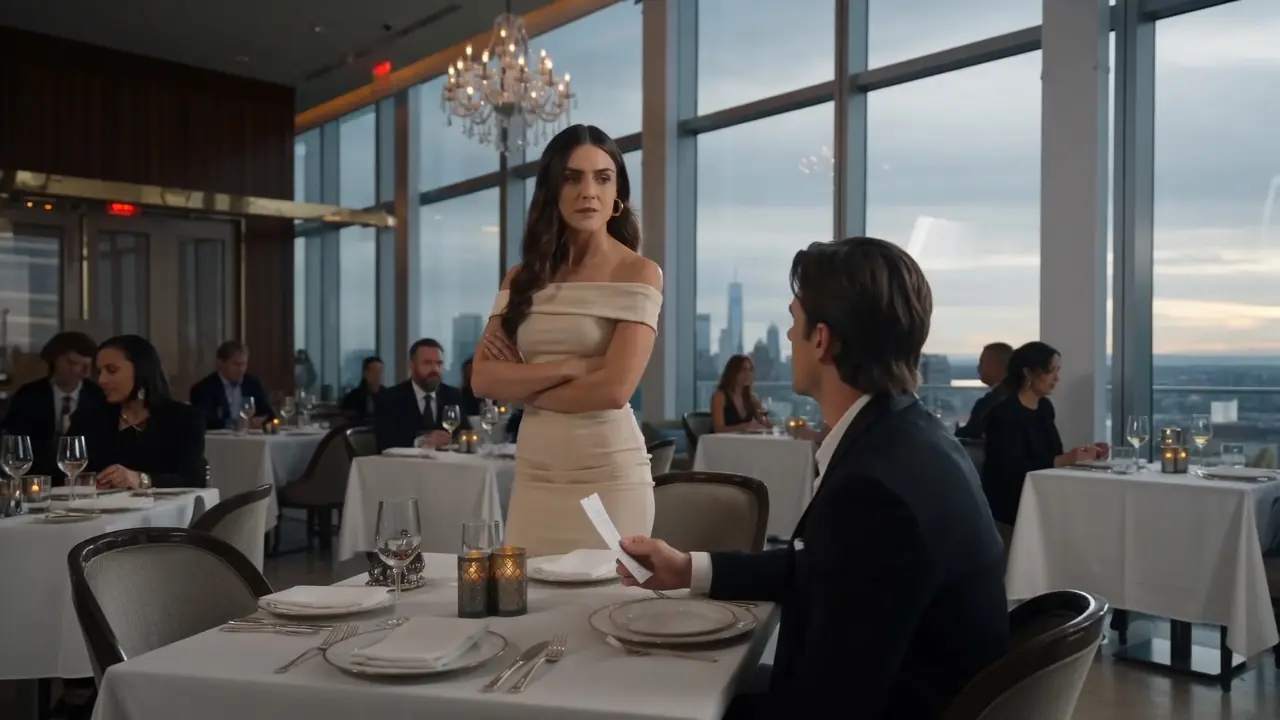
“Enough,” she said sharply. Julian looked at her, still seated, still calm. The manager stood frozen beside the table, trapped between apology and fear. Vanessa stood up slowly, her cream off-shoulder dress catching the chandelier light as the room went quieter around her. She wanted witnesses now, because witnesses turned insult into power.
“I don’t date broke men who panic over dinner bills,” she said, loud enough for nearby tables to hear. Julian’s expression did not change, but his fingers stopped moving on the receipt. Vanessa felt a cruel satisfaction at finally making him react, even that slightly. “You wear a simple suit, you complain about money, and you expect me to believe you belong in places like this?”
“Vanessa,” Julian said quietly, “I am not complaining about money.” She cut him off with a short, bitter laugh. “Of course you are. Men like you always pretend it’s about principle when it’s really about price.” The restaurant had now fallen into the kind of silence that belongs to public humiliation. Forks stopped halfway to plates, and phones began to lift from laps.
Julian placed the receipt on the table and looked up at her. “I questioned fraud, Vanessa, not the price.” That only made her angrier because he sounded composed, and she wanted him wounded. She wanted him exposed. She wanted everyone to see the loser she had decided he was.
“My dream company hires winners,” she snapped. “Do you understand that? Winners do not embarrass themselves over a line on a bill.” Her voice trembled with fury, but she mistook that tremble for strength. Julian’s eyes flickered toward the manager, then back to her. “Be careful,” he said. “You are speaking about values you may be asked to prove.”
Vanessa smirked. “Prove to whom? You?” She reached into her handbag, pulled out cash, and dropped several hundred-dollar bills onto the table. The bills scattered over the white linen near the receipt. “There. Let me save you from the struggle.”
A low murmur moved through the room. Someone at the bar whispered, and a man behind her raised his phone higher. Vanessa took one step away from the table, then turned back because the final insult felt too tempting to leave unsaid. “Enjoy your little moral victory, Julian. I’m done wasting time on a man who cannot even survive dinner.”
Julian did not stand. He did not grab her wrist, raise his voice, or plead with her to stay. He only lifted the receipt again and checked his watch. It was a slim gold watch, old and quiet, with no bright logo and no need to announce its value. Vanessa saw it, but by then pride had made her blind to anything that challenged her judgment.
She turned and walked toward the exit with her chin high. Her heels struck the marble floor in sharp, confident clicks. She imagined the room admiring her standards, her courage, her refusal to settle. She did not see the manager’s face growing paler behind Julian’s chair.
Before she reached the doors, they opened from the outside. A security team entered first, dressed in dark suits with earpieces and controlled expressions. Behind them came five executives, including a woman Vanessa recognized instantly from a Cross Meridian leadership panel she had watched three times before her interview. The woman was Evelyn Hart, chief legal officer of Cross Meridian Group. Vanessa’s stomach tightened.
The group did not approach the manager. They did not look at Vanessa. They moved directly toward Julian’s table with the certainty of people who had come for the most important person in the room. The entire restaurant shifted with them. Conversations died again, but this silence was different from the first; it was heavier, sharper, full of recognition spreading like spilled ink.
Evelyn Hart stopped beside Julian and bowed her head slightly. “Chairman Cross,” she said, “the board is ready upstairs.” The title seemed to cut the air in half. Vanessa stopped walking. Her body went rigid before her mind fully accepted what she had heard.
Julian Cross. Chairman Cross. Cross Meridian Group. The name rearranged everything in one brutal second. The man she had called broke, the man she had shamed for questioning a bill, was the owner and chairman of the company where she had dreamed of working.
Vanessa turned slowly. Her face had lost its color, and the confidence that had carried her across the marble floor collapsed into something small and frightened. Julian stood now, buttoning his simple black jacket as if it had not been sitting in judgment of her all along. He looked at Evelyn and handed her the receipt. “Please have compliance review Luminara’s billing patterns,” he said. “This is the fourth irregular charge I have seen in two months.”
The manager swallowed hard. Vanessa stared at the receipt, then at Julian’s face. He had not been too poor to pay. He had been wealthy enough to notice dishonesty without being intimidated by the room around him. Her insult had not exposed his weakness. It had exposed her values.
Evelyn took the receipt with a calm nod. “Of course.” Then her eyes briefly moved to Vanessa, and recognition sharpened there. “Miss Reed,” she said. “You were scheduled for a final interview with our leadership development division tomorrow morning.” Vanessa’s lips parted, but no sound came out.
Julian looked at Vanessa for the first time since the executives entered. He did not look angry. That was worse. Anger might have meant she still occupied enough space in him to disturb his judgment. His expression was colder than anger, cleaner than revenge.
“You said my company hires winners,” he said. Every person nearby heard him because no one dared move. Vanessa’s hands trembled at her sides. Julian’s voice remained quiet. “It does. But it does not hire people who mistake cruelty for ambition.”
The sentence landed harder than any shout. Vanessa’s future, the one she had rehearsed in mirrors and imagined behind glass boardroom doors, seemed to crack open beneath her feet. Evelyn did not need to say anything more. The interview was gone before it happened.
“Julian,” Vanessa whispered, stepping toward him. Her voice had changed completely now, stripped of pride and polished into fear. “I didn’t know.” The words sounded weak even to her. Several guests looked down, embarrassed for her, but not enough to stop watching.
Julian tilted his head slightly. “That is the problem, Vanessa. You thought kindness was optional until power entered the room.” He turned to the manager. “Please return the cash to Miss Reed. My office will settle the full bill after the review.” Then he looked back at her. “I will not need her contribution.”
Vanessa flinched. The cash she had thrown onto the table now looked vulgar, desperate, and small. The manager collected it carefully and held it out to her, but she did not take it at first. Her hands felt numb. The entire room had watched her try to buy dominance, then watched the money become evidence against her.
Evelyn stepped closer to Julian and lowered her voice, but the room was still quiet enough to catch part of it. “Should I formally cancel tomorrow’s interview?” Vanessa looked up quickly, hope and terror crossing her face at the same time. Julian did not answer immediately. He studied Vanessa for several seconds, as if giving her one last chance to become someone different.
Vanessa took a breath and forced herself to speak. “I was wrong,” she said. The words came too quickly, too obviously shaped by fear. Julian’s eyes stayed on hers. “Wrong about what?”
She swallowed. “About you.” Julian’s face did not change. “No,” he said. “Try again.” The room held still around them, and Vanessa realized she was being asked not for apology, but for understanding.
Her eyes filled, though she fought to keep the tears from falling. “I was wrong to think someone’s worth depended on how much they displayed.” Her voice cracked at the end. “I was wrong to humiliate you because I thought I had more status.” Julian watched her, and for a moment the restaurant seemed to wait with her.
“That is closer,” he said. “But still late.” He turned to Evelyn. “Cancel the interview.” Vanessa’s breath caught. Evelyn nodded once, professional and final. “Understood.”
Vanessa’s knees almost weakened, but pride kept her standing. “One mistake destroys everything?” she asked. Julian looked at the table where the receipt still lay, the plates still untouched, and the bills still waiting in the manager’s hand. “No,” he said. “One mistake reveals what everything was built on.”
The security team shifted slightly, preparing to move. Julian turned away from her, and panic struck Vanessa harder than humiliation had. “Please,” she said. “I worked for that interview for years.” Julian paused without facing her. “Then you should have spent some of those years learning how to treat people when you think they have nothing to offer.”
That final sentence destroyed the last defense she had. It did not insult her. It explained her. It made the whole room understand that the problem was never the bill, the dress, the restaurant, or the money. The problem was what Vanessa became when she believed there would be no consequence.
Julian walked toward the private elevator with Evelyn and the executives beside him. The security team followed, and the restaurant seemed to breathe only after the elevator doors closed. Vanessa remained near the table, staring at the place where he had been seated. The skyline behind the glass glittered beautifully, indifferent to the collapse of her plans.
The manager quietly placed the cash into her hand. “Miss Reed,” he said, voice careful, “your car is waiting downstairs.” She did not remember requesting it. Maybe Julian had arranged it earlier, before dinner, before the insult, before she burned a bridge she had not known she was standing on. That realization hurt more than if he had left her stranded.
She walked out under the gaze of wealthy diners who now saw her differently. Ten minutes earlier, she had believed their attention confirmed her power. Now every glance felt like a mirror. She entered the elevator alone, clutching the cash she had thrown at him like evidence of her own stupidity.
The next morning, Vanessa received a formal email from Cross Meridian Group. Her final interview had been canceled due to misalignment with the company’s leadership values. The sentence was clean, polite, and devastating. It did not mention the restaurant, the bill, or the public scene, but it did not need to. Vanessa read it three times before closing her laptop.
For days, she replayed the dinner in her mind, always trying to find the moment where she could have chosen differently. It was not when the executives entered. It was not when Julian revealed his title. It was earlier, when he questioned an incorrect charge and she decided honesty was embarrassing. That was the moment she lost him, and perhaps the future she wanted.
Julian did not speak about the dinner publicly. Cross Meridian’s review of Luminara’s billing practices led to quiet consequences for the restaurant, but he never used Vanessa’s name. That restraint became its own kind of punishment, because it left her alone with the truth rather than a scandal to fight. She could not claim he ruined her. She had done that work herself.
Months later, Vanessa saw Julian at a charity finance summit across a crowded ballroom. He stood with executives, founders, and ministers, calm as ever in another simple dark suit. No one around him needed him to explain who he was. Power gathered around him quietly, the way it had at Luminara after she had mistaken restraint for weakness.
He saw her once from across the room. Vanessa lowered her eyes first. It was not fear this time, but recognition. She finally understood that wealth was not the loudest watch, the biggest entrance, or the most expensive dinner. True power was the ability to sit calmly while someone underestimated you, knowing the truth did not need to arrive early to arrive completely.
Vanessa rebuilt her career elsewhere, slower and with far less glamour than she had imagined. She learned to listen before judging, to read details instead of appearances, and to treat waiters, drivers, assistants, and quiet men at dinner with the same care she once reserved for chairmen. It did not erase what she had done, but it changed what she did next. Some lessons cost money. Hers had cost a future.
Julian moved on without announcement. He continued to question incorrect charges, read contracts carefully, and test people by how they behaved when status was unclear. The story of that dinner followed Vanessa in whispers for a while, then faded into the private archive of Manhattan humiliations. But for her, it never faded completely.
She would always remember the moment she stood over him, certain she was leaving a poor man behind. She would always remember the executives gathering behind his chair, not to rescue him, but to recognize him. Most of all, she would remember the sentence that ended her dream: his company hired winners, but not people who mistook cruelty for ambition. And in that single sentence, Julian Cross taught her that arrogance can spend years building a future and destroy it in ten minutes.