“Take your time, honey. The world isn’t going anywhere.”
That was the last thing my mother ever said to me.
She was sitting on her front porch, nursing a cup of lukewarm tea, her eyes following a small brown bird as it dipped in and out of the old oak tree. The late afternoon sun rested softly across her face, and she looked more peaceful than I had seen her in years.
I did not know it would be the last time I saw her alive.
I kissed her forehead, told her I would call the next morning, and waved from the driveway before getting into my car. She lifted one hand from her lap and smiled as I pulled away.
I spent the rest of that day rushing from one obligation to another, answering phone calls, picking up groceries, and worrying about things I cannot even remember now.
By morning, my mother was gone.
She died quietly in her sleep, still sitting partly upright against the pillows in the bedroom where she had slept for more than thirty years. The cup she had used the day before was waiting in the kitchen sink. Her slippers were beside the bed.
The world had gone somewhere after all.
It had moved forward without her.
The funeral was a blur of black clothes, wet November wind, and hushed voices. People kept touching my arm and asking how I was holding up, as if grief were a heavy box I might accidentally drop.
I thanked people for coming. I accepted casseroles I knew I would never eat. I hugged relatives whose names I could barely remember and listened while they told me how peaceful my mother looked.
She did not look peaceful to me.
She looked absent.
When the last guests left the cemetery, I got into my car without knowing where I intended to go. I could not bear the thought of returning to my mother’s empty house, where her coat still hung beside the door and her reading glasses were folded on the kitchen counter.
So I drove.
I drove east until the roads became unfamiliar and the sky turned completely black. The radio stayed off. I did not want music, conversation, or anyone trying to fill the silence.
By the time I pulled into a Waffle House off Interstate 40, it was well past midnight.
The neon sign buzzed above the parking lot like a trapped insect in the cold November air. A few tractor-trailers were parked along the far edge, their engines rumbling beneath the darkness.
I sat in my car for several minutes with both hands resting on the steering wheel.
Then I went inside.
The restaurant was mostly empty. Three truckers occupied a booth near the windows, speaking quietly over plates of hash browns. An elderly man sat alone at the counter, stirring sugar into his coffee.
A young waitress approached me with a menu tucked beneath one arm.
She could not have been more than nineteen. Her blond hair was tied back in a loose ponytail, and there were dark circles beneath her eyes. Her name tag read SARAH.
“Sit wherever you like,” she said.
Her voice was tired but kind.
I chose a booth near the back, where no one would have to look at me.
Sarah brought me coffee and asked whether I wanted cream.
“Yes,” I said, although I normally drank it black.
I sat there for a long time, staring at the Formica tabletop and tracing the little scratches in the laminate with my fingertip. Some were shallow and white. Others had darkened with age.
I remember thinking about how quickly an entire life could evaporate.
One day, someone was sitting on a porch watching a bird. The next day, they were a photograph displayed beside a funeral guest book.
A person could spend decades building a life, collecting recipes, paying bills, remembering birthdays, and worrying about everyone else. Then suddenly, all of it could be reduced to boxes that other people had to sort through.
My eggs grew cold.
Sarah passed my booth several times without asking questions. She refilled my coffee quietly and moved on.
I was grateful for that.
Near two in the morning, she brought the check and placed it facedown beside my plate.
“No rush,” she said.
The words nearly broke me.
My mother’s voice returned so clearly that for one impossible second, I expected to look up and see her sitting across from me.
Take your time, honey. The world isn’t going anywhere.
I reached into my purse without looking and pulled out what I believed was a twenty-dollar bill. I placed it beneath the coffee cup, gathered my coat, and walked out into the darkness.
I wanted to be generous, I suppose.
Or perhaps I wanted to leave some of the sadness on that table and walk away without carrying all of it home.
I drove until dawn.
It was not until I reached my own house and emptied my purse onto the bed that I noticed the mistake.
Two one-hundred-dollar bills had been folded together in the compartment where I usually kept smaller cash.
I sat on the edge of the bed, staring at the remaining bills.
The meal could not have cost more than eight dollars.
I had left nearly two hundred dollars as a tip.
For a moment, I considered driving back. Then I looked at the clock. It was almost four in the morning, and the restaurant was more than two hours away.
I told myself I would call later that day.
But later that day, the funeral home called about paperwork. My aunt needed help clearing out my mother’s refrigerator. The church wanted to know what to do with the flower arrangements.
One day became several.
Several became weeks.
By the time I thought seriously about calling, I was embarrassed. I imagined trying to explain that I had accidentally left two hundred dollars and wanted most of it returned.
What if the waitress had already spent it?
What if the manager had taken it?
What if no one believed me?
Eventually, I let it go.
I told myself the young waitress probably assumed I was wealthy, eccentric, or drunk. Maybe she split it with the cooks. Maybe it paid her electric bill.
The guilt faded.
Life continued.
Twenty-five years passed faster than I would have believed possible.
I married a patient, funny man named Thomas who never remembered where he left his glasses but could recall the exact date of every anniversary we had ever celebrated. We raised two daughters, survived a flooded basement, changed jobs, buried friends, and learned how quickly middle age becomes old age.
Then Thomas got sick.
At first, it was fatigue.
Then came the weight loss, the scans, the careful voices doctors use when they already know the answer. The cancer had spread before anyone found it.
Treatment gave us time, but not enough.
It never feels like enough.
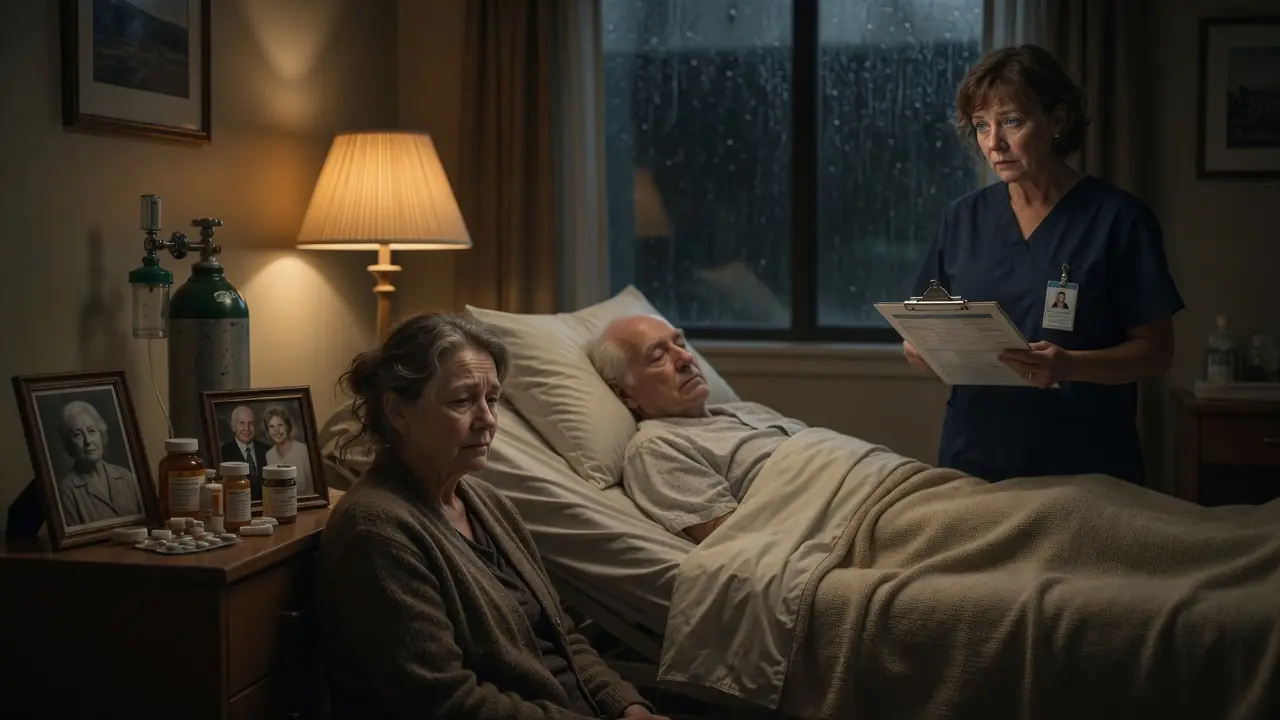
During his final months, we brought him home under hospice care. A hospital bed replaced the sofa in our downstairs bedroom. Oxygen tanks stood in the corner, and bottles of medication covered the dresser where I once kept framed photographs.
The house began to feel smaller every day.
Friends visited less often as Thomas weakened. Conversations became difficult. People did not know whether to speak about ordinary things or acknowledge that he was dying in front of them.
Most of the time, it was just the two of us and the rotating hospice staff.
The long goodbye wore me down in ways I could not explain.
Grief before death is different from grief after it. It does not arrive as one devastating blow. It takes a little from you every day.
A conversation disappears.
Then a walk to the mailbox.
Then the ability to swallow solid food.
Then the voice you love becomes a whisper.
By the time Thomas entered the final stage, I was sleeping in a chair beside his bed and measuring my days by medication schedules.
One Tuesday evening, a new night nurse arrived.
She was a woman in her mid-forties with tired blue eyes and a calm way of moving through the room. She did not make unnecessary noise. She checked the oxygen tubing, adjusted Thomas’s pillows, and spoke to him even though he was barely conscious.
“My name is Sarah,” she said. “I’ll be here until seven.”
The name meant nothing to me at first.
She stood at the foot of the bed and examined his chart. Then she looked across the room at me.
Her expression changed.
Not dramatically. Just a slight tightening around her eyes, as though she had recognized a song she had not heard in years.
She said my name.
It sounded strange in that dim room, surrounded by the rhythmic wheeze of the oxygen machine.
“Yes?” I answered.
She held the chart against her chest.
“This may sound like an odd question,” she said. “Did you ever eat at a Waffle House outside Knoxville in November of 1999?”
A chill ran across my arms.
I looked at her more carefully.
The tired teenager from that night had been thin, with blond hair pulled into a careless ponytail. The woman standing before me had shorter hair streaked with gray and fine lines around her eyes.
Still, there was something familiar in the way she held her head.
“I might have,” I said. “It was a long time ago.”
“You were wearing a black dress.”
My throat tightened.
Sarah glanced toward Thomas, then back at me.
“You had been crying,” she continued. “You ordered eggs, toast, and hash browns, but you barely touched them.”
I gripped the arms of my chair.
“You were the waitress.”
She nodded.
For several seconds, neither of us spoke.
Thomas breathed unevenly between us.
Sarah leaned against the wall and clasped her hands in front of her.
“I was nineteen,” she said. “I had been working double shifts for almost three months.”
“I remember you.”
“I didn’t think you would.”
“I left too much money.”
A small smile touched her mouth.
“Two hundred dollars.”
“I meant to leave twenty.”
“I figured that out.”
“I thought about coming back.”
“I waited.”
Her voice was not accusing. That somehow made me feel worse.
“I’m sorry,” I said.
“Please don’t be.”
She looked down at the chart in her hands.
“That money changed my life.”
I stared at her.
She crossed the room and sat in the chair beside mine.
“At the time, I was living with my mother and her boyfriend,” she said. “He drank. When he drank, he became mean.”
Her gaze remained fixed on the floor.
“I had dropped out of high school the year before. I kept telling myself I would get my GED, but every dollar I made went toward rent, food, or whatever crisis was happening that week.”
“I didn’t know.”
“Of course you didn’t.”
She rubbed her palms together slowly.
“The night you came in, I had already decided to quit. My manager had accused me of stealing from the register. My mother’s boyfriend had taken most of my paycheck, and I was so tired I could barely stand.”
Her voice remained steady, but her eyes became glassy.
“I remember looking at you and thinking that you seemed even sadder than I felt.”
I looked toward Thomas.
“My mother’s funeral had been that day.”
“I guessed someone had died.”
Sarah nodded toward the bedside table, where a framed photograph of my mother stood beside one of Thomas and me on our wedding day.
“Is that her?”
“Yes.”
“She had kind eyes.”
“She did.”
Sarah took a breath.
“When I cleared your table, I saw the bills under the cup. At first, I thought they were twenties. Then I unfolded them.”
She smiled faintly at the memory.
“I ran outside, but you were gone.”
“I should have returned.”
“No.”
“I left it by accident.”
“Maybe.”
She looked directly at me.
“But I didn’t receive it by accident.”
The sentence settled into the quiet room.
Sarah told me she had hidden the money in her shoe until the end of her shift because she was afraid someone would claim it. The following morning, she went to a community education office and paid for a GED preparation course and the examination fee.
“That was my way out,” she said.
She studied every night after work. A month later, she passed the exam.
The remaining money paid for her first nursing assistant course.
“It wasn’t enough to cover everything,” she explained. “But it made the next step possible. Before that night, every road looked closed.”
From there, she became a certified nursing assistant. Years later, after getting married and having a daughter, she returned to school part-time and earned her nursing degree.
“I always wanted to work in hospice,” she said. “People thought that was strange.”
“Why hospice?”
Sarah glanced at Thomas.
“Because I remembered you sitting alone in that restaurant. I kept thinking about how grief makes people invisible. Everyone wants to help before the funeral, but afterward, the person still has to wake up and live.”
I pressed my hand against my mouth.
“I wanted to be the person who stayed after everyone else went home.”
The oxygen machine hummed beside us.
Sarah reached out and touched my hand. Her fingers were cool and steady.
“I wanted to thank you,” she said.
“I didn’t do anything.”
“You left the money.”
“By mistake.”
“Maybe the amount was a mistake. But you still chose to leave what you thought was a generous tip.”
I began to cry.
“It wasn’t generosity. I was barely thinking.”
“Sometimes kindness happens before we have time to name it.”
For a long while, she held my hand while Thomas slept.
Neither of us spoke.
When she finally stood to check his IV, the moment seemed to close, but something in the room had changed.
I felt relief, regret, and wonder all at once.
For twenty-five years, I had thought about that night only as a foolish mistake. Two bills stuck together. Money carelessly lost.
I had never imagined it becoming books in a nineteen-year-old girl’s hands.
I had never imagined it becoming an examination she passed, a uniform she wore, a career she built, or the quiet confidence with which she adjusted my dying husband’s pillows.
Sarah worked the night shift for the next four days.
Sometimes we talked.
Mostly we sat in silence.
She knew when to offer medication and when to offer space. She spoke gently to Thomas, telling him what she was doing even when he no longer responded.
On the third night, I found her in the kitchen making tea.
“My mother’s last words were about taking my time,” I told her.
Sarah handed me a mug.
“Did you?”
“No.”
I looked toward the dark hallway.
“I rushed through most of my life.”
“Most people do.”
“She said the world wasn’t going anywhere.”
Sarah smiled sadly.
“She was wrong about that part.”
“Yes.”
“The world always goes somewhere.”
We stood beneath the kitchen light, listening to the old house settle.
“Do you believe things happen for a reason?” I asked.
Sarah considered the question.
“I think people say that when they need pain to make sense.”
“That sounds like a no.”
“I think terrible things happen for no reason at all.”
She looked down at her tea.
“But I also think we get to decide what happens next.”
Her answer stayed with me.
Thomas died two nights later.
The room was quiet except for rain tapping against the windows. Our daughters had gone home to sleep after spending the entire day with him.
Sarah was checking his breathing when she suddenly stopped.
She placed two fingers against his neck and watched his chest.
Then she looked at me.
“It’s close,” she whispered.
I moved to the bed and took Thomas’s hand.
His skin was warm but slack.
I told him I loved him. I told him the girls were safe and that he did not have to keep fighting for us.
Then I said the words my mother had given me all those years earlier.
“Take your time, honey. The world isn’t going anywhere.”
Thomas took one soft breath.
Then another.
After that, there was only stillness.
I waited for panic to come.
Instead, Sarah placed one hand on my shoulder and remained beside me while I cried against my husband’s chest.
She did not hurry me.
She did not immediately start making calls or removing equipment. She allowed the room to belong to us for a little while longer.
Eventually, she turned off the oxygen machine.
The sudden silence felt enormous.
“I’m sorry,” she said.
I nodded because I could not speak.
After the funeral home took Thomas away, dawn began to lighten the windows. The house felt impossibly empty.
Sarah gathered her things near the front door.
Before she left, I stopped her.
“Wait.”
I opened my purse and took out two one-hundred-dollar bills.
For one second, she simply stared at them.
Then she shook her head.
“I can’t accept that.”
“I know.”
I folded the bills and placed them in her hand anyway.
“Then give them to someone who needs a bridge.”
Her eyes filled.
“I already have someone in mind.”
“Who?”
“There’s a young woman in our nursing assistant program. She’s been missing classes because she can’t afford childcare.”
I closed her fingers around the money.
“Then help her stay.”
Sarah hugged me.
This time, neither of us was a grieving customer or a tired waitress. Neither of us was a nurse or a widow.
We were simply two women standing at the edge of a long, invisible chain.
After she left, I sat alone in Thomas’s room.
The hospital bed remained beside the wall. Morning light crept slowly across the floor, touching the place where Sarah had sat night after night.
I thought about the nineteen-year-old girl who had found two hundred dollars beneath a coffee cup.
I thought about the woman she became.
I thought about my mother on her porch, following a bird through the branches while I rushed away to handle things that no longer mattered.
For years, I had believed the money was something I left behind.
Now I understood that nothing truly kind is ever left behind.
It moves.
It passes quietly from one hand to another, becoming a book, an exam, a uniform, a hand held beside a hospital bed.
We rarely get to see where our smallest choices end up.
Most of the time, we never know.
A door is held open. A meal is paid for. A few patient words are offered to someone who has almost given up.
Then life carries the moment away, and we assume it disappeared.
But perhaps kindness does not disappear.
Perhaps it waits.
Twenty-five years after I left that Waffle House, my mistake returned to me in the shape of a woman who knew how to sit beside the dying and how to keep a grieving widow upright.
The money had never really been mine to recover.
It had become a bridge.
Sarah crossed it first.
Then, when my own road disappeared beneath my feet, she came back across it and held out her hand.
The world did not stop for my mother.
It did not stop for Thomas either.
But that morning, as sunlight spread through the quiet room, I finally allowed myself to take my time.
The world could wait a few minutes.
I sat beside the empty bed, watched the shadows move across the floor, and listened to the silence without trying to escape it.
For the first time in a very long while, I understood that letting go did not mean everything was lost.
Some things continued traveling long after we thought we had left them behind.