Amara Vance Croft sat alone at a corner table inside Arya, one of Manhattan’s most exclusive restaurants, with one hand resting near her water glass and the other folded quietly in her lap. The dining room around her was elegant without being loud, filled with white tablecloths, polished silverware, crystal glasses, dark wood panels, and the quiet murmur of people who had spent their lives believing they belonged in beautiful places. Only three or four guests sat at nearby tables, speaking in low voices and occasionally glancing toward her with polite curiosity. Amara tried not to notice those glances, because noticing too much had always been one of the habits she wished she could unlearn.
She wore a simple emerald green dress, fitted neatly but without anything flashy about it. Around her neck was a small gold locket Julian had given her on their second anniversary, the kind of gift that looked modest until you knew what it meant. Her hair was styled naturally and neatly, her makeup soft, her shoes comfortable instead of expensive. She knew she did not look like the women at the other tables, but she also knew she had every right to be there.
Julian Croft, her husband, had stepped away only ten minutes earlier to take an urgent call from the Singapore office. He had kissed the top of her head before leaving, promised he would be back quickly, and told her to order anything she wanted. Amara had smiled and nodded, because she was used to sharing him with business emergencies even on rare nights meant for just the two of them. He ran Orion Dynamics, a global tech empire worth billions, and responsibility followed him like another shadow. Still, he always came back to her.
Before he left the table, Julian had looked at her with the same soft concern he always tried to hide. He had asked if she was comfortable, if the room felt too much, if she wanted to sit somewhere more private. Amara had told him she was fine, even though restaurants like Arya always made her feel as if she had stepped into someone else’s life. Julian had squeezed her hand and told her she belonged anywhere he did. She had wanted to believe him completely.
For a few minutes, she did. The waiter brought sparkling water, placed warm bread on a small plate, and spoke to her with careful courtesy. The restaurant light reflected gently off the glassware, and the distant sound of piano music softened the space. Amara let herself breathe, let herself enjoy the smell of rosemary butter and roasted garlic drifting from nearby plates. Then she felt someone staring at her.
The woman was seated two tables away, dressed in a fitted white designer dress and glittering diamonds that caught every bit of light in the room. She was in her late forties, blonde, polished, and beautiful in a hard, expensive way that looked assembled rather than natural. Her eyes moved over Amara with open disdain, lingering on the emerald dress, the simple locket, and the comfortable shoes beneath the table. Then her mouth curved into a smile that held no warmth.
Amara looked away first. She told herself not to make something out of nothing, not to assume the worst, not to turn every glance into an attack. She had spent years learning how to survive wealthy rooms without shrinking in them. Sometimes that meant ignoring what people thought they were hiding. Sometimes it meant pretending not to hear what they wanted her to hear.
But the blonde woman did not stay at her table. She pushed back her chair, adjusted her diamond bracelet, and walked directly toward Amara with the confidence of someone who expected every path to clear before her. The few nearby diners quieted almost immediately, sensing the shift in the room. Amara kept her back straight and placed both hands lightly on the table. By the time the woman stopped beside her, the air around the corner table had gone tight.
“Excuse me,” the woman said, though her tone suggested she was not asking for anything. “I think there has been some kind of mistake.” Amara looked up slowly. “What kind of mistake?” The woman smiled wider, pleased to have an audience.
“This table is reserved for certain guests,” she said. “People who understand the standard of this restaurant.” Her eyes swept over Amara again. “I could not help noticing you sitting here alone, and frankly, you do not look like someone who knows where she is.” A man at a nearby table lowered his fork and looked uncomfortable.
“I know where I am,” Amara said calmly. “I am waiting for my husband.” The woman laughed, not loudly at first, but with enough sharpness that the sound cut through the quiet dining room. “Your husband,” she repeated, glancing around theatrically. “How convenient that he is nowhere to be seen.”
Amara felt the first hot spark of anger rise beneath her ribs. She had known women like this before, women who wrapped cruelty in manners and called it honesty. “He stepped away to take a phone call,” she said. “He will be back shortly.” The woman tilted her head as if listening to a child invent an excuse.
“My dear, this is Arya,” she said. “This is not the kind of place where someone simply wanders in, sits at a premium table, and invents an invisible husband.” She leaned closer, lowering her voice only slightly. “People can tell when someone is pretending.” Amara’s fingers tightened around the edge of her napkin.
“I am not pretending to be anything,” Amara said. The woman’s smile disappeared. “No, I suppose you are not pretending very well.” She pointed one manicured finger directly at Amara’s face, the diamond on her hand flashing under the restaurant light. “Look at yourself. That dress, those shoes, that nervous little face. You are making everyone uncomfortable.”
The words landed with the old familiar force. Amara had heard variations of them in boutiques, private events, charity dinners, and apartment lobbies. Different words, same message. You do not belong here. You should explain yourself. You should be grateful if we allow you to stay.
The woman’s voice grew louder as she noticed more people watching. “Do you have any idea who eats here?” she demanded. “Do you know what kind of people this restaurant serves?” Amara looked at the finger pointed inches from her face and refused to lean back. “People having dinner, I assume.”
That answer made the woman’s face flush. “Do not be clever with me.” She straightened and lifted her chin. “I am Victoria Sterling. My husband is Edward Sterling of Sterling Capital, and my family has supported half the institutions in this city.” She paused, expecting recognition that did not come. “You would do well to show some respect.”
Amara met her eyes. “Respect is not something you get by shouting your name at a stranger.” The sentence was quiet, but it carried. One of the nearby guests looked down quickly, as if hiding a smile. Victoria saw it and became even more furious. Her finger jabbed closer toward Amara’s face.
“What did you just say to me?” Victoria snapped. “You think because you managed to sit at this table, you can speak to me like an equal?” Amara’s pulse hammered, but her voice stayed steady. “I think because I am a human being, I can speak without being insulted.” Victoria’s mouth opened in disbelief.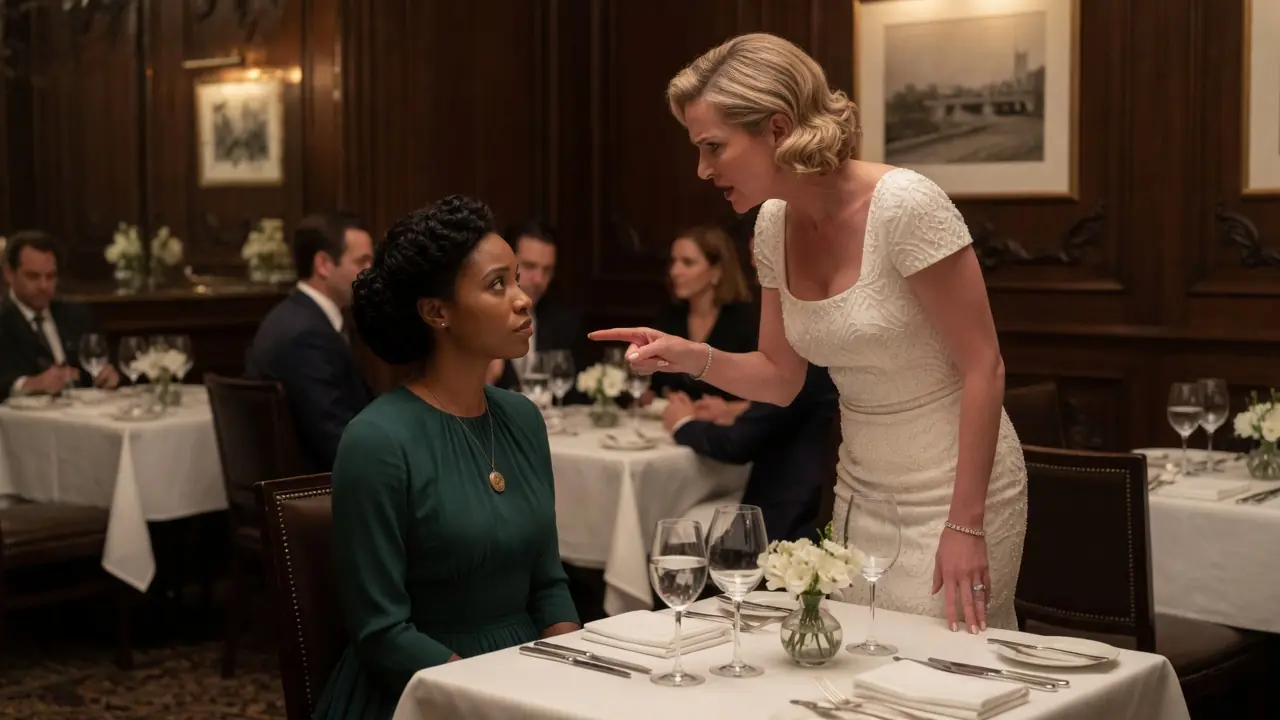
For a moment, the restaurant seemed to hold its breath. Victoria looked around at the nearby guests, as if searching for permission to escalate. No one gave it openly, but no one stopped her either. The manager stood several yards away near the dining room entrance, clearly aware something was happening, but frozen by the status of the woman causing it. Amara saw all of that in one quick glance.
Victoria laughed again, louder this time. “A human being,” she repeated mockingly. “How inspiring.” Then her expression hardened. “Let me be very clear with you. I do not know what game you are playing, but you are not fooling anyone here.”
“I am not playing a game,” Amara said. “I am waiting for my husband and having dinner.” Victoria leaned in, her perfume sharp and suffocating. “No. You are sitting here hoping some wealthy man notices you.” Her voice dropped lower, uglier. “Women like you always find a way to make yourselves visible in rooms where you were never invited.”
The words burned more than Amara wanted them to. She thought of her mother working double shifts, of her own years spent tutoring children after school, of the nonprofit office where she had met Julian while arguing about literacy funding. She thought of every sacrifice that had shaped her before she ever met a billionaire. And still, in Victoria’s eyes, she had already been reduced to a scheme.
“You do not know anything about me,” Amara said. Victoria’s face twisted. “I know enough.” She pointed straight at Amara again, her voice cutting through the dining room. “I know you walked in here dressed like that and expected people not to notice. I know you are sitting at a table you could never afford on your own. And I know you are too arrogant to leave quietly.”
Amara rose slowly from her chair. She did not do it dramatically, and she did not raise her voice. She simply stood because she refused to keep looking up at someone who had chosen to humiliate her. The nearby guests watched in complete silence now. The manager took one step forward, then stopped again.
“I am not leaving,” Amara said. “I have done nothing wrong.” Victoria’s eyes widened as if the refusal itself were an insult. “How dare you.” Her voice rose into a sharp nattering scold. “How dare you stand there and talk back to me after I tried to spare you embarrassment.”
Amara’s face stayed calm, but her hands trembled at her sides. “You did not try to spare me anything.” Victoria stepped closer. “You should be ashamed of yourself.” Amara answered, “No. You should.”
The words struck Victoria like a match to dry paper. Her arm lifted suddenly, fast enough that several diners gasped. Her palm rose high, angled toward Amara’s face, and for one frozen second everyone in the room believed she was about to slap her. Amara did not move, though every instinct in her body screamed to flinch.
Victoria’s hand stopped inches from Amara’s cheek. It hung there, trembling with rage and diamond light. The restaurant fell so silent that the piano music seemed almost too loud. Amara looked at the raised hand, then into Victoria’s eyes. “Are you really going to do that in front of everyone?”
Victoria’s jaw clenched. She did not strike. Instead, she lowered her hand slightly and pointed again, straight at Amara’s face, so close that it became its own kind of violence. “Do not test me,” she hissed. “You have no idea how quickly I can ruin someone like you.”
Before Amara could answer, a cold voice cut through the room from behind Victoria. “Lower your hand before you make the worst mistake of your life.” Victoria froze. Amara closed her eyes for half a breath because she knew that voice better than any sound in the world. Julian had come back.
He stood a few steps behind Victoria in his charcoal gray suit, phone still in one hand, his expression stripped of every trace of warmth. His green eyes were fixed on Victoria with a kind of controlled fury that seemed to pull the air from the room. He did not shout. He did not need to. Every person in the restaurant turned toward him as if drawn by gravity.
Victoria turned slowly, expecting perhaps a manager or another guest interfering where he did not belong. “Who do you think you are?” she demanded, though her voice had already lost some of its force. Julian did not answer immediately. He walked past her and stopped beside Amara, his hand moving gently to her shoulder. The tenderness of the gesture made the coldness in his face even sharper.
“Her husband,” Julian said.
The room seemed to shift all at once. The words landed, spread, and transformed every glance in the dining room. Victoria’s mouth parted slightly, her eyes darting from Julian to Amara and back again. She recognized him now. Almost everyone did.
Someone at a nearby table whispered, “Julian Croft.” Another voice murmured, “Orion Dynamics.” A third person said, barely above a breath, “That is his wife?” The manager’s face went pale. Victoria’s hand dropped completely to her side.
Julian looked at Amara first. “Did she touch you?” Amara shook her head once. “She raised her hand.” Julian’s jaw tightened. “And pointed in your face.” Amara nodded. “Yes.”
Victoria tried to speak, but her voice cracked. “Mr. Croft, I did not realize.” Julian turned back to her slowly. “You did not realize what?” Victoria swallowed. “I did not realize she was with you.” The words came out before she understood how deeply they condemned her.
Julian’s expression became even colder. “So if she had not been with me, your behavior would have been acceptable?” Victoria shook her head quickly. “No, that is not what I meant.” Julian stepped slightly in front of Amara, not hiding her, but making it very clear that Victoria would not come one inch closer. “Then explain what you meant.”
Victoria looked around the dining room, suddenly aware that the few nearby guests were watching with focused attention. One woman had her phone raised just low enough to pretend she was not recording. The manager finally hurried over, wringing his hands in panic. “Mr. Croft, Mrs. Croft, I am terribly sorry. Perhaps we can move you to a more private room.”
Julian’s eyes moved to him. “Why would my wife be moved?” The manager stammered. “Only for comfort, sir. To avoid further disruption.” Julian’s voice sharpened. “The disruption is standing in front of us wearing diamonds and prejudice.”
Victoria flinched. The manager looked as if he wanted the floor to open beneath him. Amara placed a hand lightly on Julian’s sleeve, not to stop him, but to remind him she was still there. He glanced down at her, and his expression softened for one second. Then he looked back at Victoria.
“My wife sat here peacefully,” Julian said. “You approached her table, mocked her clothes, questioned her right to be here, pointed in her face, raised your hand as if to strike her, and threatened to ruin her.” His voice remained controlled, which somehow made each word more devastating. “Did I miss anything?”
Victoria’s lips trembled. “I thought there had been a misunderstanding.” Julian gave a humorless laugh. “There was.” He gestured toward Amara. “You misunderstood her quietness for weakness.” Then he pointed lightly toward the dining room. “You misunderstood silence from others as agreement.”
One elderly man at a nearby table cleared his throat. “For the record, Mr. Croft, your wife did nothing wrong.” Julian turned toward him. “Thank you.” The man nodded. “That woman was insulting her before you came back. She raised her hand. We all saw it.”
Victoria’s face crumpled further. “Please,” she whispered. “This does not need to become public.” Julian looked around at the phones already half-raised around them. “You made it public when you chose to perform your cruelty in a dining room.” Victoria’s eyes filled with tears. “I made a mistake.”
“No,” Amara said quietly.
Everyone turned to her. Julian stepped aside just enough to let her speak for herself. Amara looked at Victoria, feeling the burn of humiliation still alive beneath her skin, but no longer allowing it to bend her posture. Her voice was calm, but it carried.
“A mistake is calling someone by the wrong name,” Amara said. “A mistake is sitting at the wrong table.” She took one careful breath. “You looked at me, decided I did not belong, and then tried to make me small enough to leave.” Victoria began crying silently.
“I did not know who you were,” Victoria said. Amara nodded once. “That is the problem.” The room went still again. “You should not need to know who I am married to before deciding whether I deserve basic respect.”
Julian’s hand found hers beneath the edge of the table. Amara did not look at him, but she held on. Victoria looked like she had been stripped of every social weapon she knew how to use. Her name did not matter here. Her dress did not matter. Her husband’s company did not matter.
Julian turned to the manager. “Remove Mrs. Sterling from this restaurant.” The manager hesitated only a fraction of a second before nodding. “Yes, sir.” Victoria gasped. “You cannot do that. My family has been coming here for years.”
Julian’s voice remained flat. “Then your family should have taught you how to behave in public.” The nearby woman recording lowered her phone just enough for Victoria to see it. That small motion frightened her more than Julian’s words. Reputation had always protected Victoria, but now reputation was the thing collapsing under her feet.
“Please,” Victoria said again, this time to Amara. “I am sorry. I truly am.” Amara studied her for a long moment. She did not see true understanding yet, only fear. Fear of exposure. Fear of consequences. Fear of losing the world that had always bent around her.
“I hope one day you become sorry for what you did,” Amara said. “Not just for who saw it.” Victoria’s face twisted with shame. The manager gestured toward the exit with a trembling hand. Slowly, Victoria turned and walked away, no longer a queen of the dining room, but a woman escorted out under the weight of her own behavior.
The restaurant remained quiet after she left. Nobody knew whether to return to their meals or pretend nothing had happened. Julian turned toward Amara fully, both hands now holding hers. “Are you all right?” he asked.
Amara almost said yes automatically. Then she stopped herself. “No,” she said. Julian’s face tightened with pain. “I should not have left you alone.” Amara shook her head. “You taking a call did not cause this.”
“No,” he said. “But I know this room. I knew what people like her might do.” Amara looked toward the table where Victoria had been sitting. “Then maybe people like her need to stop being protected by everyone else’s careful silence.” Julian nodded slowly. “Agreed.”
The elderly man who had defended her approached their table before leaving. “Mrs. Croft,” he said gently, “I am sorry I did not speak sooner.” Amara looked at him. “You spoke.” He lowered his eyes. “Not soon enough.” She appreciated that he understood the difference.
The manager returned a few minutes later, pale and apologetic. He offered to comp the meal, provide a private room, send champagne, call a car, anything to smooth the broken surface of the evening. Julian declined most of it with cold politeness. Amara asked only for their dinner to be served at the table they had reserved. She refused to be moved.
That decision mattered more than champagne ever could. When the waiter brought the first course, his hands shook slightly, but his voice was respectful. The other diners slowly returned to their conversations, though the room no longer felt quite the same. It had witnessed something ugly, and no amount of polished silver could make it invisible. Amara sat upright, still hurt, but no longer shrinking.
Later that night, the video appeared online. It did not show the entire confrontation, only the final part, Victoria pointing in Amara’s face, raising her hand, Julian’s voice stopping her cold, and the devastating reveal that Amara was his wife. The clip spread quickly through Manhattan social circles, then business circles, then everywhere else. Victoria Sterling’s name became attached to the one thing money could not easily erase: public truth.
By morning, Sterling Capital released a statement distancing itself from Victoria’s behavior. Charity boards requested private conversations. Invitations quietly disappeared. People who had once laughed at Victoria’s cruelty when it was aimed at others suddenly described themselves as shocked and saddened.
But Amara did not spend the morning watching the internet destroy Victoria. She sat in the kitchen with Julian, wearing sweatpants and one of his old shirts, drinking coffee while sunlight moved across the marble counter. Her emerald dress hung upstairs, carefully cleaned and returned to the closet. Julian had offered to throw it away, but Amara refused.
“I still like that dress,” she said. “She does not get to ruin it.” Julian smiled faintly, though his eyes were still heavy with anger. “No, she does not.” He reached across the counter and took her hand. “You were extraordinary last night.”
“I was scared,” Amara admitted.
“I know.” His thumb brushed her knuckles. “Courage does not mean you were not scared.” She looked at him, tired but steady. “It means I stayed.” Julian nodded. “Yes. It means you stayed.”
Weeks later, Arya changed its guest conduct policy and retrained its management team. The manager personally called Amara to apologize again, not because Julian demanded it, but because he finally understood that moving the wounded person away from harm was not justice. Victoria Sterling issued an apology through a publicist, but Amara did not respond to it. Some apologies are written for audiences, not victims.
The incident became another story people told about Julian Croft’s power, but Amara knew the real story was not about him saving her. He had come back at the right moment, yes, and his name had changed the room. But Amara had already stayed seated. She had already refused to leave.
That was the part she carried with her. Not Victoria’s finger in her face. Not the hand raised inches from her cheek. Not the cruel laughter or the expensive room turning silent around her.
She remembered her own voice saying, I am not leaving.
And she remembered that she meant it.