The crash sounded like a dumpster being dropped from the second floor of a building. Metal folded, glass burst, and somewhere beneath the grinding noise came the high electronic scream of a luxury SUV deciding that several very expensive parts had just stopped working at once. I was halfway through pouring coffee when my dog Max began barking at the front window.
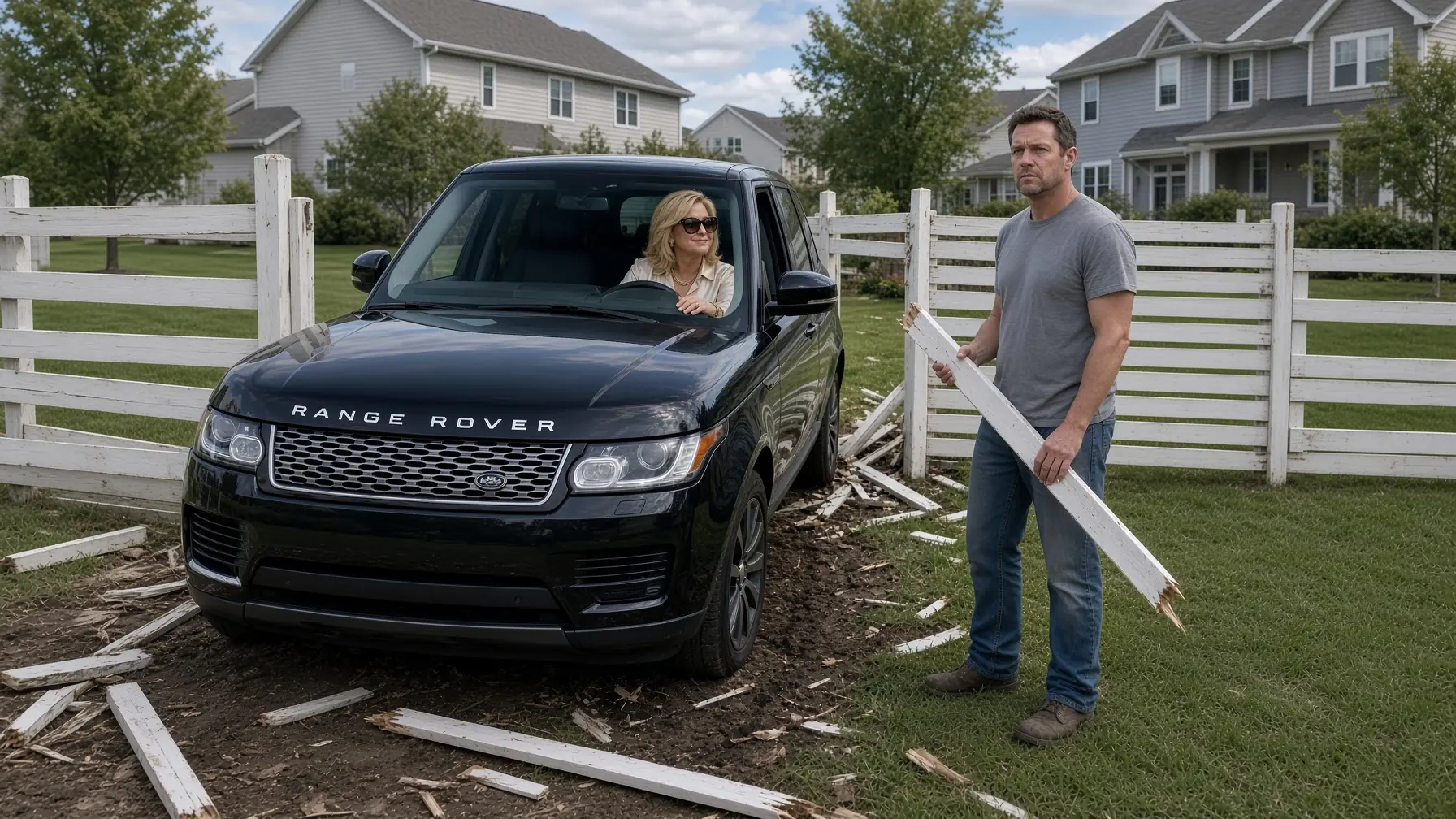
I already knew where to look. Across my side yard, Karen Whitmore’s black Range Rover sat at an angle beside the fence line, steam lifting from the front end while one headlight blinked weakly into the grass. The fence behind it was still standing.
That was the part that made three neighbors come out onto their porches. For almost two months, everybody on Willow Bend had watched Karen drive through my property whenever she decided the street was too inconvenient. Every time she did it, boards broke, grass tore up, and somehow I received another HOA letter about the condition of my fence.
Not that morning. That morning, the fence remained exactly where the surveyor, contractor, county permit, and recorded property line said it belonged. Karen’s Range Rover was the thing that had finally lost the argument.
She shoved open the driver’s door and stumbled out. Her designer sunglasses were crooked, one airbag hung deflated across the steering wheel, and the front bumper had folded downward like a loose jaw. She looked at the damaged SUV, then at the fence, then finally at me standing on my porch with a coffee mug in my hand.
“You did this,” she shouted.
I took a sip.
“No, Karen.”
I looked toward the tire tracks running across the corner of my lawn.
“You did.”
When I moved into Willow Bend eight months earlier, I thought I had found the kind of neighborhood people imagine when they finally become homeowners. Kids rode bicycles in slow circles around the cul-de-sac, people waved while mowing their lawns, and the houses were modest enough that nobody seemed to be competing over who had the most impressive driveway. Mine was a two-story place with blue shutters, a narrow backyard, and an old wooden fence that looked as though it had survived three decades by refusing to admit it was tired.
My name is Daniel Mercer. I was forty-seven, divorced, worked from home as an insurance claims analyst, and had spent enough years living in apartments to become irrationally excited about owning a shed. I had also spent enough years settling property-damage claims to know that photographs, dates, invoices, and written records mattered far more than who could shout longest.
The fence became my first project. I replaced rotten sections, reset leaning posts, repainted the boards, and spent three weekends turning something tired into something clean and solid. Max, my nine-year-old Labrador mix, treated the finished yard as his personal kingdom.
For several months, everything felt peaceful. I worked during the day, walked Max before dinner, and sat on the porch after sunset listening to lawn sprinklers click across the street. Then Karen Whitmore decided my fence had become relevant to her life.
Karen was fifty-eight and had lived in Willow Bend for almost fifteen years. She drove a black Range Rover, chaired the HOA architectural committee, and possessed the rare ability to turn a conversation about mailbox paint into something that sounded like a congressional hearing. She was not technically HOA president, although she often behaved as though the distinction were merely administrative.
Our first interaction was almost funny. She slowed beside my driveway one afternoon and told me the white paint on my fence looked “closer to bright white than community eggshell.” I thanked her and continued watering my hydrangeas.
The second time, she asked whether I had measured the spacing between fence boards before replacing them. The third time, she told me the gate hardware looked “a little industrial.” None of it seemed worth fighting over.
Then I woke one Saturday morning to Max barking at the backyard.
A six-foot section of fence was broken inward. Three boards had snapped, one post leaned badly, and deep tire tracks cut across the grass from the street behind my property to the alley near Karen’s house. I stood there for several minutes trying to imagine any innocent explanation.
There had been no storm. No fallen tree. No delivery truck had any reason to cross my yard.
At 10:20 that morning, Karen’s Range Rover came around the corner. She slowed beside the damaged section, looked directly at me, and gave a small wave.
I walked toward the street.
“Karen.”
She stopped.
“Did you drive through my yard?”
She pushed her sunglasses onto her head. “I had to get around the landscaping truck.”
“There is a road.”
“It was blocked.”
“For how long?”
She shrugged. “I don’t know.”
I pointed toward the broken fence. “You hit this.”
Karen looked at it as though seeing the damage for the first time. “That old thing?”
“Yes.”
“I barely touched it.”
“You broke six feet of it.”
She gave a little laugh. “Daniel, if a vehicle barely brushing a fence causes that much damage, maybe the real issue is the fence.”
Then she drove away.
I should have understood the warning contained in that sentence. I did not.
I repaired the fence the following weekend. Lumber, paint, hardware, and a replacement post cost me just under three hundred dollars, not counting most of a Saturday. I took photographs before and after because my job had taught me to document anything involving property damage.
Six days later, Karen drove through it again.
This time I saw her.
A landscaping truck was parked along the street, but there was still room to pass if she waited for an oncoming sedan. Karen apparently considered waiting beneath her.
She turned onto the grassy shoulder, crossed the corner of my yard, and pushed through the repaired section. Boards snapped beneath the bumper, and the Range Rover bounced into the alley behind my house.
I stood on the porch holding Max’s leash.
Karen stopped on the other side.
She rolled down her window.
“Might want to fix that.”
Then she smiled and kept going.
I called the non-emergency police number.
An officer came out forty minutes later. He photographed the damage, looked at the tire tracks, and asked whether I had video.
“Not yet.”
“Did you see her do it?”
“Yes.”
“Will she admit it?”
“I doubt it.”
He walked across the alley and spoke with Karen.
When he came back, his expression told me everything.
“She says she drove near your fence but denies striking it.”
“I watched her hit it.”
“I’m documenting your statement.”
“What happens now?”
“You can pursue a property-damage complaint or civil claim. Without video, it may become your word against hers.”
That was fair.
Frustrating, but fair.
So I installed cameras.
Not hidden cameras. Ordinary exterior security cameras covering the gate, side yard, driveway, and rear property line. I also placed one above the porch and another on the garage facing the section Karen kept using.
Four days later, she provided my first clean recording.
The video showed her SUV turn from Willow Bend, cross the curb, enter my lawn, push through the repaired fence, then continue toward the alley. She did not hesitate.
I saved three copies.
Then I filed another police report.
This time Karen admitted driving through the property but called it “an established access route.”
There was no established access route.
That phrase started the next problem.
The HOA meeting was held the following Tuesday in the community clubhouse. I arrived with printed photographs, the police report number, a flash drive containing the video, repair receipts, and a copy of my closing survey showing the fence entirely inside my property line. Karen sat at the far end of the table wearing a cream blazer and the expression of someone attending a meeting she already believed she had won.
The HOA president, Martin Bell, was a retired accountant who hated conflict so much that merely seeing two people disagree appeared to exhaust him. He watched the video twice, removed his glasses, and rubbed the bridge of his nose. “Karen, were you driving across Daniel’s property?”
Karen folded her arms. “Technically, perhaps.”
Martin stared.
She continued. “But that corner has historically been used for vehicle access during obstructions.”
“By whom?”
“Residents.”
I looked around. “Which residents?”
Karen ignored me. “The previous owner never complained.”
I had already spoken with the previous owner.
He had never given anyone permission.
Martin asked whether an easement existed.
Karen said she would need to check community records.
I placed a copy of my title documents on the table. “There is no recorded easement.”
Karen leaned forward. “Daniel, HOA property practices are not always reflected in county deeds.”
That sentence was nonsense impressive enough that two board members nodded anyway.
I said, “A private access easement affecting my land would generally be reflected somewhere more substantial than Karen remembering one.”
Martin cleared his throat.
Karen glared.
I expected the board to tell her to stop driving through my yard.
Instead, they postponed the matter.
Three days later, I received an HOA violation notice.
Exterior fence visible from common roadway is damaged and inconsistent with community appearance standards. Correct within ten days. Fine: $150.
I read the letter twice.
Then once more because my brain refused to accept the stupidity immediately.
Karen had damaged my fence.
The HOA was fining me because Karen had damaged my fence.
That was the moment the situation stopped being a neighborhood annoyance.
It became paperwork.
Karen had no idea how comfortable I was with paperwork.
I appealed the fine in writing. I attached photographs, police report numbers, video stills, repair invoices, the property survey, and the email in which Martin acknowledged the board had seen footage of Karen’s vehicle crossing the yard. I also requested that Karen recuse herself from any board discussion involving my property because she was directly involved in the dispute.
The HOA attorney responded two weeks later.
The fine was suspended pending review.
Karen did not like that.
She liked even less what happened when the attorney advised the board that HOA authority did not create a right to use privately owned property for vehicle access. The board sent every member a carefully worded memo telling residents to use public streets and avoid crossing private lots without permission.
Nobody was named.
Everybody knew who it meant.
Karen’s response arrived at 7:12 the next morning.
The camera caught the Range Rover crossing my yard again.
This time she slowed before the fence.
Then drove through deliberately.
I watched the recording in silence.
Max sat beside my chair.
“Okay,” I told him.
He wagged once.
I repaired nothing.
Instead, I called an attorney.
Her name was Caroline Hughes. She handled real-estate disputes, boundary matters, and HOA conflicts, and she had the calm voice of someone who had watched too many grown adults spend thousands of dollars fighting over six inches of grass. I gave her the deed, survey, videos, HOA correspondence, police reports, and photographs.
She watched Karen drive through the fence.
Then again.
Then a third time.
Finally she looked at me.
“She does understand that’s your property?”
“She says there was historical access.”
“Is there?”
“Not according to the survey, deed, title search, previous owner, or county records.”
Caroline nodded. “Good.”
“What can I do?”
“First, stop repairing the fence every time.”
I stared at her.
“That wasn’t what I expected.”
“You are creating a cycle where she damages property, you replace it, and the argument resets.”
“So leave it broken?”
“Temporarily.”
She tapped the file.
“Second, we send a formal notice revoking any claim of permission or implied access.”
“She never had permission.”
“I know.”
“But afterward she cannot plausibly claim confusion.”
That made sense.
“Third, have the boundary professionally marked again.”
“I already have a survey.”
“Get the surveyor to stake the relevant corner.”
“Fourth, ask the municipality what kind of lawful protective barrier is permitted inside your property line.”
I looked at her.
“A stronger fence?”
“Possibly.”
“Posts.”
“Landscaping.”
“Whatever code allows.”
She raised one finger.
“And listen carefully.”
I waited.
“You do not build a trap.”
“I wasn’t planning to.”
“Good.”
“No hidden cable.”
“No concealed concrete.”
“No sharpened objects.”
“No obstacle designed to injure somebody.”
“Nothing positioned deceptively.”
“If you protect the property, it needs to be legal, visible, permitted where required, and installed for a legitimate purpose.”
I nodded.
Caroline continued. “Because right now you have an excellent case.”
“Do not turn yourself into the defendant because anger felt creative.”
That sentence probably saved me from several stupid ideas.
The letter went out certified mail.
It identified the property boundary, attached the survey, referenced prior incidents, and stated clearly that Karen had no permission to drive across any portion of my lot. She was instructed to cease entering the property with her vehicle and informed that future incidents would be documented and pursued through available civil or criminal remedies.
Karen signed for it herself.
The following evening she drove across my lawn.
The camera caught everything.
Caroline watched the clip the next morning.
“Well.”
“That seems clear.”
“What now?”
“Now she cannot credibly say she misunderstood.”
We filed a property-damage claim through her automobile insurer for the documented incidents.
That changed Karen’s mood.
Insurance companies ask questions HOA committees avoid.
Dates.
Times.
Photographs.
Repair estimates.
Cause of loss.
Statements.
Video.
Her insurer contacted mine.
Mine sent an adjuster.
The adjuster measured the damaged fence and lawn, reviewed the footage, and asked why the same vehicle appeared repeatedly.
“Ask the driver.”
He looked at the screen again.
“I intend to.”
Meanwhile, I applied for a permit to replace the damaged section with a code-compliant boundary fence and protective landscaping. Because the corner sat near an alley entrance, the county planning office also required adequate visibility for vehicles and pedestrians. I hired a licensed contractor instead of rebuilding it myself.
His name was Malcolm Reeves.
He looked at the broken boards.
Then the tire marks.
Then me.
“You expecting livestock?”
“No.”
“Kids driving golf carts?”
“No.”
I showed him the video.
He watched Karen’s Range Rover cross the lawn.
Then watched again.
“Oh.”
“Exactly.”
Malcolm scratched his beard.
“We can build something better without making it dangerous.”
“That is precisely what my attorney said.”
“Smart attorney.”
He suggested a permitted fence layout set properly inside the surveyed boundary, reinforced at the vulnerable corner with visible protective posts approved for residential use and landscaping that made the property line unmistakable. I will not pretend I understood the engineering details, nor did I need to.
That was why I hired him.
The important part was simple.
Everything would be lawful.
Everything would be visible.
Everything would be documented.
And nothing would be installed for the purpose of hurting Karen.
The city inspector approved the plan.
The HOA architectural committee initially objected.
Karen participated in that objection.
Caroline sent one email asking why a board member directly involved in repeated property-damage incidents was participating in an architectural decision affecting the damaged property.
Karen was removed from the review.
The fence was approved three days later.
Malcolm’s crew worked for two days.
They removed the damaged boards, rebuilt the section, reset the line where the survey stakes showed it belonged, and installed the approved protective elements inside my property. Reflective markers made the corner obvious at night, and a small sign near the alley read:
PRIVATE PROPERTY — NO VEHICLE ACCESS
I photographed everything.
Permit.
Final inspection.
Survey stakes.
Fence.
Markers.
Sign.
Then I sent Karen one final written notice.
It included photographs.
It reminded her that she had no authorization to enter the property.
I copied the HOA attorney.
Her insurer.
And my attorney.
Karen responded by email.
You are being ridiculous.
I saved that too.
For nine days, she used the street.
I almost believed the story had ended.
Then came Tuesday morning.
At 8:17, Karen left for her yoga class.
I know the exact time because the camera timestamp recorded it.
A landscaping crew was unloading mulch two houses down. Their truck occupied part of the lane, but traffic could still pass one direction at a time.
Karen stopped behind a delivery van.
Waited eleven seconds.
Then backed up.
Her Range Rover turned toward my lawn.
From my kitchen window, I saw the vehicle mount the edge of the grass.
Max started barking.
I stood.
Karen continued.
The PRIVATE PROPERTY — NO VEHICLE ACCESS sign was directly ahead of her.
The white fence extended across the old shortcut.
The protective boundary feature was plainly visible.
She did not stop.
I would later learn from the camera footage that she accelerated slightly.
Maybe she believed the barrier would give way like the old fence.
Maybe she assumed I had built another decorative obstacle she could push through.
Maybe after months of getting away with it, stopping simply no longer occurred to her.
The Range Rover crossed the grass.
Then came the crash.
The approved protective structure held.
The front of the SUV did not.
Airbags deployed.
One front wheel turned awkwardly.
The grille cracked.
The bumper tore loose.
The hood buckled upward.
For one terrible second, I worried she was badly injured.
I ran outside.
Karen pushed the door open before I reached the yard.
She was conscious.
Angry.
Confused.
But standing.
“Don’t move too much,” I said.
“You did this.”
“I’m calling 911.”
“You put that there because of me.”
“I put it on my property because vehicles kept driving through my fence.”
“You knew I would hit it.”
“I sent you photographs.”
Karen stared.
I continued. “You received the warning.”
She pointed at the damaged Range Rover.
“Look what you did to my car.”
Mrs. Patel from across the street had come onto her porch.
She said, “Karen, you drove into it.”
Karen spun toward her.
“Nobody asked you.”
Mrs. Patel folded her arms.
“No.”
“But we’ve all been watching you use his yard for two months.”
Two more neighbors appeared.
Then Malcolm Reeves’s reflective post did something my old pine fence never could.
It remained silent.
No argument.
No explanation.
Just a physical boundary staying where it was legally allowed to stay.
Police arrived first.
Then paramedics.
Karen refused transport after being checked.
Officer Jenna Morales took statements and photographed the scene.
Karen immediately told her I had constructed the fence to damage her vehicle.
Officer Morales looked toward the permit sticker inside the fence post enclosure.
Then at the warning sign.
Then at the tire tracks crossing my lawn.
“Mr. Mercer?”
“Yes?”
“Did you install this yourself?”
“Licensed contractor.”
“Permit?”
I handed her the folder.
She looked through it.
Final inspection.
Survey.
HOA approval.
Contractor invoice.
Then Caroline’s cease-and-desist letter and Karen’s signed delivery confirmation.
Officer Morales looked at me.
“You keep paperwork.”
“It’s an occupational problem.”
She almost smiled.
Karen did not.
The officer then asked whether cameras covered the incident.
I pointed toward the house.
“Yes.”
Karen’s face changed.
Not dramatically.
Just enough.
We watched the clip on my phone.
There was no ambiguity.
The Range Rover waited behind traffic.
Backed up.
Entered my property.
Passed the warning sign.
Continued toward the fence.
Impact.
Officer Morales took the file information and requested that I preserve the original recording.
Karen kept insisting the barrier should have broken.
Officer Morales finally said:
“Ma’am, a property boundary is not required to fail because you drive into it.”
Mrs. Patel coughed to hide a laugh.
I looked away before mine escaped.
The tow truck removed Karen’s Range Rover before noon.
Her insurer called me that afternoon.
Then called my attorney.
Then asked for copies of every prior video.
The property-damage claim that had seemed small suddenly became much more interesting to them.
Karen had apparently described the earlier incidents as accidental contact with an “informal neighborhood access point.” The videos showed repeated intentional crossing of clearly private property, followed by continued entry after written notice.
Her insurer ultimately handled her vehicle damage according to her coverage and its own investigation. I was never privy to every detail, nor did I need to be.
My claim was simpler.
Fence damage.
Landscaping damage.
Prior repairs.
Survey costs connected to the dispute.
Some legal expenses were not recoverable through insurance, but Caroline pursued the portions we could document appropriately.
Karen stopped waving at me.
The HOA problem took longer.
The incident forced the board to confront something it had avoided for months.
Karen had participated in discussions and enforcement decisions involving property she herself had repeatedly damaged.
That was not merely bad manners.
It was a conflict of interest.
Martin Bell called an emergency board meeting.
This time the HOA attorney attended.
So did I.
Karen sat at the same table where she had once suggested my fence was the real problem.
She looked tired.
Without the sunglasses and performance, she seemed older.
Martin cleared his throat.
“We need to address the prior violation notices issued to Mr. Mercer.”
The attorney spoke before Karen could.
“The notices should be withdrawn.”
Karen stiffened.
“Excuse me?”
“The board had evidence that the fence damage resulted from repeated vehicle contact involving a board member.”
“That doesn’t change architectural standards.”
“It changes whether enforcement was applied appropriately.”
Karen crossed her arms.
The attorney continued. “Additionally, Ms. Whitmore should have recused herself from all matters involving Mr. Mercer’s fence once the dispute arose.”
Karen looked around the table.
Nobody rushed to defend her.
That was new.
The board voted to withdraw every fine connected to the fence damage.
Then they voted to commission an independent review of architectural enforcement from the previous three years.
Karen resigned from the committee before the review finished.
Not from humiliation.
Not because neighbors chased her from the clubhouse.
She submitted a short letter saying the position had become “needlessly politicized.”
Everyone was polite enough not to argue.
The review found something more important than my fence.
Karen had not been secretly stealing HOA money.
She had not forged deeds.
There was no giant criminal conspiracy.
Reality was more ordinary.
She had simply been allowed too much informal influence.
Friends received extra time to correct violations.
People she disliked received notices quickly.
Some residents were warned verbally before fines.
Others were fined without warning.
Several board discussions lacked proper documentation.
The association’s procedures existed, but enforcement depended too much on personality.
That was how small power became unhealthy.
Not because one woman transformed into a supervillain.
Because nobody wanted the unpleasantness of telling her no.
The HOA adopted written conflict-of-interest rules.
Violation decisions required documented votes.
Board members could not participate in enforcement matters involving personal disputes.
Residents received a formal appeal process with deadlines.
Martin Bell told me later:
“We should’ve done this years ago.”
“Yes.”
He looked embarrassed.
“I’m sorry.”
I believed him.
That did not erase anything.
It still mattered.
Karen repaired her Range Rover.
At least I think she did.
For several weeks, a rental sedan sat in her driveway.
Then the black SUV returned with a new front end and one slightly different headlight.
The first morning I saw it, I stood beside the garage with Max.
Karen drove past slowly.
She looked toward the fence.
Then toward me.
For one second, I wondered whether she might stop.
Apologize.
Shout.
Threaten another lawsuit.
Something.
She did none of it.
She continued down the street.
Using the street.
That alone felt surprisingly satisfying.
A month later, I received a certified letter from Karen’s attorney alleging that the protective structure had created an unreasonable hazard.
Caroline answered.
She included the permits.
Inspection.
Survey.
Warning correspondence.
Photographs.
Prior police reports.
Multiple videos.
The claim went nowhere.
That did not mean homeowners can build anything they want merely because it sits on private property.
They cannot.
Codes matter.
Visibility matters.
Safety matters.
Intent can matter.
That was exactly why Caroline had insisted I use professionals and approvals instead of anger and a hardware store.
Had I hidden something dangerous behind a flimsy fence specifically hoping Karen would crash into it, the story could have ended very differently.
Instead, the boundary was visible.
Lawful.
Inspected.
And avoidable.
All Karen had to do was stay on the road.
The neighbors stopped joking about my “drive-through fence.”
Mostly.
Mr. Reynolds three houses down still brought me a handmade sign one Saturday.
MERCER EXPRESSWAY — CLOSED PERMANENTLY
I laughed.
Then refused to hang it.
“Come on.”
“My attorney would kill me.”
“She has no sense of humor.”
“She has an excellent sense of billing.”
We put the sign inside my garage instead.
Max sniffed it and lost interest.
By autumn, the yard looked normal again.
Grass covered most of the old tire tracks.
The white fence had weathered slightly and no longer looked newly installed.
I planted two shrubs near the vulnerable corner, set well inside the permitted area, and spent most evenings doing something I had forgotten was possible.
Ignoring Karen.
That may have been the best revenge of all.
Not ruining her life.
Not bankrupting her.
Not making her beg.
Simply removing her ability to occupy so much of mine.
For months, every sound outside had made me wonder whether another section of fence was breaking.
Every HOA envelope raised my blood pressure.
Every black SUV turning the corner pulled my attention from whatever I was doing.
Then one day it stopped.
The fence became a fence again.
My yard became my yard.
Karen became a neighbor.
Nothing more.
Nearly a year after the crash, I was at the mailbox when she walked over.
No sunglasses.
No Range Rover nearby.
Just Karen carrying two envelopes.
“Daniel.”
I looked up.
“Karen.”
She stood there awkwardly.
That was unusual.
“I heard Martin stepped down.”
“He did.”
“I know.”
She looked toward my fence.
Then at the pavement.
“I suppose you’re happy.”
“About what?”
“The board.”
“No.”
She looked surprised.
“I thought you hated the HOA.”
“I hated being fined for damage you caused.”
“That isn’t the same thing.”
Karen’s mouth tightened.
Then she said, “I was under a lot of pressure that year.”
I waited.
“My husband and I were having problems.”
“I was doing most of the HOA work.”
“People constantly complained.”
I still waited.
She finally looked at me.
“I got used to people moving when I pushed.”
There it was.
Closer to truth than I expected.
Karen continued. “You didn’t.”
“No.”
“And that made me angry.”
“I noticed.”
A faint, embarrassed smile almost appeared.
Then disappeared.
She said, “I shouldn’t have driven across your property.”
“No.”
“I shouldn’t have involved the HOA.”
“No.”
She looked irritated. “You could make this easier.”
I smiled.
“You’re doing fine.”
Karen exhaled.
Then: “I’m sorry.”
I believed she meant at least part of it.
“Thank you.”
She glanced toward the fence again.
“I really did think that first fence was flimsy.”
“It was wood.”
“I know.”
“You kept driving a two-and-a-half-ton SUV through it.”
“I know.”
For the first time since I had met Karen Whitmore, both of us laughed.
Not much.
Enough.
Then she walked home.
We did not become friends.
That would have been too neat.
But afterward, she waved occasionally.
I waved back.
Boundaries work better when everybody respects them voluntarily.
People who heard the story later always wanted the dangerous version.
They wanted me to have buried steel behind the boards.
Poured some secret block of concrete.
Designed a trap.
Waited behind the curtains while Karen destroyed a luxury SUV against something I had hidden specifically to punish her.
That version makes a better revenge fantasy.
It also would have been stupid.
The real victory was paperwork.
A survey.
Cameras.
Police reports.
Certified letters.
A lawyer who kept me from turning anger into liability.
A contractor who knew code.
A permit.
An inspection.
A clearly marked boundary.
In other words, all the boring things arrogant people assume do not matter until those things line up against them.
Karen’s real mistake was not hitting something stronger than her Range Rover.
She had hit something stronger weeks earlier.
A record.
She kept damaging the fence because she believed every incident disappeared the moment she drove away.
It did not.
Every photograph remained.
Every video remained.
Every letter remained.
Every insurance report remained.
Every HOA email remained.
The crash was only the loudest part of a story she had been documenting against herself for months.
Max died two years later at eleven.
Cancer.
I buried him beneath the maple tree near the back fence.
For weeks afterward, the yard felt wrong without him.
Karen left a small bag on my porch one evening.
Inside was a clay paw-print frame.
No note except:
For Max. I’m sorry.
I put his photograph in it.
Life has a way of making people less simple than the roles we first assign them.
Karen had been cruel.
Entitled.
Vindictive.
She had also eventually become capable of shame.
That did not excuse what she did.
It made her human.
I preferred that to making her a monster forever.
Monsters teach us nothing because monsters are easy to dismiss.
Ordinary people with small amounts of unchecked power are more useful to study.
They look like neighbors.
Board members.
Managers.
People who sincerely believe rules protect order right up until the rules inconvenience them.
I sold the house seven years after moving in.
The couple who bought it had two children and a golden retriever.
During the final walkthrough, the husband looked at the fence.
“This is solid.”
I laughed.
“Yes.”
“Contractor do it?”
“Yes.”
He pointed toward the old protective corner.
“What’s that for?”
I thought about Karen.
The Range Rover.
The HOA letters.
Caroline’s office.
Max barking at the window.
Then I said:
“Long story.”
He smiled.
“Everything okay with it?”
“Completely permitted.”
“That’s all I needed.”
Exactly.
Before leaving for the last time, I stood in the yard and ran one hand across the top rail.
When I first built the original fence, I thought its purpose was to make the property feel like mine.
I had been wrong.
Ownership did not come from boards.
It came from boundaries other people were required to respect even when they disliked them.
And from your willingness to defend those boundaries without becoming as reckless as the person crossing them.
Karen once believed power meant she could drive wherever she wanted and make the rules explain it afterward.
For a while, everyone around her helped maintain that belief.
Then one homeowner started keeping records.
One lawyer started asking questions.
One insurer started comparing statements to video.
One HOA attorney started reading its own bylaws.
And one properly approved boundary finally remained where it belonged.
That was what stopped her.
Not a trap.
Not revenge.
Not some secret weapon hidden behind a white fence.
Just a line on the ground that had always been there—
and, eventually, a system willing to treat it like one.