Clara Whitcomb should have run the moment the floorboard groaned beneath her boot. The sound was small, only one tired plank bending under her weight, but inside Gideon Hale’s barn it cracked through the silence like a confession. On the other side of the rough wooden partition, the splashing water stopped at once. Steam curled through the gaps between the boards, and Clara pressed one hand to her chest as if she could hold her heartbeat still. For three nights, she had hidden there, and now the barn itself had betrayed her.
The first night, Clara told herself she had come looking for her father’s missing field knife. The second night, she claimed she wanted to study the pump gears drying beside Gideon’s washroom, because no other man in Rockbridge County had built anything like them. By the third night, every respectable excuse had become too thin to hide behind. She was not there for a knife, a gear, or a note in her father’s research journal. She was there because Gideon Hale had become the one mystery she could not stop observing.
Clara was the daughter of Professor Elias Whitcomb, a botanist and natural philosopher who believed every living thing revealed itself to a patient eye. He had raised her among pressed leaves, river stones, root sketches, and jars of moss labeled in careful Latin. He taught her to notice what others missed, to study the shape beneath the surface, and to distrust simple explanations. That training had served Clara well until she met Gideon Hale. He was not a specimen, not a machine, not a plant bending toward light.
He was a man, and that made the danger different. Rockbridge County called him the Iron Hermit, though he was only twenty-nine years old. He had buried his wife two years earlier, shut the world outside his gate, and turned grief into wheels, pumps, channels, and iron systems that made the river obey his hands. Some people said he loved machines because people had failed him. Others said genius had made him strange long before sorrow finished the work.
Clara first came to the Hale property with her father after farmers downstream complained that Gideon’s waterworks were changing the river’s behavior. Professor Whitcomb had been hired to inspect plants along the bank and determine whether the altered current was damaging the valley. Gideon met them near the lower channel with sleeves rolled, hands marked by burns, and wet hair falling across his brow. He spoke little to Clara, but when he described pressure valves and river gates, his quiet voice gained a force that made her look up from her notes. He did not merely build machines; he argued with nature until it answered.
The partition door slammed open before Clara found a second lie. Gideon stood in the doorway, wet hair dark against his forehead, his dark work shirt clinging to his body, steam rolling behind him from the copper wash tub. His eyes fixed on Clara with a steadiness that frightened her more than anger would have. He did not look shocked, confused, or surprised. He looked like a man who had finally decided to end a secret he had been allowing.
“I can explain,” Clara whispered, though no explanation came. Gideon stepped closer and planted one hand against the beam beside her head, not touching her, but blocking every path a lie might take. The scent of soap, smoke, and heated iron surrounded him. “You can try,” he said. His voice was low, and Clara’s fingers twisted in the damp edge of her shawl.
“I was looking for my father’s field knife,” she said quickly. “He thought he left it near the drying table.” Gideon did not glance toward the drying table, not even once. His gaze dropped to the floorboard beneath her boot, then returned to her face with a calm that made her cheeks burn. Clara swallowed, ashamed before he even spoke. “I should not have come back here.”
“No,” Gideon said. “You should not have hidden.” The words struck harder because he did not raise his voice. Clara lowered her eyes, but his silence forced her to feel every inch of the truth standing between them. Then his voice dropped even lower. “I knew the first night.”
Clara’s breath stopped. Not tonight, not because the plank had betrayed her, not because she had finally stepped wrong. He had known from the beginning, and he had said nothing for three nights. That realization filled her with a humiliation so sharp she nearly forgot where she was. Before she could ask why, the river roared beneath the barn.
The sound came from the lower side of the building, where Gideon’s channels pulled water from the Rockfish River into the iron wheel room. A violent crack split through the lower boards, and cold brown water burst across the floor in a shining rush. The lamp flame bent sideways, the copper tub slid hard against the wall, and one of the great wheels below groaned like a wounded animal. Gideon turned toward the sound, and for the first time Clara saw his control break. “Clara.”
There was no accusation in his voice now. The loose floorboard beneath her boot lifted with the floodwater like a lid being pried open from below. Clara grabbed for the crossbar behind her, but the water shoved at her ankles and stole her balance. Gideon lunged and caught her wrist before she fell sideways into the rushing current. From beneath the lifted plank, where she had been standing for three secret nights, something dark and narrow slid into the lantern light.
It was an iron wedge, blackened with oil and wrapped in a strip of red cloth. Gideon saw it and went pale. He dropped to one knee in the water, pulling Clara behind him with one arm while reaching for the object with the other. When his fingers closed around the wedge, the barn shook again, harder than before. Clara’s shame vanished, replaced by fear.
“What is it?” she cried. Gideon turned the object beneath the lamp, and the muscles in his jaw tightened. “Someone jammed this beneath the sluice governor,” he said. “This was meant to make the river break through tonight.” Clara stared at the wedge, understanding only enough to know the flood was not an accident. Someone had turned Gideon’s own invention against him.
The lower wall cracked again, and water sprayed through the gaps in a hard sheet. Gideon pulled Clara away from the lifted boards just as the plank tore loose and vanished beneath the current. She gasped, clutching his arm, while the water swallowed the exact spot where she had stood. For three nights, her foolish secret had been hiding above a trap meant to destroy the barn. The thought made her knees weak.
Gideon shoved the iron wedge into his pocket and dragged open the side door. “Move,” he ordered. Clara stumbled after him, her dress heavy with water, her boots slipping on the soaked boards. Behind them, the iron drive shaft screamed as pressure built inside the wheel room. The entire barn trembled like it was trying to tear itself loose from the earth.
They reached the outer platform, but the channel below had become a violent brown surge. Clara looked toward the river and realized the flood was too focused, too directed, too purposeful to be natural. Someone had opened the high gate and blocked the release, guiding the current into Gideon’s system with the patience of a man who knew how it worked. Gideon pulled a heavy lever beside the door, but it jammed halfway. He threw his shoulder against it, and the metal refused him.
“If that gate does not drop, the main wheel will tear loose and take the lower barn with it,” he said. Clara looked toward the open hatch beneath the platform. “What do you need?” Gideon glanced at her sharply, as if the question itself had struck him. “There is a release chain inside the wheel room,” he said. “I cannot reach it from here.”
Clara peered through the hatch and saw only water, turning gears, and the flash of metal teeth. The opening was too narrow for Gideon’s shoulders, but not too narrow for her. Her stomach twisted, but her mind had already begun measuring distance and rhythm. “What does the chain look like?” she asked. Gideon gripped her arm. “Do not think it.”
“You knew I was hiding for three nights,” Clara said, pulling free. “Now trust that I can see what you cannot.” Before he could stop her, she lowered herself through the hatch into the wheel room. The cold struck her first, sharp enough to steal the air from her lungs. Water surged around her knees, then her thighs, forcing her to brace both hands against the wall. The wheel turned beside her, iron spokes passing close enough to punish one careless movement.
“Clara!” Gideon shouted from above. “I see it,” she called back, though she barely did. The brass release ring trembled above the intake pipe, just beyond the swinging reach of a broken brace. Clara forced herself to count the wheel’s rhythm, one, two, gap, one, two, gap. Her father had taught her to count patterns in water, roots, and wind, but never in a room that could crush her.
She stepped once and slipped hard against the wall. Pain shot through her shoulder, but she pushed forward. Above her, Gideon reached through the hatch, his arm straining toward her even though he could not reach far enough. “Come back,” he shouted. Clara clenched her teeth and lunged for the brass ring.
Her fingers missed the first time. The current twisted her skirt and pulled her sideways toward the wheel. She dug one boot against the intake pipe and threw herself forward again with a cry that tore her throat raw. This time, her hand closed around the ring. She pulled with everything she had.
For one terrible second, nothing happened. Then the chain released with a metallic scream, and somewhere outside the barn the high river gate slammed down. The pressure changed at once, and the roar weakened from a monster’s cry to a heavy, wounded rush. The main wheel slowed, groaning through its last violent turn. Gideon reached down, caught Clara under both arms, and hauled her up through the hatch.
She collapsed against him, soaked, shaking, and too stunned to be ashamed of how tightly she clutched his shirt. Gideon’s arms locked around her as water streamed from her hair onto his sleeve. For a long moment, neither of them moved. Clara could feel his breath coming hard against her temple. Then he drew back just enough to look at her.
“Never do that again,” he said, but his voice shook. Clara’s lips trembled. “You said the barn would come down.” His eyes burned with fear disguised as anger. “I did not say throw yourself into my wheel room.” “If I had not,” she whispered, “your barn would have kept its secret and killed us both.”
The words changed the air between them. Gideon looked toward his pocket, where the iron wedge still rested like a hidden accusation. Clara followed his gaze. “Who would do this?” she asked. Gideon did not answer at once. He pulled the wedge out and held it beneath the lantern light.
The red cloth tied around it bore a faded mark stamped in white thread, a small W inside a circle. Clara’s breath stopped. She knew that mark. Her mother had stitched it into every field satchel her father carried so villagers could return them if they were lost. The field knife had never been missing by chance.
Gideon saw the recognition on her face. “You know it,” he said. Clara reached out with trembling fingers, then stopped before touching the cloth. “It is from my father’s satchel,” she whispered. The barn seemed to quiet around them, though water still dripped from every board. Gideon’s face closed in a way that felt worse than anger.
“I thought as much,” he said. Clara stepped back as if he had struck her. “You suspected my father?” Gideon’s eyes did not soften. “I suspected someone close enough to study my channels. Your father has spent three weeks measuring my river.”
Clara’s shame turned to anger because anger was easier to stand inside. “And you let me hide here because you suspected us?” she demanded. Gideon’s jaw tightened. “I let you hide because I knew you were watching me, not the machines.” That answer silenced her more completely than accusation. It left her with nothing to defend.
Before she could answer, hoofbeats sounded outside the barn. A carriage lantern swung between the posts, and Clara heard her father’s voice calling her name. Professor Elias Whitcomb stepped into the doorway with his rain cloak drawn around his shoulders and fury already hardened across his face. “Clara,” he snapped, “step away from him.” Gideon moved in front of her, not enough to trap her, only enough to stand between her and the command.
Professor Whitcomb saw the flooded floor, the cracked boards, and the iron wedge in Gideon’s hand. For one second, his expression betrayed him. Clara saw it because she had been trained to notice the smallest change in a living face. Gideon saw it too. The professor recovered quickly, but not quickly enough.
“Father,” Clara said, her voice trembling. “What did you do?” Professor Whitcomb’s eyes hardened. “I did what was necessary to stop this valley from being owned by a grieving madman and his iron toys.” Gideon’s hand closed around the wedge. “You sabotaged my sluice.”
“I exposed a danger,” Whitcomb snapped. “Your machines alter river flow, threaten farms, and endanger every family downstream.” Clara stepped around Gideon, water dripping from her skirt. “Then why hide the wedge under the floor?” she asked. “Why use your own cloth? Why not present evidence before the county council?”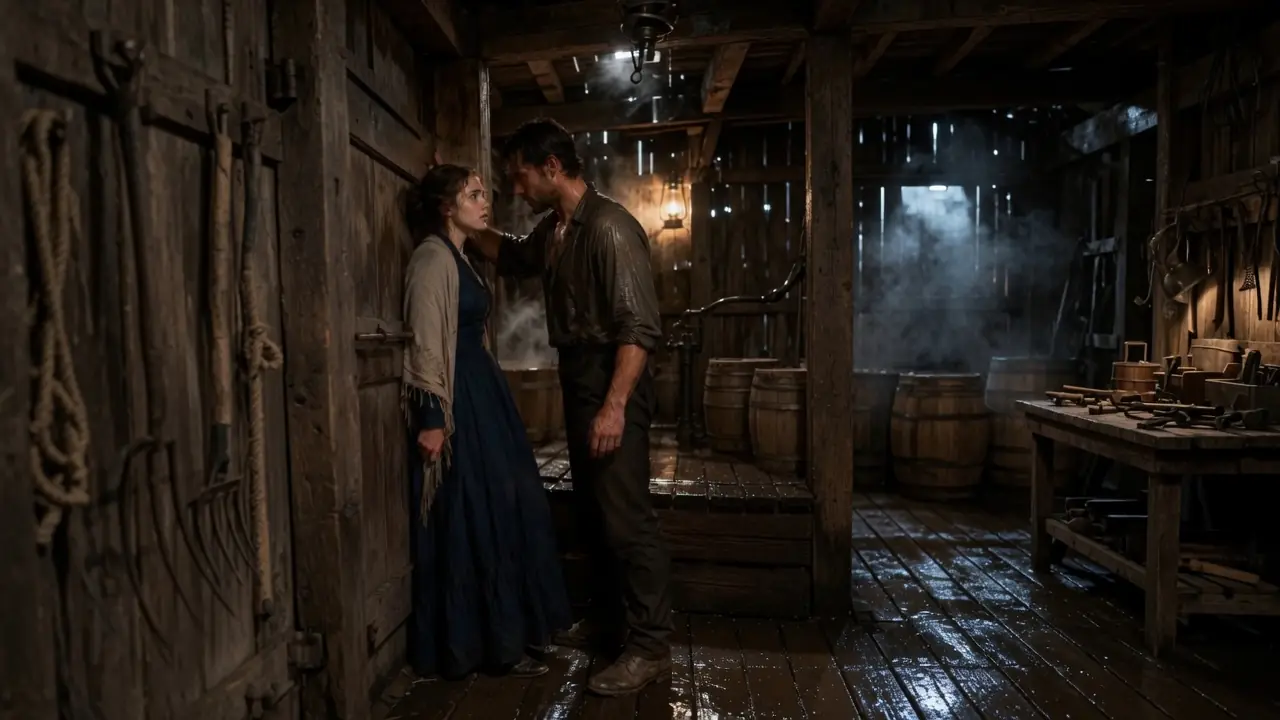
Her father’s mouth tightened. “Because men like Hale charm councils with diagrams while families lose crops.” Gideon gave a bitter laugh. “You did not do this for farmers. You did it for Bellweather Rail.” Clara turned sharply toward Gideon, then back to her father. Bellweather Rail had been trying to force passage through Gideon’s land for months.
If Gideon’s waterworks were declared dangerous, the county could condemn the property and sell right-of-way rights. Professor Whitcomb looked at Clara, and in that glance she saw the last piece fall into place. “They paid you,” she whispered. He flinched, and that was answer enough. Clara felt the world she had trusted tilt beneath her.
“Clara, listen to me,” he said. “No,” she replied, voice breaking. “You used science like a thief uses a knife.” Her father lifted his hand, perhaps only to silence her, but Gideon stepped forward so fast Whitcomb froze. “Do not lift a hand at her,” Gideon said.
The professor’s face twisted with contempt. “You think you can protect her? You, who let your wife die in a house full of machines?” The words struck the barn like a gunshot. Clara turned toward Gideon, but he had gone utterly still. For one terrifying moment, she thought the accusation would break him.
Instead, Gideon moved closer to Whitcomb until the older man backed into the doorframe. “My wife died of fever,” Gideon said, each word carved from stone. “My daughter died two days later. The machines did not take them.” His eyes burned with years of buried rage. “But men like you have spent two years trying to make my grief sound like guilt.”
Clara stepped beside Gideon, not behind him. “My father planted that wedge,” she said. “I saw the cloth. I saw his face when he entered. I will testify before the council.” Professor Whitcomb stared at her as if she had become a stranger. “You would ruin your own father for this man?”
“No,” Clara said. “You ruined yourself. I am only refusing to hide beside your lie.” Gideon looked at her then, and something in his face shifted. Not love, not yet, but recognition. It was the look of a man seeing someone choose truth when silence would have been easier.
By dawn, the sheriff had the wedge, the marked cloth, and Professor Whitcomb’s satchel, which held a Bellweather Rail payment draft folded inside a botany journal. The valley woke to scandal before breakfast. Men who had called Gideon dangerous now learned how close they had come to believing a disaster staged for their fear. Clara gave her statement at the courthouse with her wrist wrapped in linen and Gideon standing silently near the door. Her father would not look at her.
When the sheriff led Professor Whitcomb away for formal inquiry, he spoke only once. “You have chosen poorly, Clara.” Clara answered before Gideon could. “No, Father. For once, I chose with my eyes open.” Then she walked out into the morning air and breathed as if the world had changed its shape overnight.
At the courthouse steps, Gideon stopped a respectful distance behind her. “I am sorry,” Clara said without turning. “For hiding. For lying. For my father.” Gideon looked toward the river road, where daylight touched the wet wheels of his wagon. “I am sorry I let you keep hiding,” he replied.
Clara turned. “Why did you?” His face was tired, honest, and unguarded at last. “Because every night you came, I thought you might speak.” The answer reached her more deeply than she expected. “And if I had?” she asked. “Then I would have answered,” Gideon said.
The months that followed did not make gossip kinder. Rockbridge County did not know what to do with a disgraced professor’s daughter and a widowed inventor who spoke more to river wheels than townspeople. Clara moved into a room above Mrs. Bell’s apothecary and helped catalogue medicinal plants while the inquiry against her father wound through court. Gideon repaired the barn, reinforced the sluice, and replaced the treacherous floorboard with oak so solid it would likely outlive them both. She did not return by hiding.
She came by daylight, notebook in hand, and knocked on the barn door. At first, Gideon answered only questions about water pressure, valve timing, and flow balance. Then he began asking her about willow bark, river mint, soil rot, and why certain mosses grew stronger near the channel. They rebuilt trust like one of his machines, piece by piece, careful not to force what needed to fit naturally. Clara learned where he kept Ruth’s old books and never touched them without permission.
Gideon learned that Clara took more sugar in her coffee than any scientist would proudly admit. He also learned that when she was embarrassed, she looked down and pretended to be studying the floor. Neither of them spoke of love, because the word seemed too quick for what had survived floodwater, betrayal, shame, and truth. Instead, they stood beside running water and learned the rhythm of one another’s silence.
One evening, long after the barn had dried and summer had turned the fields green, Clara stood beside the repaired partition. The oak board beneath her foot did not groan. Gideon came to stand across from her, wiping iron dust from his hands, and for a moment they were again where they had begun. The difference was that no wall stood between them now. No lie did either.
“I knew the first time,” Gideon said quietly. Clara looked up. “That I was hiding?” He shook his head. “That you would change everything.” She reached for his hand then, and this time neither of them stepped back.
Outside, the river moved through the channels without violence, turning wheels that no longer sounded like grief. Clara watched Gideon’s fingers close around hers, strong, scarred, and careful. Some secrets destroy a house, she thought. Some secrets save one, once dragged into the light. And some, once spoken, become a door.