At 9:06 on a gray San Francisco morning, Adrian Mercer walked through the lobby of the Four Seasons carrying a leather portfolio under one arm.
Navy polo.
Pressed khakis.
White sneakers.
No tie.
No entourage.
No visible reason for anyone to assume he controlled several billion dollars.
Across the lobby, Claire Whitmore stood beside the windows laughing with two German investors.
Cream Chanel suit.
Diamond earrings.
Hair pulled into a perfect knot.
Everything about her seemed designed to communicate one fact before she opened her mouth.
She belonged here.
Adrian checked his watch.
Six minutes late.
Traffic.
His assistant had already notified Claire’s office.
He crossed the marble floor.
“Ms. Whitmore?”
Claire turned.
The smile on her face disappeared.
“Adrian Mercer.”
He extended his hand.
“We have the nine o’clock meeting regarding your Series C.”
Claire stared at his hand.
Then at his clothes.
Then his face.
Her own hands remained around the handle of her purse.
“Excuse me?”
“Mercer Capital.”
No recognition.
“My assistant Priya confirmed with your office three weeks ago.”
Claire took one small step backward.
“This is a private investor meeting.”
“I know.”
The silver-haired German beside her shifted uncomfortably.
Adrian kept his hand extended.
Claire looked at it as though accepting it might create some obligation she did not want.
“Who let you in?”
Adrian lowered his hand.
“I walked through the front door.”
“I mean into this meeting.”
“I was invited.”
Claire laughed once.
Not because anything was funny.
“You expect me to believe you’re representing an investment firm?”
“I am.”
“In that?”
She looked deliberately at his polo.
A woman sitting near the concierge desk lifted her eyes from her phone.
Adrian felt something familiar settle inside his chest.
He had felt it at nineteen.
At MIT.
At twenty-five.
At investment conferences.
At restaurants.
At corporate offices where people occasionally handed him empty coffee cups without asking who he was.
He kept his voice steady.
“If you call your assistant, this can be cleared up in thirty seconds.”
Claire’s expression hardened.
“What can be cleared up is that you’ve approached a private conversation between serious investors and misrepresented yourself.”
“I haven’t misrepresented anything.”
“Mercer Capital.”
“Yes.”
“Never heard of it.”
The German investor cleared his throat.
“Claire, perhaps—”
She raised one finger.
“I’ve got this.”
Then looked back at Adrian.
“You flew in from where?”
“New York.”
“For this?”
“Yes.”
“You expect me to believe a New York investment firm sent someone dressed for a weekend barbecue to discuss a half-billion-dollar financing round?”
Adrian said nothing for a moment.
Then:
“I came personally.”
Claire smiled.
That made it worse.
“Of course you did.”
She turned toward security.
“Excuse me.”
Two hotel security officers looked over.
Adrian’s jaw tightened.
“Ms. Whitmore.”
She ignored him.
“Could someone please remove this man?”
The older guard, a Black man named Samuel Reed, approached first.
His younger colleague followed.
Samuel looked at Adrian.
Then Claire.
“What seems to be the issue?”
“This man is disrupting a private business meeting.”
“I have an appointment.”
Claire snapped:
“No, you don’t.”
Adrian looked at her.
“My assistant confirmed it.”
“You keep saying that.”
“Because it’s true.”
“I don’t know what you’re trying to pull, but I’m not interested.”
A phone rose behind Adrian.
Someone had started recording.
He saw the reflection in the glass.
Claire saw it too.
Instead of becoming cautious, she became more performative.
“Frankly, this is exactly the kind of opportunism founders have to protect themselves from.”
The German investor frowned.
“Opportunism?”
Claire continued.
“People read about funding rounds online, show up at hotels, invent credentials, try to get access to people who actually belong in the room.”
Adrian looked directly at her.
“People who actually belong.”
She heard the emphasis.
Did not retreat.
“You know what I mean.”
“I think I do.”
Samuel shifted slightly.
“Sir, do you have identification?”
“Yes.”
Adrian reached slowly toward his pocket.
Claire immediately said:
“I don’t care what card he printed.”
Adrian stopped.
Something inside him became very calm.
Not forgiving.
Decided.
He looked at Samuel.
“I’ll leave.”
Samuel seemed surprised.
“Sir, if you can verify—”
“No need.”
Claire crossed her arms.
“You’ll be escorted.”
Adrian looked at her.
“That won’t be necessary.”
“I’d prefer it.”
“Why?”
“To make sure you don’t approach any other guests.”
There it was.
Adrian picked up the portfolio he had briefly set on a side table.
Then walked toward the door.
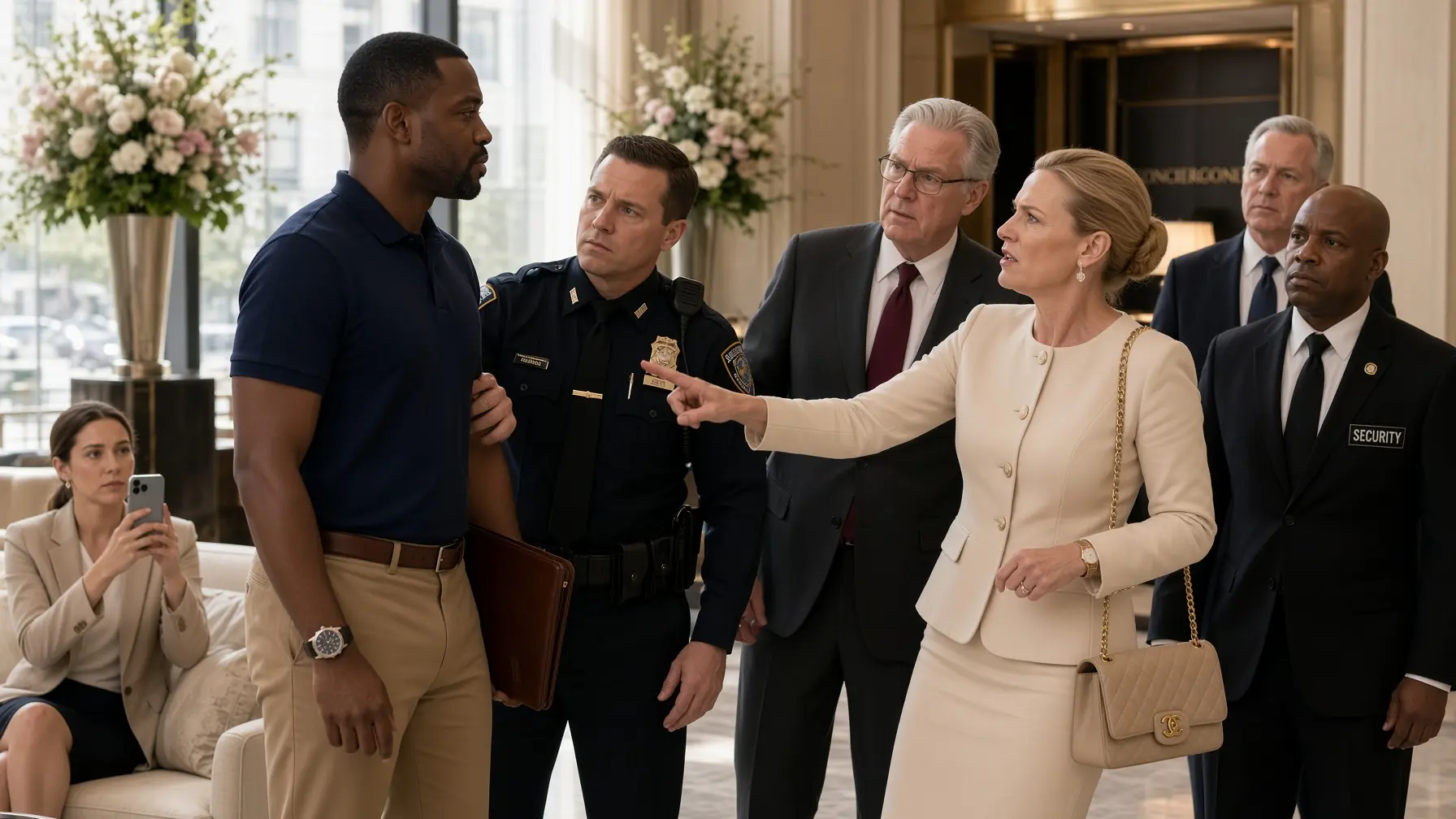
Samuel stayed beside him without touching him.
At the entrance, he lowered his voice.
“Sir.”
Adrian looked over.
“I’m sorry.”
“You didn’t make the decision.”
“No.”
“But I still helped carry it out.”
Adrian considered him.
“You asked a question first.”
Samuel looked confused.
Adrian continued.
“That matters.”
Outside, cold air struck his face.
His phone buzzed immediately.
Priya.
Everything okay? Claire’s assistant says the meeting ended.
Adrian typed:
Cancel Los Angeles. Get me home.
Three dots appeared.
Then:
And Whitmore?
Adrian looked back through the hotel windows.
Claire had already turned toward the German investors.
Laughing again.
As though nothing had happened.
He typed:
We’re done.
Three months earlier, Whitmore Systems had been valued at nearly eight hundred million dollars.
Now valuation mattered less than survival.
The company was burning more than seven million dollars in cash each month.
Its flagship logistics platform was technically impressive but expensive to scale.
Two enterprise clients had delayed contracts.
A major product launch slipped six months.
Bank debt covenants were tightening.
The company had approximately eleven weeks of operating runway.
Claire knew the number by heart.
Eleven weeks.
The phrase had begun appearing in her dreams.
She had spent eight months pitching investors.
Twenty-three firms.
Twenty-three rejections.
Some said the company required too much capital.
Some disliked the market.
Several disliked Claire.
One investment committee memo leaked.
Strong technology. Weak leadership adaptability.
Another investor wrote privately:
Founder appears resistant to dissent and overly dependent on personal instinct.
Claire called that cowardice.
Her CFO called it feedback.
Marcus Lee had worked beside Claire for five years.
He was forty-six.
Methodical.
Quiet.
Brilliant at the work Claire found boring.
Cash flow.
Controls.
Operational planning.
Risks that did not photograph well.
He had repeatedly warned her:
“The technology is not what’s scaring investors.”
“What is?”
“You.”
Claire laughed the first time.
She stopped laughing around rejection number eighteen.
Mercer Capital was their final serious option.
Marcus had made the introduction.
He knew Adrian’s CFO from years earlier.
The firm had spent eight months reviewing Whitmore Systems.
Technical diligence was nearly complete.
The preliminary investment size discussed internally was as high as five hundred million dollars.
Enough to refinance debt.
Finish the product.
Extend runway.
Give the company time.
Claire knew all of that.
What she did not know was what Adrian Mercer looked like.
Because she had never opened the briefing document her assistant sent.
At 10:41, Claire returned to her office on the forty-second floor.
The German investors had left.
Again.
They had repeated the same answer they gave last week.
No.
Claire decided the morning had been a waste.
She opened her laptop.
“Jenny?”
Her assistant appeared at the door.
“Yes?”
“Delete the credentials for that man at the hotel.”
Jenny did not move.
“What man?”
“The one claiming to be from Mercer Capital.”
Jenny’s face changed.
“Adrian Mercer?”
“Yes.”
A pause.
“Ms. Whitmore…”
“What?”
“That was the investor.”
Claire looked up.
“What investor?”
Jenny stepped inside.
“Adrian Mercer.”
“I know his name.”
“No.”
Jenny swallowed.
“I mean Adrian Mercer.”
Claire stared.
Jenny placed her tablet on the desk.
A financial profile filled the screen.
The photograph showed the same man.
Same face.
Same calm eyes.
In the image, he stood beside a conference-stage lectern wearing a dark polo shirt.
The headline read:
ADRIAN MERCER BUILT ONE OF THE QUIETEST POWERHOUSES IN PRIVATE CAPITAL
Claire stopped breathing.
She scrolled.
Founder.
Managing partner.
Mercer Capital.
Several billion under management.
Former software entrepreneur.
MIT.
Successful exits.
Industrial technology.
Enterprise systems.
Governance-focused investor.
Then another article.
Adrian beside the CEO of a major semiconductor company.
Polo shirt.
Another.
Davos.
Open-collar shirt.
Another.
University speech.
Jeans.
Claire’s fingers became cold.
“Jenny.”
“Yes?”
“Tell me this isn’t him.”
Jenny said nothing.
That was worse than answering.
Claire stood.
Her chair rolled backward.
“How was I supposed to know?”
Jenny looked at her.
“The meeting brief had his photograph.”
“I didn’t read it.”
“I know.”
Claire looked up sharply.
Jenny immediately regretted the tone.
But the words were already there.
Claire whispered:
“Five hundred million.”
Jenny nodded.
“Potentially.”
Claire grabbed her phone.
“Get Marcus.”
Marcus entered three minutes later carrying quarterly cash forecasts.
Claire turned the tablet toward him.
“I made a mistake.”
He read the screen.
Then looked at her.
“What kind of mistake?”
“I had Adrian Mercer removed from the Four Seasons.”
Marcus did not react.
For several seconds.
Then:
“Removed.”
“Security.”
“From your meeting.”
“I didn’t know it was him.”
Marcus set the forecasts down carefully.
“Claire.”
“He wasn’t dressed—”
Marcus closed his eyes.
She stopped.
That expression was worse than anger.
“You didn’t know what he looked like.”
“No.”
“So you asked his name.”
“Yes.”
“He said Adrian Mercer.”
“Yes.”
“And you still had him removed.”
Claire’s mouth opened.
Nothing useful came out.
Marcus pulled out his phone.
“Why?”
“He looked…”
He waited.
Claire hated him for waiting.
“Out of place.”
Marcus looked at her.
There it was.
The thing she had avoided naming.
He sat down.
“Do you know what Mercer says in almost every founder interview?”
Claire did not answer.
Marcus continued.
“He dresses casually for first meetings because he wants to see how people respond before they know what he can do for them.”
Claire looked toward the bay.
“You’re joking.”
“I’m not.”
“So it was a test.”
Marcus shook his head.
“Don’t do that.”
“What?”
“Turn this into him tricking you.”
She faced him.
“He deliberately dresses down.”
“And you deliberately called security.”
Silence.
“That wasn’t created by his shirt.”
Claire sat slowly.
“What do we do?”
Marcus laughed once.
Not with humor.
“You call him.”
She already was.
Voicemail.
She tried again.
Voicemail.
Then email.
Mr. Mercer, I sincerely apologize for the confusion this morning. I failed to properly review my schedule and would appreciate an opportunity to reschedule.
Marcus read it over her shoulder.
“No.”
“What?”
“Delete it.”
“Why?”
“Because ‘confusion’ means nothing happened.”
She looked at him.
“What should I say?”
“The truth.”
Claire stared at the blank screen.
The truth was harder to type.
At 11:18, Adrian sat aboard a flight preparing to leave San Francisco.
Priya called.
“She sent an email.”
“I saw it.”
“Are you replying?”
“No.”
“James thinks we should formally decline.”
“Not yet.”
“Why?”
Adrian looked through the airplane window.
“Because we invested eight months of work.”
“So?”
“And there are three thousand employees inside that company who did not throw me out of a hotel.”
Priya went quiet.
“You’re still considering it?”
“No.”
He paused.
“I’m considering whether we walk away completely or find a structure where the company survives without rewarding the governance failure.”
“That sounds difficult.”
“It is.”
“That usually means you like it.”
He almost smiled.
“Ask James to model alternatives.”
“What kind?”
“Capital with leadership conditions.”
“Board control?”
“Maybe.”
“CEO transition?”
“Maybe.”
“Independent audit?”
“Yes.”
Priya hesitated.
“Do you think she’s racist?”
Adrian looked out at the runway.
“I think she made a racialized assumption about me.”
“That’s not the same question.”
“No.”
“Then?”
“I don’t know her well enough to diagnose her soul.”
The plane began moving.
“But I know enough not to hand her five hundred million dollars with no governance protections.”
By noon, Claire’s morning had become public.
The woman who recorded the hotel incident posted a short video.
It showed Adrian approaching.
Introducing himself.
Extending his hand.
Claire refusing.
Her words:
People who actually belong in the room.
Then security walking him out.
The post did not identify Adrian.
At first.
The German investor did not either.
He posted:
Leadership is easiest to evaluate when someone thinks the other person has nothing to offer. Saw a disturbing example today.
Within an hour, someone recognized Adrian.
Then everything accelerated.
Claire watched social media turn fifteen minutes of her life into a permanent object.
She wanted to call the video misleading.
It was not.
She wanted to say Adrian had behaved suspiciously.
He had not.
She wanted to explain that she had been under pressure.
She had.
Pressure did not explain the specific assumption she made.
By two o’clock, the board chairman called.
His name was Thomas Avery.
“Tell me what happened.”
Claire began:
“There was a misunderstanding—”
“No.”
She stopped.
Thomas continued.
“I watched the video.”
Claire stared at the floor.
“Then you know.”
“I know what the camera shows.”
Silence.
“Was he aggressive?”
“No.”
“Threatening?”
“No.”
“Did he refuse to identify himself?”
“No.”
“Then why did you call security?”
Claire closed her eyes.
“Because I thought he was lying.”
“Why?”
She could not answer without saying it.
Thomas waited anyway.
Finally:
“Because he didn’t look like the investor I expected.”
Thomas spoke more quietly.
“That’s going to be a problem beyond the funding round.”
“I know.”
“No.”
His voice hardened.
“I’m not sure you do.”
At four o’clock, Marcus returned.
“The Mercer investment is not moving forward under the original term sheet.”
Claire felt the room tilt.
“Did they say that?”
“Yes.”
She gripped the desk.
“Then we’re dead.”
“Maybe.”
She looked up.
Marcus continued.
“James Nolan called me.”
Adrian’s CFO.
“He said Mercer is evaluating an alternative recapitalization.”
Claire stared.
“What does that mean?”
“Potential investment.”
“Different governance.”
“How different?”
Marcus placed a document on the desk.
“Board control.”
Her face changed.
“Absolutely not.”
“Then prepare Chapter 11 options.”
Claire glared.
“You’re serious.”
“We have eleven weeks.”
“Ten and a half now.”
She looked down at the draft.
New independent directors.
Board finance committee.
External culture and retention review.
Independent HR reporting.
Founder no longer holding unilateral hiring and promotion authority for executives.
CEO succession process.
Claire pushed it away.
“He’s using what happened to steal my company.”
Marcus did not touch the paper.
“No.”
She looked at him.
“He’s pricing the risk you showed him.”
“That’s the same thing.”
“No.”
Marcus’s voice remained level.
“If he wanted to punish you, he could walk away and let the company collapse.”
He pointed at the document.
“This keeps employees paid.”
“Shareholders diluted.”
“You diluted them when the company ran out of money.”
Claire stared at him.
Marcus continued.
“You need to stop confusing consequences with persecution.”
Claire called Adrian seventeen times over the next twelve hours.
He answered none.
Her final voicemail was different.
No mention of rescheduling.
No explanation.
“Mr. Mercer.”
She paused.
“I watched the video.”
Another pause.
“I heard what I said.”
Her voice cracked.
“I keep wanting to explain it.”
“I don’t have an explanation that makes it better.”
“I treated you like you didn’t belong because you didn’t match the person I expected to have money.”
She swallowed.
“That was wrong.”
“I’m asking for fifteen minutes.”
“Not for forgiveness.”
“For the company.”
She ended the call.
At six the next morning, Claire boarded a flight to New York.
She arrived at Mercer Capital shortly after noon.
No appointment.
The receptionist checked.
Adrian would not see her.
Claire sat anyway.
One hour.
Two.
Three.
People passed.
Some recognized her.
A few whispered.
The reversal was impossible to miss.
Yesterday she had controlled the room.
Today she was waiting for someone else to decide whether she deserved access.
At 4:10, the receptionist approached.
“Ms. Whitmore.”
Claire stood.
“Mr. Mercer can give you fifteen minutes.”
She followed the receptionist upstairs.
Adrian waited in a small conference room.
No view.
No mahogany.
No intimidating board table.
Just six chairs.
He wore a gray shirt with the sleeves rolled once.
Claire entered.
He did not stand.
“Sit.”
She did.
For several seconds, neither spoke.
Then Claire began.
“I’m sorry.”
Adrian raised one hand.
“Before you apologize.”
She stopped.
“I need to know which thing you’re sorry for.”
Her throat tightened.
“Calling security.”
“Why?”
“Because you were invited.”
Adrian shook his head.
“Try again.”
Claire looked down.
“Because you hadn’t done anything.”
“Closer.”
She took a breath.
“Because I looked at you and decided what you were before I knew anything about you.”
Silence.
“And what did you decide?”
“That you weren’t an investor.”
“Why?”
Claire looked at him.
His face held no anger.
That somehow made it harder.
“Because you were Black.”
“And?”
“Casually dressed.”
“And?”
She swallowed.
“I associated those things with not belonging in that room.”
Adrian nodded once.
“There.”
Claire wiped beneath one eye.
“If I had known who you were—”
“Don’t.”
She stopped.
“That sentence is the entire problem.”
He leaned back.
“If you had known my net worth, you would have treated me well.”
“Yes.”
“At least you’re honest.”
He looked toward the table.
“But if I had been a junior engineer?”
Claire said nothing.
“Hotel guest?”
Nothing.
“Courier?”
Her eyes lowered.
“Someone looking for directions?”
“No.”
“No what?”
“No.”
Her voice broke.
“I wouldn’t have treated a white man that way.”
Adrian nodded.
“That’s what I needed you to understand.”
Claire drew a breath.
“I’m not asking you to forget it.”
“Good.”
“I’m asking you to consider three thousand employees who had nothing to do with what I did.”
“I have.”
That surprised her.
“You have?”
“Yes.”
Adrian slid a document across the table.
Not a punishment list.
Investment terms.
Claire read.
Mercer Capital would invest up to four hundred million immediately, with an additional one hundred million available against operational milestones.
But the money would not go under the old structure.
A seven-member board.
Four independent seats.
Claire could remain CEO during a ninety-day transition review, but leadership would be evaluated by the new board.
An outside firm would conduct a workplace culture and promotion audit.
No predetermined racial quota.
No press stunt.
No donation demanded personally by Adrian.
No compulsory confession as a condition of funding.
Instead:
Documented promotion criteria.
Independent complaint channel.
Whistleblower protection.
Quarterly workforce and retention metrics to the board.
Related governance controls.
If the audit uncovered discrimination or retaliation, corrective action would be mandatory under board supervision.
Claire finished reading.
“You’re not requiring me to resign.”
“No.”
“Why?”
“Because I don’t make executive decisions based on viral video.”
She looked at him.
“You could.”
“I could also light money on fire.”
He leaned forward.
“The incident tells me you’re a governance risk.”
“It does not tell me whether you’re incapable of changing.”
“That requires evidence.”
Claire looked at the document.
“And if the board decides I should go?”
“You go.”
Her jaw tightened.
“This is my company.”
Adrian looked at her.
“No.”
She stiffened.
He continued.
“It belongs partly to employees who built it.”
“To shareholders who funded it.”
“To lenders with claims.”
“To customers depending on it.”
“You founded it.”
“That doesn’t make everyone else furniture.”
Claire said nothing.
Adrian added:
“If you want total control, don’t take outside capital.”
That was impossible to argue with.
“What about the investment?”
Claire asked.
“If I sign?”
“You don’t sign alone.”
“The board does.”
“Subject to confirmatory diligence.”
“And what happened yesterday?”
“It will be disclosed.”
“To investors?”
“Yes.”
“To employees?”
“Yes.”
“To the public?”
“The public already knows.”
She winced.
Adrian continued.
“I am not buying silence.”
“Then what do you want?”
“A functioning company.”
He looked directly at her.
“And I want to know whether the way you treated me is an isolated failure or a reflection of how Whitmore works.”
Claire looked down.
“What if it’s worse than I know?”
“Then knowing is still better.”
She gave a small, broken laugh.
“Easy for you to say.”
“No.”
Adrian’s expression changed.
“It isn’t.”
She looked up.
“I’ve worked in companies where people like me knew exactly what was wrong and leadership preferred not to know.”
He pushed the agreement toward her.
“I’m giving the board a chance not to be one of them.”
Claire flew back to San Francisco that evening.
No dramatic handshake.
No forgiveness.
No friendship.
Just documents.
The Whitmore board met the following morning.
Arguments lasted six hours.
One director wanted to reject Mercer entirely.
Another wanted Claire removed immediately.
Marcus argued for the recapitalization.
Thomas Avery asked Claire to leave the room while they discussed her future.
She sat outside her own boardroom for ninety-three minutes.
When the door opened, Thomas called her back.
“The board has approved the Mercer financing.”
Claire nodded.
“And me?”
“You remain CEO for ninety days.”
Relief came too quickly.
Thomas continued.
“Do not mistake that for confidence.”
The relief vanished.
“The independent review begins Monday.”
“And after ninety days?”
“We decide whether you are still the right person to lead.”
Claire looked around the table.
Several directors would not meet her eyes.
Others looked at her more directly than ever before.
She signed.
The capital saved Whitmore Systems.
Not Claire.
The distinction became important.
Payroll continued.
Product development resumed.
The cooperative lender extended terms once new funding closed.
Customers regained confidence.
The company had time.
Then the audit began.
It was worse than Claire expected.
Not catastrophic.
Not a cartoon villain’s empire.
Something more believable.
Unequal promotion patterns.
Black employees receiving lower leadership-potential ratings despite similar performance.
Several complaints closed as “communication issues.”
A Latino engineering manager repeatedly described as aggressive while white colleagues with similar communication styles received praise for decisiveness.
Two Black women reported being mistaken for administrative staff inside their own department more than once.
One former employee wrote:
Whitmore rewards people who resemble Claire’s idea of leadership. The problem is that her idea has a very specific face.
Claire read that sentence alone.
Then again.
The auditors interviewed her for nine hours across three sessions.
They showed emails she barely remembered sending.
Strong technically, not polished enough for enterprise clients.
About a Black candidate.
Smart, but doesn't project executive presence.
About another.
The same month she promoted a white director known for swearing during client meetings because he had “natural authority.”
Claire stared at both performance files.
“What do you think?” the investigator asked.
Claire answered slowly.
“I think I thought I was evaluating personality.”
“And now?”
“I think I had a very narrow picture of what leadership looked like.”
“That is not the same thing as intentional discrimination.”
“No.”
She looked at the documents.
“But the outcome doesn’t care what word I used in my head.”
At the end of ninety days, the board removed Claire as CEO.
Not because Adrian demanded it.
He abstained from the discussion through Mercer Capital’s board representative because he did not want his personal experience to become the only basis.
The independent review found the company needed leadership capable of rebuilding trust.
Marcus Lee became interim CEO.
Claire moved to a non-executive founder role with no authority over hiring, compensation, promotion, or HR matters.
When Thomas informed her, she asked:
“Was this always the plan?”
“No.”
“Would I have stayed if the audit had been clean?”
“Possibly.”
That answer hurt more because she believed it.
She packed her office herself.
Stanford awards.
Magazine covers.
Photographs.
A framed headline naming her one of technology’s rising founders.
The final object was a photograph from Whitmore’s first year.
Six employees standing inside a rented warehouse.
Marcus was there.
So were three engineers who had since left.
Claire stared.
For years she had told herself she built the company alone because she had the original idea.
The picture disagreed.
Six months after Adrian Mercer walked out of the Four Seasons, Whitmore Systems held its first companywide meeting under permanent new leadership.
Marcus had been confirmed as CEO.
He stood before more than two thousand employees.
The independent audit findings appeared behind him.
No euphemisms.
Promotion disparities.
Retention gaps.
Complaint failures.
Management weaknesses.
“This is not evidence that every manager here discriminated.”
Marcus said.
“It is evidence that our systems produced unequal outcomes and often failed to examine why.”
Next slide.
Changes.
Structured promotion panels.
Written criteria.
Independent HR escalation.
Salary band reviews.
Manager training tied to actual decision-making, not generic videos.
Exit interviews reviewed quarterly by a board committee.
An anonymous reporting channel operated externally.
Marcus looked toward the room.
“We’re not announcing that the problem is solved.”
He changed the slide.
“We’re announcing that nobody gets to hide it anymore.”
Claire sat in the back.
Nobody introduced her.
She preferred that.
Adrian visited once each quarter.
Not to inspect Claire’s personal redemption.
To inspect his investment.
Whitmore hit most operational milestones.
The technology really was strong.
Employee turnover fell.
Customer retention improved.
The company still made mistakes.
Good companies did.
The difference was that more mistakes became visible before they became culture.
One year after the hotel incident, Whitmore Systems held its investor summit at the same Four Seasons.
Adrian almost suggested another venue.
Then decided against it.
Buildings did not commit harm.
People did.
He arrived at 8:58.
Charcoal polo.
Khakis.
Same leather portfolio.
Samuel Reed was still working security.
He recognized Adrian immediately.
“Mr. Mercer.”
Adrian smiled.
“Samuel.”
Samuel extended his hand.
Adrian shook it.
“Good to see you under better circumstances.”
“You too, sir.”
Claire stood inside the main conference room.
Not at the entrance.
Not waiting to perform a symbolic welcome.
She no longer ran the event.
When Adrian entered, she approached.
“Adrian.”
“Claire.”
She extended her hand.
He looked at it.
A year earlier, his had remained hanging in the air.
Claire noticed the hesitation.
“I understand if you don’t.”
Adrian took her hand.
One brief shake.
Professional.
Nothing more.
Claire released it.
“Thank you for coming.”
“Marcus invited me.”
She smiled faintly.
“I know.”
That was progress too.
Not needing every good thing to be about her.
Later, during a panel, a journalist asked Adrian:
“You invested after being personally humiliated by the founder. Why?”
Adrian considered the question.
“Because Whitmore had three thousand employees.”
“And because the product had value.”
“And because governance can sometimes be repaired.”
“Did Claire deserve the second chance?”
Adrian shook his head.
“I don’t think investment decisions should be framed around what one individual deserves.”
The room quieted.
“The employees deserved a company worth saving.”
“The shareholders deserved professional governance.”
“The customers deserved continuity.”
“And Claire deserved due process, including the possibility that the audit might not support the worst assumptions people made about her after the video.”
The journalist looked surprised.
“She discriminated against you.”
“Yes.”
“You don’t sound angry.”
“I was angry.”
“Then?”
“Anger can tell you something is wrong.”
He looked toward the audience.
“It cannot always tell you the correct remedy.”
The journalist turned toward Claire.
“What would you tell the woman you were that morning?”
Claire remained quiet for a long time.
Then:
“You thought being successful meant your instincts were better than everyone else’s.”
A few people shifted.
“You thought prejudice belonged to obviously hateful people.”
“So you never examined your own shortcuts.”
She looked toward Adrian.
“You saw a Black man in a polo shirt and decided he could not possibly be the person you needed.”
Her voice tightened.
“The most embarrassing part is not that he turned out to be a billionaire.”
“It’s that if he had been nobody important, I probably would have walked away believing I had handled the situation correctly.”
The room became still.
“That is the thing I have had to live with.”
Not:
I lost my company.
Not:
I lost my title.
Something harder.
“I was kind when kindness was socially rewarded.”
“I was generous when generosity came with plaques.”
“I donated to causes.”
“I said the right things.”
“But when I thought nobody powerful was watching, my instincts told the truth about me.”
Adrian did not rescue her from the silence.
She finished herself.
“I’m still working on changing those instincts.”
Claire never became CEO again.
For several years, that fact bothered her.
Eventually, less.
She advised a few early-stage founders.
Always with another independent director involved.
She spoke occasionally about governance failures, though she stopped accepting panels that wanted a simple redemption story.
When audiences applauded too warmly, she grew uncomfortable.
“I’m not here because I handled something well.”
She would say.
“I’m here because I handled something terribly and survived long enough to study why.”
Adrian respected that more than any public apology.
They never became close friends.
That also made the story less satisfying to people who preferred clean endings.
They worked together.
Sometimes disagreed.
Sometimes laughed.
Never forgot what happened.
That was enough.
Years later, business students still watched the Four Seasons video.
The most replayed moment was always the same.
Adrian’s hand extended.
Claire’s hands remaining still.
A few seconds.
Nothing dramatic.
No shouting yet.
No security.
No viral consequences.
Just one person offering ordinary professional courtesy and another deciding, almost instantly, that the person offering it could not possibly belong.
Professors often asked:
“What was Claire’s most expensive mistake?”
Students answered:
Calling security.
Losing control of the financing.
Ignoring the briefing.
Damaging her reputation.
Adrian, when invited to speak, gave a different answer.
“She made the conclusion before asking the question.”
Then he explained.
The clothes were evidence to her.
His skin was evidence.
The hotel was evidence.
Her expectations were evidence.
Everything except the one thing that would have resolved the situation.
Asking:
Are you Adrian Mercer?
Or checking the meeting schedule.
Or calling her assistant.
Ten seconds.
Maybe twenty.
Instead, assumption became certainty.
Certainty became humiliation.
Humiliation became a business crisis.
Adrian never claimed bias could be eliminated by hiring more consultants or publishing better slogans.
He believed something simpler.
Good systems created friction between assumption and consequence.
Verification before removal.
Written criteria before promotion.
Independent review before complaints disappeared.
More than one person involved when power could seriously affect somebody’s life.
Because everyone had bias.
The dangerous part was building organizations where bias could act quickly and invisibly.
The last time Claire and Adrian discussed the hotel, they were waiting for an elevator after a board meeting.
Claire looked at his shirt.
Black polo.
Adrian noticed.
“What?”
She smiled.
“Nothing.”
“That was definitely something.”
“I was thinking about how much trouble one polo shirt caused me.”
Adrian shook his head.
“No.”
She looked at him.
“The shirt didn’t cause anything.”
Claire laughed softly.
“I know.”
The elevator arrived.
Before stepping inside, she said:
“You know what I wish I could change?”
“The obvious?”
“Besides that.”
He waited.
“I wish you hadn't been rich.”
Adrian raised an eyebrow.
Claire continued.
“Because then I would have had to learn the lesson without the convenient twist.”
He understood.
“If you had been an ordinary man…”
“I still should have shaken your hand.”
“Yes.”
“I still should have listened.”
“Yes.”
“I still should have checked.”
“Yes.”
She looked down.
“And the fact that you had five hundred million dollars should never have been the thing that made any of that obvious.”
Adrian smiled slightly.
“That’s the first thing you’ve said about that morning that I completely agree with.”
The doors opened.
They stepped inside.
A young hotel employee entered behind them carrying a stack of boxes.
Claire moved aside immediately.
“Need help?”
The employee looked surprised.
“I’m okay.”
“Sure?”
“Yes, ma’am.”
Claire nodded.
Nothing heroic.
No music.
No cameras.
No audience.
Adrian noticed anyway.
The elevator doors closed.
And that, he thought, was probably what change looked like when nobody was filming.