The morning was cold in the village of Ashbourne, and the sky above the little stone road looked like a wet gray sheet. A thin rain had fallen through the night, and now the road was full of soft brown puddles that shone like old coins. The wind moved slowly across the fields, and it carried the smell of wet hay, of horses, and of wood smoke from a hundred small chimneys. It was the kind of morning that made people pull their coats tight and speak in low voices, as if the day itself was still asleep.
A young woman named Vivienne Marchmont stood at the edge of the village green with a small brown basket in her hand. She was not tall, and she was not grand. She wore a plain gray wool cloak that had been mended twice at the hem, and her boots were old but clean. Her hair was the color of dark honey, pulled back in a simple knot at the nape of her neck, and one loose curl kept falling against her cheek.
She pushed it back with the side of her wrist, because her fingers were full of the basket and the small purse tied to her sash. She was waiting for the cart. Every Wednesday the old carter, Mr. Peary, drove his wooden cart from Ashbourne to the market town of Wren Hollow, six miles east along the stone road. He took whoever paid him a penny, and he took whatever they carried.
Vivienne had six eggs in her basket, wrapped in clean linen, and a small jar of her mother's honey. She would sell the eggs and the honey, and she would buy a bit of blue thread and a paper of pins, and if there was enough left, a small piece of dried fish for her father's supper. Her father had been ill for two winters now, and dried fish was one of the few things he would still eat. The cart came up the road slowly.
The old horse's hooves made a soft wet sound on the stones. Mr. Peary sat up on the front seat with a heavy cloak pulled around his shoulders, and he lifted one hand to Vivienne as he came near. The cart was already full. Three women from the village sat on the wooden bench along the back, and a boy of about ten sat on the flatbed of the cart with his feet hanging down. There was one small space left, right beside the boy, and Mr. Peary nodded at it.
“Miss Marchmont,” he said. His voice was rough from many cold mornings. “You are the last. That is the last seat. Climb up and mind the wheel.”
Vivienne set her foot on the wooden step, and she pulled herself up. The basket bumped against her hip. She settled onto the small space beside the boy, and she smiled at him. He smiled back, showing a gap where a tooth had recently fallen out.
The cart began to move again, slow and steady, the wheels turning through the puddles with a wet, patient sound. They had not gone more than half a mile when Vivienne saw him. A man stood by the side of the road near a low stone wall, and he was leaning against the wall as if his legs would not hold him much longer. His coat was a good coat, dark green wool, but it was streaked with mud along the sleeves and the hem. His boots were fine leather, but they were caked with clay to the ankles.
His hair was black, cut short, and it stuck to his forehead with rain. His face was pale, and there were dark hollows under his eyes. He was not old. He looked perhaps thirty, perhaps a little more, but he looked tired the way a man looks who has walked for many hours without rest. He was tall, and even leaning against the wall he took up space, as if the wall itself was smaller because he stood against it.
He did not raise his hand. He did not call out. He only watched the cart come near, and then he watched it move past, and his eyes were the eyes of a man who did not expect help. Vivienne turned her head as the cart passed him. She saw the way his hand rested on his own knee, the way his shoulders bent forward just a little.
She saw the mud on his boots, and the raw scrape along the back of his hand. She smelled, as the cart went by, the sharp cold smell of wet wool and rain, and something else, something faint, like blood or hard walking. “Mr. Peary,” she said. Her voice was quiet, but it carried. The old carter turned his head.
“Miss?” “That man back there—he looks poorly. Might we take him up?” Mr. Peary slowed the horse and looked back over his shoulder. He squinted at the stranger by the wall.
“No room, Miss. Cart is full. You saw. I saw. Then you know.”
She was quiet for a long moment. The wheels turned. The rain had started again, small and cold, and it touched the back of her neck. She thought of her father, who had walked once from Ashbourne to Wren Hollow in a rain like this, and who had come home coughing, and who had never quite stopped coughing since.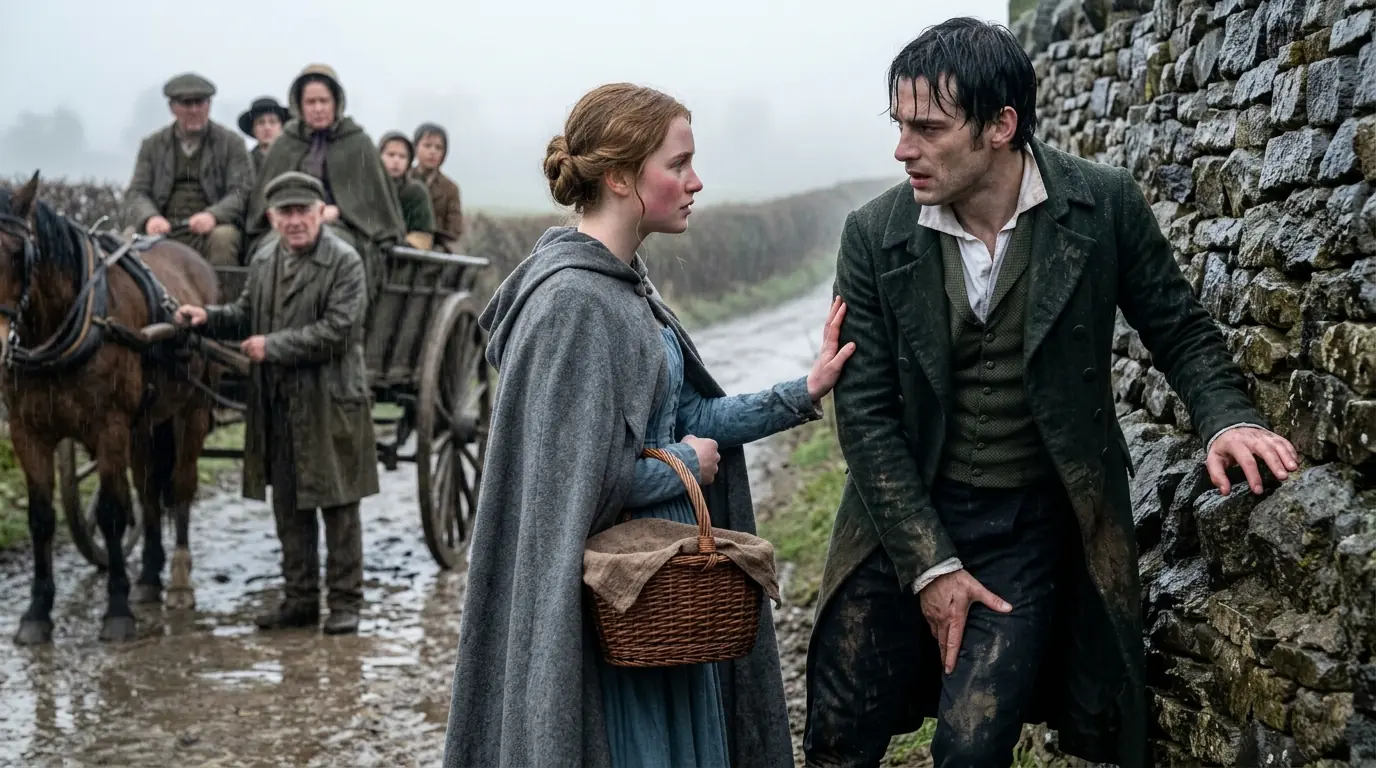
She thought of how a person could be broken by a small thing, a wet day, a long road, no one stopping. “He may have my seat,” she said. Mr. Peary turned all the way around. “Miss?”
The three women on the back bench were watching her now, and the boy beside her was watching her, too. One of the women, a stout woman named Mrs. Bramley, whose husband kept the small alehouse, made a soft sound with her tongue against her teeth. It was not a kind sound. It was the sound of a woman who thought young girls should know their place, and their place was not in the road.
Vivienne did not look at Mrs. Bramley. She climbed down from the cart, careful with the basket, and she stood in the wet road with the rain touching her face. She lifted her chin, and she walked back along the road toward the man by the wall. Her boots made small splashes in the puddles.
Her cloak grew heavy at the shoulders. The man watched her come. He did not straighten up. He did not smile.
His face stayed the same tired face, but his eyes moved. They moved from her boots up to her face, and they stayed there. “Sir,” she said, when she had come near, “there is a cart. It goes to Wren Hollow. There is a seat if you will take it.”
He did not answer at first. He looked past her, at the cart, at the horse, at Mr. Peary and the three women and the boy. Then he looked back at her. “And you?” he said.
His voice was low, and it was not a village voice. It was the voice of a man who had been taught to speak well, though the tiredness rubbed the edges of it. “I will walk.” “To Wren Hollow?” “Yes, that is six miles.”
“I know.” He was quiet. The rain fell on his black hair, and a single drop ran down the side of his face. He did not wipe it away. “Why?” he said.
She thought about the answer. She thought about her father and the cough that had never gone. She thought about the way this man was leaning against the wall, and how a wall was not a chair, and how a chair was not a bed, and how none of those was what he needed. She thought about how easy it was to pass a person, and how hard it was to stop. “You look as though your legs will fail you before mine will,” she said.
“That is the whole of it.” Something moved in his face. Not a smile, something smaller. His mouth tightened for a moment and then softened. He looked at her for a long breath and she felt the weight of that look the way she had felt the weight of the rain on her cloak.
“I do not know your name,” he said. “Vivienne Marchmont.” “Miss Marchmont.” He nodded, very slow. “I will remember it.”
He pushed himself off the wall. He was slower than a man his age should have been. She saw him wince as his right foot took his weight. He walked with her back to the cart and she saw that he tried to hide the limp and could not. “Mister.”
Peary looked down from the front seat. “Sir,” he said uncertain now because up close the man's coat was very fine, mud or no mud. “Miss Marchmont has given me her seat.” the man said. “I accept if you will have me.” “A penny, sir.”
The man reached into the inside of his coat. He drew out a small purse and he handed Mr. Peary a coin. Vivienne did not see what coin it was but Mr. Peary looked at it and then looked at the man and did not say another word. The man climbed into the cart, slow, careful of his right leg and he settled onto the small space Vivienne had left. He looked down at her.
“Miss Marchmont,” he said again. “I have never yet been shamed by a kindness. I do not know how to bear it. You need not bear it, sir. You need only sit.”
He gave a small breath that was almost a laugh and then his face went tired again. “Mister.” Peary clicked his tongue and the horse walked on and the cart moved away down the wet stone road with the man's dark head above the others. Vivienne stood in the road and watched the cart grow small.
Then she turned and began to walk. The rain was harder now. She pulled her hood up. Her boots sounded on the stones.
She had six miles ahead of her and a basket on her arm and her cloak was already wet through at the shoulders. She did not look back. She did not know that the man in the cart looked back at her twice. She did not know that the second time he almost told Mr. Peary to stop.
That he had changed his mind. That she must have the seat again. She did not know that only the pale of his own face in the tiny bit of mirror on the front of Mr. Peary's cart, only the sight of how nearly he had fallen at the wall made him stay where he was. She walked. The road turned east through low fields where sheep stood in patient gray groups.
The rain fell steady. Her hem grew heavy with wet. She thought about the man's voice. Not a village voice. Not a farmer's voice.
A voice from somewhere else. She thought about the fine dark green of his coat under the mud. She thought about the way Mr. Peary had looked at the coin and said no more. None of it was her concern. He was a stranger.
She would probably never see him again. She had done a small thing and small things were the only things she had to give. Her father had told her once when she was a little girl and had given her only sweet to a beggar's child at the church door that a person could not save the world but could put down a small stone in a stream. And a stone in a stream slowed the water if only a little. She had never forgotten it.
She put down small stones. That was who she was. She walked for two hours. The rain slowed. Then stopped.
Then started again. Her feet began to hurt. Her hand ached from the basket. Once a farm cart came by going the wrong way back toward Ashbourne and the driver called out to her. But she only smiled and said she was fine, and walked on.
Once she stopped by a low bridge and sat on the wet stones and ate a small piece of bread from her pocket. The bread was hard and the water in the stream below the bridge ran fast and brown from the rain. She listened to it for a moment. She thought again of the man's tired eyes. She reached Wren Hollow near the middle of the afternoon.
Her boots were soaked and her hem was heavy with mud and her cloak stuck to her back. The market was smaller than usual because of the rain, but she found her usual place and sold her eggs to Mrs. Fenn, the baker's wife, and her honey to old Mr. Hobbs, the schoolmaster. She bought her blue thread and her paper of pins and she bought a small piece of dried fish and she bought, because there was a penny extra she had not counted on, a small twist of sugar for her mother. She did not see the man in the dark green coat in Wren Hollow. She looked once or twice without meaning to.
She did not see him. She thought perhaps he had gone on farther or gone to some private house or gone to bed at an inn. It was none of her concern. She walked home in the last light of the afternoon. Her father's cough could be heard from the lane when she came near the cottage.
Her mother met her at the door, took the basket, made her sit by the small fire, and pulled the wet boots off her feet with a scolding tongue and gentle hands. Vivienne did not say anything about the man on the road. It seemed a small thing and small things did not need telling. Two days later, the news came to Ashbourne. It came in the way news always came, through Mrs. Bramley at the alehouse and old Mr. Peary who had told his wife, who had told the smith's daughter, who had told everyone.
The news was this, the man on the road with the dark green coat had not been a common traveler at all. He had been the duke of Ravenhurst himself, Alister Corvin, come north from London on some private matter, whose fine carriage had broken an axle in the mud six miles west of Ashbourne, and whose horse had gone lame under him after he had tried to ride on, and who had walked on a badly turned ankle until Miss Marchmont had given him her seat on Mr. Peary's cart without knowing who he was. The village heard this news the way villages hear news. Some laughed. Some clicked their tongues.
Mrs. Bramley told anyone who would listen that she had known from the first there was something odd about that man, though she had said nothing of the sort at the time. The smith said a duke was a duke, and it would have been proper to give him the seat whoever he was. The schoolmaster said Miss Marchmont had done a Christian thing, and would not have done less for a tinker. Vivienne heard the news from her mother, who had heard it from a neighbor, who had heard it from Mrs. Bramley. Vivienne was at the small kitchen table mending a tear in her father's shirt, and her needle did not pause when her mother spoke.
A duke, her mother said. Vivienne, a duke on our own road. Mhm, said Vivienne. She pulled the needle through. You gave your seat to a duke.
I gave my seat to a man who could not walk further. If he had been a tinker, I would have done the same. You know that, and I know that. But do you think a duke knows that? Vivienne looked up then.
Her mother's face was worried and hopeful at the same time. It was a look Vivienne had seen many times. It was the look of a woman who had one daughter and a sick husband and very little money, and who lived in a small cottage in a small village, and who had learned over many years to see luck the way a fisherman sees a fish from far off with hope. “Mother,” said Vivienne softly, “he does not know me. He will not think of me again.”
“He asked your name. He was polite. He asked your name.” Vivienne bent her head back to the shirt. Her fingers were steady on the needle.
She said nothing more, but her mother's words sat in the small kitchen like a warm coal, and she felt them at the edge of her thoughts all the rest of the day. Three days after that, a carriage came up the lane to the cottage. It was not a grand carriage, but it was a good one, black lacquered, with a pair of matched bay horses and a driver in a plain dark coat. Vivienne saw it first through the small window over the kitchen basin. She was washing turnips, and her hands were red with cold water, and she stood very still with a turnip in her palm and watched the carriage come.
The driver climbed down, and he came to the door, and he knocked. Vivienne dried her hands on her apron and went to answer. Her father was in the small parlor, sleeping in his chair. Her mother was at the market. She was alone.
“Miss Marchmont?” said the driver. He held his hat in his hand. “Yes, His Grace the duke of Ravenhurst presents his compliments and asks whether you might spare a quarter hour to speak with him. He waits in the carriage.” She stood in the doorway for a long moment.
Her heart moved once, hard, against her ribs, and then settled again. She had not expected it. She had told herself she did not expect it. She had, all the same, been listening for the sound of wheels on the lane for three days. “I will come,” she said.
She walked out to the carriage in her apron and her house dress, and she did not go back for a shawl. The driver opened the door. Inside, on the far bench in the soft dark of the carriage, sat the man from the road. He was cleaner now. His coat was black, not green, and his hair was combed.
His face was still pale, but the tiredness at the edges had softened. He looked up at her, and he did not smile, but something in his mouth moved the small way it had moved before. Miss Marchmont. Your Grace. She said it steady, though she had never said such words to a person's face before.
“Will you sit?” “I am muddy.” “So was I.” “Sit.” She sat.
The bench was soft leather, and the inside of the carriage smelled of good wax and clean wool, and faintly of leather polish, and something like sandalwood. The door closed with a quiet heavy sound. They were alone. He looked at her for a long moment. She did not look away.
“I came,” he said, “to say two things. May I say them?” “Yes.” “The first: I have been in this country many years, and I have received many kindnesses, and most of them were kindnesses given to a duke. Yours was not.”
“You did not know me. That is a rare thing to me. I will not forget it.” She waited. She did not answer.
She had learned over the years that people who spoke well should be allowed to finish. “The second,” he said, “my ankle is well. My axle is mended. My business in Wren Hollow is nearly done. I have no reason to be in Ashbourne, but I find I do not wish to leave without knowing whether you are angry with me.”
“Angry?” She was surprised. “For what?” “For taking the seat you offered.”
She thought about it honestly, as he had asked. “No,” she said. “You needed it. I did not. You walked six miles in the rain.”
“I have walked six miles in the rain many times. My father is ill. I walk to the market on Wednesdays. It is what I do.” He was quiet.
His eyes were dark gray, she saw now, in the soft light of the carriage, not blue, gray like slate wet with rain. “Miss Marchmont,” he said, “may I do a small thing for your father?” “No.” He tilted his head very slightly. “He does not need charity,” she said.
“He needs a small thing from time to time. Dried fish when he cannot eat much else, a warm room, company. We manage. I would not have him think that his daughter went out on a cart and came home with the duke's coin. He would be ashamed.”
“That is fair,” he said after a moment. “May I ask another thing?” “Yes?” “May I call on you again? Not with money, not with promises, only to speak.”
She looked at him. The rain from three days ago felt very close, the wall he had leaned against, the mud on his boots, the way he had said, “Your name is a rare thing to me.” She was not a fool. She knew what such a call meant. She knew what the village would say.
She knew, also, that she had put down a small stone in a stream, and that the water had not moved past it the way the water usually did. “You may call,” she said, “once, and we will see.” He nodded, one slow nod as if a bargain had been struck. “Thank you, Miss Marchmont.” “Your Grace.”
“Alister,” he said, “when we are not in a carriage.” She almost smiled. She did not. “We will see.” He called two days later.
He came without his driver in a smaller trap, and he walked up the lane in a plain dark coat with his hat in his hand. Vivienne saw him from the window and told her mother, and her mother nearly dropped the teapot. Her father, who had heard everything from his chair the day of the first visit, and who understood more than his cough let him say, only smiled a small tired smile and said, “Ask him to sit.” The duke sat. He drank the weak tea Vivienne's mother made, and he ate a small piece of the bread that was three days old, and he did not seem to mind, either.
He spoke to Vivienne's father about the weather, and about the sheep in the fields, and about a book of poems her father had been reading before his eyes grew too tired. Her father's eyes brightened as he spoke. Vivienne watched from the doorway, and she felt something in her chest that was not fear and not quite hope. It was warmer than either. Before he left, the duke turned to Vivienne.
“Miss Marchmont,” he said, “may I come again?” “You may.” “When?” “When you can.” He came on Wednesday, when she was not at market because the rain was heavy.
He came the Wednesday after that. He came on a Sunday afternoon, and he sat with her father for an hour while Vivienne mended stockings by the fire and did not speak. He asked one afternoon whether he might read aloud to her father from the book of poems, and her father said yes, and the duke read in his low good voice for half an hour, and her father fell asleep smiling. And Vivienne did not know where to put her eyes. He did not court her.
That was the strange thing. He came, and he spoke to her father, and he asked about her mother's garden, and he took his tea, and he left. He did not touch her hand. He did not bring her flowers. He did not say the sort of things she had heard the smith's son say to the girl he wished to marry.
He only came and came again and sat and looked at her sometimes with those slate-gray eyes and left. She thought about it in bed at night in the dark of her small room under the eaves. She thought about it while she walked to the well in the morning. She thought sometimes that she had made him up that he could not be real that a duke could not be sitting in her father's parlor drinking weak tea and asking after the sheep. And then Wednesday would come and the trap would come up the lane and he would be there again and she would know.
The village talked. Of course they did. Mrs. Bramley had a great deal to say and she said it in a loud voice at the alehouse and in a lower voice at the church door. The smith's daughter, who was called Petra and who was Vivienne's friend since childhood came to the cottage one afternoon and sat on the small step by the door with Vivienne and said quietly, “They are saying things, Viv. You know they are.”
“I know. They are saying he plays with you. That a duke does not marry a farm girl. That he will grow tired. That you will be shamed.”
Vivienne looked out at the small kitchen garden her mother kept the rows of carrots and the little herbs the wet dark earth. “Petra,” she said, “I know all of that. I have said it to myself every night. And I do not know. But I know he sits with my father.”
“I know he reads to him. I know he asked last Wednesday whether he might bring a physician friend of his to look at my father's chest and when I said no he said he understood and did not press it. He is a strange man to be a duke. He does not act like the men in the stories.” “Perhaps he is only playing a better game.”
Vivienne was quiet. “Perhaps. But I do not think so.” Petra did not answer. She only put her hand over Vivienne's for a moment, and then she went home.
There was a woman in the village, a woman named Mrs. Halbrook, who was distantly related to Vivienne's mother, and who had, for many years, considered herself the finest and most well-born of anyone in Ashbourne. Her father had once been a curate at a good church in the south, and her husband had died leaving her a house with three chimneys and a small silver tea service, and she had never forgotten either of these facts. She had a thin mouth and pale eyes, and a way of speaking as if her words were coins she was reluctant to spend. Mrs. Halbrook had, from the beginning, disliked Vivienne. Not for anything Vivienne had done, only because Vivienne was pretty in a quiet way and steady, and had once corrected Mrs. Halbrook very gently at the church on a matter of scripture.
Mrs. Halbrook had never forgiven it. When Mrs. Halbrook heard about the duke, she made her plans. She would not do anything obvious. She would only ensure, in her quiet, careful way, that the duke was made to see what sort of family the Marchmonts were. A farmer with a cough, a wife who took in mending, a daughter who walked to market in the rain.
She would arrange, if she could, for the duke to see it all at once, in the plainest and least flattering light, so that his fine feelings, whatever they were, might be cooled by the honest facts. Her chance came at the harvest supper. Ashbourne held a harvest supper every year at the alehouse, and every family came, and there was singing and cider, and a long table down the middle of the room heaped with bread and cheese and roast pork and apples baked with honey. It was a warm, loud, good evening, and it was the one night of the year when the village was truly one thing. Mrs. Halbrook, who had learned that the duke was expected, made sure to arrive early.
She wore her best dark blue dress and her mother's small pearl brooch. She sat near the head of the table. She watched the door. When the duke came in, he came in plain clothes, and he stood at the door for a moment as if he were not sure whether he should be there at all. Vivienne, from her seat further down the table beside her mother, saw him and lifted her hand, only a little, only for him to see.
He came down the long table to her, and he sat where a place had been made for him, and he greeted her mother, and he greeted her father, who had insisted on coming, and who sat very still and pale beside his wife. Mrs. Halbrook watched all of this. Then she stood up, and she came down the table with a small plate of cheese in her hand, and she stopped beside Vivienne. “Miss Marchmont,” she said. Her voice was clear, and it carried, because she meant it to carry.
“How kind of his Grace to grace our little supper. I was only saying to Mrs. Fenn how very charming it is when a great man chooses to slum among us. Of course, one must remember, dear, that a gentleman's kindness to a girl of your station is not the same thing as a gentleman's intentions. You have not, I hope, mistaken one for the other. It would be so painful to see you shamed in front of everyone on top of everything else your poor family has already endured.”
The table went quiet around them. Not the whole alehouse, only the near part, the twenty or so people close enough to have heard. Mrs. Fenn stopped with a piece of bread halfway to her mouth. The smith looked down at his hands.
Vivienne's mother made a small sound and half rose from her seat, and then sat back down again as her husband touched her wrist. Vivienne did not stand. She did not turn red. She did not weep.
She only set her fork down, very careful, on the edge of her plate. She looked up at Mrs. Halbrook, and she said, in a voice that was quiet, but perfectly clear, “Thank you for your care, Mrs. Halbrook. I will keep it in mind.” Then she picked up her fork again, and she cut a small piece of pork, and she ate it.
Her hand did not shake. The duke did not move. He watched Mrs. Halbrook. He watched Vivienne. His face did not change.
He did not defend her. He did not speak. He only watched. Mrs. Halbrook, having said what she came to say, and having received no satisfaction, went back to her seat. The near part of the table stayed quiet for a long minute.
Then Mrs. Fenn cleared her throat, and the smith said something about the pork, and slowly, the noise came back. The duke leaned toward Vivienne. He spoke low, near her ear, so that only she could hear. “Miss Marchmont,” he said, may I say something? “You may.”
“You have just done, at that table, the finest thing I have ever seen a person do. I want you to know I saw it.” She did not answer. She could not. Her throat was tight.
She only nodded once. He did not touch her hand. He sat back in his chair, and he ate his supper, and he spoke to her father about the apples. But she felt his notice on her all the rest of the evening, steady as a warm coal, and she did not weep. But she thought she might, later, when she was alone.
That night, in his rented rooms at the small inn at the edge of the village, the duke of Ravenhurst sat in a wooden chair by a small fire for a very long time. He did not drink. He did not read. He only sat, with his elbows on his knees and his hands clasped, and he looked at the fire. He was not a man who did things quickly.
He had learned that lesson long ago and hard. He had married once when he was very young to a woman his father had chosen, and she had been cold and clever and had spent his money and mocked his shyness, and had in the end died of a fever two winters into the marriage. She had not loved him. He had not loved her. He had learned from that to move slow and to look carefully and to trust nothing that shone too bright.
Vivienne Marchmont did not shine. That was the first thing he had noticed about her that day on the road. She had come toward him in a wet gray cloak with mud on her boots, and she had told him plainly that he looked as though his legs would fail him, and she had given him her seat and walked away in the rain without waiting to be thanked. She had not asked his name. She had told him hers only because he had asked.
She had not looked once at his coat or his boots or his purse. She had looked at his face, and she had seen that he was tired, and she had done what she could do. He had spent since then seven weeks in Ashbourne and its neighborhood. He had spent them slowly. He had watched her in the small ways he could.
He had heard the way she spoke to her mother, the way she took her father's hand when she thought no one was looking, the way she laughed once quietly at something the smith's dog had done in the lane. He had heard from Mr. Peary, who did not know he was speaking to the duke's own valet in the alehouse, that Miss Marchmont walked to market every Wednesday in every weather without complaint, and had done so since her father took ill three years ago. He had heard from the schoolmaster that she had once read the whole of a book of English history in a fortnight, and had returned it with a small careful note thanking the schoolmaster for the loan. He knew now what she was. He had known in a way since the wall by the road.
He had only needed to be sure. He was a man who solved problems and he had identified in his own life a problem. The problem was this. He had lived since his wife's death in a cold house with cold rooms and cold servants and he had not known that any other kind of life was possible. He had been perfectly comfortable in the coldness.
He had not known he was cold. And then a girl in a wet gray cloak had climbed off a cart in a rain and given him her seat and he had known sitting on that cart with his ankles screaming and her small figure growing smaller in the road behind him that his life had been colder than he had understood. He was not going to lose this. He was not going to be careless. Mrs. Halbrook, that thin-mouthed woman at the supper had done him a favor without knowing it.
She had shown him in one clean cruel sentence exactly what Vivienne would face if he moved too slow or too soft. She would face it not once but a thousand times from a thousand mouths if he did not act clearly and act soon. He sat by the fire and he thought about what he was going to do. He thought about it for a long time. When he stood at last his face was calm and his mind was made up.
He did not sleep well that night. In the morning before it was light he sent his driver on a quiet errand into Wren Hollow. And then he waited. There was a thing that happened in the middle of those seven weeks that Vivienne did not know about until much later. It was a small thing.
It was not a grand gesture. It was when she learned of it the thing that made her sure. There was a boy in the village named Tam, who was eight years old, and whose father had drowned in the river two years before, and whose mother took in washing to keep them alive. Tam was a good boy, but a small one, and he had that autumn a bad cough that would not leave him. His mother had no money for a physician.
She had told no one this. She had only worked harder and prayed at night. The duke, on one of his visits to the cottage, had happened to walk past Tam's mother's little house and had heard through the thin walls a child coughing the kind of cough he had heard once before in his own younger brother who had died of it. He had not said a word. He had gone home to his rooms, and he had written a letter, and he had sent his driver, and two days later a physician had arrived from Wren Hollow to see whether there might be work in the district, and had, entirely by chance, called at Tam's mother's house, and had found the boy, and had treated him without charging.
Saying only that he was paid in advance by a private gentleman who wished no name given. Tam's mother had not known. Tam had not known. The village had not known. Only the physician had known, and the driver, and the duke.
And the duke had not told Vivienne. He had not told anyone. Vivienne learned of it three months later when the physician came back through Ashbourne on another matter, and stopped, and told Tam's mother that the boy's lungs were mending well, and that she should thank the gentleman who had paid, and Tam's mother had said, “What gentleman?” And the physician had said, “Well, I was told to give no name, but he is the tall dark one who takes his tea at the Marchmont cottage every Wednesday, and that is all I will say.” That was later.
That was after everything. On the morning after the harvest supper, Vivienne knew none of it. She only knew that she had held her fork in front of Mrs. Halbrook, and that the duke had leaned toward her and said he had seen it, and that her sleep had been strange and thin, and that she had woken before dawn with a feeling in her chest she could not name. The duke came to the cottage that afternoon. He came in his black lacquered carriage, not the small trap.
He came with his driver, and with a second man Vivienne did not know, a small neat man in dark clothes with a leather case under his arm. He asked at the door whether he might speak with Mr. and Mrs. Marchmont, and with Miss Marchmont, all three together, for a matter of some seriousness. They sat in the small parlor. Vivienne's father was in his chair. Her mother sat on the small settle beside him.
Vivienne sat on the wooden stool by the fire with her hands folded in her lap. The duke stood, because there was no fourth chair, and the small neat man stood behind him with his case. “Mr. Marchmont,” said the duke, “Mrs. Marchmont, Miss Marchmont, I will speak plainly, because that is what I have learned from your daughter. I have come to ask, formally, for Miss Marchmont's hand in marriage, if she will have me, if you will consent.” Vivienne's mother made a small sound and put her hand to her mouth.
Her father, in his chair, closed his eyes for one long moment, and then opened them and looked at the duke with a look Vivienne had not seen on his face in years. It was a look that was proud and tired and very glad. The duke went on. He did not look at Vivienne. He looked at her father.
“I am aware,” he said, “that there are those who will say that a duke should not marry a farmer's daughter. I have thought about that. I have decided that they are wrong. I have decided this because your daughter, on a wet road, gave me her seat on a cart without knowing who I was, and walked six miles in the rain, and did not tell me her name until I asked, and did not ask mine. I do not know what any of those people at the harvest supper would call that.”
“I know what I call it. I call it the reason I am standing in your parlor.” He turned then. He turned to Vivienne. His slate-gray eyes were steady on her face.
“Miss Marchmont,” he said, “I have brought a man of law with me. Not to press you, only to be certain, if you say yes, that everything is done properly, so that no one in this village, or in any other, can ever say that you were not fully and formally provided for from this day. Your father's care, your mother's home, whatever else you would ask, it is all here, and it is all yours, whether you say yes to me or no. That is not a bargain. That is a debt I owe you from the wall by the road.”
He drew a breath. “But I am asking you the other question also. Will you marry me? Not because I am a duke, not because your family will be provided for either way, only, if you will, because you looked at me on that road and saw a man, and because I would like, for the rest of my life, to be seen by you.”
The parlor was quiet. The fire made a small sound. Outside, a rook called once from the yew tree. Vivienne did not answer at once.
She looked at her father, who was watching her with those tired, proud eyes. She looked at her mother, who was crying without sound. She looked at the small, neat man of law, who was looking at the floor as if he did not wish to intrude. And then, she looked at the duke.
She thought, in that long, slow moment, of many things. She thought of the wet, gray road, and the smell of rain on wool and the way he had said your name is a rare thing to me. She thought of the seven weeks of Wednesdays. She thought of Mrs. Halbrook's mouth. She thought of Petra's hand on hers on the small step by the door.
She thought of her father and how his eyes had brightened when the duke read to him. She thought of Tam, though she did not yet know his name in this connection, and of every small stone she had ever put down in a stream. She stood up. She smoothed her apron once with her hands. “Your Grace,” she said.
“Miss Marchmont?” “You have asked me a question. I will answer it. But I will answer it my own way, if you will allow.” “Of course.”
She stepped closer to him, not close enough to touch, but close enough that only he could see her face fully. “You said in my father's parlor that you would like to be seen by me for the rest of your life. That is a large thing to ask and it is a large thing to offer. I will not give it to you cheaply. If I say yes, I will see you.”
“I will see you when you are tired and when you are wrong and when you are unkind and I will not pretend I do not see. Can you bear that?” He did not smile. He did not look away. “I have never wished for anything more in my life.”
“And I will see you when you are good,” she said more quietly. “I will see that, too. I will see the small good things you do when you think no one is looking. I have already seen some of them. I will see the rest.”
Something moved in his face then, something young. He did not answer. “Then yes,” she said. “I will marry you, Alister Corvin.”
“Not because you are a duke. Because on a wet road, when I told you to sit, you sat and looked at me as if you had not been looked at properly in a long time. I would like, for the rest of my life, to look at you properly.” Her mother was crying openly now. Her father lifted one thin hand and Vivienne went and took it and knelt beside his chair for a moment and put her forehead against his hand.
And he stroked her hair once, only once, with the gentleness of a very tired man who had lived to see his daughter safe. The duke stood very still. His face had gone, at last, soft. He looked at her the way, she thought later, a man looks at a fire when he has been in the cold for a long time. They were married three weeks later in the small stone church at Ashbourne.
Vivienne wore a plain cream dress her mother and Petra had made together and she carried a small bunch of late roses from her mother's garden. The duke wore dark blue and his hair was neatly cut and he was pale but steady. Her father sat in the front pew in a chair that had been carried up the aisle for him and he watched every step of the ceremony with those bright tired eyes. Mrs. Halbrook did not come. She had gone three days before to visit a cousin in the south and she stayed there many months.
When she returned, she did not speak of the wedding and no one spoke of it to her. Petra was Vivienne's only bridesmaid. Mr. Peary drove the wedding party from the church to the cottage in his old cart decked with ribbons and he cried as he drove. Though he denied it after Mrs. Fenn baked the cake. Old Mr. Hobbs, the schoolmaster, read a small poem he had written himself, which was not very good but which was said with such feeling that everyone clapped for a long time.
The duke had, at Vivienne's request, arranged for her mother and father to remain in the cottage with two servants of their own choosing and a physician on regular call and a warm room built onto the back for her father with a window that looked out over the fields her father had loved all his life. He had done this quietly and without announcement, and Vivienne had thanked him only once in a low voice as they walked together in the churchyard the day before the wedding. They went, after the wedding, to his estate in the north, a great gray stone house called Ravenhurst, with high windows and long halls and a gallery of dark old portraits. Vivienne had never been in such a house. She walked through it in her new dress with her hand light on his arm, and she looked at everything, and she did not pretend that she was not looking, and he watched her look, and something in his face grew easier the more she looked.
It was a year later, near the end of another autumn, and Ravenhurst was warm inside, though the wind was cold outside. Vivienne sat in the small library on the east side of the house, in a low chair by the fire, with a book of poems open on her knee. She was not reading. She was watching the fire. Her father's book, the one the duke had read from that first Sunday, was on the small table beside her.
Her father had died in the summer, gently, in the small warm room the duke had built for him, holding her hand and her mother's hand, and telling her, in his last hour, that he had lived to see her happy, and that this was more than any man could ask. She had grieved. She was grieving still, but it was the quiet kind of grief that lived beside her days, not the loud kind that ate them. The duke came into the library. He was in his shirt sleeves because he had been working in his study, and his hair was a little untidy.
He stopped when he saw her, and something in his face softened, the way it always did now when he came into a room and found her in it. “You are not reading,” he said. “No. May I sit?” “You need not ask.”
He sat in the chair across from her and he stretched his long legs toward the fire and he was quiet for a moment. Then he said, “Vivienne?” “Yes?” “I have been thinking about something I have never told you. I did not think I would, but I would like to tell you now.”
She set the book aside. She looked at him. The firelight moved on his face. “That day on the road,” he said, “when you gave me your seat, I was not only tired, I had been walking on a badly turned ankle for nine hours.”
“I had been thinking for the last two of those hours that I would sit down at the next wall and that I would not, perhaps, get up again. Not that I would die, I was not so dramatic as that, only that I would sit down and be found by someone and be taken somewhere and lie in a bed for a long time and let the world go on without me. I was very tired of the world at that moment. I had been tired of it for a long time.” She did not speak.
She waited. “And then a cart came,” he said, “and it went by me and I did not blame it. I did not raise my hand and then it stopped and a girl in a wet gray cloak walked back to me in the rain and told me my legs would fail me before hers would and gave me her seat on that cart and walked away without looking back.” He was quiet. The fire made a small sound.
“I have thought many times since,” he said, “about what would have happened if you had not looked back at me from the cart. If Mr. Peary had not slowed, if you had thought that morning that six miles in the rain was too far, I do not like to think about it. I do not think I would have died at that wall. I think I would have got up and gone on and lived a very long time in the way I had been living. I do not like to think about that, either.”
He turned his eyes to her. Slate gray, very steady. “You gave me your seat,” he said. “You did not know it. You gave me a great deal more than a seat.”
Vivienne sat very still. Her eyes had filled, but she did not cry. She reached across the small space between the chairs, and she took his hand. His hand was warm. His fingers closed around hers.
“Alister,” she said. “Yes?” “I have something to tell you also.” “I have been thinking about how to tell you. I will tell you now.”
He waited. “In the spring,” she said, “we will have a child.” He did not answer at once. She watched his face.
She saw the news reach him, slow, the way news reaches a man who has taught himself for many years not to hope for such things. She saw his throat move. She saw his eyes shine once, and then steady. “Vivienne—” “Yes?” “I do not know what to say.”
“You need not say anything.” He lifted her hand, and he pressed it against his own cheek. His cheek was warm. She felt the slight roughness of a day's beard under her fingers. She felt his breath, one long slow breath against the inside of her wrist.
They sat like that for a long time. The fire went low. Outside, the wind moved in the yew trees, and somewhere far off in the house a servant closed a door. And somewhere farther off a rook called once, twice, and was still. Neither of them spoke.
At last, without letting go of her hand, he said, quietly, “I have never yet been shamed by a kindness, Miss Marchmont. I said that to you once. I still do not know how to bear it, but I would like to try for the rest of my life.” She smiled. She did not answer with words.
She only tightened her fingers around his and he tightened his around hers and the fire burned low and outside the wind moved on and inside the small library at Ravenhurst the world was warm and the two of them were in it and no one from that day on would ever say again that she had walked home in the rain alone. For she had not walked alone. Neither of them had. They had only for a little while been walking toward the same wet road from different sides in a country that was cold until a cart stopped in a village called Ashbourne and a girl in a gray cloak climbed down and looked at a stranger and gave him what she had. And that in the end was enough to warm two lives and a third that was coming and a great gray house in the north and every small cold room in it for all the long good years that lay ahead.