The morning Thomas Callaway died, the vultures started circling before Mara could even close his eyes. She knelt beside her father’s narrow bed inside the small wooden ranch house of Iron Creek Ranch, her hands still wrapped around his cooling fingers, while weak October daylight pushed through the warped glass windows. The fire in the hearth had burned down to red coals, and the unpaid ranch ledgers lay open on the kitchen table like another burden waiting for her. Outside, far down the dirt road, wagon wheels were already coming too fast for honest grief.
Thomas had warned her with his last breaths that they would come quickly. Not strangers first, but family, the kind who smiled in town while waiting for his land to weaken. Raymond Callaway, her uncle, would arrive pretending to mourn, and behind him would come Marcus, Pritchard, and every other man who thought a woman alone could not hold a ranch. Mara begged her father not to speak that way, but Thomas squeezed her hand and told her to listen.
“Hold the land,” he whispered. “No matter who begs, threatens, or calls it help.” His blue eyes, sunken and tired, still carried the stubborn fire that had built Iron Creek from nothing. Mara promised him she would hold it, though she did not know how she would pay the debts, fix the wells, mend the fences, or survive the winter. Thomas looked toward the window when the wheels grew louder and whispered, “Stand up, girl. I hear wheels.”
By the time Raymond’s wagon stopped in the yard, Thomas Callaway was gone. Mara stayed kneeling for one breath longer, then closed her father’s hand around the ranch ledger as if returning the duty he had carried all his life. She stood, wiped her face with the heel of one cracked hand, and walked to the front door. Through the warped glass, she saw Raymond climbing down from his wagon, his belly straining against his vest and his face arranged into false sorrow.
Behind Raymond came two more wagons. Marcus sat in one with his wife, looking uncomfortable but not surprised, and Pritchard stood near the other already studying the barn roof and the fences. Mara stepped onto the porch in her faded brown dress and worn canvas coat, grief making her face pale but her spine straight. Raymond removed his hat slowly and said, “Mara, sweetheart, we came as soon as we heard.” Mara looked at him and answered, “He died twenty minutes ago. How exactly did you hear?”
Raymond’s expression flickered, and that tiny flicker told Mara everything. He mumbled something about Doc Henderson saying Thomas was failing, but Mara cut through the lie before it could settle. “You thought you’d get here fast enough to start dividing his property before his body was cold,” she said. Marcus tried to step forward, raising one hand as if he could smooth the moment over, but Mara’s voice stayed flat and cold. “Get off my land.”
The words were quiet, but they landed hard. Raymond’s fake grief disappeared, replaced by the calculating look Mara had known since childhood. He told her she could not possibly run Iron Creek by herself, not with debts, failing wells, broken fences, and a herd too small to carry the place through winter. Mara came down the porch steps until she stood eye to eye with him. “My father’s last words were to hold this land,” she said. “Iron Creek stays in Callaway hands, and that means my hands.”
Raymond told her she was emotional and not thinking clearly. Mara told him there was nothing to discuss. She did not shout, but every word carried across the yard with enough force to make the horses shift nervously. Pritchard tried to speak about reason and fair offers, but Mara turned her eyes on him until he fell silent. Marcus finally pulled Raymond back toward the wagon, muttering that they would come again when she was more reasonable.
“I won’t be more reasonable,” Mara called after them. “I’ll be less.” She stood on the porch and watched the wagons leave, dust hanging in the cold October air long after they disappeared down the valley road. Only when she was certain they were gone did her legs weaken. She sat on the top step, bent forward, and let the promise crash over her like a mountain.
Three days later, Mara buried Thomas in the small cemetery at the edge of the property beside her mother. The reverend came from town, along with Doc Henderson, Willis from the bank, Mrs. Chen from the general store, and a few neighboring ranchers who had respected Thomas enough to stand in the cold. No family came. Raymond and Marcus had decided to wait for her to fail rather than pretend to mourn.
After the burial, Mara returned to the house alone. Thomas’s chair sat beside the fireplace, his tobacco pipe still resting on the side table, smelling faintly of cherry smoke. The rooms felt too large now, each object reminding her of a voice she would never hear again. She picked up the pipe, turned it over in her hands, and placed it back exactly where it had been. That night, she let herself breathe, but the next morning she opened the books.
The ranch debts were worse than she feared. Thomas had left bank notes, store credit, feed bills, farrier accounts, and small unpaid promises tucked into drawers and ledger pages. By noon, Mara had written down nearly eight hundred dollars in debt, a number large enough to crush a weak ranch and frighten a strong one. But there were assets too: two hundred acres, forty head of cattle, a few horses, one breeding mare her father believed in, the house, the barn, and her own two hands.
Those hands bled before the week was over. Mara started before dawn and worked until darkness forced her inside, walking every inch of the north fence and replacing rotted posts in freezing rain. She hauled water, broke ice, patched wire, mucked stalls, and calculated feed with a mind too tired to rest. At night she collapsed into bed with her back aching, then rose before sunrise to do it all over again.
The town watched with the hungry patience of people waiting for a wager to settle. Some were kind, like Mrs. Chen, who extended credit without making Mara ask, and Doc Henderson, who stopped by under the excuse of checking a horse. Sam Garrett sent his sons for a day to help with fence work, refusing payment because Thomas had helped him through a drought years before. But others waited for failure. Raymond visited the bank too often, Pritchard mentioned buying Iron Creek once Mara “came to her senses,” and Cole Brennan told the saloon that nature would prove women were not meant to run ranches.
Six weeks after Thomas died, a stranger rode up while Mara was working in the flower garden. The garden was the one useless thing she still protected, planted years ago because her mother had loved flowers. Tough prairie roses, wildflowers from the hills, and a few herbs clung stubbornly to life beside the weathered house. Mara stood slowly and watched the rider approach, her hands dirty and her rifle too far away on the porch.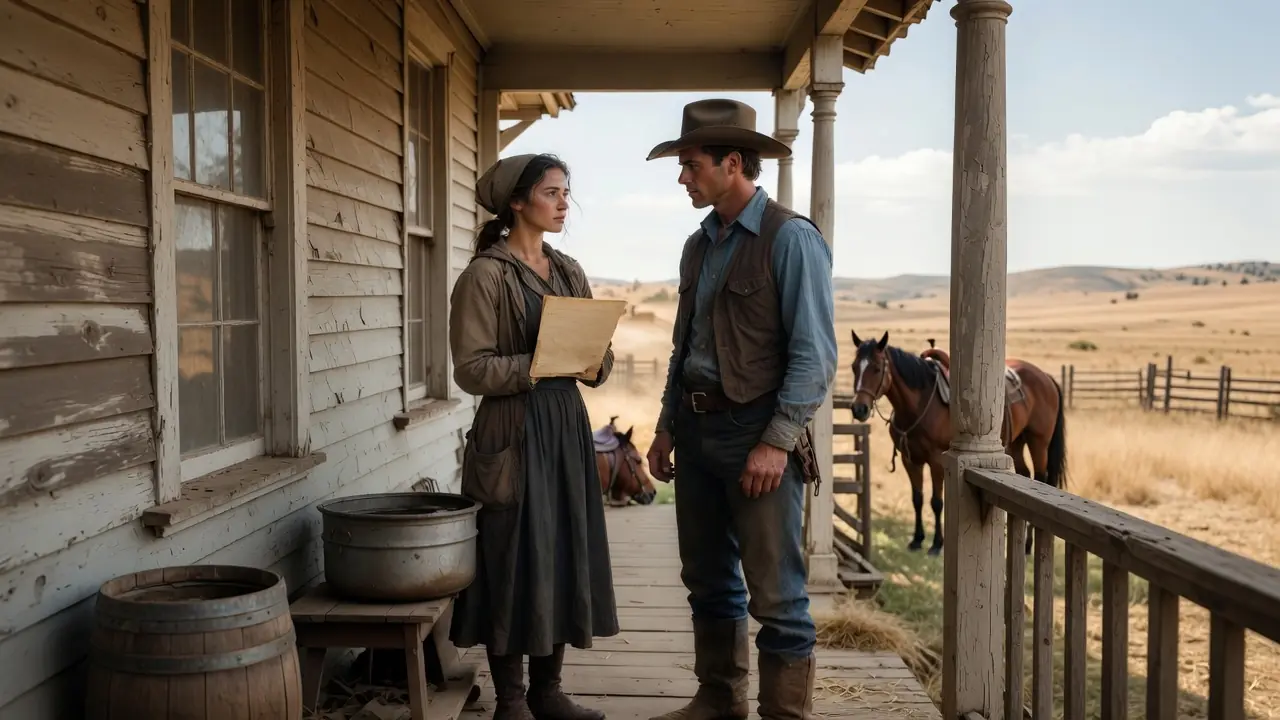
The man stopped his dark bay horse fifteen feet from her and touched the brim of his hat. He was tall, broad-shouldered, close to forty, with dark hair graying at the temples and a face shaped by sun, wind, and years of hard country. “Miss Callaway?” he asked. Mara answered cautiously, and he introduced himself as Gideon Rowe, a rancher from up near the Canadian border. He offered condolences, but Mara could tell condolences were not the reason for such a long ride.
When she pressed him, Gideon admitted the truth. He wanted to buy Iron Creek Ranch, all of it, land, buildings, livestock, and debt. He offered fair value plus enough to clear what Thomas owed, telling her she could leave free and start fresh somewhere easier. Mara felt anger rise first, then exhaustion, then bitter amusement. “You heard a woman alone couldn’t keep it,” she said, “and you thought I’d be desperate.”
Gideon did not deny it. “That’s about the shape of it,” he said. Mara almost respected his honesty, but not enough to soften. She told him Iron Creek was not for sale, not to him, not to Raymond, not to anyone, not now or ever. Gideon looked past her at the broken roof, the tired fences, and the hard land, and asked how long the north fence had taken her.
The question caught her off guard. She told him two weeks, alone, and he nodded slowly as if that answer mattered more than the debt. Then he said there were two kinds of people who refused to sell when every practical reason said they should: fools who did not understand what they were facing, and fighters who understood perfectly and did not care. Mara did not answer. Gideon turned his horse to leave, then looked back and said, “You don’t strike me as a fool, Miss Callaway.”
The next morning, he returned with his thirteen-year-old son, Caleb. Mara was hauling water from the creek, her shoulders aching under the yoke, when Gideon reined in and told her he had not come to buy. He had come to fix her barn roof. Mara stared at him, suspicious and tired, and asked what the catch was. Gideon said there was no catch, only that the next heavy snow might bring the roof down, and he did not like watching good livestock suffer because pride stood in the doorway.
Mara wanted to refuse, but the barn roof did need fixing, and winter was coming hard. Caleb sat quietly on a gray mare and said his father was good with roofs and that he could help haul water. Something inside Mara cracked a little at the boy’s plain offer. Finally she said Gideon could help, but only if she worked beside him, because it was still her ranch and she did not accept charity she had not earned.
They worked until sunset. Gideon moved with calm efficiency, wasting no words and no motion, and Caleb hauled water, sorted nails, and held boards without complaint. By dark, half the damaged roof had been replaced and the rest braced well enough to survive until they finished. Mara’s arms shook from exhaustion, but for the first time since Thomas died, something on Iron Creek was better at sunset than it had been at sunrise.
Gideon and Caleb returned the next day, then the next. The roof was finished, then Gideon helped inspect the well problem, and Caleb proved patient with the breeding mare Thomas had purchased as his last gamble. The town noticed quickly. Mrs. Chen mentioned it carefully when Mara came in for flour, warning that people were already talking. Mara said people could think what they wanted, though the words felt braver than she felt.
Raymond came three days later, furious. He found Mara and Gideon working on the east fence, and his face twisted at the sight of another man helping where he had expected only failure. He accused Mara of using Gideon to pretend she was managing alone, then said the town was calling Gideon a husband in everything but name. Mara stepped between the two men and told Raymond that Gideon was a neighbor helping a neighbor, and that what she accepted on her own land was none of Raymond’s business.
Raymond tried to claim family concern, but Mara heard the threat beneath it. Gideon did not raise his voice, but his presence beside her was solid enough to change the air. He told Raymond the lady had asked him to leave. Raymond spat in the dirt and swore it was not over, but he climbed back into his wagon and left. Mara watched him go and realized she cared less about the town’s gossip than she once would have.
Soon after, Gideon returned north to handle business on his own ranch. He told Mara he would be gone about two weeks and that she should send word through Sam Garrett if she needed anything. Mara said she would be fine, and Gideon replied that he knew she would, but she should send word anyway. When he and Caleb rode away, Iron Creek felt emptier than before. Mara told herself it was only because the work went slower alone.
December came hard. The troughs froze solid every morning, the south fence broke in three places, and the bank note loomed closer while the numbers refused to change. One night, Sam Garrett arrived with his sons and a letter from Gideon, saying the situation up north had taken longer than expected and asking Sam to check on her. Sam’s son noticed cattle tracks heading toward the ravines, and Mara knew she had missed the broken fence while trying to manage everything else. Pride said no to help, but survival said yes.
Sam and his boys brought back eleven head from the ravines. One was too injured to live, but the rest could be saved, and that mattered. That night Mara cooked venison stew and hard bread for them, the first shared meal in the house since Thomas died. Sam told his youngest son that some things were worth the fight, even when ranching was hard enough to break a man. Mara listened silently, Gideon’s folded letter still in her pocket.
The day after Christmas, Gideon returned with Caleb. Mara was in the barn checking the breeding mare when she heard horses, and relief struck her before she could stop it. Gideon brought feed supplements, lamp oil, and coffee that did not smell burned, then asked if she would let them stay through the worst of winter. Mara wanted to protect herself by refusing, but the mare was close to foaling, the fences still needed work, and loneliness had become its own kind of danger.
She agreed to let them stay through winter. Gideon took the spare room, Caleb settled into chores, and the ranch found a rhythm that frightened Mara because it felt natural. Gideon handled the far repairs and heavy work, Caleb cleaned tack and worked with horses, and Mara managed the finances, decisions, and daily order of Iron Creek. It remained her ranch, but the crushing weight of doing everything alone lifted just enough for her to breathe.
The breeding mare foaled on a night below zero. The wind battered the barn, and the foal came wrong, backward, threatening both mare and baby. Gideon arrived half-dressed and immediately began giving orders while Caleb brought more lantern light and Mara gathered hot water and clean cloths. For two hours they fought under freezing barn rafters, turning the foal and keeping the mare alive by stubborn effort.
When the foal finally came, it landed wet and still in the straw. Caleb cleared its nose and rubbed its sides, but nothing happened. Mara felt the last piece of Thomas’s hope collapsing in front of her. Then Gideon pressed his hands against the tiny ribcage, once, twice, three times, until the foal gasped, choked, and began to breathe.
At dawn, the colt stood on trembling legs. Mara cried quietly because she was too tired to stop herself. Gideon told her it was her mare, her gamble, and her victory, and that he and Caleb had only helped. But Mara knew help had made the difference between life and loss, and that truth unsettled her more than she wanted to admit.
The bank note came due less than a week later, and Mara was still seventy dollars short. Gideon offered the money as a gift, but she refused sharply, afraid that money from him would become a claim, a debt, a chain she could not see yet. Gideon was hurt, though he hid it behind a blank expression. At the bank, Willis gave Mara only thirty days before the board would move to restructure the loan.
That night, Mara cried into her pillow for the first time since Thomas died. The next morning, Caleb found her in the kitchen and told her how Gideon had once refused help after his wife died, nearly losing his own ranch because one person could not do everything alone. “Accepting help doesn’t make you weak,” Caleb said. “It makes you smart.” The words landed harder because they came from a boy who had already learned too much about grief.
Mara found Gideon in the barn and admitted she had been wrong. She told him he had offered help and she had treated him like Raymond. If the offer still stood, she would accept the seventy dollars as a gift. Gideon simply said it stood, and when Mara said she did not know when she could repay him, he answered, “It’s a gift, Mara. That means you don’t.”
She paid the bank two days later. Willis stamped her payment book with relief, then warned her that Raymond had been asking questions about what happened if she died without heirs. The warning chilled her, but the payment bought her breathing room. She rode home to find Gideon and Caleb working the corral, and when Gideon said the payment gave “us” time to get through winter, Mara heard the word more clearly than he probably meant it.
By January, the arrangement felt dangerously like family. They ate together, worked together, argued over repairs, and spent evenings in the front room while Caleb read and Mara mended beside the fire. But the town’s gossip grew sharper, and Cole Brennan cornered Mara in Mrs. Chen’s store, hinting that no decent woman lived with a man under her roof unmarried. Mrs. Chen threw him out, then gently told Mara the truth: people were talking, and Raymond would use it if he could.
When Mara returned home, Raymond was already on the porch arguing with Gideon. He called the arrangement improper and shameful, claiming the town would turn against her and the bank would question her fitness to manage the property. Mara told him to leave, and Gideon stood beside her, calm and immovable. After Raymond drove off, Mara told Gideon that Mrs. Chen had suggested marriage. The word hung between them like a match waiting to be struck.
Gideon did not laugh. He admitted he had come to Iron Creek wanting a second property, a new life for Caleb, and something worth building after losing his wife. He said maybe there was another way to become part of something, not by buying land, but by joining what already existed. Mara said it was insane because they barely knew each other. Gideon answered that he knew she worked until her hands bled, sang in the flower garden when she thought no one heard, and cared so much about honoring her father that it was eating her alive.
Mara asked about love. Gideon said they could begin with respect, honesty, and work, which was more than many marriages began with. The next morning, Mara told him she would marry him, but the ranch would stay in her name and Gideon would have no legal claim. Gideon agreed, then added one condition of his own: they would give the marriage a real chance, not just tolerate each other for convenience. Mara shook his hand, and the agreement felt more frightening than any business deal.
They married three days later in the front room of the ranch house. Doc Henderson witnessed, Sam Garrett stood with Gideon, Mrs. Chen brought cake, and Caleb grinned as if the adults had finally caught up with what he had known for weeks. The ceremony was brief and practical, and Gideon’s kiss was gentle, almost formal. Still, it was real, and real mattered more to Mara than anything pretty.
Raymond came a week later, furious that the marriage had closed another path to the ranch. Mara informed him that Iron Creek remained legally hers, properly filed and protected, and that Gideon had no ownership stake for Raymond to exploit. Gideon stood beside her as husband, partner, and witness, not as owner. Raymond left angry and empty-handed, but he was not finished.
In March, Willis rode out with a letter from the Territorial Land Office. Raymond had filed a claim challenging Thomas’s will and arguing that the property should pass to the nearest male relative. Mara sat at the kitchen table, staring at the letter, and for the first time since her father’s death, whispered that she was tired of fighting. Gideon knelt beside her and took her hands. “Then let me carry some of the weight,” he said.
They hired Katherine Wade, a sharp-eyed lawyer with no patience for weak arguments. She reviewed Thomas’s will, bank records, witness statements, and years of proof that Mara had managed Iron Creek beside her father. Doc Henderson testified that Thomas was clear-minded. Willis confirmed Mara had handled ranch finances for years. Mrs. Chen, Sam Garrett, and other townspeople came forward because they had seen the truth long before the court asked for it.
The courthouse was packed the day of the hearing. Raymond’s lawyer tried to paint Mara as emotional, incapable, and dependent on a hurried marriage to survive. Katherine dismantled him with documents, witnesses, and calm precision. When Mara took the stand, she spoke clearly about learning ranch work as a child, managing livestock, balancing accounts, and hearing her father’s final command. When the lawyer suggested she married because she needed saving, Mara looked him straight in the eye and said, “I married because I found a partner worth building with.”
Late that afternoon, Judge Hawthorne confirmed Thomas Callaway’s will as valid. Iron Creek Ranch belonged to Mara Callaway, now Mara Rowe, legally and beyond challenge. The courtroom erupted, but Mara stood still, letting the words settle into her bones. Confirmed. Legal. Hers.
On the courthouse steps, Caleb grabbed both her hands and grinned. “Told you,” he said. “Stubborn and smart and doesn’t quit.” They rode home through late afternoon light, the Montana valley opening before them, and Iron Creek appeared slowly: house, barn, corrals, flower garden, repaired fences. Mara realized then that the ranch was hers by law, but theirs by labor, love, and every hard day they had survived together.
That night, lying beside Gideon, Mara whispered, “I think I’m happy.” Not just surviving, not just not unhappy, but truly happy. Gideon pulled her close and told her she deserved to be. For the first time in longer than she could remember, Mara slept without fear of tomorrow.
Spring came slowly, but it came. The colt named Thomas grew strong, and the breeding program Mara had once feared to dream about began to take shape. Gideon invested from his northern ranch, and this time Mara accepted because partnership no longer felt like surrender. Together, they bought better mares, repaired the barn properly, expanded the corrals, and turned Iron Creek from a dying ranch into a place with a future.
Years later, people would tell the story many ways. They would say Mara Callaway was the woman who refused to quit when everyone expected her to fail. They would say a cowboy came to buy her forgotten ranch and stayed to help her save it. But the truth was deeper than that. Iron Creek survived not because Mara carried everything alone, but because she learned that real strength meant choosing the right people to stand beside her.
By the time the sun set over the Montana hills, Iron Creek Ranch no longer felt like a burden inherited from grief. It felt like a legacy being built forward, one fence post, one foal, one shared decision at a time. Mara had kept her promise to Thomas, but she had done more than hold the land. She had turned survival into life, loneliness into family, and a forgotten ranch into a home worth fighting for.