The explosion hit Maple Ridge Estates at 8:47 on a Thursday night.
Not a little pop.
Not the crack of a log breaking apart in a fireplace.
A heavy, hollow boom that shook windows along the cul-de-sac and sent three car alarms screaming into the cold November air.
Thomas Brennan looked up from the book in his lap.
For one second, he thought a transformer had blown.
Then came another sound.
Glass.
Someone screaming.
Thomas stood.
Through the front window, he saw smoke rising above the white two-story house three doors down.
Karen Whitmore’s house.
He grabbed his coat and stepped outside.
Neighbors were already pouring into the street.
Porch lights came on.
Garage doors opened.
A dog barked from somewhere behind the Millers’ fence.
Then Thomas saw Karen.
She stood barefoot in her driveway wearing a blue robe, one sleeve darkened with soot.
Her blond hair had come loose.
Black streaks marked one side of her face.
Behind her, smoke rolled through an open front door.
Karen pointed toward the house and screamed:
“It was the wood!”
A neighbor shouted:
“What?”
“The firewood!”
Karen coughed.
“That man’s firewood exploded!”
Every face turned.
Toward Thomas.
He stood beneath the streetlight with both hands in his coat pockets.
Sixty-one years old.
Gray beard.
Retired from thirty years of mechanical design work.
Widower.
Quiet neighbor.
And, according to Karen Whitmore, suddenly responsible for an explosion inside her living room.
Thomas looked at her.
Then at the smoke.
Then at the security camera mounted beneath his own gutter.
He knew one thing Karen apparently had forgotten.
For the past three weeks, every log she had carried from his yard had been recorded.
He said nothing.
Because the fire department had just arrived.
And unlike Karen, Thomas had learned long ago that when evidence was coming, it was usually best not to interrupt it.
Eight years earlier, Thomas Brennan moved into Maple Ridge because he wanted peace.
His wife, Laura, had died from ovarian cancer.
After thirty-four years of marriage, their house in Tulsa felt too large.
Too full.
Every room carried a memory.
Her coffee mug still sat in the cabinet.
Her gardening gloves remained in the garage.
The indentation on her side of the mattress disappeared eventually.
That was somehow worse.
So Thomas sold the house.
Bought a smaller place in Maple Ridge Estates.
It looked safe.
Orderly.
White fences.
Mature trees.
Trim lawns.
A neighborhood pool.
A modest homeowners association.
Thomas thought rules might be comforting.
Keep the grass reasonably short.
Don’t leave broken cars on blocks.
Don’t build a forty-foot radio tower in the backyard.
Fine.
He paid his dues early.
Fixed things when they broke.
Helped neighbors when asked.
Built a small workshop behind the house.
And every fall, he split his own firewood.
Oak mostly.
Some hickory.
A little maple.
He stacked it behind the tool shed beneath a covered rack he had built himself.
Laura used to say splitting wood was the only exercise Thomas willingly performed without complaining.
After she died, he kept doing it.
The repetition helped.
Lift.
Set.
Swing.
Split.
Stack.
Simple work.
No meetings.
No grief counselors.
No sympathy.
Just wood becoming winter heat.
For seven years, nobody cared.
Then Karen Whitmore became HOA president.
Karen had lived in Maple Ridge only nine months before taking the position.
Technically, she had been elected.
Barely.
Most homeowners did not attend the annual meeting.
Karen did.
She arrived with proxy forms from residents who hardly remembered signing them and a printed platform titled:
RESTORING MAPLE RIDGE STANDARDS
She won by fourteen votes.
Within weeks, everyone knew her name.
Mailbox paint.
Trash-can visibility.
Fence stains.
Holiday decorations.
Parking angles.
Basketball hoops.
Karen found violations the way some people found hobbies.
She photographed everything.
Sent letters.
Quoted bylaws.
Measured grass with a ruler.
She was not wrong about every issue.
That made her more difficult.
A neglected property really could affect neighbors.
A blocked sidewalk mattered.
A dangerous fence mattered.
But Karen had a particular talent for turning reasonable standards into personal authority.
The first time she came to Thomas’s house, she carried a clipboard.
“Mr. Brennan?”
“Yes?”
“Your firewood stack is visible from the common lane.”
Thomas looked over her shoulder.
The stack was behind a six-foot fence.
Only the top row could be seen through a gap between his shed and a cedar tree.
“That firewood?”
“Yes.”
“It disrupts community appearance.”
Thomas stared.
“From which community?”
Her smile tightened.
“Section 4.3 addresses exterior material storage.”
Thomas had actually read the bylaws.
“Section 4.3 prohibits construction debris and unsecured outdoor storage visible from the street.”
“This is residential firewood.”
“Which is material.”
“So is my house.”
Karen did not laugh.
“You have ten days to relocate it.”
“Where?”
“Somewhere not visible.”
Thomas looked toward the rack.
Then at Karen.
“I’ll review the rule.”
“I’ve already reviewed it.”
“That makes one of us.”
She left.
Thomas did review the rule.
Then the original architectural guidelines.
Then two years of board minutes.
Firewood was permitted if neatly stacked, reasonably screened, and not creating a pest or fire hazard.
Thomas’s rack met all three conditions.
So he did not remove it.
He tightened the tarp.
Straightened the rows.
Trimmed a branch that exposed part of the stack.
Then sent a short email to the HOA:
Please identify the exact provision requiring removal. Current storage appears compliant with Section 4.3 and the 2019 architectural interpretation regarding seasonal firewood.
Karen replied:
The board retains discretionary authority regarding visual harmony.
Thomas smiled.
That phrase told him everything.
Not safety.
Not a specific violation.
Visual harmony.
He saved the email.
Three days later, twenty logs disappeared.
Thomas noticed because he stacked firewood in rows of twenty.
Ten across.
Two deep.
He had been doing it that way for years.
At first, he assumed a neighbor borrowed some.
That had happened before.
People usually asked afterward.
Nobody did.
Two nights later, twelve more disappeared.
Then eight.
Thomas stood behind the shed staring at the shrinking stack.
The value was not enormous.
Maybe fifty dollars.
That did not matter.
Someone was entering his fenced yard at night.
He installed a motion light.
Then marked several log ends with tiny pencil lines only he would recognize.
The next morning, four marked logs were gone.
Near the gate, the damp grass showed narrow heel impressions.
Thomas crouched.
Looked.
Then stood.
He did not accuse anyone.
He installed cameras.
One beneath the workshop eave.
One above the rear gate.
Both covered only his property and the access area immediately beyond it.
The system recorded continuously to a local drive and backed up motion clips.
For two nights, he captured raccoons.
A possum.
Mr. Miller’s cat.
On the third night, at 12:14 a.m., his phone buzzed.
Thomas opened the live feed.
Karen Whitmore entered his backyard.
Beige coat.
Scarf.
Flashlight.
Gloves.
He watched her lift six logs from the rack.
Then six more.
She carried them through the gate and placed them inside the back of her SUV.
Thomas stared at the screen.
Karen returned.
Took four more.
At one point she muttered something close enough for the microphone to catch.
“He has plenty.”
Thomas sat on the edge of his bed.
For nearly a minute, he did nothing.
Then he saved the clip.
Exported another copy.
Emailed one to himself.
The next morning, he drove slowly past Karen’s house.
Through her front window, he could see a decorative black steel log holder beside the fireplace.
Inside it sat his wood.
He recognized the pencil marks.
Thomas almost laughed.
Karen was fining him for possessing firewood she was secretly burning.
That was when the situation stopped being irritating.
And became interesting.
Thomas did not confront her immediately.
Instead, he attended the next HOA meeting.
Karen sat at the head of the clubhouse table.
“Next item.”
She looked directly at Thomas.
“Continued noncompliance regarding exterior wood storage.”
The room shifted.
Everyone knew about the dispute.
Karen continued.
“Despite prior notice, Mr. Brennan has failed to remove what the board considers an excessive and visually disruptive quantity of combustible material.”
Thomas raised his hand.
“Question.”
Karen sighed.
“Yes, Tom?”
“When was the most recent inspection?”
“Yesterday.”
“Of my backyard?”
“From the common lane.”
“And you confirmed the wood was still there?”
“Yes.”
Thomas nodded.
“Interesting.”
Karen frowned.
“Why?”
“Because a significant amount has been stolen during the last several nights.”
A few people looked up.
Karen replied quickly:
“That has nothing to do with the HOA.”
“I agree.”
“Then why bring it up?”
“Because I installed security cameras.”
Silence.
Karen’s expression changed.
Only slightly.
Thomas continued.
“They recorded the person taking it.”
Karen leaned back.
“Surveillance equipment may itself violate architectural standards.”
“Maybe.”
Thomas nodded.
“But that’s a separate question.”
The treasurer, Diane Cooper, asked:
“Tom, did you report the theft?”
“Not yet.”
Karen said:
“Then for all we know, this is another attempt to avoid compliance.”
Thomas looked at her.
“No.”
“It’s evidence.”
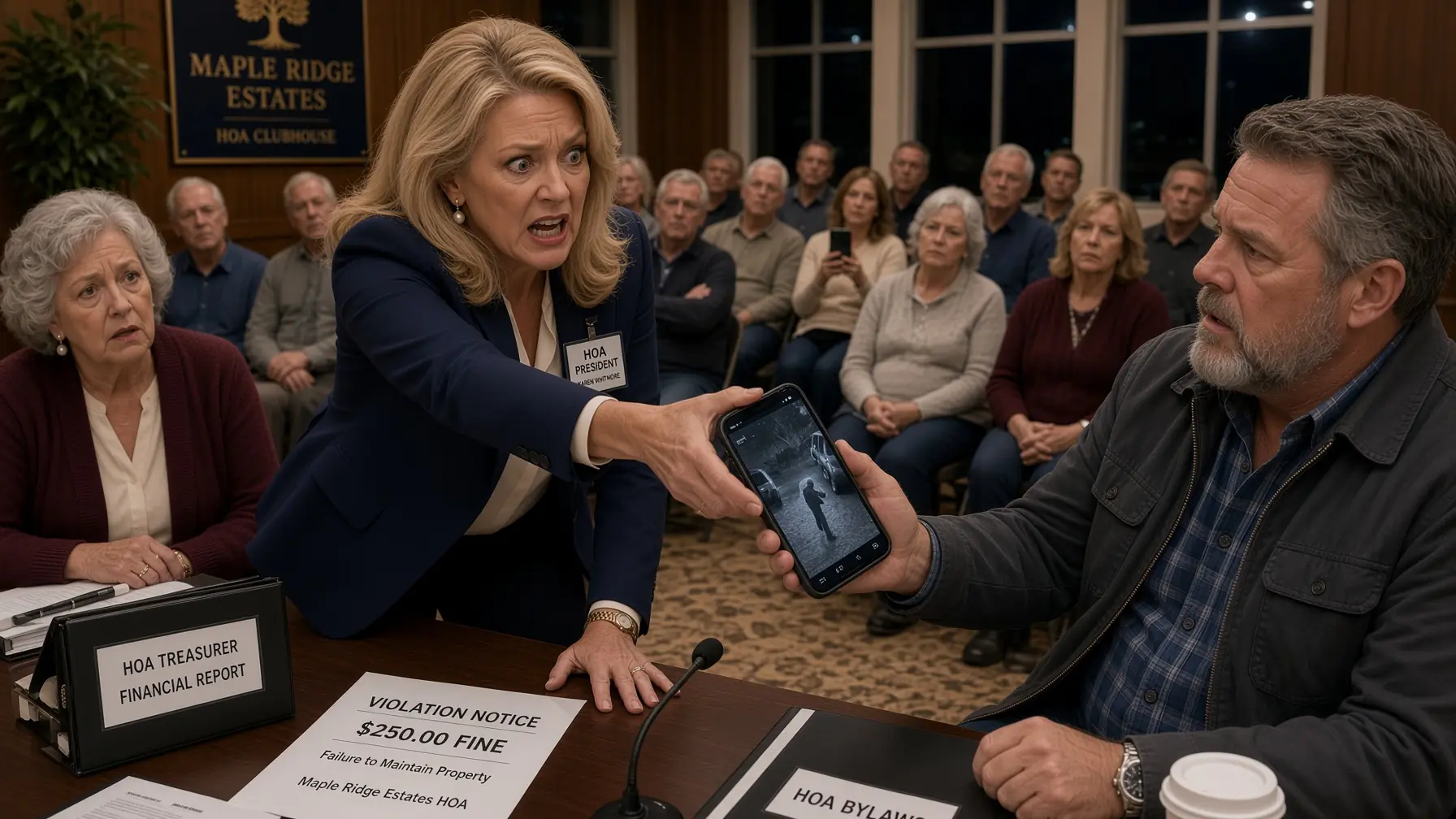
He held up his phone.
Karen stared at it.
Thomas did not play the video.
Not yet.
He said:
“I’d like any enforcement decision concerning the firewood postponed until the board reviews the governing documents and the security footage.”
The vice president, Martin Ellis, nodded.
“That seems reasonable.”
Karen turned.
“It does not.”
Martin looked at her.
“We’re fining a homeowner over wood that apparently is being removed from his property by someone else.”
“The theft is unrelated.”
“It may be.”
Martin replied.
“But I’d like to know what the video shows.”
Karen stood.
“This meeting is becoming a circus.”
Thomas said:
“I haven’t shown anything.”
That somehow made it worse.
Karen gathered her papers.
“The board will reconvene.”
She left early.
Thomas watched her go.
He had spent three decades working with mechanical systems.
One lesson applied equally well to people.
Pressure rarely created a new weakness.
It revealed the one already there.
Three days later, Thomas received another HOA letter.
This one cited his cameras.
Unauthorized exterior surveillance installation visible from common areas.
He laughed.
Then read the architectural standards again.
Small residential security cameras were allowed.
No approval required if mounted below the roofline and not directed into neighboring private windows.
His cameras complied.
Thomas replied in writing.
Attached photographs.
Requested the rule Karen relied upon.
No answer.
That same week, he noticed another problem.
Karen was still taking firewood.
Even after learning cameras existed.
Thomas could hardly believe it.
Then he understood.
Karen likely thought he had been bluffing.
Or thought she could later claim the footage was improper.
Or maybe she simply could not imagine consequences applying to her.
Thomas kept saving recordings.
He did something else too.
He moved his driest, best-seasoned oak closer to the workshop for his own use.
The remaining outdoor stack consisted mostly of older, mixed firewood he had been planning to inspect and sort before burning.
Some pieces were damp.
A few showed fungal staining.
Nothing explosive.
Nothing altered.
Nothing booby-trapped.
Just ordinary wood that Thomas himself was not yet ready to put into his stove.
Karen kept taking it.
That distinction would matter later.
The night of the explosion, Karen built a large fire.
Investigators reconstructed that much afterward.
She had guests coming the following weekend and wanted the fireplace running to “season the room,” as she later described it.
The chimney had not been professionally inspected in years.
The previous owners had used the fireplace rarely.
Karen used it often.
A cracked clay flue liner had allowed heat and combustion gases into surrounding masonry.
Worse, significant creosote had accumulated higher in the chimney.
Karen also loaded several large logs onto an already hot fire.
At some point, the creosote ignited.
The chimney fire burned intensely.
Rapid expansion and failing masonry damaged part of the flue and sent a pressure wave through the firebox.
The sound was dramatic enough that everyone called it an explosion.
Technically, the fire marshal later described it as a chimney-fire event with localized structural failure.
To Maple Ridge, it was simply:
The night Karen’s fireplace blew up.
Firefighters cleared the house.
No one was seriously injured.
Karen had minor burns to one hand and singed hair.
A section of mantel was damaged.
Smoke ruined part of the living room.
One decorative window cracked.
Thomas felt genuine relief.
Whatever else he thought of Karen, he had never wanted her hurt.
Fire Captain Andrew Shaw came outside.
Karen stood beside him wrapped in a blanket.
Thomas heard her say:
“It had to be the wood.”
Shaw asked:
“What wood?”
She pointed toward Thomas.
“His.”
The street became quiet.
Thomas took one step forward.
“Mine?”
Karen realized the problem immediately.
Her eyes flicked toward the neighbors.
Then back.
“I mean…”
She swallowed.
“I got it locally.”
Thomas said nothing.
Captain Shaw looked from one to the other.
“Where did you obtain the firewood?”
Karen folded her arms.
“That is irrelevant.”
“Not if you’re claiming the material caused the incident.”
Thomas almost admired the precision.
Karen said:
“I’d like to speak to someone else.”
Shaw answered:
“I’m the incident commander.”
Thomas looked away to hide a smile.
Karen glared at him.
“This is your fault.”
Thomas finally answered.
“I haven’t given you firewood.”
The sentence landed.
Several neighbors looked at Karen.
Diane Cooper whispered:
“Oh no.”
The next morning, a county fire investigator returned.
Thomas did not wander over with coffee.
Did not make jokes.
Did not accuse Karen.
He stayed home until the investigator knocked on his door.
“Mr. Brennan?”
“Yes.”
“Ms. Whitmore says firewood from your property may be connected to last night’s fire.”
Thomas nodded.
“She took wood from my yard without permission.”
The investigator paused.
“You have evidence?”
“Yes.”
Thomas showed him the camera footage.
Date.
Time.
Karen entering.
Karen loading wood.
Karen’s SUV.
Multiple nights.
The investigator watched quietly.
Then:
“Do you alter your firewood in any way?”
“No.”
“Apply accelerants?”
“No.”
“Store fireworks or chemicals near it?”
“No.”
“Any treated lumber?”
“Not in that stack.”
“Any reason you believed the wood itself was dangerous?”
“No.”
Thomas pointed toward the rack.
“Some was older and damp.”
“I was sorting it.”
“But it was ordinary split firewood.”
The investigator examined the stack.
Took photographs.
Collected samples for comparison.
Then went back to Karen’s house.
By afternoon, the preliminary conclusion was obvious.
Nothing in Thomas’s wood showed signs of deliberate alteration.
The primary evidence pointed toward a chimney fire and damaged flue system.
Thomas was relieved.
Karen was not.
The theft video spread through the HOA faster than Thomas wanted.
He did not post it online.
Diane saw it during a board review.
Martin saw it.
The HOA’s attorney saw it.
Then someone told someone.
By evening, half the neighborhood knew Karen had been taking the same firewood she had tried to fine Thomas for storing.
At 9:00 the next morning, Karen marched across his lawn.
She wore sunglasses.
A scarf hid part of her hair.
“You humiliated me.”
Thomas stood on his porch.
“I did not release the video publicly.”
“You showed the board.”
“You were asking the board to fine me.”
“You should have come to me privately.”
Thomas stared.
“I tried calling after the first letter.”
“You ignored me.”
“That is not the same as permission to enter my yard at midnight.”
“I was removing a fire hazard.”
Thomas almost laughed.
“By bringing it into your living room?”
Her face tightened.
“It was abandoned material.”
“It was stacked.”
“Behind a shed.”
“Yes.”
“On my property.”
Karen stepped closer.
“You think this is funny?”
“No.”
Thomas’s expression changed.
“Your house caught fire.”
“That isn’t funny.”
“You could have been badly hurt.”
For one moment, her anger faltered.
Then returned.
“You’re responsible.”
“The fire investigator disagrees.”
“You knew I was taking the wood.”
“Yes.”
“And you let me.”
Thomas stared.
“Karen, I’m not responsible for stopping you from stealing from me.”
She froze.
That sentence ended the conversation.
The board called a special meeting.
Not to remove Karen instantly.
The bylaws did not allow an audience to simply vote a president out because everyone was angry.
Directors had terms.
Officers were elected by the board.
Certain misconduct procedures required notice.
The HOA attorney explained all of that before anyone spoke.
That disappointed residents who had arrived expecting a public execution.
Reality was slower.
And better.
The agenda contained three items.
First:
Whether Thomas’s firewood complied with existing rules.
Second:
Whether the camera citation had a valid basis.
Third:
Whether Karen’s conduct created a conflict requiring her removal as board president pending a formal governance review.
Karen sat at the head table.
For once, nobody seemed intimidated.
The HOA attorney addressed the firewood first.
“The governing documents permit reasonably screened seasonal firewood.”
Thomas’s stack complied.
Fine withdrawn.
Next:
Security cameras.
Allowed under current guidelines.
Citation withdrawn.
Karen objected.
“You’re interpreting everything in his favor.”
The attorney replied:
“I’m reading the documents.”
That earned a few quiet laughs.
Then came the difficult part.
Martin said:
“We have video showing the board president entering a homeowner’s enclosed property at night and removing personal property.”
Karen replied:
“I was addressing an unresolved safety issue.”
Diane looked at her.
“Without board authorization?”
Karen said nothing.
Martin continued.
“Then the same property appeared inside your home.”
“I had no idea it belonged to him.”
Thomas did not react.
The room did.
Karen had already admitted enough in previous conversations that the explanation sounded impossible.
She became angrier.
“You’re all allowing one disgruntled resident to undermine years of work.”
Mr. Jenkins, who rarely spoke at meetings, raised his hand.
The attorney nodded.
Jenkins stood.
“I got fined last year because my roses extended six inches through my fence.”
Karen said:
“That was a documented violation.”
Mrs. Miller stood next.
“You threatened us over a child’s basketball hoop.”
Another resident:
“You fined my mother over wind chimes.”
Diane turned toward Karen.
“Do you understand what’s happening?”
Karen looked around.
“Yes.”
“A mob.”
“No.”
Diane’s voice softened.
“People stopped being afraid to compare notes.”
That hurt Karen more than any insult could have.
The board went into executive session.
Forty minutes later, they returned.
Martin read the decision.
Karen was removed as president by majority vote of the directors.
Not removed from the board yet.
That required a separate process under the association documents.
But she no longer controlled meeting agendas.
Could not issue violations alone.
Could not speak for the association without authorization.
An independent management company would temporarily handle enforcement until the board reviewed procedures.
Karen sat motionless.
Then:
“You’ll regret this.”
Martin looked tired.
“Maybe.”
“But tonight this is the board’s decision.”
Karen gathered her purse.
No dramatic applause followed when she left.
Thomas was glad.
He had begun to understand something.
Public humiliation was part of what had fed the entire problem.
He did not want to become Karen in reverse.
The investigation of the chimney fire ended two weeks later.
The written report identified several contributing factors.
Heavy creosote accumulation.
A cracked flue liner.
Deferred chimney maintenance.
High fire loading immediately before ignition.
No evidence that Thomas had sabotaged the wood.
No unusual explosive material.
No engineered device.
No poison.
No trick.
Just a neglected chimney and a fire that had become far hotter than Karen realized.
The irony remained.
She had accused Thomas’s wood of causing the incident.
And in doing so, she had drawn official attention to how that wood reached her house.
Karen’s attorney eventually negotiated repayment for the stolen firewood and minor property damage associated with her repeated entry into Thomas’s yard.
Thomas did not pursue a dramatic criminal case.
He wanted the trespassing documented.
He wanted it stopped.
That was enough.
The HOA’s insurer had its own arguments with Karen about board conduct.
Thomas stayed out of those.
He had learned to enjoy not being involved.
Maple Ridge changed after Karen lost the presidency.
Not overnight.
People had expected one meeting to fix years of resentment.
It did not.
The new board president, Martin Ellis, began by reviewing enforcement records.
Some fines were valid.
Others had been issued under questionable interpretations.
Several were refunded or waived.
Architectural rules were rewritten in plain language.
Complaints now required the exact provision allegedly violated.
No more:
visual disharmony.
No more:
community concerns.
If the HOA wanted to tell someone to change his property, it had to explain why.
Thomas liked that rule.
He suggested it.
Then refused to join the board.
Diane asked:
“Why not?”
“I enjoy sleeping.”
Karen remained in the neighborhood for another seven months.
At first she fought everything.
Letters.
Complaints.
Social-media posts.
She accused the new board of discrimination.
Retaliation.
Corruption.
Most claims went nowhere.
A few raised legitimate procedural questions, and the board addressed them.
That irritated Karen more than outright dismissal.
She wanted enemies.
Instead she got minutes.
Policies.
Votes.
Written responses.
Procedure starved conflict of oxygen.
Thomas noticed.
He had spent decades designing machinery.
A good system did not depend on everyone being nice.
It limited how much damage one difficult person could do.
The old HOA had depended on personalities.
The new one depended more on process.
That was real improvement.
In spring, a FOR SALE sign appeared in Karen’s yard.
Nobody applauded.
At least not where she could see.
Thomas found that encouraging too.
The moving truck came on a Tuesday.
Karen supervised from the driveway.
Near noon, she walked across the street.
Thomas was splitting oak.
He stopped.
She looked different.
Tired.
Less polished.
“Tom.”
“Karen.”
“I suppose you’re happy.”
“That you’re moving?”
“Yes.”
Thomas considered lying.
“A little.”
She almost smiled.
Then looked toward the woodpile.
“I still think you enjoyed all this.”
“Parts of it.”
“The meeting?”
“No.”
“The video?”
“Maybe for about thirty seconds.”
Her eyes narrowed.
Thomas continued.
“Then your house caught fire.”
“That changed the joke.”
Karen looked away.
After a long silence:
“I really believed I was improving this place.”
Thomas rested both hands on the axe handle.
“I believe you.”
That surprised her.
“You do?”
“Yes.”
“Then why does everyone act like I’m some monster?”
“Because believing your goal is good doesn’t make every method good.”
Karen said nothing.
Thomas continued.
“You stopped asking whether the rules served the neighborhood.”
“You started believing the neighborhood existed to serve the rules.”
Her jaw tightened.
“You think you’re wise now?”
“No.”
“I think I’m old.”
That almost made her laugh.
Almost.
She looked at the firewood.
Then:
“I shouldn’t have taken it.”
“No.”
“I was angry.”
“I know.”
“I thought if the pile got smaller, you’d stop fighting me.”
Thomas nodded slowly.
“That’s probably the first honest explanation you’ve given me.”
Karen looked at him.
“Does that make it better?”
“No.”
“But it makes it true.”
She turned to leave.
At the sidewalk she stopped.
“The fire really wasn’t your wood?”
Thomas stared.
“Karen.”
“I know what the report said.”
“No.”
“It wasn’t my wood.”
She nodded.
Then walked back toward the moving truck.
No threat.
No final speech.
No dramatic defeat.
Just a woman leaving a neighborhood she had tried too hard to control.
A retired couple bought her house.
George and Linda Patel.
The first week, George walked over while Thomas was stacking firewood.
He pointed.
“That the famous pile?”
Thomas closed his eyes.
“Who told you?”
“Three people.”
“Already?”
“One version involved dynamite.”
Thomas stared.
George laughed.
“I assumed that part wasn’t true.”
“Please continue assuming that.”
George held up both hands.
“I just wanted to ask if you sell any.”
“No.”
“Okay.”
Thomas waited.
Then smiled.
“But I’ll give you a few.”
George shook his head.
“I’m paying.”
“Then twenty dollars.”
“For how much?”
Thomas looked at the stack.
“I don’t know.”
“Enough that nobody calls it theft.”
George laughed.
They became friends.
The following autumn, Maple Ridge held its first neighborhood fire-pit night.
A real one.
Permit checked.
Extinguishers nearby.
No overloaded fireplaces.
Thomas brought oak.
Mr. Jenkins brought chairs.
The Millers brought pumpkin pie.
Martin brought the HOA rulebook.
Everyone booed.
He threw it back into his truck.
Children roasted marshmallows.
Neighbors talked.
Nobody measured anything.
At one point Diane raised a mug.
“To Tom.”
Thomas groaned.
“No.”
She continued.
“To proper documentation.”
That he accepted.
Everyone laughed.
Thomas looked around the fire.
For years after Laura died, he had believed peace meant being left alone.
Maple Ridge taught him something different.
Peace was not the absence of people.
It was being around people who respected where you ended and they began.
Boundaries.
Not control.
Community.
Not conformity.
Someone eventually asked Thomas whether he regretted not confronting Karen the first night he caught her stealing.
He thought before answering.
“No.”
“Why?”
“Because the camera gave me something anger couldn’t.”
“What?”
“Facts.”
Had Thomas confronted her in the yard at midnight, Karen might have denied everything.
There might have been yelling.
Maybe pushing.
Maybe a call to police.
Two people telling two different stories.
Instead, the video showed exactly what happened.
That mattered.
The same principle applied to the chimney.
Everyone wanted a dramatic explanation.
Sabotage.
Explosive logs.
A mechanical engineer taking revenge.
That story traveled farther because it was entertaining.
But it was not true.
The actual explanation was more ordinary.
A person stole.
A chimney was neglected.
A fire became dangerous.
An accusation exposed the theft.
A board finally examined its own rules.
People compared experiences.
And authority changed hands through procedure rather than revenge.
Less spectacular.
More useful.
Years later, new residents still heard the story.
Usually wrong.
Someone would point toward Thomas at the annual barbecue.
“That’s the engineer who blew up the old HOA president’s fireplace.”
Thomas would sigh.
“No.”
Then:
“What really happened?”
“She stole my firewood.”
“And it exploded?”
“Her chimney caught fire.”
“So you didn’t rig anything?”
“No.”
“Not even a little?”
Thomas would stare until the person became embarrassed.
Then he would say:
“You know what the interesting part is?”
“What?”
“People like the revenge version better.”
“Why?”
“Because revenge makes one person feel clever.”
He looked around at the neighborhood.
“Reality required everybody else to stop staying quiet.”
That was the part he preferred.
Karen did not lose her position because Thomas outsmarted her with some dangerous trick.
She lost it because evidence allowed neighbors to compare what had been happening in isolation.
The firewood complaint.
Wind chimes.
Basketball hoops.
Letters.
Unclear rules.
Selective enforcement.
One incident looked petty.
Together they revealed a governance problem.
Thomas had not destroyed Karen’s authority.
Transparency had.
And unlike an explosion, transparency did not burn anyone’s house down.
On cold evenings, Thomas still sat beside the fire pit behind his workshop.
Real oak.
Ordinary flame.
Sometimes he thought about Laura.
Sometimes about nothing.
The wood cracked softly.
Smoke rose.
No thunderclap.
No alarms.
No one shouting in the street.
Exactly the way fire was supposed to behave.
One night George Patel came through the gate carrying two beers.
He looked toward the woodpile.
“Still locking it?”
Thomas nodded.
“Cameras?”
“Still there.”
“Think somebody’s coming for it?”
“No.”
“Then why keep them?”
Thomas considered.
“Because trust is good.”
“And?”
“Documentation is cheaper.”
George laughed.
They sat beside the flames.
Across Maple Ridge, porch lights glowed.
A child rode a bicycle too fast past Mr. Jenkins’s house.
Nobody fined him.
Someone had wind chimes hanging near an open window.
They rang softly in the cold air.
Thomas raised his beer.
Not to revenge.
Not to explosions.
Not even to Karen.
To something less dramatic.
A neighborhood where rules had finally returned to being tools instead of weapons.
And a stack of firewood that was once again exactly what it had always been.
Just firewood.