Stop, I need help. Claire Donnelly ran across the parking lot before the chain even pulled tight. "That's my husband's." she said. "He's dead. That's the only thing of his I have left." The man with the clipboard didn't look up.
"Step back from the vehicle, ma'am." She grabbed the handlebar with both hands. The winch kept pulling. Her sneakers dragged two feet across the asphalt before she let go because her arms weren't strong enough to hold against a machine. And nobody standing on that sidewalk stepped forward to help her hold it, either. 11 people watched a woman lose her husband twice in the same afternoon.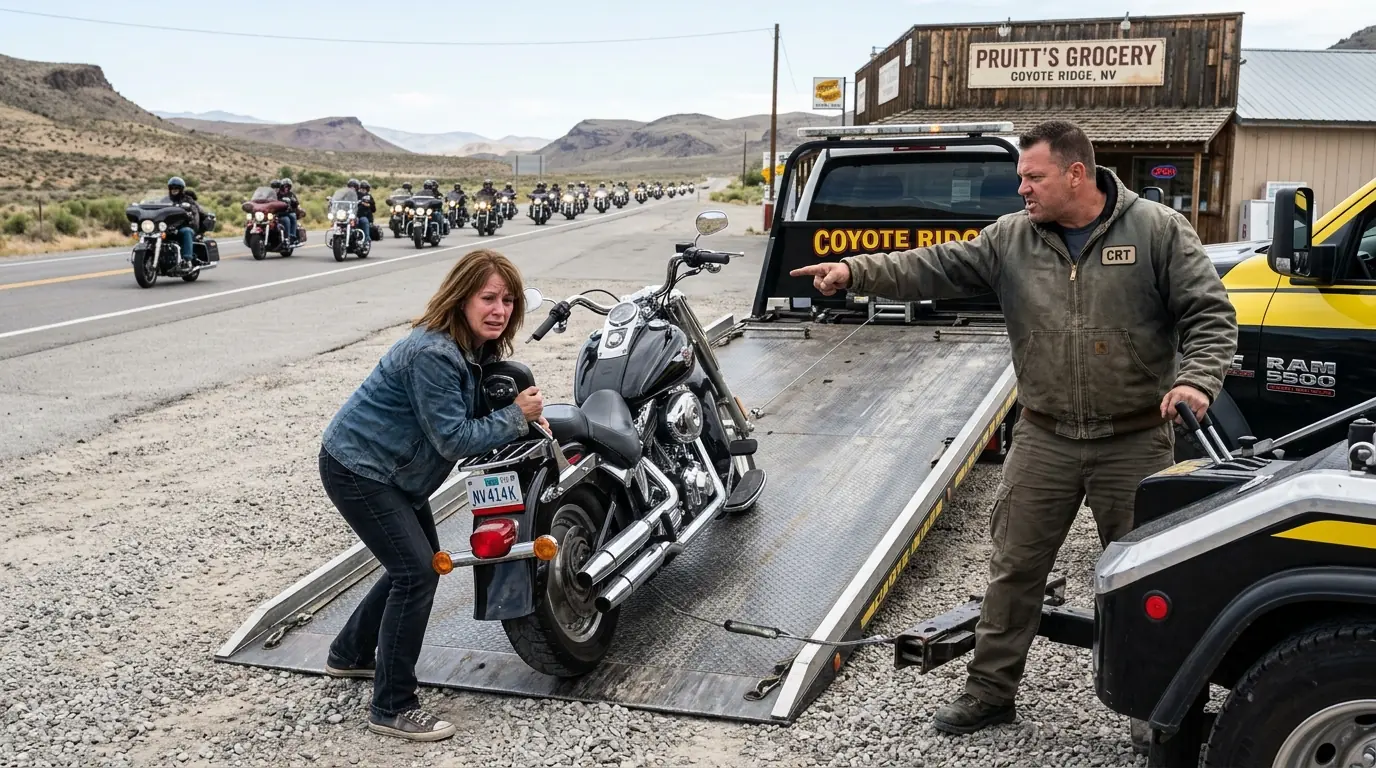
Not one of them moved. Clare posted the video that night. 2 million people watched by morning. Bank executive Marcus Vance went on television and called it responsible lending. What Vance didn't know, what nobody at Coyote Ridge Trust knew, was that 61-year-old Rex Callahan had already watched that video four times.
And men like Rex Callahan don't make noise when something like this happens. They make calls. She drove home with the grocery bag still in her arms because she had forgotten she was holding it. She set it down on the kitchen counter without looking at it and sat at the table in the dark for a long time before she turned on her phone. 41 seconds of footage.
She watched it once. Then she watched it again, slower. Pausing on the part where her own hand let go of the handlebar. Studying her own face for the moment her arm stopped being strong enough. She watched it 11 times before she understood what she was looking at.
It wasn't a repossession. It was a test. A bank had decided to find out exactly how much a grieving woman could lose in front of strangers before someone, anyone, stepped in. And the answer, recorded in high definition, was nobody. She posted it at 11:47.
He said the word delinquent the way men say words they have rehearsed in a mirror. The anchor asked him gently whether the bank had any regrets about the timing, given the circumstances. Vance leaned forward slightly, the practiced lean of a man making a point he wants to land, and said that the bank's thoughts were with the Donnelly family, but that exceptions to policy created exactly the kind of inconsistency that hurt every customer in the long run. He smiled when he said it. Not a wide smile, just enough.
Claire watched his mouth move on the screen above her kitchen counter and felt something colder than anger settle into her chest. Not rage. She was past rage. The particular cold that arrives when you understand that the person hurting you isn't confused about what he's doing. He knows exactly what he's doing.
He's just counting on the fact that you can't stop him. She thought about Tom's voice the last time he rode that bike home, calling out through the kitchen window that he'd be in for dinner in 5 minutes. She thought about the handlebar still warm under her hands an hour ago, and how it had felt like losing his hand a second time. She was still sitting there at 2:00 in the morning when her phone rang. Unknown number.
Nevada area code. "Mrs. Donnelly," the voice said. "My name is Rex. Tom rode with us for 9 years. I watched that video four times tonight." Claire pressed the phone against her ear and said nothing for a moment because her throat had closed around the sound of her husband's name spoken by a stranger who clearly hadn't needed to look anything up to remember it.
"What happens now?" she whispered. Rex Callahan took one slow breath. The kind of breath a man takes when he has already decided everything and is only now getting around to saying it out loud. "Now," he said, "we have a conversation." Before any of that, you should understand what that motorcycle actually was. Tom Donnelly bought it used with money he'd saved for 2 years.
The same month he proposed to Claire in the parking lot of the same diner where she would later sit across from Rex Callahan. He rode it to work every morning for 6 years, rain or shine. And Claire used to stand in the kitchen window and watch him pull out of the driveway, the engine fading down the block until the house went quiet again. He used to say the sound of it starting up was the sound of a good day beginning. Claire never quite believed that until the morning it didn't start at all because Tom Donnelly had died on a construction site 6 months earlier and the motorcycle had sat untouched in the driveway ever since except for the one afternoon a week when Claire came outside just to wipe the dust off the seat.
It was the only thing left in that house that still smelled like him if you leaned close enough. She hadn't let herself lean close in 6 months. She hadn't needed a reason to start again until a man with a clipboard gave her one. To understand why that same man in a gray suit felt confident enough to seize a dead man's motorcycle in front of 11 witnesses and call it procedure, you have to go back 6 weeks. Coyote Ridge Trust was being acquired.
A private equity firm out of Denver called Heartline Capital had spent 4 months reviewing the bank's loan portfolio, and what they found was simple. Too many delinquent accounts. Too many loans that made the balance sheet look soft to outside investors. The deal would close in 19 days, and the executives on both sides wanted clean numbers before the ink dried. Marcus Vance was 44 years old and had spent the last decade learning that the fastest way up in regional banking wasn't competence.
It was visibility. He had watched two colleagues with better numbers than his get passed over for promotion because nobody outside their own branch had ever heard their names. He had promised himself a long time ago that this would never happen to him. He sat across from a communications consultant named Janet Lowell one Tuesday afternoon with a spreadsheet between them. "We need visibility," Lowell said.
"Not just numbers improving quietly. We need a story the press will cover. Something that shows the board we're serious about risk." Vance looked at the spreadsheet without really seeing it. Lowell tapped one line with her pen. "Account ending 419," she said.
"Motorcycle loan. Borrower deceased 6 months ago. Widow's been a few days late twice. Never missed a full payment. Low actual risk, but the vehicle," she said, "has a certain visual.
People notice a repossessed motorcycle. People notice the patch on the seat." Vance was quiet for a moment. A part of him understood, even then, exactly what she was suggesting. He let the understanding pass through him without stopping to examine it too closely because examining it too closely would have required him to stop. "It sends a message," Lowell said.
"We don't make exceptions, not even for sympathetic cases. That's the kind of discipline Heartline wants to see." Vance picked up his pen and signed the order and told himself, the way men like him always tell themselves, that he was simply doing what the moment required of him. He didn't ask what regional manager Hugh Pratt thought. Pratt had managed the Coyote Ridge branch for 11 years and had personally approved Tom Donnelly's original loan back when Tom was alive and the payments came in on time, every time, like clockwork. The kind of customer a bank should have been grateful for.
When Pratt heard about the repossession order, he walked straight into Vance's office without knocking. "Marcus," he said, "that account is current. She's 2 days late on a payment that's due in a week. You don't repossess a vehicle that isn't even technically delinquent yet." Vance didn't look up from his screen. "The system flagged it for early action," he said.
"Heartline wants aggressive risk management before close. This is aggressive risk management." "You're going to hurt a grieving widow to impress people in Denver," Pratt said. Vance finally looked at him and something in his expression made it clear the conversation was already over. "I'm going to protect 400 jobs in this building," he said, "including yours. The deal closes in 19 days, Hugh.
After that, none of this will matter." Pratt stood there for a long moment, the way a man stands when he knows he's about to lose an argument he's already right about. Then he turned and walked out and he should have put his objection in writing because two contractors from a third-party recovery service were already on Route 9 by 10:00 the next morning with a flatbed truck and a clipboard looking for a motorcycle parked outside a grocery store. Vance had picked Pruitt's grocery on purpose. He knew Claire's shift schedule from the loan file. He knew she'd be walking out with groceries in her arms, off guard, in front of witnesses, at exactly the hour when the story would have the best chance of making the noon news cycle.
He wanted visibility. He got it, just not the kind he was hoping for. Claire Donnelly spent the next day doing everything a person is supposed to do. She called the bank's customer service line at 8:00 in the morning. A recorded message told her average wait times were currently elevated.
She held for 51 minutes listening to the same 11 seconds of hold music loop over and over before a representative read her a script about account status and recovery procedures and transferred her to a department that didn't pick up. She drove to the branch on Mill Street at noon. She asked to speak with whoever had authorized the repossession. The teller, a young man who looked like he wanted to be anywhere else, told her that Mr. Vance was unavailable and that all disputes needed to be submitted in writing through the proper channel. The proper channel.
She called three attorneys before evening. The first didn't handle banking disputes. The second wanted a retainer of $2,000 before opening a file. The third, a tired woman named Carol Briggs who had practiced consumer law in this county for 22 years, listened carefully and then told her gently that a viral video moved public opinion but rarely moved a judge and that without proof of a documented late payment violation being misapplied, fighting a bank's internal risk policy was going to be slow and expensive and far from certain. Claire thanked her and hung up.
She sat in her car outside Carol Briggs's office without starting the engine, both hands flat on the steering wheel, the radio off, the parking lot completely silent around her. She thought about the 11 people on that sidewalk. She wondered how many of them had gone home that night and told someone about what they'd seen, the way people do when they want credit for noticing without the inconvenience of having acted. She wondered if any of them had slept easily. She thought about Tom's hands on those same handlebars, every morning for 6 years, certain and unhurried, the hands of a man who never once doubted that motorcycle was his to ride.
She thought about her own hands losing their grip in under 3 seconds, and how much smaller 3 seconds could feel than it sounded. 2 million people had watched her grab that handlebar and lose her grip. The video had been shared by veterans groups, by widows she had never met, by strangers who said they cried watching it. Three news vans had been parked outside her house that morning, their satellite dishes pointed at the sky, waiting for a story they could use and move on from. And not one person with any actual power had done a single thing.
She drove home, ignored the vans, sat at her kitchen table, and read the comments until her eyes burned. Thousands of people furious on her behalf. Thousands of people who felt exactly what she felt and could do exactly as much about it as she could, which was nothing. You have to ask yourself what you would have done sitting at that table. Most of us would have done exactly what Claire did.
We would have run out of channels and called it the end of the road. It wasn't the end of the road. It was 2:00 in the morning and her phone was about to ring. The diner on Industrial Drive didn't have a name on the sign anymore. Just a faded outline where the letters used to be and a red neon coffee cup in the window that buzzed faintly every few seconds, like it was trying to remember what it used to say.
Claire arrived at 6:55. Rex Callahan was already in the back booth reading a folded newspaper the way men of a certain generation read newspapers, like the words deserved the full weight of his attention. He had a coffee in front of him that he hadn't touched. 61 years old, gray beard, forearms that told stories through ink she couldn't quite read from across the room. He stood when she walked in, extended a hand.
"Mrs. Donnelly," he said, "thank you for coming." His hand was the hand of a man who had spent 40 years working with them. She shook it and sat down across from him, and the waitress came and poured her coffee without being asked, the way waitresses in diners like this always seem to know without being asked. "Tell me what happened," Callahan said. "Not the video. What happened before the video?" So she told him, about Tom, about the loan, about the two late payments that were never actually missed, about the way the handlebar had felt warm under her hands for 1 second before it stopped being hers.
Callahan listened without interrupting, his eyes never leaving her face. When she finished, he was quiet for a long moment, the kind of quiet that has already decided everything and is simply taking a moment to be sure. "That motorcycle," he said, "what did it mean to him?" Claire's eyes filled before she could stop them. "It was the last thing," she said, "the very last thing I had that still sounded like him." Callahan nodded slowly, the way a man nods when he has heard exactly what he expected to hear, and it has confirmed something he already decided the night before. "I'll make some calls," he said.
"Go home. Get some sleep if you can." "What's going to happen?" Clare asked. Callahan folded his newspaper and set it down, and for a moment the only sound in the diner was the neon sign buzzing in the window. "Now," he said, "the people who took something that wasn't theirs are going to learn what it costs to give it back." He left money on the table for both their coffees and walked out into the morning sun. And by that evening, charters in four states had received the same four words passed from phone to phone the way they had always been passed long before either of them had been born.
Coyote Ridge. Widow. Donnelly. Ask yourself how many phone calls it would take for the people who actually love you to start driving the moment they heard those three words. For Rex Callahan's charter, the answer was none.
The calls themselves were the driving. It took 11 days for 300 motorcycles to converge on a single regional bank branch in Coyote Ridge, Nevada. And every single one of those 11 days, Marcus Vance had a chance to make this right and chose not to take it. On day three, his own legal counsel suggested quietly returning the motorcycle and calling it a customer service gesture. No admission of wrongdoing required.
Vance declined. "Admitting any kind of error this close to closing," he said, "would look weak in front of Heartline." On day six, regional manager Hugh Pratt sent him a memo recommending the bank waive the remaining balance and return the bike as a goodwill gesture before the merger closed. Vance forwarded it to Janet Lowell with one line: premature, hold the line. On day nine, a national news producer called asking for comment on a follow-up segment about the widow and the motorcycle. Vance gave a statement reaffirming that Coyote Ridge Trust followed all applicable lending regulations and that the bank's thoughts remained with the Donnelly family during this difficult time.
That evening, worried the story might escalate further, he had the motorcycle moved to a storage facility 40 miles away, citing security concerns. He told himself it was a precaution. It was, in fact, the decision that ended him. Because when Rex Callahan learned that the bank had relocated Tom Donnelly's motorcycle rather than return it, he stopped making calls and started making plans. On the morning of the 11th day, Marcus Vance arrived at Coyote Ridge Trust headquarters for a press conference celebrating the completion of the Heartline Capital merger.
He had a new tie on. Reporters from three financial outlets stood near a podium with the bank's new combined logo on a banner behind it. He never reached the podium. Vance had spent the morning rehearsing his opening line in the mirror of his office bathroom, the same way he rehearsed everything, and he had felt, for the first time in 19 days, something close to satisfaction. The deal was closing.
The numbers were clean. Whatever happened to one widow's motorcycle 3 weeks ago belonged, in his mind, to a version of the story that had already ended. He was wrong about that, the way men like him are usually wrong about which stories have actually ended. The first motorcycle came over the rise on Route 9 at 7:15 in the morning. Then another, then 40 more.
By 8:00, the bank's entire parking lot, the access road, and both lanes of the street in front of the building were filled with 300 motorcycles parked in perfect staggered columns, engines silent, riders standing beside them without a word. They didn't block the doors. They didn't shout. They didn't touch a single vehicle that wasn't theirs. They simply stood there in complete and total silence.
300 men in leather vests surrounding a glass building full of executives who had spent four months learning exactly how little visibility actually cost. Inside, Hugh Pratt watched from a third-floor window, his coffee cup frozen halfway to his mouth, and picked up his phone. "Marcus," he said, "you need to see this." Vance came to the window. He looked down at the parking lot for a long time without saying anything at all. Somewhere behind him, in the conference room, a coffee maker finished its cycle and clicked off, and the sound seemed enormous in the silence that followed.
"It's just optics," Vance said finally, more to himself than to Pratt. "They'll get bored. They always get bored." Pratt didn't answer. He had been in this building long enough to know the difference between a crowd that gets bored and 300 men who had ridden through the night and parked in perfect formation without being asked twice. He thought about the spreadsheet on Janet Lowell's desk, the single line item, the words low actual risk.
He thought about how easy it had seemed at the time to turn a person into a line item, and how little that ease was worth to him now, standing at a window with 300 reasons parked below to regret it. Sheriff Walt Hendricks arrived at 8:30 and parked his cruiser at the edge of the lot. He had known Rex Callahan for 20 years, long before either of them had gray in their beards, and he walked across that silent parking lot the way a man walks when he already knows how this ends. He found Callahan standing near the front of the formation, arms crossed, watching the building. "Rex," Hendricks said.
"Walt," Callahan said. "What are your terms?" Hendricks asked. Callahan didn't hesitate. He had known exactly what his terms were since 7:00 on the morning Claire Donnelly walked into a diner on Industrial Drive. "The loan forgiven in writing today," he said.
"The motorcycle returned undamaged to Claire Donnelly's driveway by noon. And Marcus Vance carries it there himself." Hendricks raised an eyebrow. "That's 40 miles from the storage lot." "Then he'd better start driving," Callahan said. It took until 11:40 for a bank-owned truck to pull into Claire Donnelly's driveway, towing a trailer with one motorcycle strapped to the bed. Claire stood on her porch and watched the truck stop.
Marcus Vance stepped out in the same gray suit he had worn on television, except now his tie was loosened and his collar was damp with sweat, and he looked like a man who had aged considerably in 11 days. He unstrapped the motorcycle himself. His hands weren't entirely steady on the buckles. He walked it down the ramp and across the driveway and stopped in front of her. And for a moment, neither of them said anything.
The wind moved through the yard. Somewhere down the street, a dog barked once and stopped. "The loan is forgiven," Vance said, "effective today. In writing. I'm sorry for what we put you through." Claire looked at the motorcycle, then at him for a long moment that felt much longer than it was.
"He didn't take anything from you," she said quietly. "He took something from me that I can never get back a second time. You're lucky this is the version where you only had to drive it back." Vance had nothing to say to that. He nodded once, got back in his truck, and drove away. And 300 motorcycles standing miles away outside a glass office building began, one by one, to start their engines and head home.
Marcus Vance was removed from his position at Coyote Ridge Trust 2 weeks later. After Heartline Capital's board reviewed footage of the standoff and decided the publicity risk outweighed any benefit the merger might have provided. He gave no statement to the press this time. There were no cameras waiting outside his house, only a moving truck. Hugh Pratt was promoted to interim branch president and quietly began reviewing every account Vance had flagged in his final month, reversing six other repossession orders that had never made it to a courtroom or a camera.
Nobody outside the building ever knew their names. Janet Lowell left the financial sector entirely and now works in non-profit communications in Reno, where by several accounts, she has never once mentioned the word visibility. Claire Donnelly went back to work at the hospital the following Monday. She worked her shift. She drove home.
She made dinner. The motorcycle stayed in her garage. She doesn't ride it often. Some evenings she just sits beside it with the garage door open, listening to the neighborhood go quiet, remembering the sound it used to make pulling into the driveway at the end of a long shift, back when there was still someone walking in behind it. She thought, sometimes, about what Rex Callahan had said to her across a diner table on a morning when she had run out of channels and run out of options and had nothing left except 41 seconds of footage on her phone.
"What happens now?" she had asked. And he had said, "Now we have a conversation." She understood, eventually, that the conversation had never really been with the bank's lawyers or the press or the regulators who later opened an inquiry into the branch's loan servicing practices. Those were all just consequences, side effects. The real conversation had happened in a parking lot, in complete silence. 300 engines that never even needed to start to say everything that needed saying.
We see you. We came. And we will always come. Some people spend their whole lives believing that power belongs to people with titles, executive titles, corporate logos, gray suits, and press conferences. Marcus Vance believed that, too.
Right up until the morning he drove a motorcycle 40 miles in a borrowed truck to give back what was never his to take in the first place. People talk about courage like it's loud, like it announces itself, like it comes with a soundtrack. 300 men standing in total silence in a parking lot taught Coyote Ridge something different. Real courage can look like patience. It can look like waiting 11 days without raising your voice because you already know exactly how this ends.
Power, it turns out, has very little to do with titles. It has everything to do with whether the people standing beside you would ride through the night for someone they have never even met. Claire Donnelly knows that now. Every time she walks past the garage. It just took Marcus Vance a little longer to learn it.
Thank you for riding this one out with HeartTales. If this story hit something in you, drop a comment below. We read every single one. Tell us, was there a moment in this story where you would have done something different? We want to know.
If you're not subscribed yet, join the HeartTales family. New stories every week, and they only get better from here. Two more stories are waiting for you on the end screen right now. Pick one. We'll see you there.