The first thing Clara Wells noticed about the old man was not his worn jacket or his slow steps. It was the way he looked at the café tables without truly looking at the food. His eyes moved from plate to plate with quiet restraint, as if hunger had taught him not to hope too loudly. Outside the clean sidewalk café in downtown Denver, morning light spread softly across the neat tables, the flower planters, and the glass windows behind her.
Clara had been carrying a tray of water glasses when she saw him stop near the corner table. He did not sit at first. He only rested one trembling hand on the back of a chair and looked around as if asking permission from a world that had stopped answering him. His beige jacket was thin but carefully buttoned, and his gray hair had been combed neatly despite the wind. Everything about him seemed tired, but not careless.
Clara slowed her steps. She had worked at the café for almost two years, and she had learned to notice small things. A customer tapping his fingers usually needed coffee before he asked. A mother cutting pancakes into tiny pieces usually needed an extra napkin. A lonely person sitting too straight usually needed kindness more than service.
The old man lowered himself into the chair with careful dignity. His cane leaned against the table, and his hands rested near the empty place setting. He did not wave at anyone. He did not call out. He simply sat there quietly, like someone hoping silence would make him less of a burden.
Clara stood by the door for a moment, holding the tray against her waist. Her manager had not assigned that table yet, but no one else seemed to notice the old man. A couple near the window laughed over coffee. A cyclist adjusted his helmet by the railing. The world kept moving around him, bright and busy, while he sat still in the middle of it.
She walked over before she could talk herself out of it. “Good morning, sir,” she said gently. “Would you like some water?” The old man looked up, startled, as if her voice had reached him from farther away than the few feet between them. Then he nodded once, slowly.
“Yes, please,” he said. His voice was soft and rough at the edges. “Water would be kind.”
Clara smiled and placed a glass in front of him. She noticed the way he wrapped both hands around it, not drinking right away, just holding it. The glass seemed to steady him. His fingers were thin, lined, and trembling slightly. Clara felt something quiet ache in her chest.
“Take your time,” she said. “There’s no rush here.”
The old man looked at her again. His eyes were pale blue, clear despite his age, and full of a sadness that did not ask to be pitied. “You speak as though you mean that,” he said. Clara tilted her head, surprised by the gentleness in his words. “I do mean it,” she replied.
He took a small sip of water. The movement was careful, almost grateful. Clara turned to leave, then stopped. She looked at the menu in her apron pocket, then at the old man’s empty hands. Something in her told her that water was not enough.
“Have you eaten today?” she asked.
The old man lowered his eyes. His fingers tightened around the glass. For a moment, Clara thought he might pretend not to hear her. Then he gave the smallest shake of his head. “Not yet,” he said. “But water is enough for now.”
Clara knew that sentence. She had heard versions of it from people who were too proud to ask and too tired to hide everything. She had said it herself during harder months, when rent took the first bite, bills took the second, and food became whatever remained. She looked toward the kitchen, then back at him. “Wait here, sir,” she said softly.
He lifted one hand, as if to stop her. “Child, I did not come to trouble anyone.”
“You’re not trouble,” Clara said. “You’re a guest.”
The word changed his face. Not much, but enough for Clara to see it. His shoulders loosened slightly, and his mouth pressed together as though he had to hold something inside. She walked back into the café with purpose, set down her tray, and chose a fresh burger from the kitchen’s completed orders after confirming one had been remade by mistake and would otherwise be set aside. She added a small bowl of fruit and another glass of water.
When she returned, the old man was still sitting exactly where she had left him. He had not touched anything except the water. The morning light made his face look softer, revealing the careful lines around his eyes. Clara placed the plate in front of him with both hands. “Please eat slowly, sir,” she said. “There is no rush here.”
The old man stared at the meal. He did not reach for it immediately. Instead, he looked at Clara with a stunned quietness that made her throat tighten. “You don’t know me,” he said. Clara smiled softly. “No,” she answered. “But I know what hunger looks like.”
For a moment, the café sounds faded around them. The clink of cups, the hiss of the coffee machine, the passing cars, all of it seemed to move to the edge of the scene. The old man looked down at the plate again. His hand trembled as he picked up the fork beside the fruit. “I haven’t been treated kindly in a long time,” he whispered.
Clara held the empty tray close to her waist. “Then today, let someone treat you like you matter.”
The old man closed his eyes briefly. When he opened them, they shone with quiet gratitude. “You are very young to speak with such understanding,” he said. Clara gave a small laugh, but it carried no pride. “Life teaches some lessons early,” she said.
He nodded as if he understood more than she had explained. Then he took his first bite. He chewed slowly, carefully, almost reverently. Clara turned slightly to give him privacy, but she stayed close enough to refill his water when he needed it. She did not want him to feel watched, only cared for.
“My name is Samuel Reed,” he said after a while.
Clara looked back at him. “I’m Clara Wells.”
“Clara,” he repeated, as if testing the name for memory. “That is a kind name.”
She smiled. “I hope I live up to it.”
Samuel looked at the plate, then at the street beyond the café railing. “Names are promises only if we choose to honor them,” he said. Clara did not know what to say to that, so she simply nodded. There was something about him that felt old in more than years, as though he had carried both loss and wisdom for a long time.
As he ate, Clara moved between her other tables. She poured coffee, delivered checks, and greeted new customers, but her attention kept returning to Samuel. Each time she passed, he sat a little straighter. Color slowly returned to his face. His hands stopped trembling as badly.
A woman at a nearby table noticed and smiled. “That was kind of you,” she said quietly when Clara refilled her cup. Clara glanced toward Samuel, who was carefully eating the fruit. “He just needed breakfast,” she replied. The woman shook her head gently. “Sometimes people need more than breakfast.”
Clara carried those words with her as the morning continued. She had not done anything grand. She had not changed the whole world. She had only placed food in front of someone who needed it. Yet the air around the patio seemed lighter, as if the simple act had opened a window.
Samuel finished half the burger and paused. “Would it be rude,” he asked, “to save the rest for later?”
“Not rude at all,” Clara said. “I’ll bring you a box.”
He looked embarrassed. Clara saw it and acted quickly, not making a show of anything. She brought a clean container and placed it beside him. “The fruit travels well too,” she said, keeping her voice ordinary. Samuel gave her a grateful look because she had understood the dignity of small things.
When he finished, he sat with both hands folded on the table. He did not hurry to leave. Clara sensed that the meal had warmed more than his body. It had given him a place to rest without explaining himself. It had given him a few minutes where no one expected him to prove he deserved kindness.
“Do you have family nearby?” Clara asked carefully.
Samuel looked at the glass in front of him. “I had a wife,” he said. “Margaret. She passed three winters ago.” His thumb moved along the edge of the table. “After that, the house became too quiet. Then smaller. Then somehow too large.”
Clara softened. “I’m sorry.”
He nodded. “Thank you. She loved cafés. Not fancy ones. Places like this, where people talked too loudly and children dropped spoons.” A faint smile touched his face. “She said noise meant life was still happening.”
Clara looked around the patio. A young boy at another table had just spilled orange juice, and his father was laughing while wiping it up. The coffee machine hissed inside. Someone’s dog barked once from the sidewalk. Clara smiled. “I think Margaret was right.”
Samuel’s expression warmed. “She often was.”
Clara pulled out the chair across from him for just a moment, careful not to neglect her work. “My grandmother used to say a meal tastes different when someone cares whether you eat it.” Samuel looked at her with deep attention. “Your grandmother was wise,” he said. Clara nodded. “She was.”
The conversation was simple, but it grew like a small fire. Samuel told Clara that he had once owned a little repair shop on the west side of the city. He fixed clocks, lamps, toasters, radios, and anything else people brought him. He liked broken things because they told the truth. If you listened carefully, he said, most broken things could tell you what they needed.
Clara laughed softly. “People too?”
Samuel looked at her. “Especially people.”
That answer stayed with her. Clara thought of how many people came through the café pretending to be fine. Mothers who looked exhausted. Office workers staring into coffee like it held instructions for the day. Elderly guests who folded their napkins too carefully because they needed something to do with their hands.
“Maybe that’s why I noticed you,” Clara said.
Samuel lifted his eyebrows. “Because I looked broken?”
“No,” she said quickly, then paused. “Because you looked like someone trying very hard not to ask for help.”
He absorbed that quietly. Then he nodded. “That is a fair description.”
Clara returned to work, but now Samuel no longer seemed like a stranger. He seemed like a story that had opened one page. He stayed for another half hour, sipping water and watching the street. Every so often, he looked at the container beside him, as if still surprised it was there.
Before he left, Samuel reached into his jacket and pulled out a small folded paper. It was not money. It was a thin card with an address written in careful handwriting. He slid it across the table. “This is a community garden three blocks from here,” he said. “My wife and I helped start it years ago. I still go there sometimes when the weather is kind.”
Clara picked up the card. “You grow vegetables there?”
“Tomatoes, beans, herbs, stubborn roses,” he said. “Mostly memories.”
“That sounds beautiful.”
“It is,” Samuel said. “But it has been lonely.” He looked at her with shy hope. “If you ever have a free afternoon, perhaps you might visit. Not to work. Just to see it.”
Clara held the card carefully. “I’d like that.”
Samuel stood slowly, using his cane. Clara resisted the urge to rush forward and help because she sensed he wanted to rise on his own. When he was steady, she handed him the food container. Their fingers did not touch, but the gesture felt full of warmth. “Thank you, Clara Wells,” he said.
“Come back anytime, Samuel Reed,” she answered.
He smiled then, a real smile that changed his whole face. For a brief moment, Clara could see the younger man he had once been, the husband who had laughed in cafés with Margaret, the repairman who listened to broken clocks, the gardener who planted roses because someone loved them. Then he turned and walked slowly down the sidewalk, the food tucked safely under one arm.
The rest of Clara’s shift passed in ordinary motion. But something inside her remained turned toward that encounter. She kept thinking about Samuel’s words: most broken things could tell you what they needed. She wondered how many people had tried to listen to him since Margaret passed. She wondered how long he had been hungry before he sat down at that table.
Three days later, Clara visited the community garden after work. She almost did not go because she felt nervous for reasons she could not explain. The address led her to a fenced patch of green tucked between two brick buildings. Raised beds lined the gravel path, and flowers grew beside vegetables in a cheerful, imperfect order.
Samuel was there, sitting on a bench beneath a young maple tree. He wore the same beige jacket, but this time he had a clean blue scarf tucked at his collar. When he saw Clara, his face lit with such honest surprise that she was glad she had come. “You found it,” he said.
“You gave good directions.”
He chuckled and gestured toward the garden. “Margaret insisted on painting the gate yellow. She said people should feel welcomed before they even entered.” Clara looked at the yellow gate and smiled. “She had good instincts.”
Samuel walked her through the garden slowly. He showed her tomato plants tied to stakes, mint that refused to behave, and a rosebush Margaret had planted the year before she became ill. The roses were pale pink, soft and open. Samuel touched one leaf with careful fingers. His face held sadness, but it no longer looked empty.
Clara listened to every story. She learned that Margaret had loved old songs, strong tea, and rescuing half-dead plants from grocery store clearance racks. She learned that Samuel had built most of the garden boxes himself. She learned that he still came here because it was the one place where grief felt less like a closed room.
“You keep this place alive for her,” Clara said.
Samuel looked at the roses. “Some days, I think it keeps me alive for her.”
Clara sat beside him on the bench. The afternoon light was clean and gentle, and the city moved around them without disturbing the garden’s peace. She told him about her own life, her small apartment, her long shifts, her dream of someday opening a little breakfast place where no one would feel rushed. Samuel listened the way some people pray, silently and with his whole attention.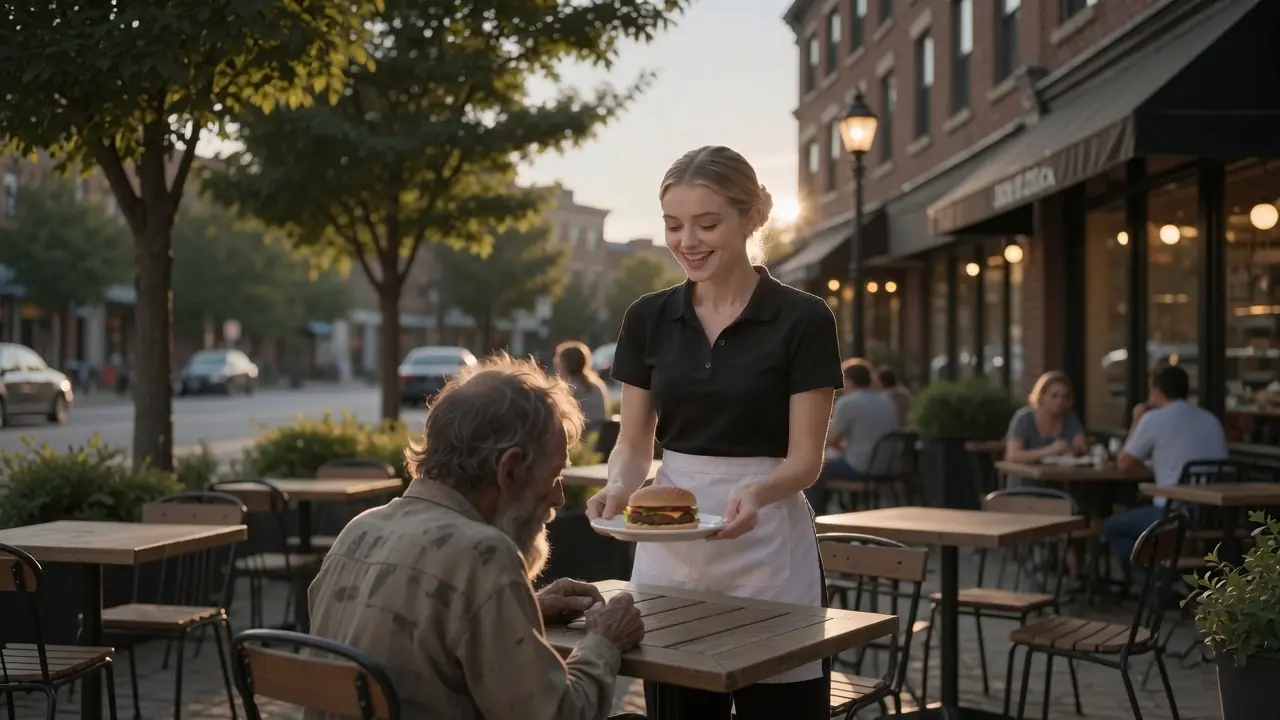
“You would make a fine owner,” he said.
Clara laughed. “I’m just a waitress.”
“No,” Samuel said, turning toward her. “You are a person who understands that food is not only food. That is where every good restaurant begins.”
His words warmed her more than she expected. No one had ever said something like that to her before. Most people saw her as temporary, as someone passing plates until life gave her something better. Samuel spoke as if the kindness she already had was not small, but important.
After that day, Samuel came to the café every Thursday morning. Clara always made sure he had water first, then breakfast if he wanted it. Sometimes he paid with a few carefully folded bills. Sometimes Clara quietly covered the meal herself when she could. Samuel never asked, and Clara never made him feel like he had to.
Their friendship became part of the café’s rhythm. Regular customers began greeting him. The boy who once spilled orange juice started showing him drawings. The woman who had noticed Clara’s kindness brought him a book of crossword puzzles. Little by little, the lonely old man at the corner table became Mr. Reed, then Samuel.
Kindness spread in small, practical ways. A customer paid ahead for his coffee one week. Another brought an extra scarf when winter wind arrived early. The café owner noticed how people seemed gentler on Thursday mornings and quietly added a small community breakfast fund near the register. No announcement was made. No one turned it into a performance.
Clara watched it happen with wonder. She had thought she was only feeding one hungry man. She had not known kindness could become contagious if given without pride. Samuel watched it too, often with misty eyes and a hand resting near his heart. “Margaret would have liked this place now,” he once told Clara.
One Thursday, Samuel did not come.
Clara told herself not to worry. People had appointments. Weather changed plans. Older people moved carefully through their days. But by noon, concern had settled in her chest.
After work, she went to the community garden. Samuel was there, sitting on the bench, but he looked smaller than usual. His cane leaned beside him, and a sealed envelope rested in his lap. When he saw Clara, he smiled, but it took effort.
“I was hoping you would come,” he said.
Clara sat beside him. “I missed you this morning.”
“I know,” he said. “I wanted to come. The body has its own schedule at my age.”
She looked at him closely. “Are you okay?”
He smiled gently. “Today, yes. Forever, no one is promised.”
Clara swallowed. The garden felt suddenly too quiet. Samuel handed her the envelope. “I wrote something for you,” he said. “Not because I am leaving today, so don’t look frightened. I wrote it because some words should not wait until goodbye.”
Clara held the envelope but did not open it. “You can tell me now.”
“I will tell you some of it,” Samuel said. He looked toward Margaret’s roses. “The day you fed me, I had forgotten what it felt like to be welcomed. Not served. Not tolerated. Welcomed.” His voice trembled slightly. “You gave an old man back a piece of himself.”
Clara’s eyes filled before she could stop them. She looked down at the envelope, pressing her thumb along the edge. “You gave me something too,” she said. “You made me believe my kindness mattered.”
“It mattered before I arrived,” he said. “I only helped you see it.”
They sat together until the sun lowered behind the buildings. Samuel told her that the garden board had agreed to name one of the benches after Margaret. He asked Clara if she would help choose the flowers around it in spring. She nodded quickly, wiping her cheek with the back of her hand. Samuel pretended not to notice the tears because he was kind in that way too.
Months passed, and Samuel grew weaker, but he did not disappear from Clara’s life. She visited him at the garden when he could not reach the café. She brought soup, muffins, fruit, and stories from Thursday mornings. He gave her advice about saving money, repairing old lamps, choosing tomatoes, and forgiving herself for not being able to help everyone.
One morning, the café owner asked Clara to help plan a weekly community breakfast. “You understand people,” he said. “You know how to make them feel comfortable.” Clara thought of Samuel’s words and accepted. The first breakfast served twelve people. By the third month, it served forty.
There were no speeches, no pity, no questions that made people shrink. Just warm food, clean tables, and volunteers who learned to look guests in the eye. Samuel attended the first one in a pressed shirt and his blue scarf. He sat at the corner table while Clara moved between guests, and his smile followed her like a blessing.
Later, he told her, “This is your breakfast place already beginning.”
Clara looked around at the crowded café. “It doesn’t belong to me.”
“Not on paper,” he said. “But in spirit, perhaps.”
When Samuel passed away the following spring, it was peaceful. Clara learned the news from his neighbor, who called the café because Samuel had written her number beside the phone. Clara stood in the storage room for a long time with one hand over her mouth. She did not cry loudly. She simply folded inward around the loss.
The next Thursday, she set his usual table with a glass of water, a small bowl of fruit, and one pale pink rose from Margaret’s bush. Customers grew quiet when they saw it. No one needed an explanation. The corner table had become part of all of them.
A week later, Clara opened Samuel’s envelope again. Inside was the letter she had already read many times, but now the words felt different. He had written that kindness had found him when he most needed it. He had written that a meal given with respect had restored his courage. He had written that Clara should never call her compassion small.
At the bottom, he had added one final line.
“Feed the lonely when you can, Clara, because hunger is not always in the stomach.”
Years later, Clara did open her own breakfast café. It was small, bright, and full of clean natural light. The tables were simple, the coffee was strong, and no one was hurried out for sitting quietly. Near the front window, she placed a small sign that read: Samuel’s Table.
Every Thursday morning, that table was reserved for someone who needed a meal and a place to breathe. Sometimes it was an older man with tired eyes. Sometimes it was a young mother counting coins. Sometimes it was someone in clean clothes whose loneliness was harder to see. Clara welcomed them all the same.
She often thought back to the first morning she saw Samuel Reed sitting outside the café. She remembered the empty water glass, the trembling hands, the way he had looked surprised to be treated with respect. She remembered placing the plate in front of him and saying there was no rush. At the time, she believed she was only giving him breakfast.
But kindness had a way of becoming larger after it left your hands. One meal had become a friendship. One friendship had become a community breakfast. One quiet old man had helped Clara see the life she was meant to build.
And every time she served someone at Samuel’s Table, Clara felt he was still there in some gentle way. Not as a ghost or a memory that hurt, but as a lesson that kept breathing. She would place the plate down carefully, smile warmly, and speak the words that had started everything. “Please eat slowly. There is no rush here.”