The window gave way on the third try.
Imogen Hartwell drew in one slow breath and held it, because the hinge had always announced itself in October, and she could not afford for it to announce her now. The house was sleeping, or close enough to sleeping that hope could be mistaken for silence. Three servants in the east wing, one in the west, and a footman dozing in the hall with his chin on his chest since the longcase clock struck four.
She had six minutes before the clock struck again.
Six minutes to climb over the sill, reach the wisteria, lower herself down the south wall, cross the lawn, and pass the boundary gate before any candle moved behind any window. The valise she had packed at midnight already sat on the leads outside, placed carefully so its brass corner would not scrape the slate. She put one gloved hand on the sill, one foot on the dressing stool beneath her, and lifted herself into the cold dawn air.
She moved with the careful precision of a woman who had nursed an invalid mother for three winters and learned that every broken thing in a house could be heard from any room in it. The lower wisteria stem was thick and old, nearly as wide as her wrist. She had measured it in August while pretending to weed the border, while her father sat in his study writing the letter that ended her life.
She had measured the lawn too. Eighty-seven paces from the south door to the boundary wall. Five feet of mossed stone on the kitchen garden side. The lane to the turnpike where the mail coach stopped for water at twenty past five. She had measured everything because measurement was the only practice the last three years had taught her to trust.
Sentiment was not reliable.
Hope was not reliable.
Her father’s word certainly was not reliable.
The cold traveled through her gloves as she gripped the stone. The wisteria smelled of old rain, damp bark, and the iron scent of a climber that had grown into the south face of Hartwell Park for sixty years. She lowered herself hand by hand, careful of the dead canes, careful where the lead flashing met the brickwork above the kitchen offices.
Then her boot found the leads of the scullery roof and rang louder than she had planned.
She froze.
Inside the scullery, a kettle ticked on the hob, and a mouse moved behind the dresser. No other sound followed. Three breaths passed. Then four.
She moved again.
Over the parapet, down the trellis, onto the kitchen garden gravel. Her valise was in her right hand. Her left held her bonnet ribbons tight beneath her chin, because if the bonnet blew off into the lane, she would lose ten minutes the road could not spare.
At the gate, she looked back once.
The window she had climbed from stood open like a mouth surprised mid-word. The curtain had caught on the casement bar where she had hooked it back. The room behind that window had been hers since she was nine.
Her mother had been buried in May.
Her father had signed the betrothal articles in August.
He had signed Imogen into marriage with the holder of a note he could not pay, a man she had met only three times in her life. The last time had been over a luncheon table, where Sir Hugh Calvert had not once looked at her face and twice had looked at her hands.
For six weeks, Imogen had played the obedient daughter. For six weeks, she had smiled when required, lowered her eyes when expected, and walked the lawn at midnight to count the distance between herself and freedom. For six weeks, she had written letters in another hand to her great-aunt in Bath.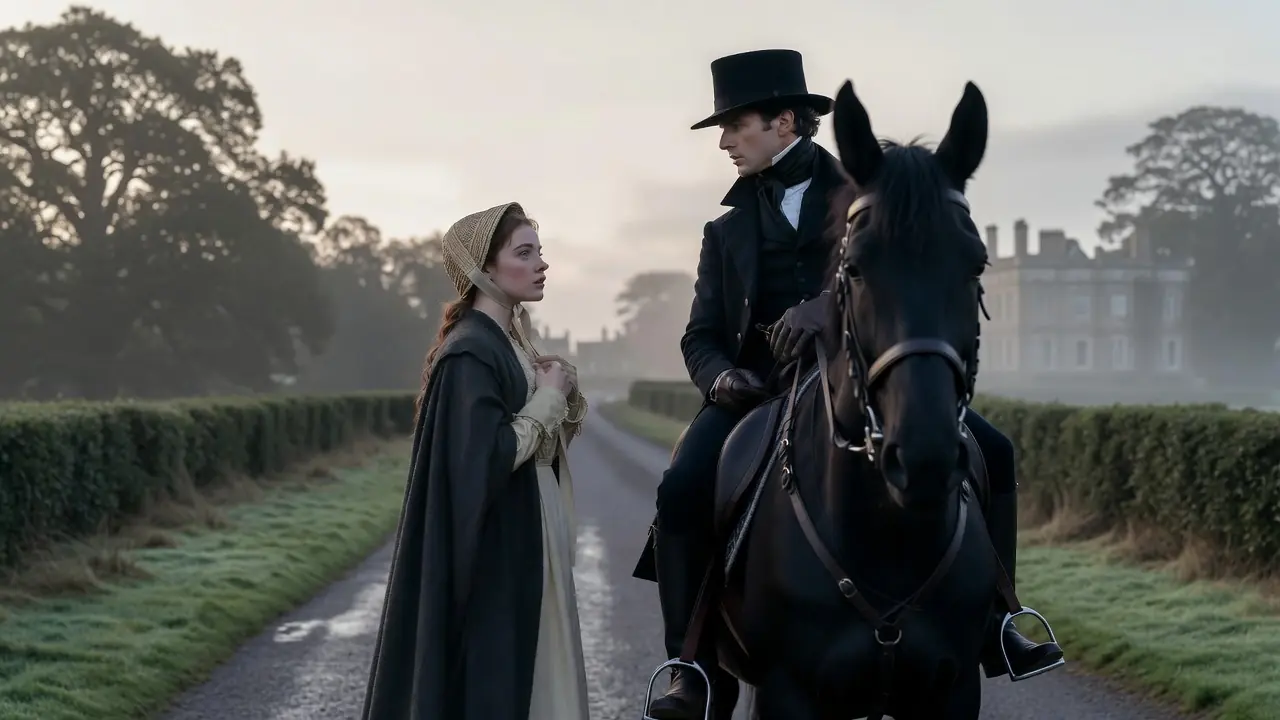
The answer had come in a firm old hand.
Come to me.
Come at once.
Do not write again from that house.
Sewn into Imogen’s stays was one guinea, with four more hidden in her sleeve. In her breast pocket were her mother’s miniature and the sealed letter from Bath. That was the whole of what she was taking from the house where she had been born.
The gravel under her boots sounded like the loudest thing in Yorkshire.
Two miles east, on the high road lifting out of the Wharfe Valley toward the moor, Theodore Calvert, Duke of Wraithmore, rode alone in the half-light. He had given his carriage and valet leave to follow at their own pace because he did not want anyone beside him for the part of the morning that mattered.
He was eight and twenty, tall and broad through the shoulders, with dark hair, gray eyes, and the controlled bearing of a man who had been Duke since his father’s death seven years earlier. He had spent three days at his northern holding, Calvert Holt, settling a dispute between two tenants over a strip of water meadow neither of them, in justice, owned.
He had ridden out of the bailiff’s yard at three in the morning because a conversation he had refused to have at supper would otherwise have resumed at breakfast.
In his pocket was a letter from his cousin, Sir Hugh Pelletier Calvert, advising that his domestic affairs were on the point of being settled to everyone’s satisfaction, including the Duke’s own. That letter had cost Theodore an hour at his desk, learning that Hugh had bought up a baronet’s note in the West Riding and meant to marry the baronet’s daughter for it before Michaelmas.
The signet ring under Theodore’s thumb had turned three times during that hour.
He had not yet decided what to do.
His black horse, Marston, knew the road and walked it at the pace his master set. The dawn was coming up gray over the moor, with no rose in it yet, only a thin yellow line somewhere east of Tadcaster. The wind carried the scent of heather and bracken.
The road was empty until he heard boots on gravel.
A figure was walking quickly from the west, bonnet pulled low, a valise dragging from one hand. She had not seen him yet because her eyes were on the road before her boots. Theodore drew Marston to a halt.
The young woman came within twenty paces before she lifted her face and saw the horse and rider.
She stopped.
Her free hand moved slightly from her side, the gesture of a woman who had been measuring distances all night and had just been asked to measure one more.
“I beg your pardon,” she said.
Her voice was clear and not loud. It shook only once on the second syllable of pardon, and she steadied it before he could decide whether he had heard the tremor or imagined it.
“I am bound for the Black Horse at Ferrybridge,” she continued. “I have business in Bath. I shall not detain you.”
Theodore looked at the valise, too heavy for her. He looked at the bonnet ribbons tied so tightly they had marked her throat. He noticed the stitched palm of her glove, repaired in a hand not belonging to a lady’s maid. He saw the folded letter making a square inside the breast pocket of her traveling cloak.
Then he remembered Hugh’s note.
The young woman is six and twenty and not, in my view, given to defiance.
Theodore took his thumb off his signet ring.
“You are some way from Ferrybridge,” he said.
He did not dismount. She would not have liked it if he had.
“Seven miles,” he continued. “The mail does not stop before half past five. May I ask whether you have a guide?”
“I have my feet,” she said, lifting her chin slightly. “And a possible sense of direction.”
“Both excellent,” he replied. “And neither sufficient. Will you allow my groom to take you up? He is a quarter mile behind with the carriage. You will reach the inn by five, in some warmth and in time.”
She studied him.
The light had risen enough for him to see her eyes. Hazel, set deep, dark-lashed, and exhausted. A small scar rested above her right brow, and he did not look at it twice because he had been raised not to.
“I do not know you, sir,” she said.
“No,” he answered. “You do not. And you will be in less danger from me at fifteen paces in the dawn than in any other arrangement I can presently devise. My groom is fifty-eight years old, has been in my family’s service since before I was born, and would walk five miles barefoot through November rather than allow harm to come to a woman in his carriage. If you would prefer to refuse, I shall ride ahead and tell the keeper at the Black Horse to expect you on foot.”
She considered.
Somewhere behind him, carriage wheels sounded on the road, slow and steady.
“I shall be obliged,” she said, “if your groom will take me up. I shall pay him for the inconvenience.”
“My groom does not accept payment for civilities,” Theodore said. “He will, however, accept a thank-you if it is offered. I am Calvert.”
“Hartwell,” she said.
She almost said of Hartwell Park, then stopped as if remembering she was no longer truly of that place.
“Of Yorkshire,” she finished. “Lately of Yorkshire.”
“Miss Hartwell,” he said, tipping his hat by half an inch.
He turned Marston aside so she might walk toward the carriage now rounding the bend.
He watched her go. At one glance, he knew his cousin’s note had been wrong on its single point of evidence. Miss Hartwell was six and twenty and very clearly given to defiance.
Harkness, the groom, needed no explanation. He saw Miss Hartwell, saw the valise, and saw his master’s face. Within moments, he had stepped down, folded the carriage step, and opened the door with the practical authority of a man who had been solving other people’s emergencies for forty years.
“Ma’am,” Harkness said. “Up you go. Mind the step. The offside spring took a knock at Wetherby and has not been seen to. The seat will not bite you. The seat opposite might, but only if you provoke it. Where am I taking you?”
“The Black Horse at Ferrybridge,” she said.
“Ferrybridge is no farther than my master’s breakfast,” Harkness replied. “And breakfast is at the Holt Gatehouse at six. We shall have you there well before the mail.”
He shut the door, climbed back onto the box, and set the carriage in motion.
Theodore rode beside it at a walk, his eyes on the road, not the window. Inside, Imogen sat upright with the valise gripped between her knees. The window faced south, the direction from which, in three or four hours, her father would wake, ring for coffee, and learn that the bed in her room was unslept.
She measured the inside of the carriage instead.
Dark green velvet worn at the corners. Leather. Beeswax. The faint scent of cedar shavings against moths. A panel by her elbow had been painted over so often the heraldry beneath was now only a shadow.
She had told him Hartwell of Yorkshire.
He had told her Calvert.
The bargain of dawn was that neither was obliged to be more specific.
At quarter past five, they came over the rise above Ferrybridge. The village lay below, the river smoking in the morning cold, the inn yard of the Black Horse already lit with lanterns.
Theodore leaned toward the carriage window, hat in hand.
“Miss Hartwell,” he said, “we shall be in the inn yard in five minutes. Will you allow me to send my groom in for your ticket? It is a small civility, but it spares you the necessity of standing at the booking clerk’s desk under your own name.”
She had not thought of that.
She set her jaw before he could see the surprise.
He saw it anyway, and did not remark on it.
“I shall be obliged,” she said. “The name of Mrs. Hartington of Otley will serve. My great-aunt in Bath will be expecting it on the parcels.”
“Mrs. Hartington of Otley,” he said. “It shall be done.”
He paused.
“May I ask one piece of information before Harkness goes in?”
“You may ask.”
“The gentleman whose name is on the article you are not prepared to be this morning, does he know you are bound for Bath, or does he believe you still at home?”
She looked at him through the window.
“He believes I am still at home,” she said. “He will know otherwise by ten.”
“Then you have until ten,” Theodore said. “It is enough.”
At the Black Horse, Harkness handed her down. He left her with a parlor maid who asked no questions because Harkness had spoken first. Three minutes later, he returned with a paper ticket and an inquiry from the Duke as to whether Mrs. Hartington of Otley would consent to a hot breakfast in the small parlor before the mail came.
She would.
In the parlor, a fire had been kindled, and a tray was already on the table. Toast, butter, hot chocolate, an egg in a cup. Theodore stood with his back to the fire and gestured to the chair.
“Mrs. Hartington,” he said, “the egg is fresh. The chocolate is from a tin Harkness keeps against emergencies. The toast is the kitchen’s responsibility, not mine. Will you sit?”
She sat.
She had not eaten since six the previous evening, unable to swallow supper while her father read aloud the announcement Sir Hugh Calvert intended to send to the Bath Chronicle. Now the scent of chocolate filled the room, and suddenly it was the only thing in it.
“You are kind,” she said after drinking. “I am unable this morning to be as gracious as I should like.”
“You are quite gracious enough.”
He did not sit. He watched the door rather than her.
“The mail to York leaves in ten minutes,” he said. “The through coach to Bath does not run today. You will lose a day at Doncaster. I have business in the South this week. I shall go down by my own carriage at a steady pace and reach Bath on Friday. If you would accept a seat in the chariot as far as Lady Adela Crofton’s house in the Royal Crescent, you would be there sooner and not required to give your name to a booking clerk. I shall ride. Harkness will drive. Refuse if you wish.”
She set the toast down.
“Mr. Calvert,” she said. “I do not know you. I have spent the last six weeks learning that a name is not, in itself, a recommendation. Will you tell me, without flourish, why you are taking the trouble?”
He looked at her very straight.
Then he gave the single sentence he owed himself since seeing her on the road.
“Because the gentleman whose name you are not prepared to be this morning is my cousin,” he said. “And because I have owed him for twelve years a debt I am no longer prepared to pay.”
The mail horn sounded outside.
She lifted her eyes. “Mr. Calvert,” she said, “you are not a mister.”
“No,” he said. “I am not.”
“You are the Duke of Wraithmore.”
“I am.”
She set her napkin beside her plate.
“And was it coincidence,” she asked, “that put you on the Great North Road at four in the morning a week before your cousin meant to put me in his carriage?”
“Not in the larger sense,” he said. “I had been to Calvert Holt to consider whether I could prevent him. I had not found the means. Your wisteria appears to have furnished it.”
“My wisteria?”
“I beg your pardon. I have no manner of right to that observation.”
“You have,” she said, and the faintest flicker touched the corner of her mouth. “No manner of right to anything you have done this morning, Your Grace. And you have done it anyway. I shall ride to Bath in the chariot.”
He bowed.
“Harkness will tell you when to come down to the yard,” he said. “Will you finish the toast?”
“I shall finish the toast.”
The chariot rolled out of the inn yard at twenty-five past five. Harkness drove, Theodore rode at the offside wheel, and Imogen sat in the forward corner that did not face the road behind her. The dawn lifted off the moor at last and spread pale over the river.
For the first hour, she did not speak.
He did not require her to.
She watched hedgerows, a lark rising from the verge, a laborer at a gate, and the changing sky. She thought about her mother’s miniature in her breast pocket. She thought about Lady Adela in Bath. Against her will, she thought about the man riding at the carriage wheel.
At Doncaster, Harkness changed the horses. Theodore brought her into a quiet back parlor and ordered tea. At Newark, after riding six hours, he finally entered the carriage and took the seat opposite hers.
“I shall ride again at Stamford,” he said. “I do not, in general, ride inside. I am told the conversation is better for it. Whether the conversation today will justify the report, I cannot presently undertake to say.”
She looked at the painted carriage panel. “Your Grace, the chevron under the paint.”
He looked at the panel, then at her.
“Argent on a chevron sable, three crescents or,” he said. “The chariot belonged to my grandfather. My father had it painted over when he succeeded. I have neither the heart to have it picked out again nor the philosophy to have it stripped. The result is the worst of both choices.”
“My father had a book of heraldry,” she said. “I read it at twelve because I had nothing else to do that winter.”
“Calvert of Wraithmore,” he said. “Three crescents for the three crusades the second earl did not attend. He was prevented by gout. The crescents are aspirational. The motto is, A promise well made is well discharged, which has been the family curse for four centuries.”
“It seems an honorable curse.”
“It is the curse of any family that has not learned to refuse a promise at the outset.”
She looked at his signet ring.
“Will you tell me,” she asked, “the nature of the promise you have owed him for twelve years?”
He looked out of the window.
“I was sixteen,” he said. “I borrowed a horse without permission and rode it lame. The owner would have written to my father, who was dying. Hugh settled the matter with a bank draft drawn on a Wraithmore account he had no authority over. He produced it for me to sign. I signed. The man was paid, and my father was spared.”
He paused.
“The one hundred forty guineas were never the debt. The debt was that Hugh had spared my father a piece of news in the last six weeks of his life. For twelve years, Hugh has used that memory to secure whatever indulgence he required.”
“And now he has used it to buy my father’s note,” Imogen said.
“Yes.”
“What do you mean to do?”
“I mean to discharge a promise I have not found the courage to refuse,” Theodore said. “I mean to tell my cousin that the debt I have paid in installments since 1802 is now paid in full. Any further claim shall be heard by the family as the second-rate moral coinage it always was.”
He stopped. His thumb turned the signet once and stopped again.
“It is a discharge I owed myself, not him.”
For two days, they traveled south. They spoke in fragments at first, then longer stretches. He told her of Calvert Holt, of tenant disputes, of a parterre badly built under the south wing. She told him of her mother, her father’s decline, Lady Adela’s letters, and the exact measurements of the wisteria.
On the second day, between Witham Common and Stilton, he laid two alternatives before her.
The first was a Chancery suit challenging the betrothal articles as procured under pressure. It would take a year, perhaps more. Imogen would live under Lady Adela’s roof while the case proceeded.
The second was marriage.
Not to Hugh.
To Theodore.
“If I marry you,” he explained, “my cousin’s claim becomes untenable within the family. The matter closes in a fortnight. The note and article are discharged by settlement. It is efficient.”
She stared at him.
“I am not proposing it as better,” he said quickly. “It is better only in efficiency. It asks of you, in the discharge of a debt imposed against your will, an instrument you should not have to use. To be married to me to be free of him is a poor kind of freedom. I have known you for thirty-two hours. I do not even know whether you laugh at things.”
To her own surprise, Imogen laughed.
A small, half-painful laugh.
He looked startled.
“I find,” she said, “that any matter is capable of mirth if a man can propose a marriage of convenience in the same sentence in which he confesses he does not know whether the bride laughs at things.”
“Then let us set the second alternative aside until Friday,” she said. “Treat me as a passenger, not an offer.”
“You are a passenger,” he said gravely. “And you have, to my certain knowledge, paid no fare.”
“Harkness may send the bill to my great-aunt.”
They reached Bath on Friday afternoon. Lady Adela Crofton stood at the door of the seventh house from the western end of the Royal Crescent before the bell could be rung. She was three and seventy, small, sharp-eyed, and made of stronger material than most people twice her size.
She took Imogen’s face in both gloved hands and examined her.
“You have your mother’s chin and none of her sense, child,” she said. “But the chin will serve.”
Then she turned to Theodore.
“Wraithmore, come in. Mrs. Lane will take Miss Hartwell up. You and I shall have words in the library when she is settled.”
That night, Imogen slept twelve hours.
The next day, in Lady Adela’s library, Theodore laid the two plans before her again. This time Lady Adela listened, removed her spectacles, and spoke only after he finished.
“The Chancery suit may be long,” Lady Adela said, “but it can be won. The marriage may be efficient, but no plan shall spend my niece’s reputation as the principal currency of the transaction.”
Then she left them alone.
Imogen looked at Theodore. “If I take Chancery, what becomes of my father?”
“I have instructed my steward to make a fair offer for the standing timber on the south plantation,” Theodore said. “The proceeds will discharge the arrears and smaller notes. Your father will not be put out of his house.”
“And if I take the second alternative?”
“The same arrangement obtains. The timber is secured. The small farm at Lower Bedale is secured. Three thousand pounds settled at your sole disposal.”
He paused.
“I am drifting into a ledger. I shall stop.”
“You shall not stop,” she said. “Finish the column.”
He did.
When he finished, she looked at the fire.
“I shall take the Chancery,” she said quietly.
For a moment, Theodore did not move. Then a small smile crossed his mouth and vanished.
“Good,” he said. “I had been hoping you would.”
“You had?”
“I had been hoping you would refuse the second alternative on the only ground it could honorably be refused: that you do not yet know whether you wish to marry me. I do not wish to be married to a woman who takes me only to be free of my cousin. Chancery is the longer road. It is the better road. At the end of it, if the question is still open, we may have other matters to discuss.”
“Theo,” she said carefully, trying the name when he offered it.
“On trial,” he replied.
The Chancery suit began the following Tuesday. Bath society noticed Imogen immediately, because Lady Adela made certain it would. New gowns appeared within days. Green merino, saffron silk, deep indigo. Imogen walked into the Pump Room with her great-aunt and let the polite world draw conclusions that were not Sir Hugh’s.
Sir Hugh arrived in Bath on the eleventh of October.
He sent cards to Lady Adela three times and was not received. He saw Theodore standing at Imogen’s chair at the Octagon and did not cross the room. The next morning, he sent a letter to the Bath Chronicle implying that Theodore’s attention to Miss Hartwell was not honorable.
The letter did not run. Lady Adela’s influence prevented it. Mrs. Holroyd, the solicitor’s widow managing the case, filed it as evidence.
Three more letters followed.
None were published.
Then one morning, Sir Hugh came to Lady Adela’s house when Theodore was in Bristol and Lady Adela was away with Mrs. Lane. Imogen received him in the library with Mrs. Holroyd seated at the writing table and the Chancery papers laid out where he could see them.
Sir Hugh made his proposition.
Withdraw the suit. Accept the marriage. The article and note would be discharged.
Imogen listened without interruption.
Then she said, “Sir Hugh, I shall not withdraw the Chancery suit. I shall not, in any form, accept the article. I am refusing your proposition in plain English. Further communications shall be referred to Mrs. Holroyd’s chambers.”
His face whitened.
He bowed and left.
That might have ended cleanly, but the next morning the Bath Chronicle published what previous letters had failed to print. It suggested the Duke of Wraithmore’s private interest in Miss Hartwell was of a less honorable nature.
By ten o’clock, the piece was in drawing rooms across Bath.
Imogen read it at breakfast and understood at once.
If Theodore continued visiting Lady Adela’s house, the insult would become worse. If he stayed at her side publicly, he would make her reputation dependent upon his. He would become the very instrument by which Sir Hugh wounded her.
So she wrote Theodore a note and told him not to come.
Not that day.
Not the next.
Not until the Chancery concluded and her name stood independent of his.
The note was delivered to the Christopher. Theodore read it, sat with his face in his hands for an hour, and then rode out of Bath without telling Harkness where he meant to go.
For four days, Imogen slept poorly.
Then Mrs. Holroyd came to Lady Adela’s library with a folder and a small object wrapped in linen.
The folder contained the truth.
The note against Imogen’s father had been altered. Its date was forged. The paper stock, the banker’s receipt, and a clerk’s deposition would prove it. The betrothal article named a debt that did not legally exist on the day it was signed.
The article would not stand.
The note would not stand.
The entire matter could be disposed of in weeks, not fourteen months.
“The further matter,” Mrs. Holroyd said, looking at Imogen steadily, “is that Sir Hugh is in danger of indictment for fraud. The indictment is at your discretion.”
Then she unwrapped the linen.
Inside was a small enameled miniature in a silver oval, found beneath Sir Hugh’s bed at the York House. Imogen recognized it immediately. She had seen him days earlier in a private garden, alone, passing his thumb over it like a man carrying grief he could not put down.
It was the face of Lavinia, the aunt who had raised him after his mother died, the only person he had ever truly loved.
Imogen looked at the miniature, then at the documents.
“I shall go to him,” she said.
At one o’clock, she entered Sir Hugh’s sitting room at the York House with Mrs. Holroyd beside her. Sir Hugh stood in the center of the room, composed at first, though for one second his face was the face she had seen in the garden.
Imogen placed the miniature on the table.
“This was found under your bed,” she said. “The chambermaid did not know what it was. I do.”
He did not speak.
She laid out the evidence next: the deposition, paper stock, banker’s receipt, certified copy of the article. She accused him of nothing. She described everything.
Sir Hugh listened to the end.
Then he crossed to his desk and wrote three documents in his own hand: withdrawal of the article and note, a statement of the true date, and a letter to the Bath Chronicle withdrawing the insult and acknowledging Theodore’s attentions as honorable.
When he returned to the table, he said, “Miss Hartwell, I beg your pardon for what I have done in Bath and for what I should have done in Yorkshire. I shall not ask either pardon to be granted. I ask only that you take what is on the table and go from this room with the matter finished.”
Imogen looked at the miniature.
“I shall not ask for the indictment,” she said.
Sir Hugh sat very still.
She set the miniature back on his side of the table. “It was not mine to take. It was an artifact of the conversation. It is yours again.”
He inclined his head slowly, the gesture of a man finally required by another person’s decency to inhabit his own.
The next morning, the Bath Chronicle printed his withdrawal.
Sir Hugh left England for the Low Countries and never returned.
Imogen wrote to Theodore in Marlborough, setting out the facts and the absence of any further matter standing between him and the date she had named at the magnolia. He received the letter at breakfast, did not finish his coffee, and rode for Bath.
At four in the morning, he stood at Lady Adela’s door.
He did not knock. Lady Adela’s footman, instructed at midnight, admitted him and took him to the library. Ten minutes later, Imogen came down in her wrapper, her hair braided for the night.
“Theo,” she said.
“Imogen,” he replied. “I have been, for four days, a fool.”
“You were not slow,” she said. “You wrote no letter because I forbade you to write.”
“You set me outside the door,” he said, “because you would not allow me to become the means by which you were made, in print, what you climbed out of a window to escape. I have not been loved by anyone in the way you set me outside that door.”
She looked at him.
“Theo,” she said. “I shall not marry you to be free of your cousin. Your cousin is, by yesterday’s post, in Holland. I propose to marry, in my own time and by my own consent, on the date I named at the magnolia, a man with whom I should like to spend the next forty years rebuilding a parterre at the south wing of Calvert Holt.”
He crossed the half pace between them and kissed her on the cheek, only on the cheek, exactly where she allowed.
“By the lilacs,” he said.
“By the lilacs,” she answered.
They were married the following May in the chapel at Calvert Holt. Lady Adela gave the bride away, though she remarked afterward that gave was entirely the wrong verb, as she had surrendered nothing.
After the service, Imogen and Theodore walked down to the rebuilt parterre under the south wing. The lilacs were in bloom, four white and four mauve, and the air was heavy with their sweetness.
She placed her hand over his on the gatepost.
“Tomorrow,” she said, “take me into the kitchen garden. Mrs. Burrell tells me the wisteria on the south face of the kitchen offices is sixty years old and has not been measured since 1804.”
Theodore looked at her and smiled.
“Imogen Calvert,” he said, “I shall measure it with you.”
The thrush finished its song in the next field.
The lilacs held the warmth of the May sun.
And beneath their joined hands, the gatepost was steady.