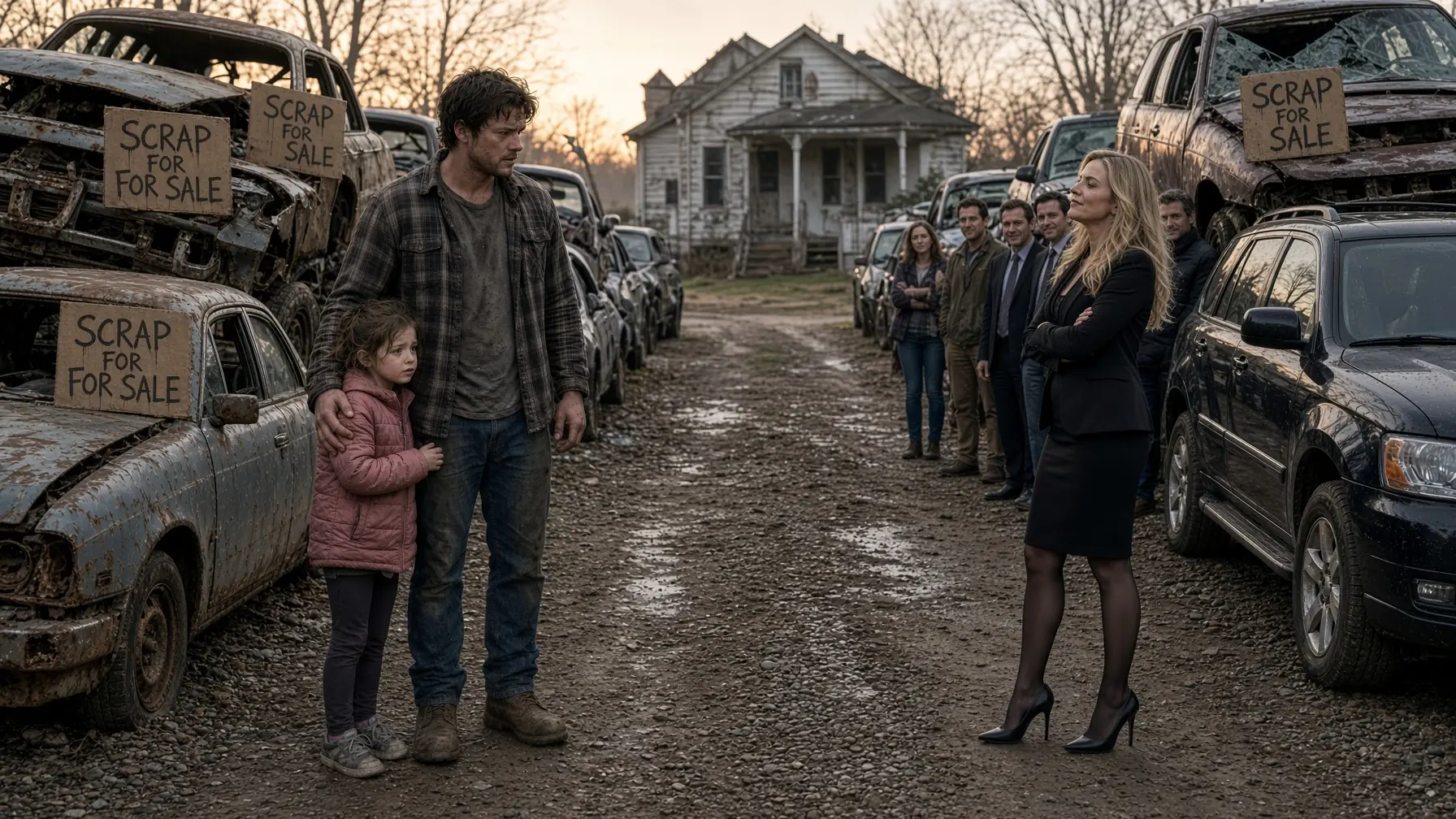
Nobody in Milfield thought Owen Callaway would last long as a single father. Too quiet, too steady, too ordinary. So when Diana Voss, owner of three dealerships and a reputation built on crushing smaller people, decided to have some fun, she chose Owen's driveway. 12 rusted, broken, engine dead cars appeared overnight. A gift from Diana and her circle deliberately meant to be a punchline meant to bury him in debt and shame.
What Diana didn't know was what Owen had spent 15 years hiding not just how to fix cars, but how to own the people who broke them. Owen Callaway woke at 5:30 every morning without an alarm. He moved through the house in a particular order. Coffee first, then oatmeal on the stove, then three quiet knocks on the door at the end of the hallway.
The knocks were never louder than necessary. And Bonnie always answered them the same way. A small groan, then the shuffle of feet, then the door opening to reveal a seven-year-old with tangled hair and serious eyes. Their house on Cartmill Road was a single-story with a narrow front yard and a garage that held more tools than it did cars. The neighbors who had lived on that street long enough, knew that Owen kept to himself, paid his bills on time, and never asked for anything, the ones who hadn't lived there long, assumed he was simply unremarkable.
Neither group was entirely right. Owen had been in Milfield for 7 years, long enough that most people had stopped wondering about him, which was exactly how he preferred it. He had a few routines, a few friendships that did not require much maintenance, and a daughter who had inherited in equal measure his quietness and his way of watching things before deciding what to think about them. Bonnie was the kind of child who asked one precise question, where other children asked five imprecise ones. Owen answered her questions with the same seriousness he brought to everything else which had produced by the time she was seven.
A girl with an unusually accurate picture of how the world worked and a deep preference for honesty over comfort. The garage told a different story if anyone had known how to read it. Along the back wall hung tools on a pegboard, each one in its exact place, each one worn smooth from years of use. On the floor beside the workbench sat a metal toolbox painted red, or what had once been red, now a faded rust orange, where the paint had chipped and aged. It had belonged to Owen's father.
And before that, to no one Owen knew of, Bonnie was not allowed to touch it, though she sat on top of it nearly every evening while her father worked, swinging her legs and asking questions he almost always answered. Owen worked as a mechanic at the community garage on Miller Street, fixing trucks and lawn equipment and the occasional water pump for whoever needed it. The pay covered what they needed and not much else. He did not complain about this. He did not seem to notice it.