The first police officer was already reaching for the orange-handled mallet when I realized the woman standing in my garden had not come there simply to destroy something.
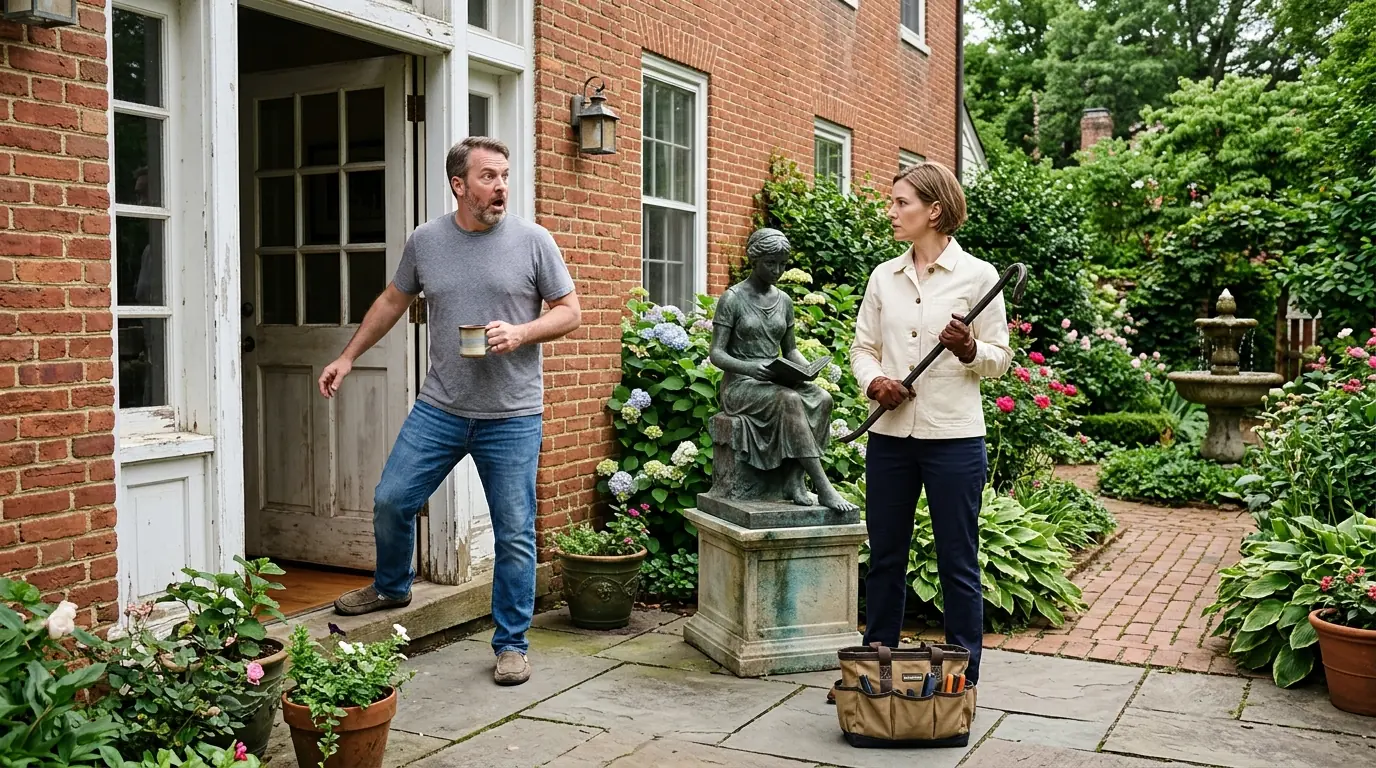
She had come to leave a story behind.
“Don’t touch that yet,” I said.
Officer Rachel Monroe stopped before her gloved hand reached the tool. Behind her, another officer stood near the side gate talking to a woman in a cream-colored jacket who had somehow transformed herself, in less than five minutes, from an intruder in my backyard into the calmest person at the scene. Her name, I would soon learn, was Claire Sutton. She spoke softly, kept her hands visible, and answered every question as if she had been rehearsing the answers for days.
I was fifty-two years old, barefoot on my own patio, wearing a coffee-stained sweatshirt and staring at the shattered remains of a bronze sculpture my family had owned since before I was born. The head lay beneath a rosemary bush. One arm had broken at the shoulder. The open bronze book that had rested across the figure’s lap was split from the body. The base had fractured badly enough that a section of the internal casting was visible for the first time in more than a century.
And lying beside all of it was a masonry mallet that looked almost exactly like mine.
Almost.
Officer Monroe looked from the mallet to me. “Mr. Hale, you said that isn’t your tool?”
“I said it looks like one I own.”
Claire immediately spoke from behind the other officer. “He had it in his hand when I came through the gate.”
I turned toward her.
“You were already in my yard.”
“I heard the noise.”
“You made the noise.”
Officer Monroe raised a hand. “Everyone stops. Mr. Hale, look at me.”
I did.
“Did you strike the sculpture?”
“No.”
“Did you handle that mallet today?”
“No.”
“Did you see Ms. Sutton strike the sculpture?”
That question mattered.
I forced myself to answer exactly.
“No. I heard the first impact from inside. When I came outside, she was standing beside it.”
Claire exhaled audibly.
Not enough for most people to notice.
Enough for me.
She thought she had just won something.
Officer Monroe continued. “Do you know this woman?”
“I’ve seen her once.”
Claire shook her head. “He confronted me aggressively about a month ago.”
Officer Monroe looked toward her. “Why were you here then?”
“I was walking nearby.”
“You were taking photographs through my fence.”
“I photograph architecture.”
“You told me you worked for insurance.”
Claire’s expression did not move.
“I may have been confused about which address I had.”
The second officer, Daniel Price, asked her to remain near the gate. Then he walked toward us. “Ms. Sutton says she was on the sidewalk when she heard repeated impacts, came through the open gate, and saw you damaging the statue.”
“The gate was locked.”
“It wasn’t locked when we arrived.”
“Because she opened it.”
“With what?”
I looked toward the latch.
The side gate had a simple hook mechanism on the inside. From outside, a person could not normally reach it.
Unless they had something long and narrow.
I remembered the first crash.
Then a pause.
Then the second.
Then another.
My stomach tightened.
“She planned this.”
Claire laughed once.
It was quiet, controlled, almost sympathetic.
Officer Price looked toward her.
Claire said, “That’s exactly the kind of thing he was saying when I called.”
“You called police?”
“Yes.”
“How long ago?”
“Immediately.”
That was when I noticed something else.
There was no fear in her.
No adrenaline.
No confusion.
She had stood in the middle of my garden after destroying a rare bronze, waited for me to appear, accused me before I had even understood what happened, and then calmly called police.
It was too complete.
I looked at Officer Monroe.
“I have cameras.”
Claire stopped smiling.
Not dramatically. She was better than that.
But something behind her eyes changed.
Officer Monroe turned toward me. “Cameras covering the garden?”
“One on the patio. One over the detached garage. Another under the rear eave.”
Claire said immediately, “He could have edited anything.”
Officer Monroe did not even look at her.
“How quickly can you access them?”
“Right now.”
My hands were shaking so badly I had to enter the security-app password three times.
The video loaded.
The timestamp read 9:43 a.m.
Empty garden.
At 9:46, the side gate moved.
A woman appeared.
Cream jacket.
Dark pants.
Leather gloves.
Claire Sutton.
She carried a large gray tote bag over one shoulder.
Officer Price moved closer.
Claire did not.
On the video, she reached over the gate using a long metal rod, caught the interior latch, and lifted it.
Officer Monroe said quietly, “Ms. Sutton, don’t leave.”
“I wasn’t planning to.”
The video continued.
Claire crossed the garden toward the statue known in my family simply as the Reader.
She set the tote down.
Opened it.
Removed a towel.
Inside the towel was an orange-handled mallet.
My throat tightened.
She carried it to the fountain and placed it behind the low stone wall.
Then she removed something else from the bag.
A short handled sledge.
Black head.
Wooden shaft.
She approached the statue.
The first strike landed against the lower pedestal.
The camera microphone caught the impact.
That was the sound that had shaken my kitchen window.
The second blow hit the same area.
A fracture opened along the base.
Claire stepped back.
Looked toward the house.
Waited.
I had not come out yet.
Then she struck the statue near the lower torso.
Officer Price muttered something under his breath.
The bronze figure tilted.
The base failed.
The Reader fell sideways into the ivy with enough force to tear one arm away.
Claire did not recoil.
She stepped forward and hit the damaged sculpture again.
Then again.
Not frantic.
Methodical.
Officer Monroe paused the video.
Claire’s face had gone completely pale.
The officer asked, “Would you like to change your statement?”
Claire looked toward her.
Then toward me.
Then back.
“I want a lawyer.”
It was the first intelligent thing she had said all morning.
But Officer Monroe did not close the video.
“Keep playing it.”
I did.
Claire returned the sledge to her tote.
Then walked behind the fountain and picked up the orange-handled mallet.
She removed a cloth.
Wiped the handle.
Placed the mallet beside the broken pedestal.
Then she took out her phone.
The rear camera had audio.
Not perfect.
Enough.
“It’s done.”
Pause.
“No. He hasn’t come outside.”
Another pause.
Then:
“The duplicate’s next to the base.”
Officer Monroe’s eyes moved toward the real mallet lying in the grass.
Onscreen, Claire listened.
“Once patrol photographs it, it becomes part of the scene.”
Another pause.
Then words that would eventually turn a vandalism case into something much larger.
“No intact Winslow, no clean comparison. Tell Adrian the base went too.”
She hung up.
Twenty-seven seconds later, I appeared through the patio door.
Only then did Claire raise her phone and begin photographing me.
The photographs she later showed police were real.
That was the clever part.
She had not fabricated images of me standing beside the destruction.
She had created the destruction, planted the apparent tool, then waited for me to become exactly what any innocent owner would become when he saw a family object smashed apart.
Angry.
Confused.
Loud.
Grieving.
She intended to use my natural reaction as part of her evidence.
Officer Monroe watched the final seconds of video.
Onscreen, I shouted, “What did you do?”
Claire backed away.