Ethan Parker did not begin the week intending to count his wife’s insults. He did not wake up Monday morning with a notebook ready, planning to turn his marriage into evidence. In fact, he had spent years doing the opposite, smoothing things over, swallowing comments, smiling through tension, and telling himself Laura was just stressed. But when she looked across the breakfast table and told him he buttered his toast like a child, something quiet inside him finally stopped bending.
He stared at the toast in his hand, half-covered in butter, and almost laughed from the absurdity of it. Their seventeen-year-old son, Noah, was sitting at the end of the table pretending to scroll through his phone, but Ethan saw the way the boy’s eyes flicked up and then down again. Noah had learned the same household rule Ethan had learned. When Laura started criticizing, the safest thing to do was disappear without moving.
That first comment was not new. Laura had been correcting him for months, maybe years, but lately it had sharpened into something constant. She corrected the way he walked into a room, the way he opened cabinet doors, the way he cleared his throat, the way he sat down after work. Nothing was too small for her attention, and nothing he did was ever simply allowed to exist.
After breakfast, Ethan opened the notes app on his phone and typed one line. Monday, 7:14 a.m., toast buttered incorrectly. He looked at the words and felt foolish for a second. Then Laura called from the kitchen that he had loaded the dishwasher “like someone who had never lived indoors,” and Ethan quietly typed the second line. By lunch, he had three.
Tuesday came with a fresh list of failures. His shoes were tied too loosely, his “good morning” to Noah sounded flat, and his driving to the grocery store was apparently too cautious for a grown man. When he laughed during a phone call with his brother Mark, Laura stepped into the hallway and told him he sounded ridiculous. Ethan smiled into the phone, lowered his voice, and added another note after the call ended.
By Wednesday evening, the list had become less funny and more revealing. Laura criticized how he folded towels, how he held the remote, how he chewed dinner, and how he breathed while watching television. “Do you have to breathe so loudly?” she asked, eyes fixed on the screen. Ethan slowly turned his head toward her, waiting for even a trace of self-awareness, but she only looked annoyed that he had made her ask.
He wrote it down. Wednesday, 8:42 p.m., breathing too loudly during TV. The sentence looked impossible, but there it was. He wondered what kind of man had to document his own breathing to prove he was being worn down. Then he realized that was exactly why he had to keep going.
Thursday was worse because Laura had an audience. They stopped at the grocery store after work, and when Ethan thanked the cashier, Laura smiled tightly and said, “That sounded so forced. You always make normal interactions awkward.” The young cashier looked away, embarrassed for him. Ethan carried the bags to the car in silence while Laura complained that he had chosen the wrong checkout lane.
Friday morning began with coffee. Ethan made it the same way he always did, but Laura took one sip and pushed the mug away. “Too strong,” she said. “You never pay attention.” Ethan looked at the coffeemaker, then at her untouched mug, then at his phone on the counter. Number twenty-eight.
By Friday night, he was at thirty-five. Thirty-five criticisms in five days, and not one of them had improved anything. She had not corrected a real mistake, solved a real problem, or helped him become a better man. She had simply chipped at him, small strike after small strike, until the ordinary act of standing in his own kitchen felt like standing in front of a judge.
Saturday should have been a break. Ethan mowed the lawn, repaired a loose board on the side gate, and helped Noah clean out the garage. Laura criticized the mowing pattern, the way he spoke to their neighbor Bob, and how slowly he washed his hands afterward. When he sat in his favorite chair after dinner, she told him he sat “like an old man who had given up.”
That one stayed with him. Not because it was the cruelest thing she had said, but because Noah heard it. His son had been walking through the living room with a glass of water, and Ethan saw his face tighten. Noah did not defend him, and Ethan did not blame him for that. A child should not have to enter his parents’ war to protect one of them from the other.
By Sunday afternoon, Ethan had reached forty-five. They were hosting a small backyard barbecue for the neighbors, and Ethan hoped Laura would at least behave in front of other people. He should have known better. The grill was taking a few minutes to catch, which was normal, but Laura came outside holding a drink and wearing that sharp little smile that always arrived before a public correction.
“Honestly, Ethan, you can’t even light a simple grill?” she said loudly enough for everyone to hear. Mrs. Patterson from next door stopped mid-sentence. Bob from across the street suddenly became fascinated by the label on his beer bottle. Laura gave a short laugh and added, “Look at him struggling with something a twelve-year-old could figure out.”
The grill flared to life three seconds later. Flames rose cleanly, exactly as they were supposed to, but no one smiled. Ethan stood there with the lighter in his hand and felt something settle in him. It was not anger, not exactly. It was a calm, cold decision that he would not continue living as the target in his own home.
He did not confront her at the barbecue. He cooked the food, served the neighbors, and kept the evening pleasant because he refused to give Laura another story where she could call him unstable. When everyone left, she acted as if nothing had happened. Ethan washed the grill tools, entered criticism number forty-five, and went to bed knowing number forty-six was coming.
It arrived Monday morning in the kitchen. Ethan was making eggs while Noah poured cereal at the counter. Laura walked in wearing a silk robe, glanced at Ethan, and sighed as if his existence had already disappointed her before the day began. “Look at your father,” she said to Noah.
Noah froze with the cereal box in his hand. Ethan did not turn around yet. Laura continued, her voice smooth with contempt. “Look how he stands there, shoulders slouched, moving like he has nowhere important to be. This is what happens when a man has no ambition.”
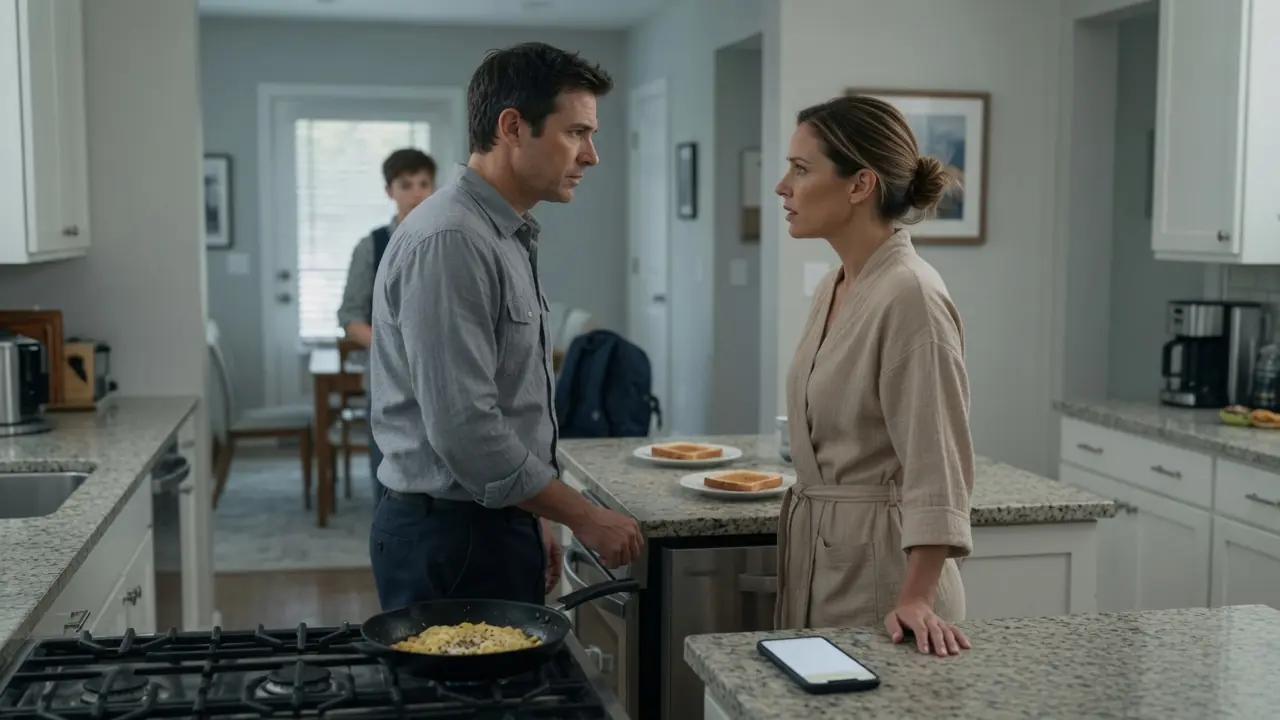
Ethan turned off the burner. Laura gestured toward him as if he were an exhibit in a lesson about failure. “You are seventeen now, Noah. Do not grow up to be like him. A man should have drive, presence, confidence. Your father is a terrible example of what a man should be.”
There it was. Number forty-six. But this one was different. Ethan could handle being criticized for toast, coffee, laundry, and breathing, but Laura had just dragged their son into it and tried to damage the boy’s respect for his own father.
“Noah,” Ethan said calmly. “Finish breakfast and get ready for school.” Noah nodded immediately, grateful for the exit. He carried his bowl into the dining room, though Ethan knew he was still close enough to hear. Laura folded her arms and looked pleased with herself, as if she had delivered wisdom instead of cruelty.
“We need to talk,” Ethan said. Laura rolled her eyes. “About what? How you cannot handle constructive criticism?” Ethan almost smiled at the phrase. Constructive criticism. Forty-six attacks in one week, and she still believed she was building something.
“Tonight,” Ethan said. “After dinner. We are going to talk about the future of this marriage.” Laura scoffed. “There it is. Drama. I try to motivate you and you act like a victim.” Ethan looked at her for a long second. “Seven o’clock,” he said. Then he picked up the pan and quietly finished making Noah’s eggs.
That day, Ethan made three calls. The first was to a lawyer named Patricia Wells, whose number he had saved months earlier but never used. The second was to his brother Mark, asking whether he could stay in Mark’s guest room if things went badly. The third was to a real estate friend who knew rental homes across town. Ethan was not acting on impulse. He was preparing because Laura had crossed a line that could not be uncrossed.
When he came home from work, Laura was watching television as if the morning had been perfectly normal. Noah was doing homework at the kitchen table, quieter than usual. Ethan helped him with a geometry problem, and the boy looked relieved that his father’s voice was steady. Children feel the weather inside a house even when adults pretend there is no storm.
After dinner, Laura took her usual place on the couch. Ethan sat across from her instead of retreating to his small office. She did not look up from the television. “Are we doing your dramatic conversation now?” she asked.
“Yes,” Ethan said. “But first I want you to know I have been keeping track of something.” She finally looked at him. “Keeping track of what?” Ethan took out his phone and opened the notes app. “Your criticisms.”
Laura laughed. “You have been counting my criticisms? That is pathetic.” “Forty-six,” Ethan said. Her laughter faded only slightly. “That is how many times you criticized me since last Monday. Forty-six separate comments about how I eat, walk, speak, breathe, sit, work, and exist.”
“Maybe if you did not give me so much to criticize, I would not have to say anything,” Laura shot back. Ethan nodded slowly. There it was. The confession hidden inside the defense. She did not deny the list. She believed he deserved it.
“This morning was number forty-six,” he said. “When you told our son I was a terrible example of manhood.” Laura sat forward. “I was teaching him what not to become.” “No,” Ethan said, his voice still controlled. “You were teaching him that love means tearing someone down until they become quiet enough to manage.”
For the first time, Laura did not answer immediately. Ethan continued, “Saturday night, we are having dinner here. Your parents, my brother, and our closest friends will be invited.” Laura narrowed her eyes. “Why?” Ethan stood. “Because people have only seen the version of you that smiles in public. It is time they understand what happens behind closed doors.”
Laura called him ridiculous. She said he was overreacting. She said every marriage had criticism, and he had become too sensitive. Ethan listened to it all, then went upstairs and printed the list. He organized the forty-six entries into categories with the same care he used at work. Personal attacks. Public corrections. Parenting interference. Daily disrespect.
Saturday evening, the house looked perfect. Laura made pasta salad and chatted warmly with her parents, Richard and Ellen, as if nothing serious were coming. Mark arrived with his wife Jenna and gave Ethan a quiet nod. Their friends David and Melissa brought dessert, laughing softly in the entryway, unaware they were walking into a reckoning.
Dinner went smoothly. Laura was charming, attentive, and funny. She told stories, complimented Melissa’s dress, and helped Ellen with coffee. Ethan watched the performance and felt no bitterness, only clarity. This was the woman the world knew, and perhaps that was why he had doubted himself for so long.
After dessert, Ethan stood and placed the folder on the table. “Thank you for coming tonight,” he said. Laura smiled at him, still unaware. “I asked you here because I need the people closest to us to understand what has been happening in this house.”
The room became still. Laura’s smile flickered. Ethan opened the folder. “This week, I documented every criticism Laura directed at me. Forty-six in seven days.” Richard shifted in his chair. Ellen looked from Ethan to her daughter with confusion.
Ethan began reading. Monday, toast buttered incorrectly, dishwasher loaded incorrectly, greeting to Noah not energetic enough. Tuesday, shoes tied wrong, driving too cautious, laugh too loud on a phone call. Wednesday, towels folded wrong, remote held wrong, breathing too loudly while watching television. He read calmly, without exaggeration, which made the list sound even worse.
By the time he reached Friday, Ellen had one hand over her mouth. Richard’s face had darkened. Mark leaned forward with his elbows on the table, listening closely. Laura’s cheeks reddened as she realized the list was not going to sound like harmless feedback when spoken aloud.
“Saturday,” Ethan continued, “I was corrected for how I mowed, how I spoke to Bob, how I sat in my chair, how I held a sandwich, how I closed the door, and how I washed my hands.” He turned a page. “Sunday, at the barbecue, Laura said in front of our neighbors that I could not light a simple grill and that a twelve-year-old could do better.”
David looked down at the table. Melissa’s eyes widened. Ethan did not look at Laura yet. “Then Monday morning, she told Noah that I was a terrible example of what a man should be.” Silence filled the room so completely that the wall clock sounded loud.
Richard turned to his daughter. “Did you say that to the boy?” Laura opened her mouth, closed it, then said, “I was trying to motivate Ethan to improve.” Mark gave a short, humorless laugh. “By telling his son not to become him?” Laura glared at him. “You do not understand our marriage.”
Ethan picked up another page. “Let us examine improvement. Criticism twelve, I chew cereal too loudly. Criticism eighteen, I breathe too heavily. Criticism twenty-three, I say thank you wrong to cashiers. Criticism thirty-one, I open mail wrong.” He looked at Laura. “Which of those was meant to improve my character?”
Laura stood suddenly. “You are twisting everything.” Ethan remained seated. “I am reading exactly what happened.” Ellen’s voice broke through, soft but firm. “Laura, these are not normal complaints.” Laura turned toward her mother. “You too?”
Richard sat back heavily. “Your mother is right. I have been married forty-two years. I have argued with your mother, disappointed her, and frustrated her. But I have never tried to make our children see her as less than a woman. She never did that to me either.”
Laura looked around, searching for support, but none came. Ethan watched her realize that the charming public version of herself could not erase what he had documented. She tried one last defense. “Every marriage has criticism.”
“This is not criticism,” Ethan said. “This is daily erosion. A criticism points to a problem. What you have done is turn my existence into the problem.” Laura’s eyes flashed. “Maybe because you act so mediocre.” The words came out before she could stop them.
The room reacted before Ethan did. Ellen looked away in shame. Richard pushed his chair back slightly. Mark’s jaw tightened. Ethan simply nodded, because her own mouth had done what his list could not fully do. It had revealed the truth.
“That is what you think of me,” Ethan said quietly. “Not as a husband, not as a father, not as a man who has spent fifteen years building a life with you. A mediocre project that needs constant correction.” Laura started to speak, but Ethan lifted one hand. “No. I am done being corrected for existing.”
The next morning, Ethan packed his essentials before sunrise. He had already arranged to stay with Mark for a few days while he finalized a rental. His lawyer had told him how to protect himself legally and financially, and he followed every instruction calmly. This was not a storming out. This was a man leaving with a plan.
Laura came downstairs while he was carrying a bag to the car. She wore pajamas and panic instead of confidence. “What are you doing?” she asked. “Leaving,” Ethan said. “I told you last night.”
“You are really going to break up our family over some criticism?” she asked. Ethan closed the trunk and looked at her. “Some criticism was forty-six attacks in one week. Some criticism was telling our son his father is a warning sign.” Laura’s eyes filled, but Ethan had learned to distinguish tears of remorse from fear of consequences.
Noah appeared in the doorway, pale and quiet. “Where are you going?” Ethan walked back toward him. “Uncle Mark’s for now. Then my own place.” Noah nodded slowly. “Can I call you?” “Anytime,” Ethan said. “This does not change how much I love you. It only means I will not stay somewhere I am disrespected every day.”
Laura stepped closer. “We can go to counseling.” Ethan looked at her. “Would you like to sit with a therapist and explain why my breathing needs professional improvement?” Her face crumpled. “I said I can change.” Ethan’s voice softened, but the decision did not. “You had forty-six chances this week to choose kindness. You chose contempt.”
Mark pulled into the driveway in his truck. He did not say much, just helped Ethan load the last two bags. Laura stood on the porch, looking stunned, as if she still could not understand how toast, coffee, stairs, and remote controls had become the end of a marriage. But Ethan knew it had never been about those things. It had always been about respect.
Three months later, Ethan sat in his rented house across town, drinking coffee with Noah before school. The house was smaller than the family home, but it felt peaceful in a way Ethan had almost forgotten houses could feel. Nobody corrected the way he leaned against the counter. Nobody sighed because he stirred his coffee too loudly. Nobody turned his breathing into a personal flaw.
“Dad,” Noah said, looking up from homework. “Can I ask you something?” Ethan smiled. “Always.” Noah hesitated. “Why did you stay so long?” The question was fair, and Ethan respected him too much to answer with a lie.
“Because I thought marriage meant accepting criticism from someone you love,” Ethan said. “I did not understand the difference between being helped and being slowly taken apart.” Noah looked down at his pencil. “She still asks if I think you will come back.” Ethan took a breath. “What do you tell her?” Noah met his eyes. “That you seem happier now.”
He was right. Ethan was happier. Not because divorce was easy, and not because he enjoyed hurting Laura. He was happier because peace had returned to the places where fear had been living. He laughed louder now. He worked better. He stood straighter without realizing it.
The legal process moved forward, helped by the records Ethan had kept. Laura tried at first to claim he had abandoned the family, but the documented pattern made that claim difficult to defend. Even her parents refused to pretend they had not heard what they heard at the dinner table. Richard called Ethan once, voice heavy, and said, “I am sorry we did not see it sooner.”
Ethan did not hate Laura. That surprised him at first, but it was true. He no longer needed her to suffer. He only needed not to return to a life where love was measured by how much correction he could endure. Some people mistake control for care, and some people call cruelty honesty because it sounds cleaner.
One evening, after Noah left, Ethan sat on his porch with a glass of iced tea. His phone buzzed with another message from Laura, but he did not read it immediately. He looked across the quiet street and listened to the sound of ordinary life. A dog barking. A car door closing. Wind moving through the trees.
For months, he had believed he was too sensitive. Too defensive. Too flawed. Now he understood that even strong people can forget their worth when someone questions it often enough. The list of forty-six criticisms had not ended his marriage. It had only shown him what the marriage had already become.
A man who respects himself does not stay forever in a place where he is treated like a defective machine. He does not let his child learn that love means daily correction and public shame. He does not keep shrinking just to make someone else feel taller. Ethan had remembered that late, but he had remembered it.
And in his own quiet house, breathing as loudly as he wanted, he finally felt like himself again.