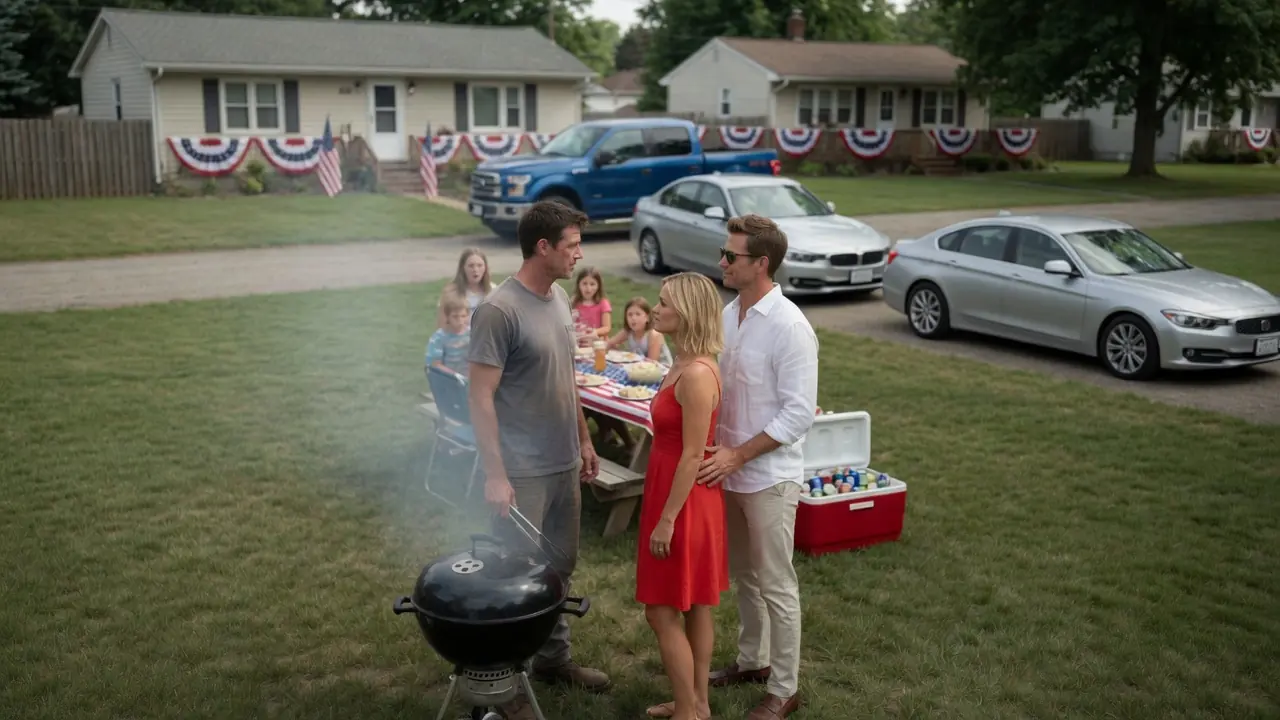
The Fourth of July sun burned white over the backyard, turning the grass pale and the aluminum grill lid too hot to touch. Nick Doherty stood beside the smoking barbecue with a pair of metal tongs in one hand, sweat running down his temples and soaking the collar of his gray T-shirt. Around him, his parents sat under the shade umbrella with paper cups of iced tea, his cousins tossed a football near the fence, and red-white-blue napkins fluttered on the picnic table beside bowls of potato salad. It should have been a simple family afternoon, the kind of holiday that smelled like charcoal, cut watermelon, and ordinary happiness.
But Nick had known for weeks that ordinary happiness was gone from his house. It had disappeared in pieces: a phone flipped face down too quickly, a shower taken with the bathroom door locked, a dinner gone cold while Mara smiled at a screen that was not meant for him. He had seen the message on the family iPad three weeks earlier, the one from Troy S. about a suite in Chicago and a lie she was supposed to tell. Since then, Nick had moved through his own marriage like a man walking across floorboards he knew were rotten underneath.
Mara sat on the edge of the patio in a red sundress Nick had never seen before. Her blonde hair was polished, her makeup careful, and her glass of sangria sat untouched in her hand while she kept glancing toward the driveway. She had barely spoken to Nick all afternoon except to ask whether the burgers were almost done. Every time his mother tried to start a conversation with her, Mara answered politely but distantly, as if she were waiting for a better party to begin.
At exactly two o’clock, the better party arrived in a silver BMW. The car slid to the curb and stopped behind Nick’s Ford F-150, blocking it in as if the driver had done it on purpose. The football stopped bouncing. Nick’s cousin Ryan caught it against his chest and turned slowly toward the street.
Troy Sallinger stepped out wearing expensive sunglasses, a white linen shirt open too low at the collar, tailored pants, and polished loafers that had never seen a dusty job site. He carried a case of imported beer on his shoulder like a trophy. He did not look embarrassed to be there. He looked like a man arriving to collect something he already believed belonged to him.
“Who is that?” Nick’s mother asked softly.
Nick did not answer. He watched Mara stand before Troy had even closed the car door. She did not look surprised. She looked relieved, and that small, terrible detail cut deeper than the message on the iPad.
Troy walked through the gate as if he had been invited to hundreds of family gatherings in that yard. He did not stop at the grill, did not greet Nick, did not offer his hand. He went straight to Mara, set the beer on the patio table, leaned in, and kissed her cheek in a way no casual friend would kiss another man’s wife. His hand settled near the small of her back, familiar and possessive.
The silence spread across the yard like spilled oil. Nick’s father slowly lowered his iced tea. His mother covered her mouth with one hand. Mara did not step away from Troy’s touch.
Nick set the tongs down on the side table. They landed with a small metallic clatter that sounded much louder than it was. He walked away from the grill, crossing the grass slowly, each step heavier than the last. He stopped a few feet from Mara and Troy, close enough to see the slight tremble in Mara’s hand and the smug curve of Troy’s mouth.
“What is he doing here, Mara?” Nick asked.
“He’s the man messaging you at midnight,” Nick said, his voice low and steady. “He’s the vendor conference in Chicago. He’s the reason you keep lying in my kitchen while I sit there pretending I don’t know.”
A gasp moved through the relatives behind him. Someone whispered Nick’s name, but he did not turn. Troy removed his sunglasses and gave him a smile that belonged in a sales office, not a man’s backyard. “Easy, buddy. Don’t embarrass yourself in front of your family.”
Nick looked at Troy only long enough to make clear he had heard him. Then he turned back to Mara. “Tell him to leave.”
Mara looked at Nick, then at Troy, and the pause between them seemed to hold seven years of marriage. Nick saw her eyes move over his sweat-darkened shirt, his rough hands, his work boots, the small burn mark on his forearm from the grill. Then she looked at Troy’s linen shirt, his BMW, his expensive watch, and the life he had been selling her in polished little lies. When she spoke, her voice shook, but not enough to stop the words.
“No,” Mara said. “I’m not sending him away.”
Nick went still.
“I’m tired, Nick,” she continued, louder now, as if she needed the whole yard to hear her choose. “I’m tired of the dust. I’m tired of the bills. I’m tired of watching you come home exhausted and fall asleep on the recliner by nine. I’m tired of this house, this routine, this small little life.”
His mother made a broken sound behind him. Nick did not move. Troy slipped his hand fully around Mara’s waist, and she let him.
“I want to feel alive,” Mara said, the cruelty sharpening as her fear turned into pride. “I want dinners that don’t come off a grill. I want hotels, cities, music, something that doesn’t feel like watching paint dry. I’m sorry if that hurts you, but I can’t keep pretending I’m happy here.”
Nick stared at the woman he had loved since they were twenty-two. He thought of the oak table he built in their kitchen, the walnut anniversary box she forgot, the lasagna she left untouched, the messages she hid. He thought of the transmission he had fixed on her car, the faucet he repaired at midnight, the roof leak he patched in freezing rain while she slept. In that moment, he understood something he should have understood earlier: she had not just chosen Troy that day; she had been leaving him for months.
“Okay,” Nick said.
Mara blinked. “What?”
He nodded once, slowly, as if confirming a measurement before cutting wood. “Okay.”
Troy’s smirk faded a little. He had expected shouting, maybe a shove, maybe some public humiliation he could use to make Nick look unstable. Mara had expected him to beg, accuse, or demand that she remember who had stood beside her when life was hard. But Nick did none of those things.
He turned away from them and walked toward the deck. The relatives stood in frozen clusters around the yard, unsure whether to follow or let him go. His mother whispered his name, but his father gently touched her arm to stop her. Nick climbed the wooden steps he had sanded and stained two summers earlier, opened the sliding glass door, and stepped into the cool air of the kitchen.
He did not slam the door. He closed it carefully.
Inside, the house felt strangely calm. The air conditioner hummed, the refrigerator clicked, and a bowl of chopped onions sat on the counter waiting for burgers no one would want now. Nick walked past the kitchen table he had built, past the framed wedding photo Mara insisted looked better in black and white, and down the hallway to the bedroom. The room smelled faintly of her perfume and clean laundry.
He took the old canvas duffel bag from the closet. He packed work jeans, flannel shirts, socks, underwear, and two T-shirts from the bottom drawer. He left the shirts she bought him, the framed vacation photo from Lake Erie, and the sweater she used to say made him look handsome. He went into the bathroom and took his toothbrush, razor, deodorant, and the small bottle of pain reliever he kept for his back.
Five minutes. That was all it took to pack a life when you only took what had always been yours.
In the garage, he paused longer. The garage was the only room that still felt honest. His tools waited in their places, clean, useful, and incapable of pretending love. He took his drill, his grandfather’s hand plane, his chisels, his measuring tape, and the tool belt that had shaped more of his life than any wedding ring ever had.
When the garage door opened, the backyard had fallen apart. People were gathering their bags, folding chairs, and children with the awkward haste of witnesses who had seen too much. Mara and Troy stood near the cooler, still close together, but Mara’s confidence had thinned. She watched Nick walk to his truck carrying the duffel bag and tool cases, and for the first time that day, she looked uncertain.
“Nick?” she called. “Where are you going?”
Nick put the tools in the truck bed and placed the duffel on the passenger seat. He looked at her one last time. There was no hatred in his face, no pleading, no anger for her to fight against. It was worse than anger. It was the flat, final look of a man who had already stepped out of the room inside his own heart.
He climbed into the Ford and started the engine. Troy’s BMW was still blocking the driveway, but Ryan and two cousins moved it out of the way after Troy tossed the keys with a nervous laugh. Mara stood beside the patio, arms wrapped around herself, watching the safety net she thought would always stay in place roll backward into the street. Nick shifted into drive and left without looking in the rearview mirror.
For three nights, Nick stayed at a Red Roof Inn off the interstate. The room smelled like stale smoke and lemon cleaner, and the bedspread scratched his skin through his clothes. He did not go home. He did not answer Mara’s messages, his mother’s tearful calls, or the texts from cousins telling him Troy was trash and Mara was a fool.
On the fourth night, he called an old friend named Mitch in Nashville. Mitch had offered him work the year before, custom cabin framing and interior finish carpentry in the hills outside the city. Back then, Nick had laughed and said his life was in Ohio. Now he sat on the edge of a motel bed, staring at the highway lights, and wondered what life he had meant.
“Offer still open?” Nick asked when Mitch answered.
There was a long pause. Mitch did not ask what happened. Good friends know when a man’s voice already carries the answer. “Yeah,” Mitch said. “Bring your hammer. Start Monday.”
Nick checked out before sunrise. He drove south with coffee from a gas station, his tools in the bed, and a silence in the cab that no longer felt like defeat. It felt like empty ground before rebuilding. He crossed into Tennessee by afternoon and did not turn back.
The first year in Nashville was not beautiful. It was work, exhaustion, motel rooms, rented rooms, job sites, sawdust, and hands so sore he sometimes slept with them open on the blanket. Mitch gave him long days and fair pay, and Nick took every extra hour offered. He framed cabins in summer heat, installed beams in winter cold, built decks overlooking wooded slopes, and slowly remembered that his hands could create more than a home for someone who did not value it.
By the second year, clients began asking for him by name. Nick had an eye for wood grain, patience with joints, and a quiet perfection that wealthy clients noticed after they stopped being impatient. He built dining tables, shelves, mantels, and custom reading benches. What began as side work in a borrowed garage turned into Doherty Custom Woodworking, a small shop tucked behind an old brick building outside Nashville.
By the third year, Nick owned his time. Not all of it, because a business owns you before you own it, but enough to breathe. He hired two apprentices, bought better equipment, and stopped waking every morning with Mara’s voice in his head. Some days he still remembered the backyard, but the memory had lost its teeth.
Then Sarah Whitmore walked into his life wearing a chunky cardigan, jeans, and a pencil stuck through her messy bun. She was the head archivist at a public library renovating its reading room, and Nick had built a twelve-foot white oak table for the project. When he delivered it, she did not glance at it quickly or treat it like furniture. She ran her fingers along the dovetail joints, crouched to inspect the supports, and looked at him with bright hazel eyes.
“No screws?” she asked.
“No screws,” Nick said. “Metal moves differently than wood. Over time, it cracks the grain.”
Sarah smiled. “So you built it to last.”
Nick felt those words settle somewhere deep in him. For years, steady had been treated like a flaw. Sarah said it like it was the highest compliment.
They had coffee across the street that afternoon. Then they had dinner two weeks later. Their relationship moved slowly, without fireworks, without secret messages, without the sick thrill of someone being chosen at another person’s expense. Sarah liked quiet mornings, honest work, and the way Nick explained wood like it had a memory.
Back in Ohio, Mara’s new life began shining and then rusting almost immediately. Troy moved into the house after Nick left, not because he wanted responsibility, but because he liked comfort when someone else had already paid for the walls. For a little while, Mara convinced herself she had won. There were expensive dinners, loud friends, weekend trips, champagne on credit, and the sweet rush of proving she had escaped the ordinary.
Then bills arrived. The electric bill. The water bill. The mortgage. The property taxes. The credit card statements Troy kept promising to handle once his commission landed.
Nick used to handle problems before Mara noticed them. A leaking faucet was tightened by morning. A flickering light was repaired after dinner. A strange noise in the furnace was diagnosed before winter could turn it into disaster. Troy, on the other hand, called everything “not a big deal” until it became one.
By October, the kitchen faucet dripped constantly. Troy’s gym bag sat on the dining table, leaving a damp ring on the wood Nick had finished by hand. Pizza boxes stacked on the counter. The grass grew too high, and the homeowners association taped warnings to the mailbox.
“Troy, we need to talk about the mortgage,” Mara said one night, holding a stack of mail.
Troy lay on the sofa with a beer in one hand and the TV remote in the other. “Babe, can this wait? I’m watching the game.”
“It can’t wait. The payment is late again.”
He groaned as if she had personally invented responsibility to annoy him. “My commission is delayed. I told you.”
“You told me that last month.”
“And I’m telling you again this month,” he snapped. “You wanted excitement, Mara. Excitement comes with a little flexibility.”
The word excitement made her stomach twist. She looked around the room and saw nothing exciting, only clutter, debt, and the slow decay of a house once held together by a man she had called boring. When Troy made a cheap comment about Nick being “just a handyman,” Mara surprised herself by saying, “Don’t talk about him.”
Troy laughed. “Oh, now you defend him?”
Mara had no answer. That was the beginning of her regret, not as a lightning strike, but as a drip in the sink. Slow, constant, impossible to ignore.
Three years after the Fourth of July barbecue, Mara came home early from a closing shift and found a yellow Jeep in the driveway. Inside, Troy stood in the living room buttoning his shirt while a younger woman sat on the couch scrolling through her phone. The girl looked bored, not guilty. Troy looked irritated at being interrupted.
“You’re home early,” he said.
Mara stared at him. “Who is she?”
“Kelsey,” the girl said, popping gum. “Promo lead for the region.”
“Get out,” Mara whispered, then louder, “Get out of my house.”
Troy stepped between them with a sneer. “Not really your house anymore, is it? Bank called. Foreclosure starts Monday.”
Mara felt the floor tilt. “You said you paid the mortgage.”
Troy smiled in a way that made her finally understand how he must have looked to Nick. “I said a lot of things.”
The girl stood, bored and impatient. Troy grabbed a duffel bag from the hallway. He had already packed. He left behind beer bottles, unpaid bills, broken promises, and the echo of every lie Mara had once mistaken for adventure.
“I left my husband for you,” Mara said, tears spilling hot and humiliating down her face.
Troy shrugged. “That was your choice.”
He walked out with Kelsey, and the yellow Jeep disappeared down the street. Mara stood in the doorway with cold air moving through the house behind her. The silence rushed in, but it was not the gentle silence she had hated with Nick. It was empty, punishing, and absolute.
Years later, Mara saw Nick again at a funeral in Columbus. Nick’s cousin Mikey had passed suddenly, and the family gathered under a gray rainy sky. Mara came because Mikey had always been kind to her, even after the divorce. She wore a thrift-store coat and scuffed boots, her blonde hair darker at the roots, her face thinner from stress and long shifts at a diner.
Then Nick walked in.
He wore a charcoal suit that fit him perfectly, and his beard was neatly trimmed. The tired bend in his shoulders was gone. He looked older, yes, but stronger, calmer, like a man who had rebuilt himself from the frame outward. Beside him walked Sarah, simple and graceful in a black dress and trench coat.
Mara heard whispers. Nick had a successful design shop now. Nick lived in Nashville. Nick was engaged. Nick looked happy.
That last part hurt the most.
After the service, Mara waited in the mist near the parking lot until Nick walked Sarah to their white SUV. Sarah looked at Mara, then at Nick, and gave him privacy without suspicion. That quiet trust made Mara ache more than any argument could have. She had never given Nick that.
“Nick,” Mara said.
He turned. His face did not harden, but it did not soften either. “Mara.”
“You look good,” she said, hating how small her voice sounded. “Success suits you.”
“Thank you.” He looked toward the chapel. “You holding up okay? I know you liked Mikey.”
She nodded, though tears were already gathering. “I’m sorry. About everything. About Troy, about the barbecue, about the way I treated you. I was stupid. I thought I was choosing life, but I was just choosing noise.”
Nick listened without interrupting.
“I threw away the only person who truly loved me,” she continued. “I see that now.”
For a moment, the rain seemed to hush around them. Mara wanted him to be angry. She wanted him to cry, to accuse her, to prove that somewhere inside him she still had the power to wound. But Nick only stood there with his hands in his coat pockets, calm and distant.
“I appreciate you saying that,” he said.
“Do you ever think about us?” Mara asked. “About the house?”
Nick looked past her at the wet road. “I think about it as a lesson.”
She flinched.
“It taught me what I’m worth,” he said quietly. “And it taught me I can’t build a foundation with someone who keeps looking for an exit.”
Mara pressed a hand to her mouth.
“I’m happy now,” Nick added. “I hope you find that too.”
She reached out as if to touch his sleeve, then stopped because she knew she had no right. “Nick, I regret losing you.”
He nodded once, not cruelly, not warmly, just finally. “Take care of yourself, Mara.”
Then he turned and walked back to Sarah. He opened the driver’s door, got in, and drove away without looking back. Mara stood in the parking lot until the taillights disappeared into the gray afternoon.
She had once wanted an adventure. She had chosen the man with the BMW, the hotel suites, the loud promises, and the easy thrill. She had called Nick boring because he was steady, simple because he was loyal, and small because he built a life instead of pretending one. Years later, she finally understood that peace had been the prize.
But by then, Nick was gone.
And this time, his silence was not pain.
It was freedom.