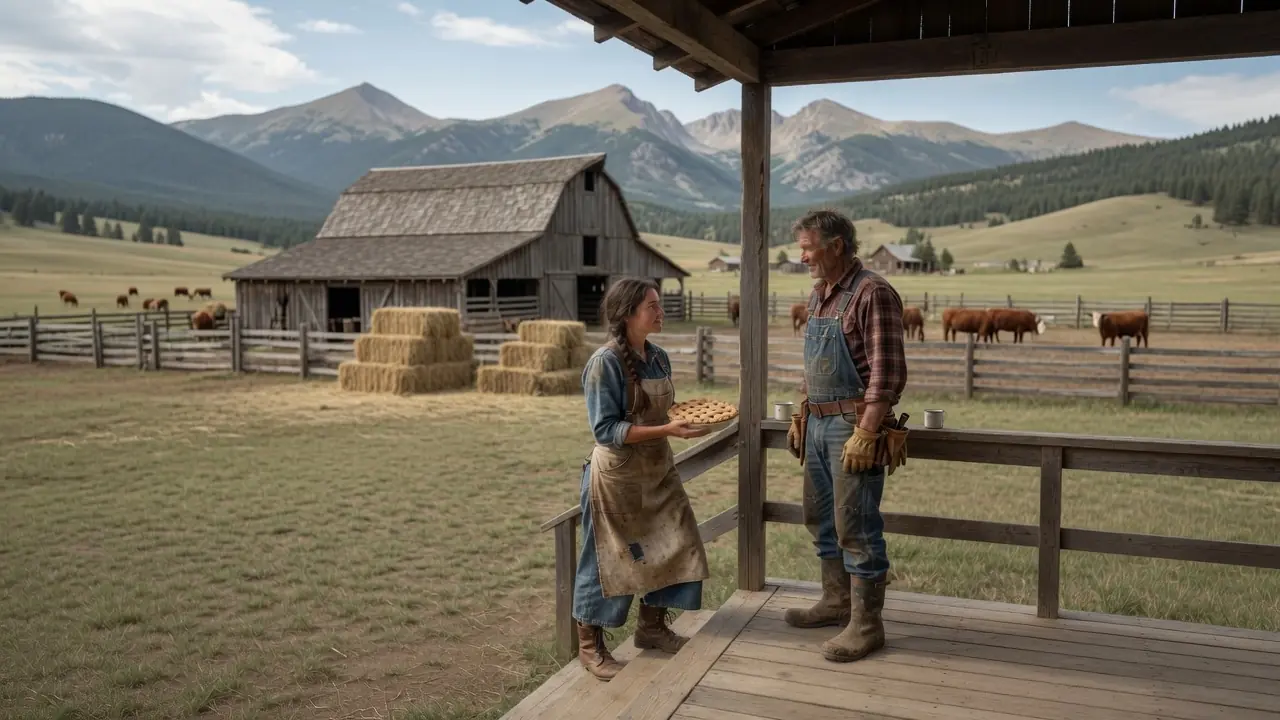
Some gestures look small from a distance. A woman crossing a pasture with a pie wrapped in a clean cloth. A widowed rancher sitting on his porch with coffee cooling beside him. A quiet Tuesday morning in Colorado, with cattle grazing beyond the fence and the Rocky Mountains standing blue and steady under the September sky. But sometimes the smallest gestures are the ones that have been saying the most for years.
Margaret Hale was twenty-five years old and had lived beside the Calloway Ranch all her life. She knew the land the way other women knew their sewing baskets, every dip in the field, every weak fence post, every trail the cattle preferred after rain. Her own forty acres sat south of Thomas Calloway’s property, divided by a long split-rail fence and a creek that ran thin in summer but sang loudly in spring. She had grown up watching the Calloways work their land, and after Eleanor Calloway died, she had watched the place become quieter than any ranch should be.
Thomas Calloway was fifty-five, a widower with gray in his beard, a steady hand, and a face shaped by years of sun, wind, and loss. He was not a hard man, though he looked like one from a distance. Hard men shouted, demanded, and made the world bend around their pride. Thomas did none of those things. He worked, kept his promises, spoke only when he had something worth saying, and lived alone in a house that had once been warmed by a wife’s laughter.
Eleanor had died three years earlier, after an illness that took its time. The whole valley had felt the loss because Eleanor had been the kind of woman who turned neighbors into family. She remembered birthdays, brought soup to sick people, and somehow knew when a person needed company without asking for it. When she was gone, Thomas buried her beneath the cottonwood east of the house and went back to work the next morning. People admired that, but Margaret understood it differently.
He did not go back to work because he was strong. He went back because work was the only thing that did not ask him to explain his grief. A fence never asked why his hands shook. A cow never asked if the house felt too empty at night. A field did not pity him when he walked through it alone. Margaret saw that, and two weeks after Eleanor’s funeral, she carried over a pot of stew.
“You didn’t have to,” Thomas had said when she stood on his porch. “I know,” Margaret had answered. That became their sentence, repeated almost every Tuesday for three years. Sometimes she brought bread, sometimes beans, sometimes preserves, and sometimes pie when the fruit was good. He always accepted with the same quiet gratitude, and she always left before either of them had to name what the habit had become.
Margaret told herself it was neighborly care. Thomas told himself the same thing. It was easier that way, and both of them were practical people who respected useful explanations. But useful explanations are not always honest ones. By the third year, Margaret knew exactly when Thomas would be on the porch, how he took his coffee, which repairs he was avoiding, and what kind of silence meant grief instead of peace.
Thomas knew more about her than he admitted too. He knew Margaret fixed her own fences and could mend a harness faster than most men in Durango. He knew she negotiated cattle prices with calm precision, never letting merchants push her into bad terms. He knew she kept her property clean, her accounts sharper than a banker’s ledger, and her pride tucked behind a warm smile. He also knew he looked forward to Tuesdays in a way that made him uncomfortable if he examined it too closely.
The apple pie came on a bright September morning in 1883. The apples came from the tree at the south end of Margaret’s property, the one that leaned slightly east and gave its sweetest fruit only when the weather turned crisp. She made the crust before sunrise, rolling the dough with cold hands the way her mother had taught her. She crimped the edges more carefully than she needed to and brushed the top until it baked into a clean, even brown. Then she wrapped it in cloth and started across the field.
Thomas was already on the porch when she arrived. He sat in his old wooden chair with one boot on the lower rail and a coffee cup in his hand. His shirt sleeves were rolled to the elbow, and a streak of dust marked one side of his trousers from morning chores. He watched her come up the steps, his expression softening in that quiet way she had learned to notice. When she held out the pie, he looked at it as if she had brought him a piece of home he thought he had lost forever.
“Apple,” he said. “September apples,” Margaret replied. “The good ones.” He looked from the pie to her face, and then he smiled. It was rare, that smile, slow to arrive but powerful when it did, taking years off him and showing the man he might have been before grief settled across his shoulders.
“If only I were ten years younger,” he said, light and almost teasing, “I would marry the woman who baked this.” He meant it as a harmless joke, a safe thing said by a man who believed the door was closed before he ever touched the handle. Margaret looked at him, and the morning seemed to hold still. A hawk circled high above the pasture, cattle shifted near the fence, and somewhere in the distance a gate creaked in the breeze. “Ten years would not be enough,” she said quietly.
Thomas blinked. Margaret set the pie on the porch railing before he could ask what she meant. “I have cattle to check,” she said, as if she had not just shaken something loose between them. Then she turned and walked back across the field, her skirt brushing the tall grass. Thomas stood on the porch and watched her go long after she had passed the fence line. The pie sat beside him, still warm, and for once his coffee went untouched.
He thought about her words all afternoon. Ten years would not be enough. Not enough for what? Not enough to make him young? Not enough to close the distance between fifty-five and twenty-five? Not enough to make a joke into something else? Thomas was a slow-thinking man, not because he lacked sense, but because he respected decisions too much to rush them.
Margaret tried to pretend the morning had not unsettled her, but she was not skilled at lying to herself. She checked the cattle, repaired a latch, and spent half an hour cleaning a water trough that did not need cleaning. Still, every thought led back to Thomas on the porch, his gray-streaked hair, his careful hands, his rare smile. She had not meant to answer him so plainly, but some truths grow tired of waiting. After three years, hers had finally stepped into the open.
The town of Durango had different ideas for Margaret Hale. Durango was growing quickly, full of railroad men, merchants, and women who believed marriage was a problem best solved before thirty. People admired Margaret’s independence but only in the temporary way society admires a woman’s strength before asking when she plans to stop needing it. They thought she needed a younger husband, a prosperous husband, a man who could expand her property and make her life easier. The name most often attached to that idea was Daniel Marsh.
Daniel was twenty-eight, handsome, well dressed, and the son of a merchant with enough money to make every mother in town speak kindly of him. He had been calling on Margaret since spring, appearing at the market when she sold butter, stopping by with news, offering small compliments that sounded polished in advance. He was not cruel. In fact, he was pleasant enough that Margaret sometimes wished she could want him. Wanting the sensible thing would have made life much easier.
He came to her property the day after the pie, carrying flowers ordered from Denver. Not wildflowers gathered from a field, but arranged flowers wrapped with ribbon, expensive and deliberate. Margaret accepted them with courtesy, placed them in water, and offered coffee because hospitality was not the same as encouragement. Daniel sat at her kitchen table and spoke of supply contracts, railroad opportunities, and the future of Durango. He looked around her house with the approving eye of a man already imagining how he might improve it.
At last, he asked if she would attend the Harvest Social with him. Margaret looked out the window toward the north field, where the Calloway barn roof rose above the grass. “I’ll think about it,” she said. Daniel smiled as if that meant yes. After he left, she stood at the same window for a long time, one hand resting on the counter. Far off, she could see Thomas riding toward the north fence line, exactly where she knew he would be.
Thomas heard about Daniel before Margaret gave any answer. Two weeks after the pie, he rode into Durango for feed and nails, and the news reached him before he reached the counter. Martha Greer at the dry goods store said Margaret Hale had nearly accepted Daniel Marsh’s invitation, and everyone agreed it was a fine match. Thomas bought his supplies, nodded where politeness required it, and rode home under a sky too wide for a man trying not to feel small.
That evening, he sat on his porch and looked at the place on the railing where Margaret had set the pie. He thought of Eleanor, not with betrayal in his heart, but with the calm ache that comes when love has become memory. Eleanor had known him better than anyone, and she had never tolerated foolish pride. He could almost hear her voice telling him that a man could be lonely and still be stubborn enough to pretend it was dignity. He got up, went inside, and looked at himself in the mirror by the kitchen door.
He saw a fifty-five-year-old rancher. He saw lines at the corners of his eyes, gray in his hair, and hands roughened by decades of work. He saw a man old enough to know better than to ask a young woman to share his remaining years. Then he remembered Margaret’s face when she said ten years would not be enough. He put on his hat before fear could talk him out of moving.
Margaret was mending the south fence when he appeared. He stopped at the line between their properties, hands resting on the top rail, waiting with the patience of a man who had finally decided but still did not presume. She kept working for several seconds because she knew Thomas Calloway, and she knew he would speak when the words were ready. “Margaret,” he said at last. “Thomas,” she answered, still looking down at the fence wire.
“I have been thinking about what you said.” She set the tool down and looked at him. “Which thing?” He gave her a look that almost made her smile. “You know which thing.” The afternoon light lay across the pasture, clean and steady, and the mountains stood behind him like witnesses.
“Ten years would not be enough,” Thomas said. “I have turned that over until I wore the edges smooth, and I still do not know what you meant.” He looked down at the fence rail, then back at her. “I am fifty-five years old. I know what that means. I am not going to pretend age is nothing just because pretending would make this easier.” His voice lowered. “But I would like to know if you are willing to tell me.”
Margaret looked at him, this careful, decent man who had spent three years accepting her Tuesdays without asking why they mattered. “It meant,” she said, “that ten years would not make you any more what I wanted, because you are already what I wanted.” The fence line between them became very quiet. Thomas did not speak. He only looked at her as if something had entered the world and he was afraid one sudden movement might frighten it away.
When he finally exhaled, Margaret realized he had been holding his breath. “Margaret,” he said softly, “I do not know what to do with that.” She stepped closer to the fence. “Then start by believing it.” His face shifted, not into joy exactly, but into wonder, which on Thomas Calloway looked deeper than joy. He nodded once, slowly, like a man accepting a responsibility he had been given by grace.
The Harvest Social came at the end of October. Margaret went because life did not stop asking questions just because the heart had answered one privately. Thomas did not go; he had not attended a town social since Eleanor died, and Margaret understood without needing an explanation. Daniel Marsh was there, handsome and attentive, and the whole town watched them with eager approval. He danced well, brought her cider, and spoke kindly enough that any sensible woman might have been satisfied.
Martha Greer cornered Margaret near the refreshment table. “Daniel Marsh is a fine man,” she said. “He is young, prosperous, and clearly interested.” Margaret looked across the room at Daniel, who smiled when he caught her eye. He was everything the town thought she should choose. But then she thought of Thomas arriving with spare lumber after her fence went down in the spring flood, fixing it before she even asked, and never mentioning it again.
“That is the whole thing, Martha,” Margaret said quietly. “What is?” Martha asked. Margaret looked toward the dark window, where the mountains were hidden beyond the glass. “The man who shows up when no one is watching.” Martha had no quick reply to that. Margaret left the social early and rode home under a sky full of stars, knowing she had disappointed the town and chosen herself instead.
Through November, Thomas began repairing his house. He did not announce it, but Margaret noticed everything. The porch rail that had leaned for two years was straightened. The kitchen window had a new frame. The spare room, which had held Eleanor’s things behind a closed door, was opened, aired, and gently cleared. He was not erasing the past. He was making room for a future.
One Thursday, not Tuesday, he knocked on Margaret’s door with his hat in his hands. She opened it and saw the seriousness in his face before he spoke. “I would like to ask you something properly,” he said. Margaret stepped aside but did not invite him in yet. Some questions deserved the doorway.
“Daniel Marsh is a good man,” Thomas said. “The town knows it, and so do I. He is twenty-eight, with prospects and money and every reasonable argument in his favor.” He looked at her with a tenderness that made the air between them ache. “I am fifty-five. I have a ranch that needs work, a porch I only just fixed, and more years behind me than ahead. I cannot compete with reasonable arguments.”
“Then don’t,” Margaret said. Thomas blinked. She held his gaze, steady and unashamed. “I am not looking for an argument. I am looking for a man.” He swallowed, and his grip tightened around his hat. “Then I would like to come calling on you, properly, if you will allow it.”
Margaret smiled then, and it changed the entire doorway. “Thomas Calloway,” she said, “I have been waiting for you to get here for approximately three years.” He absorbed that with the solemn expression of a man receiving news both wonderful and slightly deserved. “I was thinking it through,” he said. “I know,” she replied. “Come in. There is coffee.”
Durango had opinions, as Durango always did. Some called it surprising, some romantic, and some foolish. Daniel Marsh behaved with unexpected grace, congratulated Margaret, and within a month began calling on a banker’s daughter from Denver. That improved Margaret’s opinion of him considerably. Martha Greer eventually admitted that while she still thought the age difference was large, Thomas Calloway did have “excellent fence character,” which Margaret accepted as high praise.
Reverend Cole raised the matter directly with Thomas before agreeing to perform the ceremony. “She is twenty-five,” he said. “You are fifty-five.” Thomas did not bristle because it was a fair concern. “In twenty years, I will be seventy-five,” he answered. “And in twenty years, she will have had twenty years with a man who sees her clearly and means what he says.” The reverend thought on that, then nodded once. “That is worth more than youth,” he said.
Their courtship was not filled with grand declarations. It was filled with suppers, repaired gates, quiet walks, and long Sunday rides through aspen groves and mountain meadows. Margaret brought order to Thomas’s accounts before they married, though she pretended she was only helping. Thomas repaired her hay shed before winter and pretended he had simply been passing by with tools. Neither of them believed the other’s excuses, which became part of the pleasure.
They married in February of 1884 at the small church in Durango. Margaret wore a deep green dress the color of Colorado pines, because she saw no reason to dress like a girl when she was marrying as a woman who knew her own mind. Thomas wore his best dark jacket and stood at the altar with his hands steady, though his heart was not. When Margaret walked toward him, he understood that some blessings arrive late because they are not meant to be rushed. The town watched closely, hoping to decide what it thought, but by the end even the skeptics were quiet.
Margaret moved into the Calloway Ranch in March, when the last snow was melting from the peaks and the lower meadows were beginning to show green. She brought books, quilts, seed packets, her mother’s pie recipe, and a competence that improved the ranch within a month. The house did not become hers by decoration alone. It became hers because she moved through it naturally, opening windows, shifting furniture, setting bread to rise, and making every room remember warmth.
Thomas did not feel that Eleanor had been replaced. He felt, instead, that the house had learned to breathe again. Margaret never asked him to stop speaking of Eleanor, and because of that, he found he could speak of her without guilt. Love did not divide the heart as neatly as people feared. It made rooms where different sorrows and joys could sit without crowding one another.
Their son William was born in January of 1885, during a storm that rattled the windows and buried the fence posts under snow. Thomas was fifty-seven when he first held him, and fear came with the wonder. The boy had Margaret’s red hair and Thomas’s solemn way of staring at the world, as if already judging the quality of fence work. Later, when the house was quiet, Thomas asked Margaret, “Will I be enough?”
She knew exactly what he meant. His age, his fears, the years he worried his son might not have with him. Margaret touched his cheek and said, “You fixed my fence the morning after the flood without being asked, and you never mentioned it afterward. That is what a father does. You already know how.” Thomas did not ask again.
Years later, on a September morning much like the one that had started everything, Thomas stood near the north fence and saw Margaret crossing the field. This time she did not carry pie. She carried William on her hip, the boy red-haired, serious-faced, and fascinated by the cattle. Thomas opened the gate before she reached it, because some habits become love when repeated long enough.
Margaret handed him the child, and Thomas held his son while looking at his wife, the pasture, and the mountains beyond them. He thought of the apple pie, the porch, and the foolish joke that had not been foolish after all. “If only I were ten years younger,” he said softly, not as regret, but as acknowledgment of what he had almost missed. Margaret looked at him with the same steady expression that had undone him three years earlier.
“Ten years would not have been enough,” she said. “I needed exactly you.” William looked between them with the calm incomprehension of a child who would grow up inside this story before he understood it. Thomas smiled, rare and full, and closed the gate behind them. Then he walked back toward the ranch with his wife and son in the clean Colorado morning, grateful beyond measure that a woman had once carried a pie across a field and loved him enough to make him understand what it meant.