"Ma'am, do you know one bracelet in here costs more than your whole house?" A saleswoman sneered, and the entire store burst out laughing. The manager, Melissa Grant, folded her arms. "Ryan, you're selling diamonds to a woman who can't afford new shoes. Or are you paying her bill for her?"
Ignoring every laugh, Ryan Carter, a quiet single father who worked the sales floor, offered the old woman a chair, poured her water, then slipped her a little cash for a taxi home. In return, he was fired on the spot. She only smiled. The Aurora jewelry showroom on Maddox Avenue was built to make people feel small. Everything about it was engineered for that purpose, from the cold pale marble to the glass cases that threw back a person's reflection whenever they leaned in too close.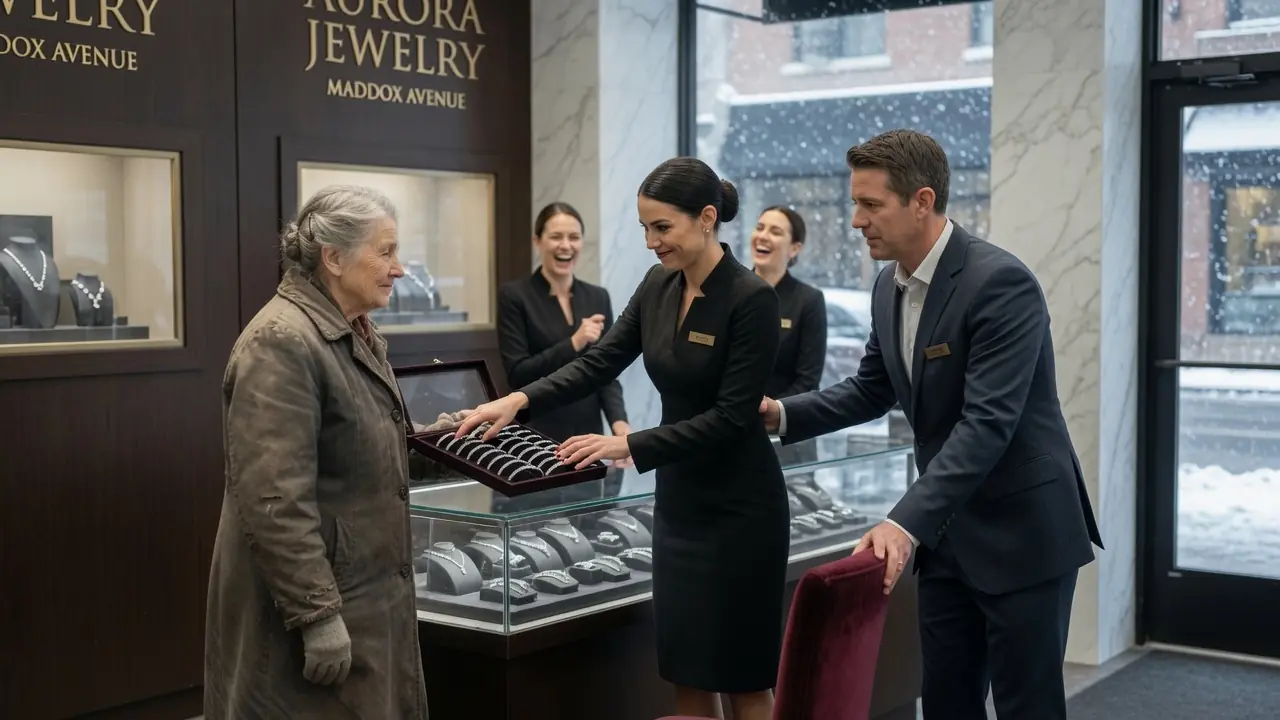
Ryan Carter had worked there for almost 2 years, and he had learned early that the store sold two things at once. It sold diamonds to the rich, and it sold a quiet, practiced humiliation to anyone who walked in without the right shoes. He had come to Aurora the way a lot of people arrive at jobs they never planned for, which is to say through a door he did not choose. The divorce had taken nearly everything, the house, the savings, the version of himself that used to believe things worked out. What was left was a small apartment, a used car that started on the second try, and a habit of staying calm when the world gave him no reason to.
He wore the same two suits on rotation, pressed them himself, and told himself that dignity did not cost money. Melissa Grant, the store manager, had noticed that calm and mistaken it for weakness. She was the kind of person who measured everyone by what they could do for her, and Ryan, in her arithmetic, could do very little. She let the other associates cut in front of him, steal his walk-ins, and quietly reassign his commissions when a sale grew large enough to matter. He watched it happen and said nothing because saying something meant a fight, and a fight meant a write-up, and a write-up meant he could lose the one job standing between him and the street.
Above all of them, far above the marble floor, sat a name most of the staff had never attached to a face. Olivia Bennett ran the entire Aurora Group, a young CEO with a reputation for cutting decisions and a strange refusal to be seen. She almost never appeared in the stores themselves. The associates spoke about her the way sailors speak about weather, as a force that arrived, changed everything, and left without explanation. To Ryan, she was an abstraction, a signature at the bottom of a policy memo, nothing more.
That with light snow ticking against the front glass, and the staff clustered near the register laughing at something on a phone. The bell above the door chimed, and a woman stepped inside shaking the cold off a coat that had clearly been good once and had not been new in a long time. Her gloves were worn thin at the fingertips. Her gray hair was pinned back with the kind of care that suggested habit rather than vanity. And she moved through the store slowly, the way a person moves when they are used to being watched with suspicion.
The laughter by the register did not stop so much as change its target. One of the younger associates, a woman named Danielle, who had learned every one of Melissa's cruelties by heart, drifted toward the newcomer with a smile that had nothing kind in it. She asked whether the woman might be more comfortable at the coffee shop down the block where the seats were free and no one minded how long you stayed. The old woman only smiled back and said in a steady voice that she would like to see the finest pieces the store had to offer. That was when the room turned.
Danielle spoke first and the others followed and the sound of it filled the polished space like something spilled. "Ma'am, do you know one bracelet in here costs more than your whole house?" she said and the whole floor broke open with it. Melissa Grant walked over with her arms already folded, enjoying the audience the way she always did, and let her gaze travel down the old woman's coat as though pricing it and finding it worthless. "Ryan." Melissa called across the floor, loud enough that every customer near the cases turned to listen.
"You're selling diamonds to a woman who can't afford new shoes or are you paying her bill for her?" She wanted the crowd on her side and she got it and she stood in the center of it as though it were warmth. The old woman did not flinch and that stillness seemed only to irritate Melissa more because cruelty needs a reaction to feed on and this woman gave it nothing. Ryan had been at the far case straightening a tray of rings that did not need straightening and he had heard all of it. He crossed the floor without hurrying because hurrying would have looked like an apology and he had nothing to apologize for.
He went to the back, filled a glass with water and brought it to her on the small silver tray the store used for champagne, setting it down beside her as though she were the most important person to walk through those doors all year. Then he crouched to her eye level, unlocked the nearest case, and began to show her the pieces one by one, naming the cut of each stone and the origin of each setting. His voice as even and respectful as it would have been for anyone wearing a watch worth more than his car. Melissa's face hardened as the scene refused to collapse. She had expected him to fold, to mumble something, and steer the woman toward the exit.
And instead, he was kneeling on her marble floor, treating a stranger in a threadbare coat like royalty. The other associates had gone quiet, unsure now whether to join their manager or look away. Caught in the gap between her mood and something in Ryan's steadiness that made the whole joke feel cheap. The old woman studied a sapphire bracelet he held up to the light and asked him quietly how much it cost. When he told her, she nodded slowly and admitted with no shame at all that she had not brought any money with her that day.
A ripple of vindication ran through the watching staff, the sense that the punchline had finally arrived. Melissa opened her mouth to deliver it. Ryan spoke first and gently. "That's all right," he said. He set the bracelet back on its cushion with care, closed the case, and stood.
"It's a hard thing to come out in weather like this. Whether you buy something or not, you deserve to see them properly." He said it without a trace of performance, the way a man states something he simply believes, and the old woman looked at him then with an attention that had nothing to do with jewelry. What he did next was the thing Melissa would never forgive. He reached into his own jacket, took out a small fold of bills, and pressed them quietly into the old woman's hand.
It was enough for a taxi, no more. The kind of money that meant nothing to the pieces in those cases, and a great deal to a man who counted every dollar. "The cold's no place to wait for a bus." He said, low enough that it was meant only for her. "Get yourself home warm."
For a moment, the old woman did not move, and her eyes shown with something the whole staff was too far away to read. She closed her fingers around the bills, and she looked at Ryan the way a person looks at something they have been searching for without knowing it. Then Melissa's voice cracked across the room like a struck glass. "That is enough." She was no longer smiling.
Whatever had unsettled her, she turned it all on Ryan because he was the safe target, the one who never fought back. "You are handing out money to vagrants on my sales floor. Do you have any idea what that looks like to our clientele? You've turned this store into a shelter." Her voice climbed with each word, and the customers near the door pretended to examine cases they had no intention of buying from.
Ryan straightened his jacket and met her eyes without heat. "She's a guest who walked through our door." He said. "I treated her like one." That answer, calm and unbending, was somehow worse to Melissa than any argument would have been, because it left her nothing to push against.
She wanted a fight, and he refused to hand her one. And so, she reached for the only weapon that would settle the matter in front of everyone watching. "Then you can be a guest somewhere else." She said. "You're done.
Clean out your locker and get off my floor. You're fired, Ryan, effective right now." The word landed in the quiet store and stayed there. A couple of the associates who had joined the mockery minutes earlier now stared hard at the marble, unwilling to be part of what they had helped begin. Ryan absorbed it the way he had absorbed every unfair thing the last 2 years had thrown at him, without collapse, and without surrender.
He did not beg. He did not remind her of the sales he had made, or the way she had padded her own numbers with his work. He simply nodded once, as though she had told him the weather, and turned back to the old woman still seated in the velvet chair, with her water untouched beside her. "I'm sorry your visit ended like this," he told her, and he meant it more than he meant anything he had said all day. "You take care of yourself now.
Stay warm." He offered her a small, tired smile. The smile of a man who had just lost his livelihood, and was still somehow more concerned about a stranger's cold walk home than his own. Then he crossed the floor, retrieved a thin coat from the back, and walked out through the same door she had entered into the falling snow. The bell chimed behind him, and the store exhaled.
Melissa launched into a lecture about standards and image, and never letting sentiment cost the company a sale, and the associates arranged their faces into agreement, because that was the safest thing to arrange. None of them were looking at the old woman anymore. She had become once again invisible to them, a solved problem sitting quietly in a chair she was not supposed to be allowed to use. She watched the door for a long moment after it closed. Then she rose unhurried, and set the fold of bills Ryan had given her on the polished counter, beside the register, smoothing it flat with one thin hand.
She did not explain it. She reached into her worn coat, took out a phone that was newer and finer than anything anyone in that store earned in a month, and pressed a single number. Her voice, when she spoke into it, had lost every trace of the frailty they had all read into her. "Bring the car around to Maddox Avenue," she said. "I've seen what I needed to see."
She ended the call and stood there in the center of the floor, and something in her posture had changed so completely that Danielle, watching from behind the counter, felt a cold thread of doubt begin to unspool in her chest. Two minutes later, a long dark limousine slid to the curb outside the glass, gleaming and impossibly out of place against the gray street. A driver in a dark suit stepped out, came around, and opened the rear door. Then he walked to the entrance of Aurora Jewelry, held that door as well, and inclined his head to the old woman in the threadbare coat, as though she were the most important person he would serve all year. "Mrs. Bennett," he said clearly into the silence, "whenever you're ready."
The name moved through the store like a drop in temperature. Melissa's arms came unfolded. Danielle's hand found the edge of the counter. Every associate who had jeered an hour ago now stood frozen, watching the woman they had tried to send to a coffee shop walk slowly toward a limousine that had come for her alone. She stopped at the door and turned back to look at them one last time, and there was no anger in her face, which was somehow more frightening than fury would have been.
"You have a very fine store," she said quietly. "And you nearly threw away the only decent thing in it." Then she stepped out into the snow, and the driver closed the door, and the car pulled away from the curb and was gone. Inside the limousine, Eleanor Bennett settled against the leather seat and let out a long breath. She was the mother of Olivia Bennett, the woman whose signature sat at the bottom of every Aurora memo, and she had spent the afternoon doing what she did quietly several times a year, walking into her daughter's stores as a stranger to learn what the cameras and the quarterly reports could never tell her.
She had learned plenty today, more than she wanted to. She thought of Melissa's folded arms and the ugly easy scorn, and she thought of the way an entire staff had turned a cold afternoon into sport at an old woman's expense. And then she thought of the man who had knelt on the marble to show her sapphires she could not buy, who had given her taxi money out of a pocket she suspected was nearly empty, and who had walked out with his job gone and his kindness intact. She had not caught his last name in the noise, only the one Melissa had spat across the floor. Ryan.
She turned it over as the city slid past the tinted glass. Snow softening the hard edges of the buildings. Whatever else she had come to Maddox Avenue to find, she had not expected to find that. Not there. Not in a place that sold cold reflections at a markup.
Eleanor took out her phone again and looked at it for a long moment without dialing. There would be a conversation with her daughter tonight, and it would not be a comfortable one because Olivia had built this company on results and had never once imagined that a store bearing the family name could become a place where kindness got a man fired. That would have to change. Eleanor intended to see that it did. But first, she wanted to know exactly who Ryan was.
A man did not give away money he plainly needed to a stranger who could offer him nothing, then thank her for her time on his way out the door of a job he had just lost. That was not a strategy. It could not be faked, and it could not be taught. And in all the years Eleanor had spent measuring people, it was the rarest thing she knew how to recognize. The limousine turned toward the Bennett estate, and behind it in a store built to make people feel small, Melissa Grant stood very still in the center of the marble floor, beginning at last to understand what her afternoon of cruelty had cost.
She did not yet know how much. She would learn. But that reckoning belonged to the days ahead. And for now, the snow kept falling on Maddox Avenue, quiet and clean over the place where a single act of decency had just set everything in motion. The Bennett estate sat above the city on a hill that caught the last of the winter light.
And that evening, its long windows glowed against the dark, while Eleanor told her daughter everything. She left nothing out. She described the folded arms and the scorn the woman named Danielle, who had suggested the coffee shop, the manager who had made a game of an old stranger's coat, and the single associate who had knelt on the marble and treated her like she mattered. Olivia Bennett listened without touching the coffee going cold in front of her. She had built the Aurora Group into something formidable by refusing to be sentimental, by trusting numbers over stories.
And now her own mother was handing her a story that made the numbers look like a lie. The stores were profitable. The stores were also apparently places where an elderly woman could be humiliated for sport, and a decent man could be fired for stopping it. Both things were true at once, and the second one had been invisible to her until tonight. "I want to see it," Olivia said finally.
"The cameras, all of it. I want to watch exactly what happened on that floor." Her mother nodded because she had expected nothing less, and because she knew her daughter well enough to understand that Olivia would not act on feeling alone, she would look at the evidence with her own eyes, and only then would she decide what kind of company she was willing to run. The footage arrived by secure transfer within the hour, pulled from the Maddox Avenue system by a request no store manager could refuse. Olivia watched it alone in her study, the volume low, the images sharp enough to read faces.
She saw her mother enter shaking snow from a coat Olivia recognized, one Eleanor had owned for years, out of stubbornness rather than need. She saw the mockery begin. She watched a woman named Danielle deliver a rehearsed cruelty, and she watched Melissa Grant walk into the center of it and make it worse. Then she watched Ryan Carter cross the floor. There was no sound worth hearing on the tape, but there did not need to be.
She saw him pull out a chair meant for millionaires and turn it toward a woman in a worn coat. She saw him bring water on the champagne tray. She saw him kneel and lock a case and hold each piece to the light with a patience that no policy required and no commission would reward because the woman had already said she had no money to spend. She replayed the moment he pressed the folded bills into Eleanor's hand. She slowed it down, watched it twice, and felt something shift in her chest that she did not have a clean word for.
Here was a man about to lose his job giving away cash he clearly needed to a stranger who could do nothing for him, and doing it so quietly that he plainly never imagined a camera or a CEO would ever see. It was not performance. Performances were built for an audience, and Ryan Carter had believed himself entirely unwatched. What struck her hardest came at the end. When Melissa fired him, Ryan did not argue.
He did not point at the woman by the counter who had stolen his sales, or the manager who had padded her numbers with his labor. He simply nodded, turned back to Eleanor, and apologized to her. a stranger, that her visit had ended so badly. He wished her warmth on her walk home. Then he took his thin coat and walked out into the snow with his livelihood gone and his composure whole. Olivia sat with the frozen final frame glowing in front of her, the empty doorway, the falling snow, and understood that she was looking at the one person in that store who had actually protected the thing her family name was supposed to mean.
Everyone else had protected the image of luxury by grinding a human being under it. He had protected a person, and it had cost him everything. And he had not asked for a single thing in return. Find him, she told her assistant the next morning before she had finished her first cup of coffee. Ryan Carter, an associate at Maddox Avenue until yesterday.
I want an address, not a phone number. I'm going myself. Her assistant blinked at that because Olivia Bennett did not go to people. People came to Olivia Bennett. But the look on the CEO's face closed the subject before it could open.
Ryan's apartment was on the third floor of a building where the elevator had a handwritten sign taped over the button, and the hallway smelled of other people's dinners. He opened the door in a plain shirt with the sleeves rolled, a dish towel over one shoulder, and for a moment he simply stared at the woman standing in the corridor because he knew that face from a hundred company memos and could not understand why it was outside his door. "Mr. Carter," Olivia said. "I'm Olivia Bennett. I think you know who I am.
May I come in?" He stepped back to let her through, too surprised to do anything else, and she took in the small, clean room. In a single glance, the second-hand furniture arranged with care, the neat stacks of job listings on the table, the total absence of anything that suggested a man who wasted money on himself, it confirmed everything the tape had already told her. She did not sit at first. She stood in the middle of his small living room and told him plainly what she had come to say.
The woman he had helped, the one Melissa Grant had mocked, and he had shown sapphires to, was her mother. Eleanor Bennett had been visiting the store quietly, the way she visited several stores a year, to see with her own eyes what the reports could never show her. And what she had found in the middle of all that cruelty was him. Ryan absorbed this the way he absorbed most things, without flinching, though a slow understanding moved across his face. He had given taxi money to the mother of the most powerful person in the company he had just been fired from.
He had knelt on the floor for a woman whose family owned every case, every stone, every marble tile he had been thrown off of. When he finally spoke, it was only to ask whether Eleanor had gotten home safely in the cold. That question before any other told Olivia more than the tape had. "She got home fine," Olivia said, "because of you." She reached into her bag and set an envelope on his table.
Thick, deliberate, the kind of sum meant to close a matter and leave both parties satisfied. "I came to thank you and to make right what was done to you. That's a reward. It's more than the job paid in a year. You earned it and I'd like you to take it."
Ryan looked at the envelope for a long moment, and then he did something Olivia had not planned for. He shook his head, and he pushed it gently back across the table toward her. "I appreciate it," he said. "I do. But I can't take that."
She started to speak, to explain that it was owed, that he had lost his job over her mother, and he lifted a hand not to interrupt, so much as to be understood clearly. "If I take money for it," he said, "then it wasn't kindness. It was just a transaction I got paid for late. I didn't help her to get anything. I helped her because she was cold, and people were being cruel, and that was wrong, and somebody had to stand up."
He slid the envelope the last few inches back to her side of the table. "I'd rather keep the memory of doing something decent than trade it for money I could use. I know how that sounds, but it's the truth." Olivia looked at the envelope sitting untouched between them, and at the man who plainly needed what was inside it, and would not touch it. And the thing that had shifted in her chest the night before settled into something steadier.
It was no longer gratitude. Gratitude was owed to anyone who did you a favor. What she felt now was closer to respect, the rare and uncomfortable respect one feels toward a person who lives by a rule you have quietly stopped believing was real. She left the envelope in her bag and stayed another hour, instead sitting in his second-hand chair, talking with him in a way she had not talked to anyone at the company in a long time. She learned how the store actually worked from the floor, the stolen walk-ins, the reassigned commissions, the small daily cruelties that never appeared in a single report she read.
She learned that the numbers she trusted had been built on a culture she would have been ashamed to watch. By the time she stood to go, she had stopped thinking about how to repay Ryan Carter and started thinking about how to use him. Not use him the way Melissa had, but the opposite of that. Here was a man who understood exactly what her stores had become and embodied exactly what she wished they were. And she had spent one evening and one morning learning that both of those truths lived in the same person.
The idea took shape over the following days and it was Eleanor who pressed it hardest. Her mother had not stopped thinking about the man who knelt on the marble and when Olivia described the refused envelope, Eleanor only nodded as though it confirmed something she had already decided. "You cannot pay a man like that to go away." Eleanor said over dinner at the estate. "You bring him closer.
You put him where he can change the thing that nearly threw him out." So Olivia went back and this time she did not bring an envelope. She brought an offer. She wanted Ryan to come to the Aurora headquarters, not as an associate on a floor, but as a customer experience training specialist. A role built specifically to rebuild the service culture across every store the group owned.
She wanted him to take what he had done instinctively for her mother and turn it into something the entire company could be taught. Ryan did not answer right away and Olivia had come to understand that his silences were not hesitation but consideration. A man actually weighing a thing instead of performing enthusiasm. "You want me to teach people to be decent." He said at last.
"That's not really something you can put in a training manual. Either you see a cold woman and you bring her water or you don't." He looked at her directly. "I'm not sure I can hand someone that." "Maybe not all of it," Olivia said.
"But you can show them what it looks like. You can make it the thing that gets rewarded instead of the thing that gets you fired. Right now, my company punishes exactly what you did on that floor. I want to build one that promotes it. I can't do that without someone who actually believes it.
And I've met almost no one who does." It was for her an unusually honest thing to admit. And Ryan heard the honesty in it. He thought about the small stack of job listings on his table, the ones that would pay less and demand that he swallow more. And he thought about what it would mean to walk back into the Aurora name through the front door instead of being thrown out a side one.
But that was not what decided him. What decided him was the chance to prove something he had believed his whole life and never been given room to demonstrate that kindness was not weakness, and that it could build something real rather than simply surviving in the cracks of a place that despised it. "All right," he said. "I'll do it. Not for the title, because I want to find out if you're right that this can actually be worth something to a company like yours."
He offered his hand across the small table. "But I do it my way. And I'll tell you the truth even when you don't want to hear it. That's the only version of this I'm any good at." Olivia took his hand and agreed and understood that she had just hired the one employee in her company who would never tell her what she wanted to hear.
Word of the arrangement reached the stores before Ryan's first day, and it did not travel kindly. The idea that a floor associate fired for insubordination had been handed a headquarters title and a mandate to reshape the entire service culture struck the store managers as either a joke or a threat, and Melissa Grant made certain it was heard as both. She had spent the days since the limousine pulled away in a cold, private panic, and now she had a target for it. The story she spread was simple and poisonous. Ryan had not earned anything, she said, in the manager group chats and the quiet corners of regional meetings.
He had gotten lucky. He had charmed the CEO's mother, played the humble martyr for a camera, and been rewarded with a job none of them believed he was qualified to hold. The version she told left out the cruelty and the fired man and the taxi money and kept only the part that flattered the storytellers, that Ryan had schemed his way up by flattering the right old woman. The rumor found willing ears among senior managers who had their own reasons to resent the appointment. They looked at Olivia's sudden interest in one former associate and saw favoritism, a CEO letting her mother's sentiment override sound judgment.
Some of them had been at Aurora long enough to feel they had earned a say in who rose and who did not. And here was an outsider dropped above them by what looked like pure nepotism by proxy. The whispers reached the board, and the board began to watch. Ryan felt the cold of it from his first week. Meetings he needed to attend were moved without notice.
Data he requested for the culture overhaul arrived late, incomplete, or not at all. When early pilot changes at a few stores showed a dip in sales, exactly the dip anyone should expect while a staff unlearns old habits, the managers made sure the number reached Olivia, stripped of context, framed as proof that decency cost money the company could not afford. Olivia held the line, but the pressure on her mounted quickly. The board had trusted her instincts for years on the strength of results, and now she was defending a controversial hire and a costly reform in the same quarter that revenue softened in the very stores where his program was being tested. Every member who had privately doubted the appointment now had a chart to point at.
She found herself explaining in room after room why a man who gave a stranger taxi money should be trusted to rebuild a luxury brand. And she watched the explanation land on faces that had already decided. Through all of it, Ryan did his work and told the truth, which was the only thing he had promised. He walked the stores, watched how the staff treated the people who could not obviously afford to be there, and wrote reports that named the culture plainly, rather than softening it for the men who had built it. He did not fight the rumors, and he did not court the managers who spread them.
He simply kept doing the thing he had said he would do, believing still that the work would eventually speak louder than the whispers. He was wrong about the timing of that, though not about the end. The whispers were not going to exhaust themselves and fade. Melissa Grant had understood from the moment the limousine door opened that Ryan Carter was the living proof of what she had done. And a woman like Melissa does not learn to live beside her own exposure.
She had already begun to plan something colder than a rumor, and Ryan doing honest work in good faith at the center of a company that had every reason to resent him had no idea yet how far she was willing to go. The trap Melissa Grant built was patient, and that was what made it dangerous. She had learned that a rumor could wound Ryan Carter, but not remove him, and removal was the only outcome that would let her breathe again. So, she stopped whispering and started arranging things, working through a handful of managers who shared her resentment and had their own careers to protect if the culture overhaul succeeded and exposed how they had been running their stores. They chose a store where one of Ryan's pilot programs was already underway, so that any failure would land on his name by default.
Over several weeks, they manufactured a complaint, coaching a disgruntled client through a grievance that sounded devastating on paper. A story of a valued customer humiliated and mishandled under the new service policies Ryan had introduced. The documentation was careful. The emails were dated to make it look as though Ryan had been warned and had ignored the warnings. Every thread led back to him, and none of it led back to Melissa.
When the complaint surfaced, it surfaced everywhere at once. It reached the regional directors, the board, and then through channels Melissa made sure were open, the press. A business reporter who covered the luxury sector ran a piece questioning whether the Aurora Group's celebrated young CEO had let personal sentiment drive a reckless overhaul, whether her mother's fondness for one former associate had cost the company its judgment. The article named Ryan. It framed his entire appointment as the vanity project of a CEO who had stopped listening to reason.
Olivia read it in her study, the same room where she had watched the footage of Ryan kneeling on the marble, and she felt the walls of the thing closing around her. The board convened within a day. The members who had doubted the hire from the start no longer bothered to hide it, and even those who had trusted her now spoke carefully the way people speak to someone whose judgment has become a liability. The revenue dip, the controversial appointment, and now a public scandal had arrived in the same breath, and together they told a story that was easy to believe and hard to fight. She defended him.
She sat at the head of the long table and told the board that the complaint did not fit the man she had watched give away money he needed to a stranger who could give him nothing. But she had no proof, only the tape and her conviction. And conviction was exactly what the board no longer trusted her to have. They wanted the problem gone. They wanted the name Carter out of the news and out of the company, and they made it plain that her own standing depended on making that happen quickly.
Ryan understood the shape of it before anyone explained it to him. He had spent his life reading rooms he was not welcome in, and he could feel that the storm had stopped being about a complaint and become about Olivia. Every day he stayed, the story had a subject. Every day he stayed, the board had a reason to question the woman who had hired him, and the press had a face to attach to the word reckless. The overhaul he believed in was drowning, and he was the anchor pulling it down.
He came to her office at the end of a long day when the building had emptied and the city lights had come up in the windows, and he set a single sheet of paper on her desk. It was his resignation. Olivia looked at it and then at him. And something in her face hardened against the idea before he had said a word. "No," she said.
"I am not accepting that. You did nothing wrong, and I am not letting them win by making you disappear." "This isn't about winning," Ryan said. "It's about arithmetic. As long as I'm here, they have a target, and the target has your name attached to it.
The board isn't fighting me. They're fighting you through me. Take me out of the equation and there's nothing left for them to point at. He kept his voice level the way he had kept it on the marble floor the day he was fired. A man stating a hard thing he had already made peace with.
"I won't be the reason you lose the company you built." Olivia argued. She told him that walking away would look like guilt, that it would confirm the story rather than end it, that he would be sacrificing his own name to protect hers. And Ryan told her quietly that his name had never been worth much on paper anyway. And that he would rather spend it buying her the room to fix the company than keep it clean while she went down defending him.
It was the same instinct that had emptied his pocket for a cold stranger, turned now on the woman who had given him a second chance. And she could not talk him out of it anymore than Melissa had once talked him out of the water and the chair. He left the resignation on her desk and walked out of the Aurora headquarters for the second time through the front door, this time instead of a side one, but leaving all the same. There was no scene, no crowd, no mockery. There was only a man who had believed kindness could build something walking away from the ruins of that belief.
With the same composure he had walked out of the store with months before, carrying the quiet, bruising thought that decency had once again turned out not to be enough. The story might have ended there, the way it ends for most people, with the honest man gone and the liars still standing. It didn't, and the reason it did not was Eleanor Bennett. When she learned that Ryan had resigned under the weight of a customer complaint, she did not believe it for a single moment. And she said so to her daughter with a flat certainty that left no room to argue.
She had watched that man refuse an envelope of money he needed. A man like that did not humiliate a client and then hide it behind falsified emails. "You are going to investigate this." Eleanor told Olivia. "And you are not going to stop at the version that is convenient."
"Someone built this and they built it well enough to fool a board that wanted to be fooled. Find out who." It was not a suggestion. Eleanor had spent her life measuring people and she had staked that judgment on Ryan Carter once already on a cold afternoon on Maddox Avenue and she was not prepared to be wrong about the rarest thing she knew how to recognize. So, Olivia stopped trying to manage the scandal and started trying to break it open.
She pulled in a small team she trusted completely and gave them the one instruction that mattered, which was to follow the evidence without regard for whose name it embarrassed. They began with the complaint itself and the moment they treated it as a construction rather than a fact, the construction began to come apart. The falsified emails were the first thread. Whoever had built them had backdated the timestamps, but the store's servers kept their own quiet record and that record did not match the dates in the complaint file. The warnings Ryan was supposed to have ignored had been created after the incident they claimed to predate.
Someone had written the past to fit the story and the servers remembered the truth. From there, the team pulled the security footage from the store where the complaint originated. The same kind of footage that had once shown Olivia the truth of the marble floor. The cameras told a very different story than the paperwork. The client whose grievance had launched the scandal had not been mistreated at all.
The staff had followed new policies exactly with patience and care, and the footage showed the interaction ending without incident. The complaint had been written afterward, coached into existence, and the internal emails coordinating it led thread by thread back through the managers who had spread the original rumor, and finally back to the one who had orchestrated all of it. Melissa Grant's name sat at the center of the web. The investigation laid it out with a clarity that left nothing to interpret the deliberate targeting of the pilot store, the manufactured complaint, the falsified warnings, the careful feeding of the story to a reporter, the whole apparatus built for the single purpose of driving Ryan Carter out of the company and taking Olivia's credibility down with him. What had been dressed up as a service failure was revealed as sabotage, aimed not only at a man, but at the reform he carried and the CEO who had championed it.
Olivia brought the findings to the board herself, and this time she did not need conviction because she had proof. She walked them through the server records, and the footage, and the email trail, and she watched the certainty drain from the faces that had been so certain a few weeks before. The members who had used the revenue dip as a weapon fell silent when the dip was set beside the truth, a temporary cost of unlearning bad habits, and not the disaster it had been framed as. One by one, the room came to understand that the reckless judgment they had blamed on Olivia had actually belonged to the people trying to destroy her reform. The board came at last to the thing Eleanor had understood from the beginning, and the rest of them had needed evidence to see.
Ryan Carter wasn't a liability. He was the only person in the entire chain who had protected the core value the Aurora name was supposed to stand for. Everyone else had been guarding the image of luxury or their own position inside it, and he had been guarding a principle, and it had nearly gotten him destroyed twice by the same store and the same manager. Melissa Grant was dismissed, and this time there was no theater to hide behind. The company moved against her and the managers who had conspired with her, not merely as employees who had misbehaved, but as people who had committed deliberate documented fraud, falsifying records, and manufacturing a grievance to damage a colleague and the company itself.
The matter passed out of Olivia's hands and into the hands of lawyers, and the consequences that followed were not the kind a resignation could soften. The cruelty that had once filled the Maddox Avenue floor had cost in the end far more than anyone standing in it that day had imagined. When it was over, Olivia did not send an envelope or an assistant. She drove to Ryan's apartment herself up the three flights past the elevator with the handwritten sign and knocked on the door she had knocked on once before. He opened it in the same plain shirt, the same quiet surprise a man who had gone back to the stack of job listings on his table, and made his peace again with a world that punished the thing he did best.
"I owe you an apology," Olivia said standing in the corridor. Not a reward this time. An apology. "I let them make you disappear to protect me, and I should have fought harder before I let it get that far. You were right about the arithmetic, and you were wrong about your name being worth nothing.
It turned out to be worth more than the whole board's judgment. She held his gaze. I know what happened now. All of it. You didn't do a single thing they said, and I let you walk out my front door carrying it anyway.
Twice this company has thrown you out for being decent. I'm here to make sure it never happens a third time." Ryan listened the way he always listened, without rushing to fill the silence, taking in the fact that the CEO of the Aurora Group had climbed three flights of stairs to say she was sorry to a man she had every institutional reason to forget. When he answered, it was not with bitterness because bitterness had never been in him. "You believed me," he said finally.
"When it would have been so much easier not to. When it cost you something to keep looking, you kept looking anyway. That's more than most people manage." She had not come only to apologize. She offered him the thing his work had earned, and his enemies had tried to steal a return to the Aurora Group this time as director of service culture, reporting directly to her with the authority to build across every store, the reform that Melissa had fought so hard to kill.
It was not a gesture of guilt, and it was not charity. It was a recognition that the company needed exactly what he was, and that it had nearly destroyed itself trying to expel him. Ryan took the offer, and he took it for the same reason he had taken the first one, not for the title, but to finish what he had started to prove that the thing he had done on instinct for a stranger could be built into the bones of a company and made to last. This time, he walked back into the Aurora headquarters with the whole story known, the rumors dead, and a mandate that no manager could quietly starve, and the work that had been drowning began at last to breathe. What grew between him and Olivia in the months that followed grew slowly the way the only real things do.
They had met in the wreckage of the company's worst instincts, and they rebuilt it side by side. And somewhere in the long hours of that work, the respect she had first felt in his small apartment deepened into something neither of them named for a long while. She had spent years trusting numbers because people had always disappointed her, and here was a man who had refused an envelope and offered up his own name to shield hers, and he did not disappoint. He simply kept being day after day exactly who the tape had shown her he was. His own guardedness eased in her company the same way.
The divorce had taught him to expect people to take what they could and leave him with less, and Olivia took nothing from him and kept handing back things he had stopped believing he would get his name, his work, his faith that decency could win. They healed each other quietly in the ordinary way of two people who have each survived being underestimated, and Eleanor watching from the estate above the city approved of it with the deep satisfaction of a woman whose judgment on a cold afternoon had turned out to be right about everything that mattered. The Aurora jewelry that emerged from all of it became known for something no competitor could copy. It still sold the finest stones in the finest cases, but it became famous in an industry built on making people feel small for treating every person who walked through its doors with the same respect whether they arrived in a limousine or a coat worn thin at the fingertips.
The service culture Ryan built stopped being a policy and became the thing the brand was known for, the most humane house in a cold trade. Ryan Carter was no longer the associate the whole store had mocked. He had changed an entire company, and he had done it with a glass of water, a chair meant for millionaires, a few folded dollars for a taxi, and the refusal to look away when everyone around him did. Alongside Olivia and Eleanor, he helped build the programs that outlasted the scandal, the training in how to treat people, the support for the staff.
The old culture had been dismantled, and funds were set aside to help those who arrived at the door with nothing but the cold on their shoulders. The truth the whole story turned on was the simplest one, and it had been true from the first chime of the bell on Maddox Avenue. A person's worth was never in the clothes they wore or the money they carried, but in how they treated the people who could do nothing for them in return. One quiet act of decency offered to a stranger by a man who thought no one was watching had not only remade his own life, it had healed an entire company and set a standard that would reach far more people than a fired salesman kneeling on cold marble could ever have imagined.