Helen Evans had not known a house could feel alive until she stood inside Benjamin Watson’s cabin after the storm. The Colorado valley outside lay buried under snow, silent and white, with the pine trees bending beneath the weight of winter and the fences almost swallowed by drifts. Inside, the stone hearth still glowed with the last low breath of fire, and the cabin smelled of smoke, wool blankets, pine boards, coffee, and the kind of safety Helen had stopped believing belonged to women like her. She stood barefoot on the clean plank floor with her shawl wrapped around her shoulders, watching Benjamin add one careful log to the embers as if the fire were something precious enough to be guarded.
Only a few months earlier, Helen had been a widow with no roof, no money, and no future anyone cared to protect. Her husband Thomas had died in the mines outside Denver, leaving behind debts, unpaid rent, and a rooming house owner who had given her three days to leave. People had spoken to her with pity until they realized pity cost them nothing and shelter did. After that, they spoke with colder voices, telling her there was no place for a woman alone unless she was willing to trade away the last pieces of herself.
She had walked into the mountains with a torn coat, a small cloth bag, and a stubborn belief that work still had value somewhere. She slept under trees, washed her face in creek water, and kept moving when hunger made her knees weak. More than once, she thought of turning back, but there was nothing behind her except rooms that had closed, men who smiled too long, and streets where a widow became invisible unless someone wanted something from her. Then, one gray afternoon, she saw smoke rising from a valley below and followed it like a prayer.
Benjamin Watson’s ranch had looked almost unreal the first time she saw it. A timber cabin stood near a larger barn, horses shifted inside the corral, and wood smoke curled from the chimney in a steady column against the cold sky. Benjamin had been splitting logs when she came close, broad-shouldered and silent, with an axe in his hand and snow caught on the edges of his coat. He had looked at her torn boots, trembling hands, and hollow face, then listened while she asked for work instead of mercy.
Helen remembered how ashamed she had felt saying the words. She had told him she could cook, clean, mend clothes, haul water, scrub floors, and do whatever honest labor he had, if only he would let her sleep in the barn. Her voice had shaken, but she had not begged. She had already been humbled by hunger and cold, but she had not surrendered her dignity. Benjamin had looked at her for a long time before saying there was work if she could keep up.
The first weeks had been hard, but they were cleanly hard, which made all the difference. Helen rose before sunrise, lit the stove, boiled coffee, baked biscuits, swept floors, carried water, mended shirts, and learned where Benjamin kept every tool, sack of grain, and coil of rope. Benjamin worked outside from dawn until dark, and when he came in, he never treated her like a burden. He ate what she cooked, thanked her in few words, and gave her tasks with the quiet expectation that she was capable of doing them.
At first, Helen had been frightened of his silence. She had known men who used silence as a threat, letting women guess what mood might arrive next. But Benjamin’s silence was different. It did not press her down, did not trap her, did not ask her to perform. It simply made room for the wind, the fire, the sound of boots on floorboards, and the slow return of strength to her body.
By late November, her cheeks had color again, and her hands no longer trembled when she carried the coffee pot. She learned the rhythm of the ranch, the way horses flicked their ears before weather changed, the way the hens hid eggs under loose straw, the way the north barn door had to be latched twice because the wind liked to worry it open. Benjamin noticed all of it. He did not praise easily, but when he said, “You’ve done good work here,” Helen had felt the words settle deep inside her chest.
Then the cold sharpened. Snow came early and refused to leave, piling against the windows and sealing the valley away from the rest of the world. Helen’s small back room grew colder each night, the walls too thin and the little cot too far from the main hearth. She wrapped herself in every blanket she owned and never complained, because she had been given shelter and would not repay it with weakness. But winter did not care about pride.
Benjamin found her one morning on the kitchen floor, half-conscious beside the unlit stove. Her fingers were numb, her lips pale, and her body shook so hard she could not speak clearly. He carried her to the main room with frightening gentleness, wrapped her in blankets, and built the fire high enough to throw light across the rafters. When she woke, he was kneeling beside her, his face grim with worry he did not bother hiding.
“That room will kill you before spring,” he told her. Helen tried to argue, but her voice broke before she could shape the lie. Benjamin said his room stayed warm through the night, and he would move a cot inside for her, with a blanket hung between them for privacy. She had looked at him, afraid of impropriety, afraid of needing him, afraid of what closeness might awaken in a heart she thought grief had buried. He had only said, “Proper doesn’t keep people alive in these mountains.”
So she moved into his room, and nothing improper happened. That was what changed everything. Benjamin set the cot across from his bed, hung a wool blanket between them, carried her small bag inside, and never once made her feel cornered. His restraint was steadier than any promise, and night after night, Helen lay under warm blankets listening to his breathing on the other side of the divider, feeling safer than she had since before the telegram.
Their evenings became softer after that. They ate supper near the fire, sometimes speaking, sometimes not, and the silences stopped feeling like empty places. Helen began mending his shirts more carefully than necessary, smoothing the fabric over her knee and imagining his shoulders filling the cloth again. Benjamin began cutting extra kindling before she asked, placing it near the stove so she would not have to step into the cold yard at dawn. Neither named these small acts, but both understood they were no longer only kindness.
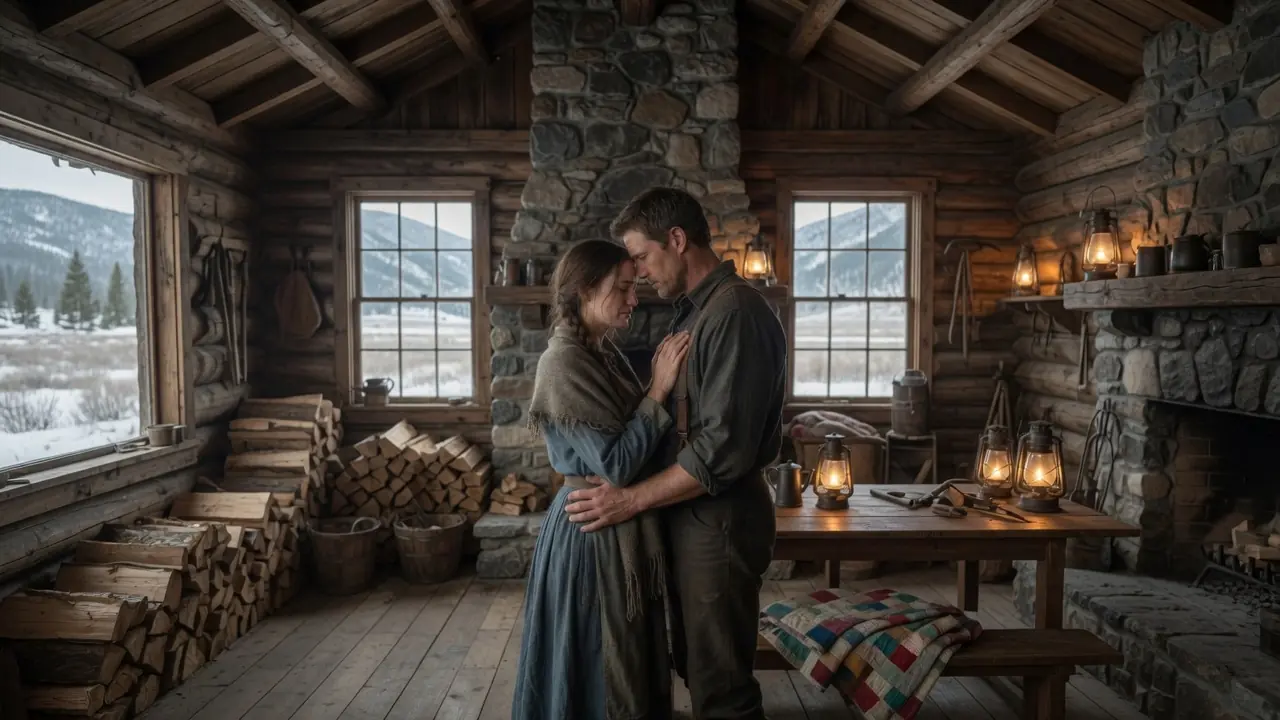
The storm that changed them arrived in mid-December with a sound like the mountains breaking open. Wind screamed around the cabin, snow hammered the walls, and the sky went dark before supper. For two days they remained trapped inside, keeping the fires alive, rationing dry wood, and listening to the barn timbers groan under the weight of weather. By the third night, even Benjamin’s bedroom hearth began to fail, the damp wood hissing uselessly while frost crept along the window glass.
Helen woke shivering so violently the cot creaked beneath her. Benjamin was already awake, crouched by the hearth, trying to coax flame from stubborn embers. The last log smoked, glowed, and faded. He looked toward the window where the storm still screamed, then back at Helen with an expression that told her the truth before he spoke it.
“We have to share warmth,” he said quietly. Helen’s heart began to pound. Every rule she had ever been taught rose up inside her, every warning about a woman’s reputation, every cold voice that had told her survival had limits. But the room was freezing, the fire was dying, and Benjamin had never once given her a reason to fear his hands. So she nodded, unable to speak.
He came to her slowly, giving her every chance to refuse. He lifted her from the cot and carried her to his bed as if she weighed nothing, then laid her beneath the heavy quilts with care so gentle it nearly broke her. He settled beside her with space between them, both of them stiff at first, both pretending this was only survival. Then her shivering worsened, and Benjamin wrapped one arm around her.
The warmth of him was immediate and overwhelming. Helen turned toward it before she could stop herself, pressing closer until her cheek rested near his shoulder and her hands found the rough cotton of his shirt. Benjamin held her without tightening his grip, letting her choose the closeness, letting her body learn that not every strong arm was a claim. Outside, the storm roared like an animal, but under the quilts, his heartbeat was steady beneath her ear.
Hours passed in a strange half-sleep. Helen woke several times to the sound of wind and the feel of Benjamin’s hand resting carefully against her back. Once, she whispered his name, though she did not know why. He answered softly, “I’m here,” and those two words carried more tenderness than all the pretty promises she had ever heard in town. She slept again with her fingers curled against his chest.
Morning came quiet and pale. The storm had passed, leaving the world outside buried in silver light. Helen opened her eyes slowly and realized Benjamin was still holding her, his face turned slightly toward hers, his breathing deep and even. For one suspended moment, she did not move, afraid that if she did, the warmth, safety, and impossible tenderness of the night would vanish.
Benjamin woke when she shifted. Their eyes met in the gray light from the window, and the silence between them changed. It was no longer the silence of survival. It held gratitude, hunger, grief, trust, and something deeper that had been growing through every meal, every mended shirt, every piece of wood cut before she needed it, every respectful distance he had kept until she stepped closer first.
Helen’s hand rested against his chest, right over his heart. She felt it beating beneath her palm, strong and calm, and tears gathered before she could stop them. Benjamin saw them and lifted one hand, brushing a loose strand of hair from her cheek. His touch was rough from work, but so careful that she closed her eyes.
“I don’t want to go back to the cot,” she whispered. Benjamin’s expression softened in a way she had never seen fully before. It was not pity. It was not possession. It was a man letting the truth finally come to his face after holding it back for her sake.
“Then you won’t,” he said. “You’ll stay beside me as long as you want.” Helen breathed in shakily. The words settled over her like another quilt, warm and heavy and impossible to push away. No one had offered her choice in so long that the gentleness of it hurt.
She sat up slowly, the quilt gathered around her shoulders. Benjamin did not pull her back, though she could see in his eyes that he wanted her close. That restraint made her love him more fiercely than any bold declaration could have. She turned toward him, trembling, and placed both hands against the front of his shirt.
“I was told I would be alone forever, Benjamin,” she said. Her voice broke on the last word. He looked at her as if every piece of her grief mattered, as if her widowhood, hunger, fear, and stubborn will had all led her to this exact morning. Then he cupped her cheek in one palm.
“Then stay with me, Helen.” She let out a soft breath, almost a sob, and leaned into his hand. His thumb brushed the edge of her cheekbone, wiping away a tear she had not felt fall. The cabin seemed to hold its breath around them, the dying embers, the frosted windows, the quilts, the quiet bed where survival had turned into something sacred.
“I have nothing left to give but my heart,” she whispered. Benjamin looked at her mouth, then back into her eyes, asking without words for permission. Helen answered by stepping closer on her knees beneath the quilt, her hands sliding up to his shoulders. When he kissed her forehead first, slowly and reverently, she cried harder because it was not a taking kiss, not a claiming kiss, but a blessing.
He drew her into his arms then, and she went willingly. His hands settled at her waist, firm but gentle, while her face pressed into his neck. The warmth between them was no longer only survival. It was want, tenderness, devotion, and the relief of two lonely people realizing they did not have to spend another winter pretending they were not made for each other.
Benjamin lowered his forehead to hers. His voice was deep and rough with emotion when he spoke. “Then give me your heart,” he said, holding her as if she were the most fragile and powerful thing in the world. “And let me give you a son.”
The words struck Helen so deeply she could not answer at first. A son. A family. A future beyond widowhood, beyond hunger, beyond being the woman who slept in corners and begged for work with pride held together by thread. She looked at Benjamin and saw no mockery, no pressure, no careless desire. She saw a man offering his name, his home, his protection, his body, his tenderness, and the life he had been too lonely to ask for before she came.
Helen touched his face with both hands. “Only if he has your steady heart,” she said through tears. Benjamin smiled then, small and rare, and the sight of it nearly undid her. He kissed her brow again, then her cheek, each touch slow enough for her to trust, warm enough for her to feel wanted rather than rescued.
The day unfolded around them with a strange new quiet. Outside, the storm had left fences buried and the path to the barn nearly gone, but inside the cabin, Helen moved like a woman whose feet had found the floor of her own life again. Benjamin made coffee while she sat wrapped in his quilt, watching him with cheeks still flushed from the morning’s tenderness. Every now and then, he looked over at her, and something passed between them that needed no words.
By noon, the sun broke through the clouds. Together, they stepped onto the porch, bundled in coats, and looked out across the snow-buried valley. Benjamin stood beside her, close enough that his sleeve brushed hers. Helen slipped her hand into his, and his fingers closed around it immediately, as if he had been waiting his whole life for that small permission.
The ranch looked different to her now. The barn was still half-buried, the fences still needed clearing, and the winter would not grow kind simply because two hearts had found each other. But the valley no longer looked like a place where she had come to survive. It looked like a place where she might plant herself, where spring might find her, where laughter might one day fill the rooms that had once held only wind and work.
That afternoon, they shoveled a narrow path to the barn together. Benjamin insisted she rest when her breath shortened, and Helen rolled her eyes at him for the first time, which made him laugh under his breath. The sound startled her because she had heard so little laughter from him. It was low, brief, and beautiful.
Over the following days, nothing outwardly grand happened. There was no minister, no ring, no gathering of neighbors, no sudden transformation into a fairy tale. There were still chores, frozen troughs, stubborn horses, and meals that needed cooking. But every ordinary thing had changed because now they moved around each other with the knowledge that love had entered the cabin and meant to stay.
At night, Helen no longer slept behind a hanging blanket. She slept beside Benjamin, held by him when the wind rose, trusted by him when the mornings came. Their affection grew in quiet gestures: his hand resting at the small of her back as he passed behind her, her fingers brushing his wrist when she handed him coffee, his lips touching her forehead before he stepped outside into the cold. Each tenderness felt earned, built from respect before desire, safety before closeness, trust before longing.
Sometimes Helen feared happiness because grief had taught her that anything precious could be taken without warning. On those days, Benjamin seemed to know without being told. He would sit beside her near the hearth, place her hand between both of his, and say nothing until her breathing steadied. He never demanded she forget Thomas, never treated her past as a rival, and that mercy made room for love to grow without shame.
One evening, late in winter, Helen found a small cradle in the loft. It was unfinished, rough-sanded and tucked beneath a canvas sheet, the wood pale and smooth in the lantern light. Benjamin had followed her up and stopped when he saw what she had uncovered. For the first time since she had known him, he looked almost embarrassed.
“My father started that before he died,” Benjamin said quietly. “I kept meaning to finish it, though I had no reason.” Helen ran her fingers along the curved rail, imagining a child’s small hand gripping it someday. The ache in her chest was almost too large to bear. “You have a reason now,” she said.
Benjamin stood behind her, careful not to crowd her. “Only if you want that life.” Helen turned to face him, tears shining in her eyes, and smiled. “I want the life we build, Benjamin. Whatever God gives us inside it.”
Spring came slowly, melting snow into streams and loosening the frozen ground. Helen stood on the porch one morning in her cream frontier dress, a brown apron tied at her waist, her shawl over her shoulders, and watched sunlight spill across the valley. Benjamin came up behind her and placed his hands gently around her waist. She leaned back into him without fear.
“I never thought I would feel whole again,” she said. Benjamin rested his chin lightly near her temple. “You were whole when you came here,” he answered. “You were just frozen, hungry, and tired of carrying it alone.” Helen smiled through sudden tears because he always saw her strength before her brokenness.
By summer, the cabin had become a home in every visible way. Helen planted herbs near the porch, hung clean curtains in the windows, and filled the shelves with mended linens, jars of preserves, and folded clothes. Benjamin built a proper bedframe, finished the cradle, and added a second rocking chair near the hearth without saying why. The house, once merely sturdy, now seemed to breathe.
People in town began to speak of them as husband and wife before any paper made it formal. Benjamin eventually drove Helen down to the nearest settlement, where a minister joined their hands in a small chapel with two witnesses and a Bible on the table. Helen wore the cream dress with the tiny blue flowers, and Benjamin wore his cleanest shirt. When he kissed her forehead after the vows, she heard one of the witnesses sniffle softly behind them.
Months later, when the first signs of new life stirred within her, Helen sat on the edge of their bed in stunned silence. Benjamin knelt before her, not as a rancher, not as a man of the mountains, but as a husband overwhelmed by wonder. He placed one large hand carefully over her belly, though there was nothing yet to see. Helen covered his hand with hers, and neither of them spoke for a long time.
When she finally whispered, “Maybe it is a son,” Benjamin’s eyes filled. “Maybe,” he said. “And if it is a daughter, I’ll thank God just the same.” Helen laughed through tears, and he kissed her hands, her forehead, and the place where their child slept unseen beneath her heart. The promise he had made in winter had become something larger than words.
The next winter did not frighten Helen. The winds still howled through the Colorado valley, and snow still buried the fences, but the cabin held warmth differently now. There was a cradle near the hearth, tiny blankets folded beside it, and Benjamin’s arms around her each night. She had come to his ranch asking for barn space and work, certain that loneliness was the only future left to her.
Instead, she had found a man who gave her shelter without taking her dignity, warmth without demanding her heart, and love only after she was ready to give it freely. She had found a home in the place where snow once threatened to swallow her. She had found passion softened by respect, tenderness strengthened by patience, and a future born from the quiet courage to stay. And when Benjamin held her close beside the fire, Helen knew the mountains had not buried her life after all; they had hidden the beginning of it.