The scanner accepted the check on the first pass. Norah Blake watched a green line appear beneath the transaction number. Instrument routing valid. A second line offered a link to 15 years of account history. Before she could open it, Colleen Ward reached over her shoulder and closed the window.
Move this to manager review. Marcus Reed stood on the other side of the plastic tray with one hand resting beside his wallet. His daughter, Lena, held a canvas bookstore bag against her knees. At the next station, a man in a pale blue shirt was explaining a wire transfer to another teller. The teller had already called Treasury support and brought him a paper cup of water.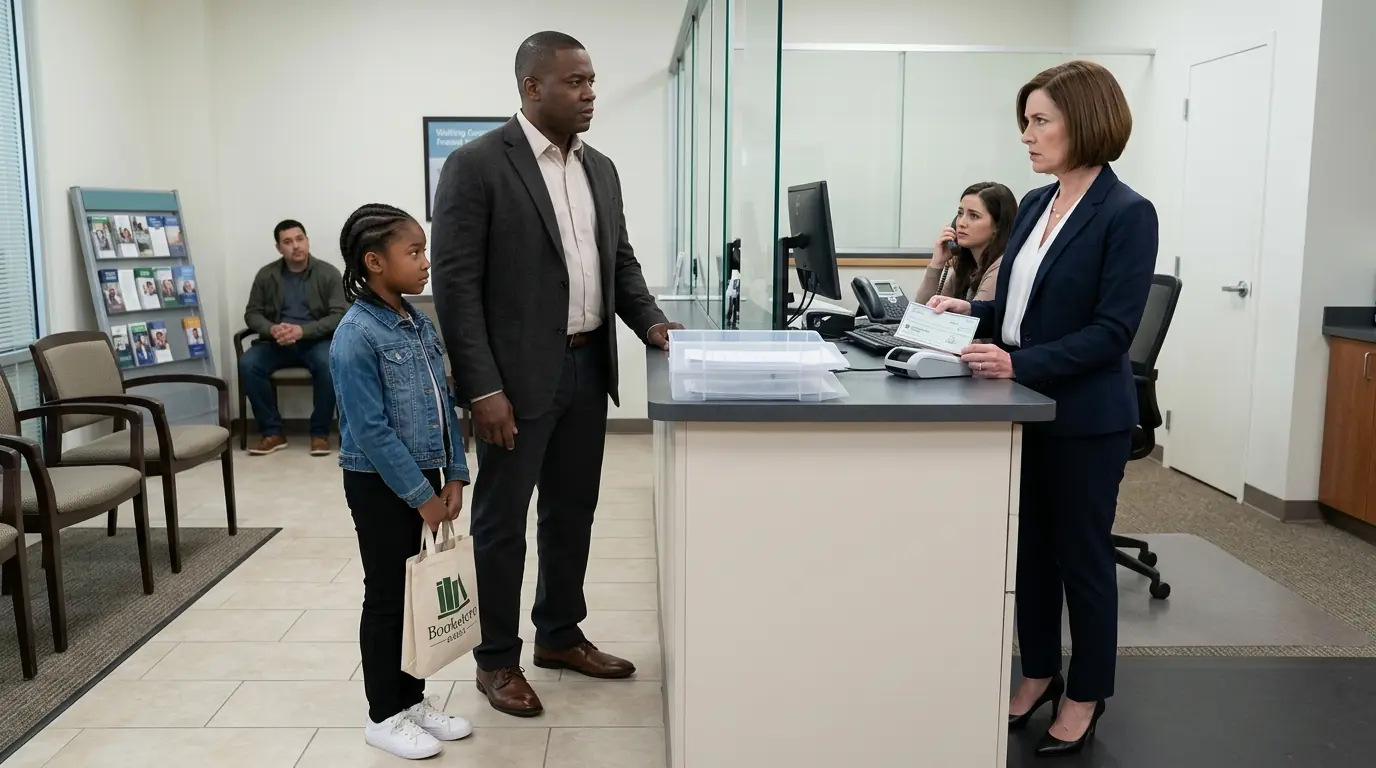
Marcus had waited behind him for 11 minutes. No one had offered him a chair. Norah placed the cashier's check beneath the counter light. The amount was $5 million. The name matched Marcus' license.
The account number matched his bank card. I can call the issuing institution, she said. Colleen pulled a cardboard verification guide from beneath the keyboard. That won't resolve the contextual concern. Marcus looked at the guide.
Is the concern with the instrument? Colleen turned the check so the amount faced her. The transaction is outside the expected presentation. Presentation of the document. Colleen's eyes moved to the brass car key beside his wallet.
The rubber cover had split near the ring. Presentation of the transaction. Lena shifted the bookstore bag from one hand to the other. Marcus had promised her three books after the bank. She had spent breakfast writing titles on an index card.
Norah reopened the customer profile. The screen showed an active account. No fraud hold, no identity warning. Several older business transactions appeared beneath the balance. Colleen pressed the escape key.
Colleen did not open the folder. A transaction of this size requires judgment. The customer in the pale blue shirt signed his wire form. His teller circled a confirmation number and handed him a copy. Marcus watched the paper change hands.
What written step comes before the issuing bank call? Colleen slid the cardboard guide back under the keyboard. We do not distribute internal procedures. I'm not asking for the guide. I'm asking which step prevents the call.
Norah kept her fingers beside the phone. Colleen looked at her name badge. Your probation review is at the end of the month. Norah lowered her hand. The phone remained in its cradle.
Marcus did not ask her to risk her job. He looked at Colleen instead. Please open the account history you just closed. I have reviewed what I need. You closed it before the first entry loaded.
Colleen lifted the check from the scanner bed. This instrument will remain with the branch. Marcus pointed to the empty receipt slot beside the printer. Then provide a property receipt with the reason code. We do not issue receipts for suspected instruments.
What indicator made it suspected? Colleen aligned the check with the edge of the counter. The branch is permitted to act when the surrounding circumstances do not support the transaction. Behind Marcus, a woman folded a deposit slip twice and placed it inside her purse. A man near the brochure rack raised his phone but kept the lens pointed toward the floor.
Lena looked at the other teller. They called someone for him. Marcus placed two fingers on the plastic tray. I know. He kept his voice low.
Then he addressed Colleen. You have my identification, my account number, the sale documents, and a valid routing response. Either make the verification call or return the original. Colleen held the check by both ends. You are attempting to recover a disputed instrument before review is complete.
I am requesting my property because you will not document that you are keeping it. For the first time, Colleen looked toward the security desk. Samuel Ortiz stood beside a gray dispatch cabinet. He had not moved. Colleen turned back.
This cannot be allowed back into circulation. She tore the check once through the center. The scanner strip separated from the signature line. Lena's bookstore bag slipped against her ankle. Colleen tore each half again and released the pieces over the tile.
One landed beneath the counter stool. Another stopped beside Marcus's shoe. Lena bent at the waist. Marcus placed his hand gently in front of her shoulder. Leave it there.
She straightened. Colleen reached for the desk phone. Samuel, I need assistance at the counter. Samuel approached without touching Marcus. What happened?
This customer is refusing to comply with an instrument review. Marcus pointed to the pieces on the floor. She did not review it. She destroyed it. Samuel looked at Nora.
Norah's hand remained beside the unused phone. Colleen lifted the receiver, escort him away from the transaction area. Samuel glanced at Lena, then at the cardboard guide still visible beneath the keyboard. There was one required step skipped before she tore the check. Did you catch which one?
Move them closer to the entrance. Colleen pointed to two visitor chairs beside the brochure stand. Samuel Ortiz did not touch Marcus. He moved one chair six inches from the wall and left a clear path between Marcus and the glass doors. Lena sat first.
Marcus remained standing beside her. A wall clock above the service desk showed 423. At another station, a customer who had arrived after Marcus was guided through a frosted door for a private appointment. An employee carried a red document pouch behind him. Colleen lifted a desk receiver.
I'm contacting verification. She pressed an internal extension. The voice that answered belonged to general customer support. Marcus could hear the recorded menu through the receiver. Lost cards, address changes, online access.
Nothing about issued instruments. Colleen waited through two transfers, then covered the mouthpiece. This may take some time. Marcus looked at the wall clock. Which department are you speaking with?
The appropriate one. Samuel opened a dispatch worksheet on a tablet mounted beside his belt. A blank field asked for observed conduct. Colleen pointed toward Marcus without lowering the receiver. Enter refusal to leave.
Samuel looked up. He hasn't been given a written trespass notice. He was told to move away from the counter. He did. Colleen pressed another extension.
The call returned to the same recorded menu. Marcus kept both hands resting on the back of Lena's chair. I am not preventing business, he said. Please do not describe me as refusing an instruction I followed. Colleen turned her shoulder toward him.
Near the entrance, Elaine Brooks took a bank envelope from her handbag. She wrote the time beneath the printed return address. 4:25. A man beside the rate poster held his mobile screen at chest level. He recorded for several seconds, then lowered it when Colleen glanced toward him.
No one spoke. Lena watched the frosted door close behind the customer with the red pouch. Why did he get a room? Marcus looked at the silver hinge. I don't know.
Colleen ended the call and immediately dialed another internal number. Verification is still pending, she announced. Norah Blake knew that was not true. General support could not authenticate an instrument issued by another institution. The correct number was printed in the transaction instructions already attached to the branch system.
She did not challenge Colleen aloud. Instead, Norah opened an exception form beneath her employee login. The form requested a reason. She selected customer document damaged during active transaction. A second box appeared.
Was external authentication completed. Norah selected no. The system generated a Treasury reference number and placed a camera retention flag on the branch file. Colleen did not see it. Samuel turned the tablet toward her.
The incident code dropdown offered several choices. Verbal threat, physical contact, restricted area entry, property damage, operational obstruction. Which one? He asked. Colleen lowered the receiver.
Use safety concern. That isn't an available code. Then use obstruction. Samuel looked at Marcus's shoes. They were behind the brass floor strip marking the waiting area.
He isn't obstructing anything. Colleen took the tablet from his hand and tapped the screen herself. Marcus watched the badge clip on Samuel's jacket twist sideways. What did she enter? Samuel took the tablet back.
Operational obstruction. Marcus nodded once. Please add that I remained inside the marked waiting area. Colleen stepped between them. This is not a negotiation.
No, Marcus said it is a description of what happened. The secure speaker terminal behind Norah gave a short tone. A regional operations analyst appeared on the display. I'm calling about Treasury reference 8471, she said. Who initiated the document damage exception?
Norah raised her hand. Colleen walked toward the display. I'm the branch manager. I can explain the customer issue. The analyst did not change the question.
Was external authentication completed before the original document was damaged? Norah looked at Colleen, then at Lena. No. The analyst typed something off-screen. Do not alter the transaction notes.
Do not release any retain camera footage. I'm transferring this to Treasury operations. Colleen folded her arms. This is a suspected fraud matter. The analyst glanced at another window.
The issuing institution transmitted an authentication response 12 minutes ago. Marcus said nothing. The display changed again. A conference notice replaced the analyst's face. Harbor Ridge Partners scheduled credit review.
Colleen read the company name twice. The instrument had already been authenticated. So why was Marcus Reed's name attached to a regional credit meeting? A yellow evidence tab marked the first page of the printed review packet. Dana Witcom placed the packet at the center of the conference table.
Colleen Ward sat beside outside counsel. Her branch access had been suspended that morning. The white access card lay inside a clear evidence sleeve near Dana's elbow. Marcus Reed sat across from her without a briefcase. Lena was at school.
He had asked that her name appear only where the record required it. Dana opened the meeting minutes sheet. We will follow the timestamps, she said, not the summaries. The first image showed Marcus entering Pine Street branch. The next showed him waiting while another customer was served.
Then the transaction data appeared. Valid identification. Active account. Available authentication route. No recorded fraud indicator.
Dana turned one page. Colleen's incident entry appeared beneath a compliance stamp. Operational obstruction. Samuel Ortiz's written statement sat behind it. Customer remained inside designated waiting boundary.
No physical contact. No verbal threat observed. Dana placed the two pages side by side. What action created the obstruction? Colleen adjusted the cap on a bottled water.
He would not accept the seriousness of the review. That is not an action. He continued questioning staff. Dana slid Elaine Brooks's witness declaration across the table. The declaration listed Marcus's words without interpretation.
It recorded the time of each request. It also noted that another customer continued receiving service during the dispute. Norah Blake's statement confirmed that external authentication had been available before the original document was destroyed. One line in Colleen's entry omitted that fact. Another described Marcus' request for a receipt as pressure on staff.
Dana tapped the margin with a black pen. Why was the authentication result excluded? I was still assessing the broader concern. What broader concern? Colleen looked toward the transaction photograph.
His profile did not support the instrument. Dana closed the pen. There is no approved risk field called profile. The sentence went into the minutes exactly as spoken. Marcus did not interrupt.
He waited until Dana reached the camera image showing him behind the marked waiting boundary. Would this entry have been reviewed? He asked if my name had not appeared on the credit schedule. Peter Lang looked down at the control matrix. No.
The answer also went into the minutes. Harbor Ridge Partners was considering a $750 million agreement with Crestline Federal. Marcus held final approval authority. Dana did not allow that fact to end the review. Instead, she asked why one branch manager had been allowed to identify the risk, order the security response, write the incident description, and approve that description for closure.
No one offered a procedural reason. The internal audit team had already sampled 24 earlier files from Pine Street. Seven contained phrases such as lifestyle inconsistency, professional concern, or unusual presentation. Four customers had been moved away from service areas before any objective conduct was recorded. Two complaints had been closed by Colleen herself.
Dana added the audit table to the packet. This is no longer a single transaction review. Colleen's attorney asked for a pause. Dana declined. The record was already complete.
Colleen's employment ended after the investigation confirmed destruction of customer property, unsupported security escalation, inaccurate documentation, and an attempt to revise the incident entry after the preservation flag appeared. Her access card was cut through the magnetic strip. The termination notice stated that the finding was misconduct, not a difference in professional judgment. Crestline sent the matter to the banking regulator and to the industry licensing body responsible for reviewing management conduct. The seven earlier customer files were reopened.
Incorrect behavioral labels were removed. Each customer received a written correction and an independent complaint number. Samuel received a suspension and removal authority retraining. His personnel record noted that he had challenged the incident code but still advanced the security process without a documented behavioral basis. He was not made a scapegoat for Colleen's decisions.
He was not cleared of his own. Norah kept her position. A non-retaliation order was placed in her employment file. Her future reviews were transferred outside Pine Street for one year. Her record contained both facts.
She had gone quiet when Colleen mentioned probation and she later preserved the evidence under her own login. Elaine's handwritten account was scanned into the investigation archive. Her name was removed from the staff training version. Marcus rejected a private settlement tied to confidentiality. He placed the proposed agreement into conditional status.
Crestline could proceed only after an independent monitor certified every control in the final matrix. The new standard separated instrument review from customer conduct review. Appearance, clothing, occupation, neighborhood, and vehicle type could not be entered as fraud indicators. A manager who raised a suspicion could not approve the resulting hold. Security action required recorded conduct.
Manager concern was removed from the form. Any destruction of original customer property triggered automatic evidence preservation and second level review. A complaint could not be closed by the branch named in it. Quarterly audits would compare security referrals against transaction outcomes, customer demographics, employee identities, and final findings. The first report would go to the board risk committee, not the branch manager.
Three months later, Lena stood at the bookstore register with three novels stacked beside the card reader. Marcus paid without checking his phone. She opened the first book and slid a blue bookmark between two pages. At Pine Street, another customer presented a large certified payment. The teller entered the instrument facts.
A separate screen asked whether the customer had made a threat, crossed a restricted boundary, damaged property, or interfered with another transaction. Every box remained blank. The teller selected continue. No manager could replace those blank boxes with a feeling.
Lena closed her book over the bookmark. At Pine Street, the word obstruction had once been enough to close a record. Now someone had to prove it.