Bryce first heard the truth from the living room couch, with the apartment lights off and a half-watched bridge engineering documentary still glowing on the television. The bedroom door was cracked open, and Briana’s voice floated through the gap, casual and careless, the way people sound when they believe the person they are insulting cannot hear them. Bryce had been asleep ten minutes earlier, one arm hanging off the couch, his glasses tilted against his shirt, but the moment she said his name, he was fully awake. He did not move at first, because some part of him already knew that whatever came next would change everything.
“He’s so ready,” Briana said, laughing softly into her phone. “I swear, Bryce has been dropping proposal hints for weeks.” A woman on the call gasped, then another voice said, “No way, you actually got the boring guy there?” The whole group laughed, loud and comfortable, as if Bryce was not a man with a heart but a private joke they had been passing around for months. He sat up slowly, staring toward the bedroom door, trying to convince himself he had misunderstood.
Then Briana said the line that made misunderstanding impossible. “Please, he was easy. He remembers coffee orders, buys thoughtful little gifts, and talks about spreadsheets like they’re love poems.” Another friend laughed and said, “Girl, you deserve the money for surviving all that.” Briana did not defend him. She laughed too, and the sound landed harder than any insult because Bryce had loved that laugh once.
He stayed on the couch, still as stone, while the call continued. The women talked about the bet like it was an old game finally reaching its prize round. The challenge had been simple: Briana had to make a “boring guy” fall so deeply in love that he would propose within a year. Bryce was the target, the safe choice, the predictable one, the man they called “spreadsheet guy” whenever Briana updated them on his progress.
For twelve months, she had been collecting moments from his life and feeding them into a group chat. His long texts, his awkward compliments, the first edition book he bought her for her birthday, the dinners he planned, the quiet Sundays he thought belonged only to them. She had sent his sincerity to her friends and let them laugh at it. They had turned the best parts of him into proof that he was easy to manipulate.
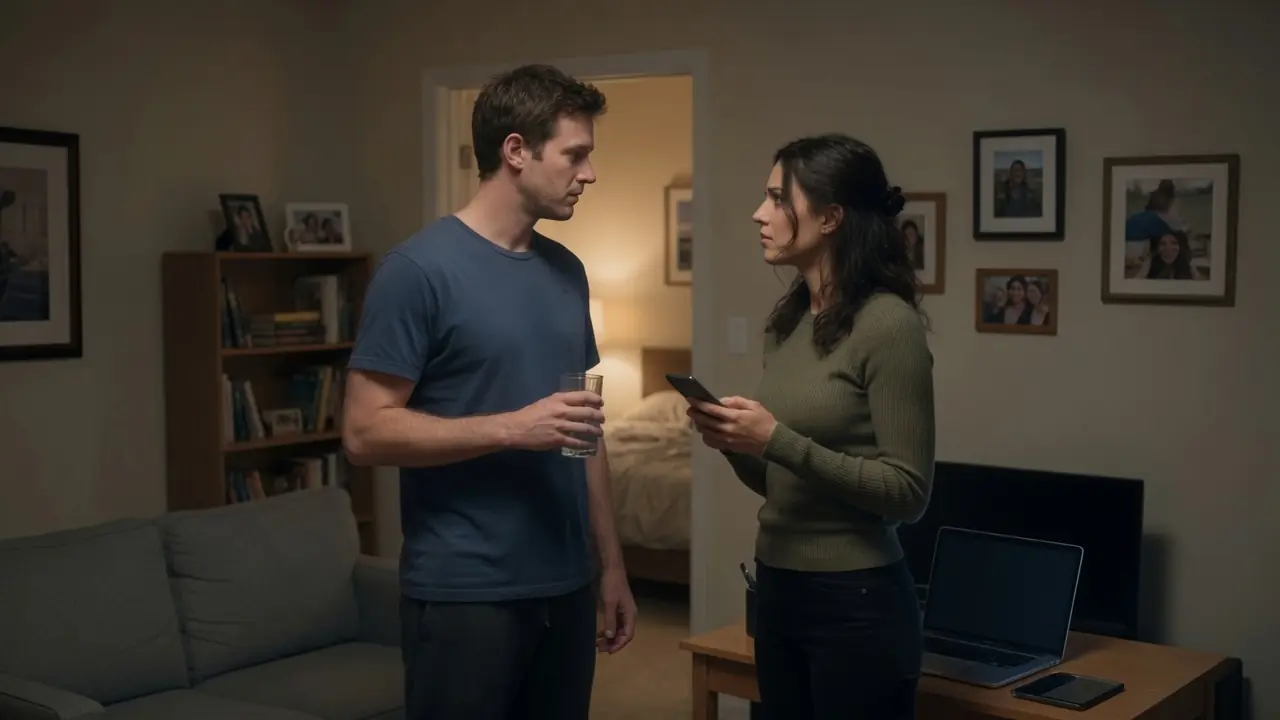
Bryce’s hands were cold by the time the call ended. Briana came out of the bedroom a few minutes later, phone in hand, wearing one of his old gray sweatshirts and acting like the world had not just split open behind her. “Babe, why are you still awake?” she asked. He looked at her face, the face he had trusted across dinner tables, inside grocery stores, under blankets during Sunday rain, and realized he had no idea who she really was.
“Fell asleep during the documentary,” he said. His voice sounded normal, which surprised even him. Briana smirked, walked over, and kissed his forehead like he was something harmless. “You and your boring documentaries,” she said. Then she went back to bed, leaving Bryce alone with the television, the silent room, and a year of memories that had suddenly become evidence.
Bryce was twenty-nine, a data analyst in Columbus, Ohio, and he had never been ashamed of being ordinary. He liked spreadsheets, baseball, predictable routines, clean invoices, and books arranged by topic. He was not the kind of man who dominated parties or made strangers turn their heads when he entered a room. But he had always believed that steadiness had value, that being dependable was not the same as being weak.
Briana had made him believe she understood that. They met at a housewarming party fourteen months earlier, when Bryce was standing near a kitchen island holding a plate of crackers and cream cheese. He had been trying to calculate how long he needed to stay before leaving would seem rude. Briana walked up to him, smiled brightly, and said, “You look like you’d rather be anywhere else.”
“I’d rather be home watching the Reds game,” Bryce replied. She laughed like that was charming instead of dull. Later, he would wonder how much of that first laugh had been real and how much was the beginning of a performance. At the time, all he knew was that someone beautiful, confident, and full of life had crossed a room to talk to him.
Their first date was at a small Thai restaurant near his office. Briana asked about his work, and Bryce tried to keep the explanation short, but she kept asking follow-up questions. She wanted to know what a variance report was, why forecasting mattered, and how he could tell when numbers were telling a story. When he apologized for rambling, she touched his wrist and said, “Don’t apologize. I like hearing what you care about.”
That sentence stayed with him for months. Bryce was used to people tolerating his interests, not inviting them. With Briana, he thought he had found someone who saw past the quiet surface and understood the inner life beneath it. She made him feel chosen in a way that was almost dangerous because he had waited so long for it.
By month two, she was staying over most weekends. By month four, half her clothes were in his closet. By month six, she had a key to the apartment, a drawer in the bathroom, her oat milk in the refrigerator, and decorative pillows on his couch. Bryce never officially asked her to move in, but her presence expanded through the apartment until it felt like asking would be unnecessary.
He loved her in practical ways. He remembered her coffee order, learned which side of the bed she preferred, kept her favorite tea in the cabinet, and saved articles about authors she liked. When she mentioned a childhood copy of a novel she had lost, he found a first edition online and gave it to her for her birthday. She cried when she opened it, and Bryce believed the tears.
She accepted his care like a woman being loved, not like a contestant collecting points. She kissed him in grocery aisles, curled beside him during documentaries she claimed were “weirdly relaxing,” and told him he made her feel safe. She also brought up marriage often enough to be noticed but not often enough to seem pushy. She would point to an engagement ring in a restaurant and say, “That’s pretty,” then smile when Bryce glanced away shyly.
A month before their anniversary, Bryce started looking at rings. He had three options saved from a jeweler downtown, each one more expensive than anything he had ever bought for himself. He asked his mother for advice, pretending it was hypothetical. His mother, who had met Briana twice and liked her, sounded emotional when she said, “Bryce, if she makes you happy, that matters.”
After the phone call, the browser tab with the rings felt like a wound. Bryce opened his laptop at dawn and looked at the three saved designs. For several minutes, he stared at them without moving. Then he closed the tab, not dramatically, just with one quiet click.
The next morning, while Briana was in the shower, Bryce checked her phone. He hated doing it, hated the person betrayal was forcing him to become, but he needed proof before he trusted the horror of what he had heard. It took less than a minute to find the group chat. The name was “The Bet,” with a crown emoji beside it.
He scrolled through months of messages. Screenshots of his texts, jokes about his clothes, comments about his job, bets about how soon he would say “I love you,” predictions about when he would mention marriage. One message from Briana made his throat tighten: “He bought me the book. I almost felt bad, lol.” Almost.
Bryce put the phone back exactly where it had been. When Briana came out of the bathroom, she smiled at him and asked if he wanted coffee. He looked at her, wet hair on her shoulders, his sweatshirt hanging loosely on her body, and understood that anger would be too easy. If he confronted her then, she would cry, deny, twist, explain, and maybe even try to make him feel guilty for listening.
Bryce did not want a fight. He wanted distance, clarity, and a clean exit. So he did what he always did when the facts were ugly and emotions were loud. He opened a spreadsheet and started planning.
The first column was property. The couch was his, the dining table was his, the bed frame was his, the television was his, the bookshelf was his, and the desk was his. He had bought every major piece before Briana moved in. He still had receipts for most of them because he kept records the way some people keep photographs.
The second column was legal. The apartment lease was in his name only, and Briana had never been added. She paid him half the rent through Venmo, which meant she had proof she lived there, but not a lease agreement of her own. Bryce knew he could not simply throw her out without proper notice, and he had no interest in doing anything reckless.
The third column was timing. Their one-year anniversary dinner was fourteen days away. Briana had been hinting about that night for weeks, telling him to pick somewhere special, asking what he planned to wear, and making comments about how “a year changes everything.” Bryce realized the anniversary was not only a romantic milestone to her. It was the deadline for the bet.
He called his landlord, Dennis, that afternoon during lunch. Dennis was a semi-retired man who owned the building and liked Bryce because Bryce paid on time and caused no trouble. Bryce explained that he wanted to terminate his lease properly and that Briana, who was not on the lease, would need formal notice. Dennis asked only one question: “Is this clean?”
“As clean as I can make it,” Bryce said. Dennis agreed to prepare the paperwork. Bryce’s lease would terminate in thirty days, and Briana would be notified that she had thirty days to either apply for a lease in her own name at current market rent or leave. Everything would be documented, polite, and impossible to spin into chaos.
Then Bryce rented a storage unit. He moved his documents first: passport, birth certificate, financial records, tax files, and the small fireproof box from the closet. Briana did not notice. She was too busy texting in the kitchen, probably reporting that “spreadsheet guy” seemed extra quiet but still on track.
Over the next few days, he moved books in reusable grocery bags. He told her he was donating some old nonfiction titles to clear space, and she barely looked up. He moved his gaming computer and said it needed repair. He moved winter clothes, extra kitchen tools, framed photos, and boxes from the hall closet.
Each trip felt strange, like performing surgery on his own life while the patient was still awake in the next room. He did not feel victorious. He felt focused. If he allowed himself to feel too much, he knew the plan would crack.
The second week, Bryce borrowed a truck from his friend Owen. Owen knew the whole story because Bryce needed one person in his corner, one person who could move a couch without asking ten emotional questions. Owen listened, said one sharp word about Briana, and then asked what time he should show up. That was exactly the kind of friendship Bryce needed.
They moved the couch, dining table, bookshelf, and bed frame while Briana was at work. Bryce replaced the bed frame with an air mattress and told her the frame had cracked. He said the couch was being reupholstered and the dining table was with Owen for a dinner he was hosting. Briana frowned a little but accepted every explanation because she never expected him to lie.
That was the bitterest part. She had lied for a year, but she trusted him to be honest because honesty was part of his role. He was the safe one, the dependable one, the boring one who would never surprise her. Bryce felt no guilt about the temporary lies because every one of them was in service of ending a much larger one.
At night, Briana still slept beside him, sometimes reaching for his hand in the dark. Bryce let her, but he no longer squeezed back the same way. She did not notice the difference. Or if she did, she believed it was nervousness before the proposal she thought was coming.
On the morning of their anniversary dinner, Bryce woke before her and made coffee. Briana came into the kitchen wearing one of his shirts, smiling like a woman already imagining the photograph of a ring on her finger. “Tonight is going to be special, right?” she asked. Bryce poured coffee into her mug and said, “Yes. It will be.”
The restaurant was called Lucas, an upscale Italian place downtown with small candles on every table and servers who spoke softly. Briana wore a dark green dress, her hair pinned up neatly, her makeup flawless. Bryce wore a navy blazer and carried the manila envelope inside his jacket. It was not the kind of shape she was hoping for, but hope can make people see what they want.
Throughout dinner, Briana performed beautifully. She laughed at his comments, touched his hand, and told him he looked handsome. She talked about repainting the bathroom, buying better curtains, and maybe taking a trip together in the fall. Bryce listened, nodded, and wondered how many of her future plans were designed only to make the proposal feel inevitable.
When the entrees arrived, Bryce noticed she barely ate. Her eyes kept dropping to his jacket pocket, then returning to his face. She thought she was minutes away from winning. He thought about the group chat, the $800 prize, and every time she had called him boring as if steadiness was a flaw instead of a form of love.
Finally, Briana put her fork down. “Bryce,” she said softly, “this has been the best year of my life.” Her voice trembled at exactly the right moment. “I mean that. Being with you has been everything.” She waited, eyes shining, ready for the scene she believed she had earned.
Bryce reached into his jacket. Briana’s lips parted. Her hand rose to her chest, already playing the part of the surprised woman about to be proposed to. Then he placed the manila envelope on the table.
Her smile flickered. “What’s this?” she asked. Bryce slid it across the table. “Open it.”
She opened it carefully at first, still expecting some clever setup. Then she saw the paperwork. Her eyes moved across the page once, then again, faster the second time. Notice to vacate. Lease termination. Thirty days. Landlord contact information.
The color left her face slowly. “Bryce,” she said, voice thinner now, “what is this?” He looked at her, really looked at her, and saw all the calculation beginning behind her eyes. “It’s a notice to vacate,” he said. “You have thirty days.”
“Is this a joke?” she whispered. “No,” Bryce said. Her eyes filled, but he could not tell whether the tears were fear, guilt, or frustration that the scene had escaped her control. “What did I do?”
Bryce almost laughed at the question. Not because anything was funny, but because after a year of turning him into the punchline, she still expected him to hand her the script. He leaned back slightly and kept his voice even. “You know what you did.”
Briana stared at him. The silence between them stretched long enough for the candle flame to tremble beside the envelope. “Whatever you think happened,” she began, but Bryce stood before she could finish. He placed cash on the table for the meal and tip, because the server had done nothing wrong.
“Happy anniversary,” he said. Then he walked out of the restaurant without looking back.
The messages started before he reached his car. First she called him insane. Then cruel. Then childish. By midnight, she was saying they needed to talk. By morning, she was threatening legal action and claiming he could not just take away her home.
Bryce did not respond. The notice had been served properly through Dennis. His property had already been removed. She had thirty days to apply for her own lease or leave, which was more grace than she had shown him while using his emotions as entertainment.
Two days later, Briana showed up at the apartment and found it half-empty. The couch was gone, the bookshelf was gone, the dining table was gone, the desk was gone, and the bed was still an air mattress. For the first time, she understood that Bryce had not acted out of sudden anger. He had been leaving for two weeks while she slept beside him and saw nothing.
She called him then, crying hard. “You planned this?” she asked. Bryce stood in his new apartment, surrounded by boxes he had labeled neatly. “Yes,” he said. “That’s what boring people do. We plan.”
There was a long silence. Then Briana said, “I never meant for it to go this far.” Bryce closed his eyes. “You meant for it to go until I proposed.” She did not deny it.
Briana moved out before the thirty days ended. Dennis later told Bryce she left green paint samples on the bathroom wall and nothing else worth mentioning. Bryce laughed once when he heard that. She had been planning to repaint a bathroom in a life she had never earned.
When Bryce told his mother everything, she sat quietly at her kitchen table and listened without interrupting. After he finished, she reached across the table and held his hand. “You are not boring,” she said. “You are steady. People who don’t know the difference don’t deserve you.”
That nearly broke him more than the betrayal. He had held himself together through the phone call, the planning, the storage unit, and the restaurant, but kindness was harder to survive than anger. His mother made him grilled cheese and tomato soup afterward, the same meal she made when he was young and hurting. Bryce ate it slowly and realized he had been hungry for something simpler than revenge.
Three months later, Bryce lived in a smaller one-bedroom apartment across town. His books were back on shelves, his desk sat by the window, and his spice rack was alphabetized again. He bought a king-size bed even though he lived alone because he liked having space. For the first time in a year, no one in his home was performing affection for an audience.
He did not know what happened to all of Briana’s friendships, though Owen heard through mutual acquaintances that the group had fractured. Some of her friends claimed the bet was only supposed to be a joke. Others said Briana took it too far. Bryce did not care enough to investigate, because some data was no longer useful.
He thought about her sometimes, but not with longing. He thought about the way she called him boring, the way she turned his sincerity into entertainment, and the way she mistook patience for weakness. He wondered how many people in the world were overlooked simply because they loved quietly. Then he would close the thought and return to his own life.
Bryce still watched documentaries. He still loved spreadsheets. He still explained things in too much detail when someone asked a question he cared about. But he no longer apologized for being the kind of man who showed up, remembered, documented, and built carefully.
Briana had bet that a boring guy would be easy to win. She was wrong. Boring was patient, observant, and precise. Boring kept receipts.
And when the game finally ended, the boring guy was the only one who walked away with everything that mattered.